Blog

Did Indeed Hide Your Job Postings? Deduplication Explained

Originally posted on RecruitingBlogs.com by John P. Carthy

If you are a recruiter and you are not familiar with Indeed’s deduplication process, it could make it difficult for job seekers to find your job postings and undermine your recruitment efforts. All too often, Indeed marks job postings as duplicates when the jobs are truly distinct. Fortunately in some situations, you can use better job titles to make sure your jobs are not hidden.

The purpose of deduplication is to improve search results for job seekers. Indeed collects job postings from multiple sources. When the same job is provided in multiple sources, Indeed shows one job and hides the rest. It also consolidates jobs from each company that have similar job titles and locations near each other.

Let’s look at a hypothetical example. Company A has four job openings that they have posted to Indeed.

Company Name Job Title Location Posting Date
Company A Administrative Assistant Fairfield, OH March 8
Company A Administrative Assistant Cincinnati, OH February 25
Company A Software Engineer I Cincinnati, OH February 14
Company A Software Engineer IV Cincinnati, OH March 8

If someone searched for Company A’s jobs, they would show up similar to this:

Administrative Assistant

Company A – Fairfield, OH – +1 Location

Software Engineer IV

Company A – Cincinnati, OH

We have removed 2 job postings very similar to those already shown. To see these additional

results, you may repeat your search with the omitted job postings included.

How did they do it? Indeed identifies duplicates using the location and the job title.

Deduplication By Location

The first type of deduplication is by location. For those jobs that have similar job titles across multiple locations, Indeed will pick one job to show and hide the rest. The locations that Indeed consolidates depends on the job search query. If someone searches across the entire US, then the query will consolidate the jobs from your company with similar job titles located in Seattle and New York into one. Indeed may or may not select the most-recently-posted job. I think it is typically the latest one, but I have seen anomolies where it is not.

In this example, when someone searches for Administrative Assistant in Cincinnati, OH, Indeed will see Company A has two positions for an Administrative Assistant. The algorithm may choose the latest job, which is the one posted on March 8 in Fairfield.

Administrative Assistant

Company A – Fairfield, OH – +1 Location

The job posted on March 25th will not show up unless the users clicks on the +1 Location link or a link to show all results. There is little that you can do if you have similar jobs across multiple locations.

Deduplication By Cleaned Job Title

The second type of deduplication is by cleaned job title. After Indeed crawls your career site, Indeed calculates a cleaned job title. They have not published their cleaning process. It is unclear whether they are using a white list of acceptable words, a black list of ignored words, or some combination. I will make some educated guesses as to how it works. They start with the job title. Then, they …

  • Strip Roman numerals I, II, III, IV and V.
  • Remove some locations that are listed in the job title.
  • Ignore requisition numbers.
  • Eliminate some punctuation, such as hyphens and parentheses.

When Indeed processes a job seeker’s query, Indeed will consolidate the results that have the same cleaned job title and select one to display. In the example, when someone searches for Software Engineer, Indeed will ignore the Roman numerals and treat Software Engineer I and Software Engineer IV as the same position. They would likely display the Software Engineer IV job. The Software Engineer I job would only be seen if the job seeker repeats the search with the omitted job postings.

If different jobs are being treated as the same, you can improve your job titles so Indeed knows to treat them separately. Use specific job titles in place of generic job titles. Use the word “Senior” as an experience level instead of Roman numerals.

If you have multiple job postings for the same job, Indeed is working to consolidate them. If Internet search engines serve as a guide, it is a bad idea to create duplicate job postings. As Rand Fishkin explains on Moz.com: “The important thing to remember is this: manipulative techniques generally won’t help you, and they often result in search engines imposing penalties on your site.”

Did Indeed Hide Your Job Postings? Analyze Your Own Job Postings

Right now, run a search on Indeed for your job postings. Determine your company name on Indeed and then search for your company (and location, if it’s helpful):

company:”Company A

The last number in the “Jobs 1 to 10 of XXXX” will tell you how many of your company’s jobs are in Indeed’s index. If you navigate to the last search results page, the middle number in the “Jobs XXX to XXX of XXXX” will tell you how many of your jobs are showing up in the search results.

Are the number of jobs in the index and in the search results what you would expect? I typically see 5-20% for retail and restaurants and 50-90% for large businesses. If it is a problem, make sure your job titles are specific, so job seekers will understand what is different between two different jobs. It’s also helpful to check how your competitors are posting their jobs.

When you figure out ways to maximize the reach of your job postings, I believe you’ll see that some hard-to-fill jobs were just hard-to-find job postings. Getting past job search engine deduplication is one of the obstacles. I hope this helps you in your recruitment efforts.

– John Carty

About the Author:

John P CarthyJohn P. Carty spent two years searching for a way to improve how recruiters and job seekers find each other. The result is a thesaurus of job titles with synonym keywords selected based on usage in job postings and web searches. Synonyms make job searches difficult. The thesaurus makes it easy. It is a work in progress, but hopefully it is a step in the right direction.

Turning Recruiting Inside Out: How To Build A Winning Culture of Referrals

iStock-Unfinished-Business-5Here’s the thing; as sexy as we make social out to be, and as much emphasis as we put on concepts like talent communities and targeted content, the fact of the matter is that what’s new and what’s next isn’t always the most effective when it comes to generating results.

In fact, according to the 2014 Career XRoads Source of Hire report, referrals still accounted for the top external source of hire at 19.2%, second only to the 41.9% o positions that are filled internally.

Compare that to “direct sourced” candidates – those ever elusive passives who form the focus of an increasingly inordinate amount of time and money at many recruiting organizations today.

Those represented only 12% of all hires, with another 3.1% coming from “pipeline” (or talent network) activities, which is less than those much maligned traditional job boards, which still accounted for a full 15% of all successful searches last year.

Take a step back for a minute and look where you’re spending most of your time and allocating most of your resources in recruiting today. It’s more than likely on that 15% or so that come in through social media, employer branding, recruiting CRMs and marketing campaigns, not to mention the myriad of other strategies that fall under the sweeping umbrella of “direct sourcing.”

In recruiting, it’s our natural tendency to look outside before looking in; after all, it’s easier to search for candidates on LinkedIn or by building elaborate Boolean strings than it is to search most traditional applicant tracking systems.

Similarly, it’s easier to acquire outside talent than it is to develop it from the inside, and it’s far simpler to source from external social networks than it is to leverage those professional networks that your employees have already built.

Everyone Is A Hiring Manager

file-2494930627As everybody in this business already knows, recruiting is a team sport, with various stakeholders having some say in which candidate ultimately receives an offer.

Most employers err on the side of too many cooks in the kitchen, adding unnecessary days to fill while aversely impacting the candidate experience by extending what’s likely an already draconian and overly complex process.

This is OK, of course, but the fact is that in the absence of standardized feedback, collaborative communications and timely turnarounds, such added scrutiny often asinine, and always extraneous.

Not that you’re going to change the minds of most hiring managers that it’s necessary for everyone, from the interns on up, to get the chance to check out a potential new hire before an offer is extended.

3 Keys To Building A Winning Referral Culture

With a few small changes to your hiring process, however, you can take transform chaos into competitive advantage – and make better hires more effectively and efficiently while simultaneously increasing retention.

That’s a business case no employer on earth can argue with – and here are the top three things you can start doing today to make sure everyone in your organization thinks like a hiring manager and begins building a truly successful referral culture that wins out every time.

1. Increase Internal Awareness.

iStock-Unfinished-Business-4If you want current workers to bring an ownership mentality to recruiting and a sense of shared responsibility for attracting and retaining awesome employees, then it’s imperative for recruiters to start providing tools and training instead of red tape and prohibitive policies.

This starts with making job opportunities easier for your current employees to find, apply for or share with personal connections and professional colleagues who might be potentially perfect fits for that recently opened requisition.

This seems not only intuitive, but an ideal that’s actually reinforced by legislation and driven by compliance – most employers are legally required to post a position for a minimum period of time (normally 48 hours) internally before opening up the position to the rest of the world.

Unless an employee is lucky, though, they’re unlikely to see that position open before the floodgates of external applicants are ultimately unleashed, because most employers require their current workers to constantly refresh or manually track openings on their internal careers site.

These tend to be even less user friendly or intuitive than even the most cumbersome and archaic applicant tracking system. And since these mostly reside on an employee intranet, buried deep in the bowels of a corporate firewall or VPN, forget trying to access these on a personal device. What’s even more futile is trying to access internal careers sites from a mobile device like a tablet or smartphone.

Look, chances are you probably promised, somewhere in the recruiting process, that there was some sort of professional development or training opportunities at your organization, and that there was something akin to a “promote from within” mentality.

But if they can’t even find and apply for open positions, how in the world do you expect them to be aware or opportunities to start generating the referrals that already constitute your single biggest source of internal hires?

Put simply, your employees are consumers of work, and if you can’t provide them with a consumer grade job search experience, than just like their talent acquisition counterparts, they’re likely to start their next job search on the outside rather than looking in. It’s easier that way, after all – but it doesn’t have to be.

Remember, org charts were the original “talent community.” Don’t be neglecting yours in favor of some network of active job seekers who’ve opted into your recruiting related e-mails.

2. Internal Mobility: Inspire Excitement, Not Fear.

iStock-Unfinished-Business-9Employee engagement, at least according to traditional maturity models, is always its highest right when an employee starts with an organization, and predictably plateaus, then plummets, the longer they spend in their roles.

Disengaged employees, of course, are not only less productive (and hence, making the business less profitable), but also the most likely to leave or consider looking for greener pastures and paychecks outside your organization.

The average cost to replace an experienced employee was estimated by Bersin and Associates to run around $11,000, which is a pretty steep price to pay for losing out on skilled internal talent to an external competitor. The easiest way to turn the tide on a disengaged employee, of course, is to move them to a new role or provide their next professional challenge – even in the case of lateral moves, employee engagement unilaterally spikes along with internal promotions and transfers.

If your organization requires a mandatory minimum that’s longer than one year (which is, more or less, about average in terms of worker tenure today) before being considered for other roles at the company, then that’s a policy that probably bears rethinking.

This prohibition probably isn’t in place at any external employer, and if your A players are stuck in a rut by some employee policy, then the only way to preempt it is to get the hell out of dodge. That’s not a win-win for anyone involved, saving maybe the recruiter on the other end of that recently opened req.

Also, it’s absolutely asinine to require an internal candidate to fill out a form every time they express interest in another opportunity – at many companies, in those cases where an interested and qualified current employee does see and apply for an open position, they’re required to fill out a form that often requires both their current manager and HR Business Partner to sign off on.

Both parties have an obvious interest in disrupting team dynamics or having to backfill a fully trained department member because they happened to have outgrown the responsibilities of the role for which they were initially hired. This leads to a widespread reticence for employees to raise their hands for any role that they don’t perceive as a slam dunk or last stab at trying to stick around without getting stuck in stasis.

At the very least, many fear that informing their managers that they’re interested in looking at other opportunities will open a professional Pandora’s box that’s liable to get them labeled a malcontent or team troublemaker who can’t be trusted.

Either way, it’s kind of a Catch 22 for a lot of current employees who want to be considered but can’t do so without shooting themselves in the foot, first.

3. Candidate Experience Isn’t Only For External Hires.

iStock-Unfinished-Business-1We talk a lot about candidate experience, but very rarely do we mention it in the context of internal mobility and referral hiring – it’s a dialogue that’s reserved almost exclusively for online applicants and talent that’s at least only somewhat tangentially connected to an organization.

But since almost half your hires are people you already hired, it’s important to remember that no maxim rings truer than that old aphorism that recruiting doesn’t stop at onboarding or an accepted offer.

Internal candidate experience is everything. If it sucks, or involves prohibitive policies, potentially putative processes or simply imposes undue obstacles that external candidates wouldn’t have to face (they get to opt out of having you contact their current managers on most every application, after all), then it’s not only going to aversely impact your retention, but your referrals as well.

No one is going to tell a friend or colleague to apply at a company that treats them like crap as current employees, and no one is going to go out of their way to help a recruiter with introduction or connection requests when that same recruiter never called them back about that internal transfer they applied for.

It just makes sense – the better you get to know the employees on the teams for which you’re hiring, the better insights and information you’re going to get on the kinds of soft skills, culture and code that no job description can capture, and be better able to convey that information to internal applicants and their referrals alike.

No one wants to put existing relationships at the peril of a crappy and cumbersome applicant tracking system. That’s why shining light on that black hole, and delivering the best possible candidate experience to your current employees and their connections, will not only render the most fertile source of hires, but also, those whose fit transcends a bulleted list on some generic job description.

This outcome is unique to internal mobility and referrals as a source of hire, since in both cases, the candidate knows exactly what it takes to survive – and thrive – in your company culture while avoiding the politics and pitfalls that can plague those candidates who had to be closed by recruiters instead of by their colleagues, clients and connections.

Offers become way easier when you’re not the only person working on getting that letter signed and a start date set – and you better believe that your hiring stakeholders and those with a referral fee in the balance will finally work with you instead of against you to get that req closed out – which can be a pretty refreshing change for many recruiters, but one that’s pretty easily realized.

All hiring is collaborative, after all – but it’s how you leverage that collaboration that counts. That’s why when you create a culture of referrals, you’ll get more than just a few qualified leads – you’ll get the collective recruiting efforts of your entire workforce.

Because if they’re not recruiting and referring for you, odds are they’re probably a retention risk, instead – and that’s one risk that’s too risky for any recruiting organization out there to take in today’s cutthroat competition for top talent – including the ones already working for your organization.

That preexisting relationship should be a recruiting asset – and if it’s not, well, you better get prepared for the exodus that’s imminent, inevitable and easily averted.

To learn more about how to build a culture of referral based hiring, make sure to check out our upcoming webinar on Thursday, March 19 featuring Ben Gotkin and Jason Buss sharing real tips and tricks for real recruiting success presented in partnership with our friends over at SmartRecruiters

Click here to register today.

And make sure to check out Collaborative Hiring: Leveraging Social Software To Hire the Best Talent, a badass brand new e-book that’s got everything you need to make sure your recruitment message gets heard by the right candidates – and referrals – across social networks and online platforms.

Download now to get your learn on in this exclusive SmartRecruiters resource on referrals. It’s worth your time – after all, while the content is priceless, it’s also completely complimentary – kind of like building up a culture of referral hiring and recruiting collaboration throughout your entire organization.

Disclaimer: Recruiting Daily was compensated by SmartRecruiters for this post. But their data and action items are actually pretty priceless, so in this case, the facts and opinions contained herein do, in fact, represent those of the publisher. Because we’re all about building a winning referral culture, too.

Gone in 7 Seconds: Snapchat Resumes and the Future of Recruiting

snapchat-resumeWe always hear candidates talk about the recruiting “black hole.” In fact, it’s such a cliche that, frankly, those of us on the other side of the desk can’t help but be a little bored since, after all, it’s the deluge of unqualified applicants – not lazy recruiters – that are to blame for the fact that job seekers almost never hear back to begin with.

No matter how you look at it, the fact is that there’s a disconnect between the way recruiters find candidates, and the way candidates are forced to find jobs – and the odds are stacked against all but a fraction of candidates with an in-demand  skills, industry expertise or hard-to-find experience.

That’s why both sides work so hard to get around the traditional application process – and, as the best sourcers already know, sometimes, working around the black hole takes a ton of creativity.

As hard as that can be, standing out as a candidate can be infinitely more difficult.

That’s why I was so intrigued when Elski Felson posted a video titled “My Story Snapchat Resume.” By the time it caught my attention, the video had already accumulated well over 360,000 views in a matter of a few days – by now, it’s over a million, and the virality of this outside-the-box approach speaks to the collective frustration of job seekers everywhere at the collective radio silence many automatically associate with recruiters.

Once this story hit my Twitter feed, I did what anyone who geeks out on this kind of stuff would do – I reached out for an interview. Within thirty minutes, the interview was complete and I was reminded of just how powerful and personal feedback can be.

We ask job seekers to put everything on the line, to jump through ATS hoops and over counterintuitive, clunky and cumbersome online application processes, and in return, they often receive nothing but an automated e-mail. But reciprocating by letting candidates at least know when they’re no longer being considered isn’t just a small step that would make a big difference to most applicants out there – it’s something that we owe every candidate, regardless of outcome.

Elski is the face of an entire army of frustrated job seekers out there who are finally fed up with recruiting as usual – only unlike many stuck in the same situation, Elski decided to take matters into his own hands.

Meet Elksi Felson.

unnamed (1)So just who is the brains behind this viral video? Elski Felson (names and details have been changed to protect the innocent from irate recruiters and online trolls, if you can tell the two apart) is a 24 year old graduate of Ithaca College, a top ranked liberal arts school in upstate New York, where he graduated with a degree in finance and is currently working towards his MBA. He’s ambitious, smart and has everything most employers look for in top talent – except experience.

Which means that he also happens to be unemployed as he looks to plant his foot in a door and start his first steps down the path towards a fulfilling career.

It’s not for lack of trying; it’s just that Elski feels, and justifiably so, that the application process was more or less a “demoralizing crap shoot.”

After months of applying for positions without hearing so much as a peep or receiving even an iota of meaningful feedback or updates, save the occasional weekly list of backlinked jobs sent from an automated feed to his inbox under the guise of a “talent network,” Elski picked up and moved across the country to try his luck, like so many before him, in sunny Southern California, moving into his sister’s spare room in Santa Monica just three weeks ago.

Hey, there are worse places to settle in for a protracted job search, but Elski finally decided to throw the traditional application process out the window and actually create something that would help him stand out and break the silence from recruiters – and optimally, even end with an offer. The result is a lesson for all of us at what the future of recruiting might really look like.

Consider Elski’s traditional resume, embedded alongside the viral video that launched him into the social media stratosphere. Which paints a more accurate representation of Elski?

The answer may have big repercussions for anyone in the business of hiring.

Oh, Snap: Elski on Paper

Oh, Snapchat: Elski on Video

Ready for His Close Up: Behind the Scenes of the Snapchat Resume

To learn a little more about Elksi and what went into pulling this stunt off in the first place, I went straight to the source. Read on to hear about the brains behind this operation – and his message for all those recruiters out there reading this who chose to ignore the traditional resume he’d been waiting to hear back on for all of these months.

Bridget Webb, Recruiting Daily: Why Snapchat?

Elksi Felson: I think I could speak for a lot of people my age when I say this. I really want to work for a company that I care about and believe in. I’ve had a few opportunities from places like a carpeting company and some banks. Stuff like that. But I see all of my friends working at similar companies and they aren’t happy.

I didn’t move out to California to work at Snapchat. It just happens to be my favorite app on my phone. So I thought, why not swing for the fences? 

BW: Where did you first get the idea to create a video Snapchat resume?

EF: I started my career search by looking at opportunities within the banking industry seeing how I was a finance major. I applied to a major player in Pittsburgh and got no response. 

I signed up for their email job listings and every Sunday when their email came I would apply. I was perfectly qualified but never heard anything. This went on for months. So I started thinking that I couldn’t break the application process any more than it already was.

BW: Have you done any other creative stunts to grab the attention of a potential employer?

EF: Yes, with that same bank in Pittsburgh. I go so sick of hearing nothing that I broke down their requirements on a paper resume much like I did with the Snapchat video. Still there was no response. I finally requested to be taken off of the email distribution list, and to this day, every Sunday, I still receive a list of their openings.

The whole process with them was so frustrating.

BW: Do you have a dream job?

EF: It’s weird, I’ve been asked that a lot lately and can’t say I really do. I’ve worked every type of service job imaginable (server, bartender, janitor in college, office assistant, graphic design intern). From this, my people skills have developed and I’ve learned that I must interact with people to be happy.

I’m not looking for a finance gig. I’m looking for PR roles mainly. I’m starting my own YouTube channel so we will see where that takes me.

BW: Are there any particular types of companies you’re drawn to?

EF: Startups. The main reason is when joining one you get to play and contribute a ton more. The overall experience is better. You’re truly part of building something as a team and not just a number. I would much rather be employee #13 over employee #43,762 any day. You are exposed to so much more and can grow your skill set faster along with your career trajectory.

BW: Last question. As a current candidate do you feel the entire recruitment process is broken?

EF: Absolutely. Paper resumes need to go. With the technology available today the entire process could be greatly improved. Case in point, I’ve been asked to fly across country on my own dime quite a few times. I can’t help but shake my head on this one.

Come on, I’m unemployed, which is a polite way of saying I’m running low on cash. I get that a sit down interview is important but really? With tools like Skype and all the video interviewing tools available you can accomplish the same thing. I think if anything, this proves that recruiters should start realizing that video works – and sometimes, better than the real thing.

Well, recruiters, whether or not you agree with his approach, you’ve got to hand it to Elski, who wasn’t afraid to take a risk and wasn’t content hiding behind a piece of paper.

His story is a good reminder that for every candidate stuck in your applicant tracking system, there’s a real story and a real person on the other end who’s getting increasingly angry at your brand – and that for Elski and so many like him, bad news is far superior to no news. Which really should be old news by now.

Since most of you reading this are ostensibly recruiters, let’s even things out with Elski and help him find a job in PR or communications. If we put our network to work, I’m sure he’ll be back to work in no time – so reach him on Twitter @ElskiFelson.

He’ll respond to you immediately (trust me) – and prove that some recruiters out there are listening (and willing to help!)

bw-headshot color

About the Author: Bridget Webb is a Recruitment and Marketing enthusiast, leader, and speaker. Her specialties include Demand Generation (customers & talent), People Analytics, Employer Branding, HR Technology and homeroom mom duties.

She graduated with a degree in Design and Business Management from the University of Montevallo and currently resides in South Carolina.

Follow Bridget on Twitter @Webb_Bridget or connect with her on LinkedIn.

Don’t Ask Me How I Know: Life Lessons Learned From A Life in Recruiting.

askhole-757966It’s inevitable, when you’re a recruiter in general, but one who happens to write about recruiting in particular, that you’re going to get hammered with a ton of asks for advice covering a myriad of topics ranging from the most mundane to the unusually esoteric (and everything in between).

This is why I’m consigned to getting solicited for my opinion by manifold parties, all wanting me to impart some sort of sage advice or pat answer when I’m pretty sure no such thing exists, at least from my experience in this business.

I wish I could impart knowledge, and try to do so where I can – and if I can’t, at least try to imbue the situation with a little humor as I write off extraneous or ridiculous requests.

Sorry, I can’t tell you how to get your resume looked at by a recruiter I don’t know at a company I know nothing about – although I can tell you how to bat at least a little better than average, there’s no silver bullet for sourcing for candidates or searching for jobs.

Wait, Wait, Don’t Tell Me…


1353109954342_5178018Hell, most of us are really just faking it, which is why I think it’s so funny how seriously everyone in this industry seems to take themselves recently.

It’s like we forgot to be recruiters and all tried to become “influencers” or “thought leaders” all at once, and I’m pretty sure based on a lot of what I’ve been reading recently, none of it’s really relevant for those of us just starting out on the often wild, sometimes wonderful and always weird world of being a professional in recruiting.

These are the people who need relevant career-related content the most, but instead are being served up a steady stream of buzzwords, BS and specious advice that somehow manages to be simultaneously too complex and too simple to actually be actionable (or attainable) outside this online echo chamber of recruiting related content – although when your goal is impressing people instead of helping them, being simple and straightforward doesn’t make much sense, I guess.

That said, I’m not trying to impress anyone, really. I am not some self-described expert; I’m no guru or ninja or even your garden variety influencer. I don’t think of myself as a thought leader, or even a blogger, really – just a guy who’s been doing this for long enough to know better.

Just don’t ask me how, exactly, I know any of the following to be true. They just somehow work, is all.

25 Life Lessons Learned During My Life In Recruiting

Pick_efa741_23243001. Pick Up the Phone and Call Candidates. If they don’t answer, leave them a voicemail AND shoot them an e-mail letting them know you’re trying to get in touch. If you can’t commit to both, do neither, since the only results happen when these tactics happen in tandem.

2. Pick up the Phone and let candidates know where they’re at in the process throughout every step of the way, and do so with as much feedback as possible as quickly as possible so they never have to guess or wonder where, exactly, they are in the hiring cycle.

3. Pick up the Phone (sensing a recurring theme here?) and call candidates who interviewed but weren’t selected to personally inform them they didn’t get the position. Don’t only call with offers – call those silver medalists, too. After all, they took just as much time as the successful candidate by finishing as a finalist in your selection process. Even if the results aren’t what they were hoping for, you owe it to them to at least give them the news and a quick thank you, too.

4. Candidates Lie. It’s a part of life. Just make sure you document everything and can directly catch anyone in a contradiction that a lesser recruiter might have missed while screening, selecting and referencing potential new hires. Words are weapons when you’re fighting against the hyperbole and hype that so often occur during the recruiting process – and using them as such can help prevent bad hires from happening to good recruiters.

5. Recruiters Lie: You’re going to have to stretch the truth at some point in your career – yes, that offer’s more or less at market or not revealing a position is open because the incumbent happened to have a nervous breakdown at the office. Just don’t make a habit out of it, and never lie directly – omitting certain details is OK, but come clean if confronted. Honesty is the best policy, you know. In recruiting and in life.

Communication-Cartoon-Dolighan6. Communication is Everything. We’re only as effective as the way we communicate with our clients, candidates, colleagues, counterparts or anyone else we touch during the course of our professional lives (and personal ones, for that matter).  If you can’t communicate, you can’t recruit. It’s really that simple.

7. Deliver on Your Promises. No matter what you’ve promised a hiring manager, candidate or anyone else, for that matter, if you say you’re going to do something, do it – and do it to the best of your abilities and with the results you gave your word that you’d deliver – or a thorough, truthful explanation if these efforts fail to meet expectations.

Failing to succeed is one thing, but failing to live up to your word is something no recruiters’ reputation can ever hope to survive.

8. Hold people accountable for their actions. This includes you, but just because you’re the recruiter doesn’t mean you should shoulder the blame as part of business as usual. When you’re wrong, own it. When others are, let them bear responsibility. But when either of you are right, be as forthcoming with praise as you are with criticism. And when someone compliments you as a recruiter, don’t deflect praise – accept it, but don’t take it to heart too much. You can always do better.

9. Enjoy Your Side of the Desk. You might have a terrible hiring manager or a hellish req, but truth is, you’re one of the lucky ones. Every morning, try taking 5 minutes before you start trying to fill jobs to remember what it was like back when you were a job seeker and take a moment to experience what you experienced as a candidate. Remember how bad it sucked, and that you have the power to make it suck a little less for the people you’ll deal with during that day. A little empathy goes a long ways.

10. Don’t Drink the Water in Mexico. Hey, while I’m giving out important information, I’d be remiss to miss this one. Trust me, no bueno. No bueno at all…

67612-Be-Proud-But-Never-Satisfied11. Never Be Satisfied: Nothing will cripple your career or kill your recruiting results faster than hubris. Be humble, and never rest on what you’ve done instead of what you’re capable of doing. Remember you cannot succeed without others, but we almost always fail by ourselves.

13. Don’t Be A Dick. The experience you provide to both customers and candidates matters – and while we can make this simple concept really complicated, just don’t be a dick, do the right thing as a recruiter and try to stick by the Golden Rule, and you’ll not only be OK – you’ll be appreciated for providing a great experience. All experiences, good or bad, resonate with repercussions with far wider than you’ll probably ever realize. Make sure you get karma working for you on this one.

14. Always Answer A Phone Call From Mom. You’re never too busy to make time for the people who really matter. Don’t put personal calls off to the sidelines – savor them and appreciate the fact that someone cares about you beyond simply the fact you might be able to get them a job. Never rush a call from Mom, and if you need more time, make the time you need to make it happen. Because you’ll never know when your time might be up.

15. Think Twice Before Pressing Send. We all get pissed once in a while. And we all are entitled to the occasional angry e-mail that can be cathartic to say what’s on your mind so it doesn’t stay stuck in your head. But never, ever press send without first taking a few minutes and asking if it solves the problem you’re trying to address – and if it doesn’t, delete it. Spoiler alert: sending an angry e-mail never, ever fixes problems – it just creates them. Trust me.

16. Shut up and Listen: Stop talking. I know this is hard if you’re a recruiter, but it’s also really important. You’ll not only do a better job hearing what people say and how they say it, but figuring out what they really mean, too. You’ll be amazed at what you learn when you take the time to really listen.

17. Always Know What You’re Recruiting For: If you don’t know what the job does or what the business needs, you’re doing everyone a disservice. Make sure you stay up to date with the industry and the trends, topics and technology that matters to the bigger business – you’ll make better informed placements when you’re better informed. Period.

18. E-Mail Signatures Don’t Have To Suck: Seriously, if you’ve got to have one, at least add something fun or interesting, like a quote, to that often ignored (but prime) real estate underneath your name and contact info. Believe it or not, people notice these things. I added “the cure for anything is salt water, sweat, tears or the sea” to my signature, and it’s been the best conversation starter I could ever ask for because it’s the one thing everyone asks about. If you want to stand out, be unique. Seems obvious, right?

19. Recruiting Never Rests. Always be sourcing candidates and recruiting talent, even if you’re not at work. No recruiter should ever go out without at least a couple of business cards. Time spent to yourself in public is time wasted – don’t be afraid to talk to strangers on the train or the bus, at the bar, at the museum or anywhere else you happen to cross paths with new people. If you’re genuinely interested in hearing about what people do, you’ll at least learn something just by listening.

209835_34020. Read Books And Blogs. Stay informed about what’s going on in recruiting – and just as importantly, in the rest of that great big world out there that doesn’t give two shits about staffing. There’s knowledge to be had in both business related blogs and books by great authors like Bukowski or Whitman.

Great writing feeds your soul and fuels your mind.

Here’s a taste of what I’m talking about:

“I met a genius on the train

today

about 6 years old

he sat beside me

and as the train

ran down along the coast

we came to the ocean

and then he looked at me

and said,

it’s not pretty.


it was the first time I’d

realized

that.”

-Charles Bukowski

Or this one:

“That you are here-that life exists, and identity; That the powerful play goes on, and you will contribute a verse.”  –Walt Whitman

Every day, we’re all writing our own stories, and if you don’t know what your verse is, it’s up to you to find your voice. But know that once you do, everything you say can and will be held against you by your clients and candidates – as well as everyone else in the industry. Which is pretty awesome, actually.

21. Practice Random Acts of Kindness: Do someone a favor sometime just because. Pay it forward, and expect nothing back in return. That’s not the point – the point is someone probably could use the love, and the supply is pretty much infinite. Send a little someone’s way once in a while.

22. You’re On the Same Team. You don’t work for your hiring managers. Your hiring managers don’t work for you. If you don’t work together, than it just won’t work out.

23. Never Take Yourself Seriously. No one else does, you know.

tumblr_m9epcaonde1qaobbko1_500_thumb[2]24. Be You. Don’t feel the need to be anyone but yourself – even if you’re a total weirdo, it’s better to come across a little odd than a little fake, particularly when you’re already dealing with the perception issues facing our profession. You’re the ultimate arbiter of your happiness, and you can’t be happy when you’re worried about how other people think of you.

The only perception that matters is your own. And you’ve got to own you, no matter who you are.

Never compare yourself to others, though – you have no idea what the journey along that personal path looked like or the struggles that they had to deal with along the way. It’s easy to judge where someone’s at, but thing is, that’s almost never the destination, and the ends don’t matter. It’s the means that mean everything in shaping who we really are.

25. Don’t Get In This For The Money: There are dozens of perfectly valid reasons for wanting to get into recruiting. Money, however, isn’t one of them. If that’s why you’re in this business, you’re just a whore. And believe it or not, the bigger a whore you are, the worse of a recruiter you’re likely to be.

You can’t succeed in this business – or really any other business out there, really, until you understand we make a living by what we get, but we make life by what we give. #truestory

There you have it. The entire compendium of my collective expertise and lessons learned over a life in recruiting.

I’m sure some of you will find this stupid, superfluous or silly, but hey, that’s why I write this shit in the first place – because if there’s one thing I know about recruiting, it’s that you’ll inevitably have something new to add to this list – and something new to teach me. I’m still learning, even after all these years; the day learning I stop is the day I stop recruiting, and I don’t see that happening any time soon. I love this shit too much to stop.

Derek ZellerAbout the Author: Derek Zeller draws from over 16 years in the recruiting industry. The last 11 years he has been involved with federal government recruiting specializing within the cleared Intel space under OFCCP compliancy. Currently, he is a Senior Sourcing Recruiter at Microsoft via Search Wizards.

He has experience with both third party agency and in-house recruiting for multiple disciplines and technologies. Using out-of-the-box tactics and strategies to identify and engage talent, he has had significant experience in building referral and social media programs, the implementation of Applicant Tracking Systems, technology evaluation, and the development of sourcing, employment branding, military and college recruiting strategies.

You can read his thoughts on RecruitingDaily.com or Recruitingblogs.com or his own site Derdiver.com.  Derek currently lives in the DC area.

Maslow Meets Marketing: The Psychology of Job Ads

tumblr_mv6inyF1uR1szft8eo1_500Earlier this year, as has become something of an annual ritual, the HR and recruiting industry’s pundits (yes, they really exist) released their predictions of talent trends in the year to come.

While these are often as stagnant as the industry they’re covering, aside from borrowing heavily from the same mantras as most Silicon Valley startups with the same promises of being more social, mobile and local, one of the most prevalent predictions on these lists stands out as particularly persistent in these previews, one that’s inevitably always included in these forecasts of the future.

These “thought leaders” look into the mists in their crystal ball and see a vision of the future that’s so obvious these oracles must declare, with absolute certainty, that “job descriptions will cease to exist!”

Then, as if to mock that same prescient certainty, they don’t. Instead, they survive, year after year after year. Despite some obvious flaws of the formats involved in both sides of the recruiting equation, the gap never seems to narrow, and things never seem to change.

While prognosticators may lament being proven wrong, the world somehow keeps on turning, recruiters still want to see your resume and HR departments the world over keep writing the same banal job descriptions. These are as inevitable as death and taxes, and frankly, far less fun than either.
As often as recruiters conveniently blame terrible resumes rolling in from unqualified applicants, or else offer advice on how to format your resume so it will stand out from all the other awful resumes out there, there doesn’t seem to be quite the same scrutiny surrounding the very thing that solicited those crappy CVs in the first place: job descriptions.
The average job description remains a mishmash of some sort of outdated version of the original job spec, a few edits from an enthusiastic new hiring manager and some sexier phrases co-opted from other companies’ career pages. When you stop and consider the amount of work that marketers put into simply writing the right headline or banner copy required to generate clicks and viewers, it’s mind boggling to think that recruiters expect anyone to consider making a major life change based on bland, cliched copy that’s even more trite than, say, those annual recruiting prediction posts.
Seriously. There has got to be a better way, right? Good news. There is.

The Candidate Hierarchy of Needs: A Recruiting Pyramid Scheme

In 1943, Abraham Maslow published his paper “A Theory of Human Motivation” in the Psychological Review.
In this seminal work, he posited a series of sequential drivers that must be satisfied in order to achieve the next. For example, when we’re starving to death, it’s unlikely we give a crap how our peers perceive us until we meet the more basic need for our survival. In this case, eating beats ego every day.
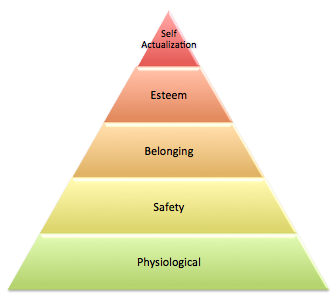
Maslow used the terms “physiological,” “safety,” “belonging,” “esteem,” and “self-actualization” to describe the general path by which human behavior generally moves.
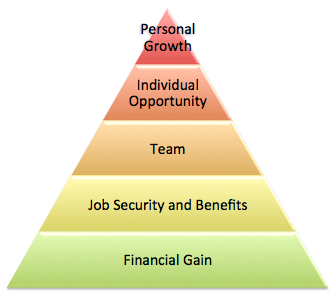
With that in mind, if we use the format of a job ad as a means to motivate a reader to actually take action, we should borrow from Maslow’s hierarchy of needs to ensure that our job postings are at a minimum, well rounded and engaging enough to drive the behavioral outcome we’re looking for.
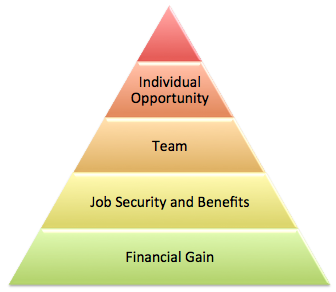
It’s not really too much of a mental stretch to see how these stages apply to the underlying intrinsic motivations a person might possess when determining whether or not to apply to a particular position, or even move them from casual viewer to active applicant and ultimately, optimally, a new hire.
At the least, we could use Maslow’s model to broaden the appeal of our job ads and hit less on qualifications and more on the motivations Maslow identified.

Compensating for The Basics

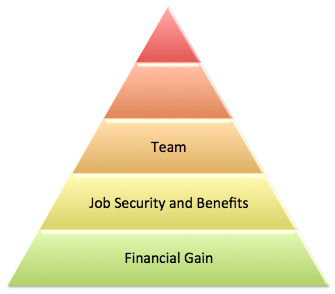
The lowest order in terms of motivation for any job seeker has to be salary. While compensation is foundational and obviously of some importance, it’s also the factor that’s the easiest to actualize and adjudicate accordingly.

Try putting the actual salary range of a position on the post instead of that nebulous “Depends on Experience” and voila! the majority of your applicants will at least know how much you’re willing to pay prior to investing time in the position.

Assuming that your job is not unpaid or a front for some sort of shady operation like human trafficking or drug smuggling (in which case, your employer brand is probably pretty intriguing), starting at salary just makes sense. Promising adequate or even fair pay for a candidate’s work should never be the principal motivator you’re playing to as a recruiter.

Put simply, cash should never be your “ace in the hole.” If that’s the most enticing thing you’ve got to offer, it’s time to rethink the role. Try talking to some other people who already do the job and ask them why they like it.

Try gaining insights into the personas and professional aspirations (and actualizations) of the people who enjoy doing the job, and chances are, those will align with the same things that are likely to resonate most with the candidates you’re looking for. They’re also likely to overlap with what you, as an employer, are looking for when you’re looking for candidates.

Third party recruiters and staffing agencies tend to be the ones whose job ads are built around the bottom line, focusing on salary as the biggest incentive that a position has to offer. “Java Developer – $90,000+!” is a great indicator that the person posting the job doesn’t have any idea about what the people doing that job either really do or really care about.

They don’t get the distinct differentiated drivers of the candidates they’re looking for, which means that they’re not doing anything but throwing shit to see what sticks, as the saying goes.

Always Practice Safe Reqs

A lot of job posts make us stop at salary – there may be manifold information or details given about the employer, but these are generic and boilerplate, more explanatory than enlightening. “You will write code and fix bugs” are statements which could be true of any developer in any organization. The key is to make this personal – which is where Maslow’s second step, safety, comes in.
Safety, for job seekers, may take the form of a full time role versus a contract gig or the security of your company as an entity that’s built to last. These can be addressed early on, from startups simply mentioning that they’re “VC funded,” for example, or larger corporations pointing to how long they’ve been around or what they’ve accomplished.
“Safety” should be imparted and accepted with the same immediacy as salary.
If you don’t make the job seeker feel their basic needs are being met (for instance you’re offering a lower than expected salary or indeterminate contract length), then chances are they’ll self select out of the process. That’s a good thing at this stage. After all, remember that a great job ad isn’t about appealing to the masses, it’s about gaining the interest of the few relevant professionals who are going to be the right match for you. Relevance trumps reach.
A growing number of companies are following in the footsteps of the larger tech employers, offering a bewildering number of perks and free incentives to their employees in the hopes of enticing top talent. These are the hyperbolic tales of unlimited free food, dogs at work, on site masseuses and free flowing champagne always on ice next to the foosball table in the “ideation room.”
Which sounds great in theory – who doesn’t want these things? But in practice, this is a hurdle a lot of job ads fail to overcome. Promising money and perks are a great way to have someone change small stuff like which bank to open an account at or whether to switch internet service providers, but fall flat when it comes to getting someone to change employers in most cases. Job security should be implied in any job description, period.
Perks and benefits are nice to have in the periphery – they’re just not enough.

Putting An ‘I’ In Teamwork

Maslow’s third tier was “belonging,” or “love,” actually. For a job ad, this means having to convey a sense of being a place where a candidate will feel accepted and like they belong. Too many job ads fear to tread on this ground. We stop at the inanimate perks and practical stuff like job requirements and don’t consider the social side that inevitably accompanies any job.
Belonging, in job ads, is best conveyed by showing them the people that a potential new hire will work with. Humans are social creatures (for the most part), and actually benefit from interacting with others. Who wants to spend 8 hours a day trapped in a cube farm treading the same carpet as people you hate?
Conversely, everyone wants to work with that ex-colleague or former manager who inspired them and championed their professional growth, or join a team of renowned subject matter experts in their field. Making a job ad generic and impersonal (e.g. “You will work with our team of developers”) risks losing that essence of what makes that team unique.
Talking about a job from the point of view of becoming part of a top notch team instead of becoming just another butt in a seat provides the opportunity to sell successes to candidates while gaining engagement by selling the aspirational nature of working with a pedigreed potential peer group.
In the startup world, it’s normal to see job ads showcasing the founders’ experience at companies like Google or Facebook as a way to simultaneously show off their blue chip background while borrowing from the perceived benchmark for quality talent associated with their previous employers.
Another consideration for the ‘team’ level of a job ad is how the team is organized, and how that team functions when working together. A job might be more attractive to a potential applicant if it explicitly states stuff like the team doesn’t like to hold lengthy meetings or works closely across other units or areas of the bigger business.
There are some great examples of companies getting this right that, from a recruitment messaging point of view, are simply brilliant. Check out Spotify’s outstanding video on engineering culture below for a case study in how to effectively speak to the innate need for “belonging” Maslow described.


For candidates who might harbor frustrations about their current employer’s perceived bureaucracy, lack of insight and innovation and conservative company culture, referring to how work gets done at a prospective employer can be both revealing and enlightening.
Moreover, talking candidly about these issues can help impart a sense of authenticity and transparency, which create the most fundamental currency required for recruiting success: trust.

Accomodating Special Needs

In his fourth level, Maslow discussed “Esteem,” or the need for appreciation, recognition and respect. People have an innate need to sense that they are valued by others, that their contribution matters and that their individual efforts contribute to the collective good or bigger business picture.
When employees lose this sense of esteem, they become unhappy, disengaged and ultimately, start to stagnate (and searching for jobs). If they feel underappreciated or that they’re going to be treated as second best, this accelerates active disengagement, which is anathema for any workforce.
It might seem obvious to mention that people like to feel valued, but in a job ad, it’s too often overlooked. It’s completely apropos to mention why the job you’re advertising is important to the rest of the team and company. It’s certain that some elements of that req you’re looking to fill will look similar to roles at other employers, which is why in most cases it’s essential to differentiate these elements at the personal level.
No candidate wants to be a cog in a machine (well, any more than they are when they apply to your ATS) but I still see companies loudly touting the fact that they’re hiring “thousands of software developers this year!” The intended message is obviously supposed to imply security, but it’s hard to feel wanted if the employer is sending off the vibe that you’re just going to be one of the crowd.
Remember, a good job ad makes the right audience actually take the correct call to action, whether that’s to apply or self-select out if the role doesn’t sound right for them. A job ad shouldn’t be so generic you’re attracting any mouth breather with a pulse out there, and if it does, you’ve got no one to blame for having to wade through the mire of terrible candidates and unqualified applicants but yourself and your crappy advert.
Knowing the role you’re performing is worthwhile and necessary is a far superior motivator than the lower level ‘carrot and stick’ style of incentives, like salary or mock “benefits” like getting legally mandated paid time off or paid holidays – or perks like having a ping pong table and bean bags that no one really cares about all that much, ultimately.
The better job ads always appeal to the truly motivating factors that underscore the concept of esteem: autonomy, results driven philosophy, lack of arcane rules or draconian policies, work-life balance and flexibility are great examples of ways to add authenticity while creating a competitive advantage through differentiation from all the other employers out there.

A Growing Concern: Aspirations & Self Actualization


So, what’s left? You’ve got an ad for a new job that tells a candidate they’ll be paid fairly for their work, they’ll be given a great set of benefits and both the job and company are secure. You’ve shown them the amazing team they get to work with and how they’ll fit into that team, and why as individuals, their work is going to make a meaningful difference and actually matter.


If you said all that and called it a day, you’d already have a really compelling job ad, but Maslow’s final tier on the road to fulfillment is the silver bullet: “self-actualization.”


This is the ultimate goal of psychological development, the last step that’s achievable only when all basic and mental needs are essentially fulfilled and the person’s focus can turn towards potential.


Research suggests that when people lead lives that differ from their true nature and capabilities, they are less likely to ever find happiness or meaning than those whose aspirations and abilities align with what they’re actually doing with their lives and goals.


In a job ad, offering this greater fulfillment to a prospective candidate can be tricky. A majority of job ads fail in the perceived balance of power each portrays. Despite the current hiring market becoming much tighter and with certain skill sets so in demand that the few candidates out there who have them can more or less write their own check, it’s important to remember that the balance of power has shifted.


But you look at any job board there’s this weird, “You should be thankful we deign to allow you to even look at this posting,” holier-than-thou hubris that’s blatantly obvious from the language choices that seem almost designed to crush the souls of anyone but the most mindless of drones and the most desperate of candidates.


But for some reason, this has become the accepted convention for the weird mashup of cut and paste job descriptions most employers post externally. They’re part internal HR document, part externally facing hyperbole with a few spurious superlatives, and the combination of the two is almost unreadable, which is why no one bothers to actually read them in the first place, most times.


Instead of using overt language that sounds cribbed from some Dickens novel or like those fat cat capitalists you see in Industrial Revolution era cartoons of classism, let candidates know what’s in it for them – not you.


What experiences will they have that will allow them to develop and grow as individuals? What new skills or training in new areas will you provide them with? Will they get a mentor or the chance to mentor other employees and create more meaningful interactions and workplace relationships? Will they have the autonomy and authority to have the freedom they need for true creativity and innovation to happen?

This final tier is future facing, but is imperative for any truly great job ad.


If you can hint at a brighter future for potential new hires, and show that this job is just the first step on a career path that’s satisfying and rewarding in your company, then you’ll hit the tipping point for attracting the talent you really want, not just the ones who happen to come across it on some job board or career site somewhere. You’ll soon see a brighter future for your abilities to get the right target to go ahead and click that big red apply button – and actually finish the application, too.

On the recruiting hierarchy of needs, that’s as close to self-actualization as you can probably ever hope to achieve.

Read more at The King’s Shilling.

bucklandAbout the Author: Matt Buckland is  Head of Talent at Forward Partners an investment studio for early stage UK ecommerce startups.

Based in Hoxton, London, Forward Partners combine investment with practical hands-on expertise and insight. He also blogs at The King’s Shilling.

Follow Matt on Twitter @ElSatanico or connect with him on LinkedIn.

How To Calculate Your Recruiting ROI

sabermetricsThere have been a ton of articles written about applying sabermetrics to workforce analytics – hell, Billy Beane keynoted the one and only TLNT conference in history to talk about how big data helped stretch a small budget into a winning baseball team.

This analogy, of course, is complete bullshit, considering that until employees are governed by CBAs, there are a fixed number of competitors and a defined number of open roles with fixed responsibilities and a dataset where you literally know every single potential new hire out there, building a winning workforce is way harder than building a winning baseball team.

Of course, even the sage himself still hasn’t won a Series, which should tell you that even the easiest approaches to predictive analytics are obviously imperfect.

Data Driven Recruiting: A Reality Check

967ff614a3cc292296a514c6d0f1d986There are far too many variables involved in human behavior to accurately predict stuff like a top performer getting headhunted out or your company desperately in need of some hard-to-find skillset because they decided to relocate to be closer to their significant other.

That’s why even the most optimistic outlooks on the positive outcomes data driven recruiting can have must be tempered by the reality that we, as humans, make decisions that no algorithm can model or predict.

Even Google still serves up irrelevant responses, which is basically the entire business model upon which SEO & SEM are predicated. And they’re probably a little further along the data adoption curve than your enterprise ATS or HCM system, as a guess.

One of the scariest parts of predictive analytics is the misconception that they have to be prescriptive – that is, the discipline is designed to find holes, weed out weaknesses and identify opportunities for change.

Optimally, that’s all true, but frankly, that’s tilting at talent windmills for all but the most cutting edge of organizations right now.

Instead, recognizing the limitations of data driven recruiting but also recognizing that the numbers are there, our approach to data (and the tangential, ubiquitous conversation) in recruiting should focus not on finding out what’s wrong, but verifying what’s working. Because that’s way easier than testing for what’s not – although obviously, once you know one, the other part becomes pretty obvious.

How To Calculate Your Recruiting ROI

With that in mind, you don’t need a fancy system or anything more than the calculator on your cell phone to be able to figure out the following fundamentals – the small stuff that’s the foundation of “big data.”

1. Am I More Expensive Than An Agency?

4f805b8b8e43ac20cdffc186260a7d72fd46f621f4e634c8e657d0c90bcabdf7Add up your total rewards and compensation with your total spend on recruitment advertising, software seats and anything directly involved in filling positions.

If you don’t know that exact amount, a good formula is to take your salary, multiply it by .67 (the cost of your benefits) and add on $2500 for every req you closed this year, which is on the low end of the estimated average spend on recruitment advertising (like job board postings) per position.

You have the compensation data for every hire you made over the same time period as your paycheck – since it’s tax season, let’s call it 4 quarters.

If the total amount you calculated earlier is over 25%, then guess what? You shouldn’t have a job. But assuming that it’s lower, you’ll know how much you’re ostensibly saving your employer every year over outsourcing your job or recruiting function.

This formula is imperfect, but it’s really the easiest way to measure your overall opportunity cost.

2. What’s Your Network Really Worth? 

1296753206690_3109306People get excited about social recruiting because these networks have already been built, but engaging on them isn’t intrinsically valuable for recruiters or employers.

Similarly, building elaborate Boolean strings is great, but if you’re finding candidates with sourcing hacks, you’re not necessarily engaging them or building any sort of meaningful, sustainable relationship with them – even if you do get them to apply for a job or send in a resume.

A recruiter’s real value, one could argue, at least one that’s unique for every recruiter and a clear competitive differentiator between both real colleagues and automated tools is that if you’re a good recruiter, you have a transportable network of contacts that’s the most important asset you bring into any organization.

Take a look at your source of hires from last year. If they’re coming from any source that’s not blind job advertising (post & pray), third party search or direct sourced for a specific position, they’re a direct result of networking activities and ostensibly recruiter specific and employer agnostic since they’re otherwise dead leads once the requisition closes without the intervention of a recruiter, and the only way to keep leads warm is by building 1:1 relationships.

Assuming the total cost of all other sources (again, look at new hire offers) is greater than the total spend on the aforementioned just-in-time, transactional talent tactics, than you’re actually delivering value with your personal network.

This includes referrals, since you’re the intermediary between employer and employee; any pipeline building activity requiring multiple touch points and channels for engagement (which is most sourcing and CRM activity); and anyone who you spoke with or personally interacted with prior to them entering the database, since you ostensibly influenced their decision making positively prior to the point of apply.

Stopping there, given referrals and internal mobility alone make up for the majority of hires, you again can determine how much your network is worth – and how much value you bring to an organization (or how much they’d lose if you bolted).

I know it’s imperfect, but again, it’s easy to calculate against a clearly defined benchmark that’s directly oriented to business and bottom line results.

3. Where Should I Be Spending My Time?

Recruiters love low hanging fruit, and given the fact that existing employees, referrals and job boards constitute, in order, the three most effective source of hire, it means that you theoretically never have to go outside your ATS to find your next hire.

That means, if you’re like most recruiters, you can keep on doing what  you’re doing: your strategy is more successful than any of the stuff like “employer branding strategy” or “social recruiting” no matter how you do the math.

ddr-logo1So sit back, relax, and keep not calling back candidates. You probably don’t need to, as nice a sentiment as it really is.

See? You don’t need a math degree to become a data driven recruiter.

You just got to know what’s in it for you – which is probably how you already operate if you’re any good at recruiting to begin with.

For more on how to put analytics to work at your work, make sure to check out the Data Driven Recruiter, presented by Jibe. Follow the Data Driven Recruiter on Twitter @RecruitDDR  and use the hashtag #RecruitWithData to follow real really kick butt tips and tricks for becoming a real data driven recruiter in real time, all the time.

Copernic Desktop Search | Lightning Fast Search Tool

Some of the best recruiting tools that I have used over the years were not truly built for recruiters. Copernic Desktop Search is one of these that I use that I felt would be a great addition to most recruiters arsenal. As with every tool, there are free and paid versions.

How I Use Copernic For Recruiting and Organization

[youtube url=”https://www.youtube.com/watch?v=9HCZPb_j4oY&feature=youtu.be” width=”500″ height=”300″]

Here are a few thoughts on the tool itself and a demo that I put together to show you exactly how I use the tool to better recruit from form desktop.

What is Copernic Desktop Search

Copernic Desktop Search is a dynamite tool that allows your to run lightening fast searches throughout your entire system, including all documents, emails, calendars, notes, document. This is an inexpensive (offers a free version as well) alternative to Window Desktop Search.

screen_desktop_search_01

4 Reasons Why should a Recruiter consider investing in a desktop search tool?

  1. The average person spends approximately r hours per week searching for documents and 2.3 wasted hours per because they do not have the appropriate tools (according the copernic site)
  2. File organization, quick and easy document recall and of course structure and unstructured data search
  3. The ability to search within documents, excel files, PDF, PowerPoint files and .doc
  4. You can search networked drive files, outlook contacts, tasks, notes, calendars, local and external drives all from 1 interface


dean_dacostaAbout the Author: Dean Da Costa is a highly experienced and decorated recruiter, sourcer and manager with deep skills and experience in HR, project management, training & process improvement.

Dean is best known for his work in the highly specialized secured clearance and mobile arenas, where he has been a top performing recruiter and sourcer.  Dean’s keen insight and creation of innovative tools and processes for enhancing and changing staffing has established Dean as one of the top authorities in sourcing and recruiting.

Connect with Dean at LinkedIn or follow @DeanDaCosta on Twitter.

TalentNet: Keep Recruiting Weird.

talentnetdallas2014282829There I was, packed into the sweatbox that was the small club in the heart of downtown Austin, pressed up against that weird mix of slick, suit clad biz dev guys, bearded techies looking straight out of the Shire, glow wand waving booth babes and the rest of that strange melange of people and personalities that somehow only seems to happen at South by Southwest.

While the crowd there was, uh, diverse (to say the least), we all could easily find common ground in the reasons we were suffering through a veritable sauna deep in the heart of Texas: our love of free drinks, great technology and amazing hip hop.

And since it wouldn’t be #SXSW without the music, the geeks were gathered to get in touch with their inner OG, eagerly anticipating the impending moment when Biz Markie took to the stage. PS: you know you’re a legend when Biggie actually referenced you in a song. Mix in a sponsored bar, and you’ve got a hell of a night.

This happened just last year, during the weekend of the 2014 TalentNet Interactive conference – which, I conveniently happen to have coincide every year with the biggest celebration of tools and technology on the planet. Alongside me were my Cool Tools Show co-host and partner in crime, Lars Schmidt, and Imo Udom of WePow – because that’s how we do. And have done for years, now.

As we waited for Biz to rock the mic, I couldn’t help but think that it was one of those moments that you realize is pretty darn funny, really random, and just another day at SXSW – an event filled with these weird, wonderful moments.

These moments can be fun, they can be inspirational, and often, they can turn into hilarious anecdotes – but ultimately, they present what’s probably the most unique chance to “find your tribe” if you’re one of us who gets geeked out about stuff like bonding with cool people over cool technology (and, more often than not, music, film or the other parts of the SXSW programming).

Keep Recruiting Weird.

tnl4It’s a one of a kind experience, but let’s face it, it’s not one that we, as recruiters, get most of the time. Those of us who are early adopters spend most of our time talking the basics of tech and building business cases on stuff like mobile and social to an often resistant audience of colleagues and coworkers. Those of us who are behind the adoption curve could care less about what’s new and what’s next.

But recruiters and talent acquisition practitioners who get excited about being on the intersection of our industry and how it aligns with the bigger tech picture shouldn’t be left out because our trade shows are more SHRM than SXSW, and even those shows that do deal with HR Technology have a pretty narrow focus on our pretty niche industry.

That’s why I host TalentNet Interactive (in partnership with Dice) to coincide with the first day of the world’s biggest film, music and interactive festival. It’s a chance for some of the smartest, most innovative minds from across the talent industry to converge in the epicenter of the nerd world and connect about our little sliver of that world: talent trends and technology.

This year, #TalentNet is back in Austin on March 13. This year we’re going to be holding the event at Whole Foods corporate headquarters, courtesy of recruiting leader (and past Recruiting Daily contributor) Andres Traslavina – and this year’s line up not only succeeds in representing some of the most interesting, innovative and influential people I know in the talent acquisition industry, but a group (including keynoter Gerry Crispin) who do a pretty good job keeping Austin weird.

Click here to see the complete lineup of speakers – I think you’ll agree they’re all pretty amazing.

What #TalentNet is All About.

They’ll be covering a wide range of topics, but there will be some recurring themes that should surface throughout the day – particularly as it relates to the rapid convergence of marketing and recruiting. The philosophy behind TalentNet is to create a program that will keep our peers in the industry up to date on the latest trends and best practices that those of us who work in both worlds see and hear when working with employers, their talent teams, their technology providers and their marketing counterparts.

This year, we’ll be looking at big questions like:

We’ll be covering these topics and way more when we dig in at Whole Foods’ world HQ to talk shop, showcase technologies and provide real takeaways to real recruiters that we can all use when we’re back at the office at our own organizations. It’s a pretty simple formula: put some smart people together to share their stories, data and tips, put them in a room and see what happens. The end result is awesome, and one of those things where, well, you’ve got to be there.

But once you are, I’m proud to say, you’ll probably come back to TalentNet – almost every speaker and track leader has been a previous TalentNet attendee or supporter (on social or otherwise) who came back to contribute their own expertise and insights to what’s become a pretty kick butt community.

And I say that word knowing that’s exactly what we’ve built – our community is a vibrant, close-knit and ever expanding group of recruiting and HR pros who “get it,” are helping our entire industry step up and raise its game, and have built lasting business relationships – and friendships – after first meeting in what can only be called the world’s weirdest talent technology think tank.

Our sessions are interactive. They’re audience-inclusive. They focus on tactical takeaways you can use right now, not high level theory and BS buzzwords that are simply thrown in there to build convermuity and sociallateral. You don’t have to know anything about tech to get some awesome insights you can immediately apply to becoming a more effective recruiting or talent practitioner. You just have to come with an open mind, and we’ll take care of the rest.
Oh, one more thing: if you’re looking for another stuffy HR conference with CPE credits and paper based feedback forms, look somewhere else. TalentNet is about having fun together, too, because in the business of people, professional success is predicated on personal relationships, and no one builds those suffering through another PowerPoint presentation.
Which is why our annual Dice karaoke after party, which happens right after the event, is worth the trip to TalentNet alone. I mean, where else are you going to see surprise guests like Elvis impersonators and world famous blogger Chris Brogan singing “Tainted Love” in front of a room full of HR professionals?
So, please join us on 3/13 at Whole Foods HQ. You’ll probably learn something radically new. You’ll definitely learn something useful. And once you’re there, you’ll see why our weird little #TalentNet family keeps growing bigger and closer every year.
No matter what you’re looking for, like Biz Markie sang that night after last year’s event, “You…you got what I need.” And you say we’re just a Facebook friend? Oh, baby.
Hope to see you next week. For real. It’s going to be hilarious.

fishdogs


Craig Fisher helps people and businesses find things, and get found; new customers, top talent, better jobs, and larger audiences.  He helped to create the 1st Linkedin Certified training in North America.

He does strategy, speaking and training for groups of all sizes, all over the world, including sales teams, recruiting teams, and professional organizations on Social Media and mobile strategy.

He is founder and host of the #TalentNet social conferences.  Follow Craig on Twitter @Fishdogs or connect with him on LinkedIn.

What Companies Are Getting Wrong About Social Recruiting

This was originally posted on RecruitingBlogs.com by Paul Petrone of Voice Glance. We loved it so much we’ve decided to share it here as well.

What should you write here? Here’s a hint: think what you can do for your audience, not what your audience can do for you. Credit: Twitter

Today, I spent time looking for companies that have social recruiting – i.e. recruiting via social media – right. I looked at all the big guys, almost all of whom have Twitter pages dedicated just to attracting candidates, and yet, after seeing a few, I quickly became disappointed.

Quite frankly, many of them were bad. They had few followers and little engagement, as in very few re-tweets and favorites. This was surprising, as you’d think these feeds would be popular, simply because who wouldn’t want to work at some of the most famous and recognizable companies in America?

And yet, they weren’t.

Why were they so bad? Because they committed the cardinal sin of marketing: they only took, they never gave.

The result?

Instead of being a really effective way to attract great people – the number one factor to success in any company – they were unpopular, un-engaging feeds that probably drew very few candidates.

The good news? It’s very fixable.

Case Study: Lego

Let me start this section by saying I love Lego. As a child, I played with Legos all the time and now as an uncle I buy my 6-year-old nephew exclusively Legos for Christmas, his birthday and whatever other holidays business-types dream up.

On top of that, Lego is a great turnaround story, which went from nearly going bankrupt 10 years ago to recently being named the most powerful brand in the world. And on top of even that, they have a solid Twitter page, filled of relevant, clever Tweets like this:

So I had high hopes for the Lego Careers Twitter page. And yet, when I went on the page, I saw a paltry 1,400 followers and almost no engagement with any of the Tweets:

Those four Tweets – the four most recent when I went on the page – were indicative of the rest of the stream: almost no Re-tweets, barely any favorites, no images; nothing more really than just job postings with some hashtags.

There’s one universal rule to marketing (and the world in general): give, and you shall receive. Lego isn’t giving, and therefore, it isn’t receiving.

What They Should Be Doing

So what should the Lego Careers Twitter page look like? Obviously, it should have job postings. After all, that is the point of the page.

But there should be a lot more.

There should be images of workers at Lego doing cool stuff, such as volunteer work or engineering the next cool set, which shows off the culture at the company. There should be pictures of really cool Lego sets and Lego structures with words like “How would you like to be part of the team that builds these?” underneath.

Fundamentally, it should have engaging content that draws people to the page beyond just job postings and hashtags. After viewing the page or some of the Tweets, people should think to themselves, “that’s a really cool place to work.”

Lego needs to give reasons for people to want to work at Lego, not just exclusively ask for resumes. That’s the equivalent of a company just asking for a check, without giving any reason why you should write it in the first place.

Even the job postings could use a little Lego flair. For example, if they are looking for engineers, why not add an image in the Tweet with a Lego man working as an engineer?

Those little touches make the page more engaging, which leads to a more popular feed, which ultimately leads to more potential candidates being reached.

The Point

Social recruiting is essentially a form of marketing, and needs to follow the rules of marketing. And, as every marketer knows, for someone to give you something, you have to give them a reason – generally, a compelling story – to want to do it.

So, if you are going to have a Twitter page for your careers, don’t just post Tweets asking for resumes. Tell the story of why people should want to work at your company, and the resumes will come organically.

About VoiceGlance

Paul PetroneVoiceGlance is a cloud-based hiring tool used by forward-thinking companies to hire smarter, instead of harder. Learn more here.

Paul Petrone is an experienced content creator and solutions architect who works with organizations of all kinds to help them win their war for talent. Paul’s writing has appeared in The Huffington Post, Yahoo News, Buzzfeed, Inc, ERE.net and AOL News, to name a few, and his LinkedIn articles generated more than 3.5 million page views in 2014 alone. He believes the secret to great content is providing real value to the reader, in the most engaging way possible.

Building A Case for Building A National Recruiting Association

Several recent posts by Derek Zeller, Steve Levy and Chris Hoyt (and especially the comments directly following those posts) contributed to my writing this column, but I wanted to weigh in on what appears to be a growing dialogue in our industry. The discussion starts with defining what recruiting really entails.

Now, most people would argue that recruiting is, at the least, a critical business ‘discipline’ (if not a legitimate ‘profession’, but more on that later). It is definitely an ‘occupation,’ a vocation if not, perhaps, always an avocation.

These might seem like slight, specious or superficial differences, but in this case, words matter – and here’s why:

Recruiting: More Than Just A Job?

16-You-Are-More-Than-What-You-Do_optRecruiting and the activities associated with matching jobs with job seekers is something that affects millions of lives – and livelihoods – every year in the United States alone (let’s stick with the challenges facing us here at home before broadening our scope to assume a global position).

It might take a village to raise a child, but it apparently takes at least a small city to recruit a candidate, with tens of thousands of full time professionals who refer to themselves as a “Recruiter.”

There’s an equally large proliferation of professionals whose primary responsibilities revolve around this ‘occupation,’ even if that’s not necessarily reflected by their actual job title.

By definition, an occupation has no shared responsibility for what it entails or how it is done, much less accountability for the outcomes of doing it well and exceeding the expectations of others. Recruiting, therefore, is a job – and for most, doing that job means little more than putting a butt in a seat and a paycheck in their pocket. Reqs are closed in a vacuum, and most recruiters approach their jobs under the erroneous assumption that as long as hiring happens, the end justifies the means – and no one else is really adversely affected when those means aren’t well meaning.

In a profession, unlike an occupation or a job, there’s a certain degree of shared responsibility and collective accountability, where all practitioners are connected, whether they like it or not, by a common set of minimum standards and guidelines governing those outcomes – and an expectation that those outcomes will impact other stakeholders practicing any particular profession. A profession is viewed collectively instead of individually, for good or for ill; reputation is a shared responsibility, not a personal attribute or individual outcome.

The (Sad) State of Recruiting: Taking the Pulse of Our Profession

i-like-this-job-only-marginally-more-than-i-like-being-homelessHowever, despite the fact that recruiting impacts so many millions of lives every year – directly or indirectly – there is no accepted “body of knowledge” that its practitioners universally agree on, which means that recruiting’s reputation is being driven without any accepted definition of what it means to be a recruiter.

With hundreds of thousands of professionals in the business of hiring, or at least tangentially touching talent acquisition, this creates something of a precipitous problem, given that without at least an accepted definition, all recruiting really is seems to be a de facto set of activities – and those activities are whatever anyone says recruiting should entail.

This isn’t a profession. Not even close.

It’s a free-for-all that costs us all. Here are some of the most glaring problems we can point to:

  • Recruiting has no barriers to entry.
  • There are no standards for what a ‘recruiter’ really is (although that might soon be changing, but that’s a story I’ll save for another time).
  • There’s no agreement on what constitutes quality or how quality should be measured, monitored and maintained.
  • There are no accredited, specialized degrees for recruitment that meet University accreditation standards, unlike the many programs in place for disciplines like engineering, accounting or even general HR.
  • There are no peer-reviewed academic research or course curriculum (save a scattering of outlying offerings at the graduate level) dedicated to recruiting or talent acquisition.
  • Similarly, there’s no recruiting related academic network, specialized journal or other way for those working on relevant content within academia to periodically disseminate or discuss the emerging ideas, insights and information needed to create the aforementioned body of knowledge. 

The only generally accepted, regularly published and currently printed academic tome attempting to cover the ‘whole’ of recruiting, arguably, is Staffing Organizations by Heneman, Judge, et al. (and I’d be happy to argue it); this has existed for years, but it’s been published for years without much impact, academic or otherwise, in addressing some of the professions most pervasive and persistent problems.

Transforming Recruiting From Occupation to Profession

10dc8830f6e7c9a9c96a1865ff767f7cAnd so, taking the actual experts (not the self-described social media types whose primary qualifications are knowing how to tweet) and academics out of the equation, we’re left without any authoritative arbiter of what constitutes a recruiter or recruiting. I

nstead, we’re left with ambiguous, often conflicting definitions arbitrarily employed by current and former practitioners, vendors, suppliers, consultants, sales reps or literally anyone who says that they have an ‘answer’ and ‘an angel’ – this angel, of course, almost always coming in the guise of selling some sort of software or staffing services.

Productizing a profession never helped do anything but commoditize the actual value of end users and practitioners – plus, these solutions purport to fix problems that we can’t agree we actually have or fix things that there’s no consensus are actually broken to begin with, which as business models go, seems suspect at best.

But without the accepted ‘center’ that the majority of our community continues holding out hope of crystallizing around this occupation, we just don’t have a context to discuss and understand the myriad practices, strategies, systems, training, tools and technologies.

Instead, we’ve got a proliferation of content marketing and consultants with competing agendas and no way to establish an agreed upon foundation for what constitutes recruiting, how recruiting is evolving or really any ability to take action beyond following a few folks who seem to get it and hoping they’re right. At least, that’s where we’re at as an industry today.

What excites me, what makes me optimistic, is that the gap between those who say and those who do is becoming more important, and defining what a recruiter really is really matters to an increasing number of folks who not only have pride in their chosen ‘profession,’ but the desire (and ability) to take recruiting to the next level.

So, maybe it’s time to finally embark on that journey. It’s been done before, and mostly, it’s been done poorly – the sad state of the industry evidences the fact that these efforts have missed their mark. But while these many previous attempts have gone wrong, maybe, just maybe, it’s time to do it right.

In my opinion, the long term solution is to actually establish recruiting as a profession. This seems simple, but it hasn’t actually happened yet – although this journey has been years in the making. Starting today, there are a few steps we can all take in the right direction.


For an occupation to become a profession, there are a few commonly accepted milestones that must be met. These include:

  1. An occupation must first become full-time. Done.
  2. An occupation must have an established, independently audited training program with standards that are universally accepted instead of simply self-declared.
  3. The establishment of a University based curriculum for formally teaching that training on the undergraduate and/or graduate level. Few ‘recruiters’ with a BS in Recruiting are going to get hired until our academic approach to the industry is radically altered, as is our approach to teaching talent acquisition at the University level – which is easier said than done, suffice to syay.
  4. The establishment of a local professional associationThere are arguably over 50 of these already in place across the country with professionally focused non-profits at the local level being a model that’s already been adopted by leaders like Ben Gotkin in the Washington DC area, to cite one of the most prominent examples.
  5. The establishment of a national association. [Ah ha!]
  6. The introduction of codes of professional ethicsHey, even in recruiting, this is probably doable.
  7. The establishment and enforcement of licensing lawsIn the US, this is likely going to be a state-by-state effort instead of a single national body. 

(source: Perks, R.W.(1993): Accounting and Society. Chapman & Hall (London); ISBN 0-412-47330-5. p.2.)

Having considered these necessary conditions for turning an occupation into a profession, the first logical step, from my perspective, that’s the most likely to put us on the right path is to establish (or re-establish) a National Professional Recruiting Association. In fact, it’s actually a no-brainer.

Why A National Professional Recruiting Association Makes Sense.

scarecrow-wizard-of-ozOne could argue – and quite convincingly – that existing, established professional organizations dedicated to HR such as the Society of Human Resources Management (SHRM) and knowledge testing & certification bodies such as HRCI are proper platforms for serving as ‘stewards’ for the recruiting profession.

These existing organizations could potentially curate recruiting content, oversee vetting the evidence for its exclusion or exclusion in a specialized body of knowledge and much more: establishing standards, encouraging proper data collection and analysis, funding research, and so forth.

I have personally argued this case for almost 25 years but have slowly (and sadly) come to the conclusion that, as one of my N’awlins friends, Dan Hilbert, puts it so perfectly, ‘That dog won’t hunt.”

Not now. Not ever.

Back in 1999, SHRM cleared the way for actually accomplishing this objective by acquiring the EMA (Employment Management Association), the only broad-based national recruiting association then in existence. At the time of its acquisition, the organization was over 40 years old, but had become dominated by vendors and seen its membership decline from a peak of over 10,000 practitioners to maybe a few thousand at best.

Fast forward a decade, and the dream had all but died. By 2008, its board was long gone from SHRM; its magazine sales diverted, purposely, to HR Magazine; it’s national conference merged into SHRM “Talent Management” and the 19 SHRM affiliate chapters with recruiting specialties were going nowhere fast.

At best, SHRM’s mission when it comes to recruiting is simple: to support HR professionals, who must, occasionally, recruit as part of their portfolio of professional responsibilities. Any additional focus on recruiting besides its tangential connection to core HR disciplines would dilute their ‘brand’ and detract from their core membership and mission.

HRCI, likewise, will never offer a specialized recruiting certification, and while its PHR, SPHR and GPHR certifications do include test questions and material relevant to recruiting, these barely scrape the surface of the knowledge and competencies required by today’s dedicated recruiting professionals. Their entire database of recruiting-related materials is a tiny sliver of what’s required for certifying recruiting, a fraction of the functional expertise that’s required to effectively set baselines and benchmarks related to recruiting.

One could also argue that existing niche associations should step up to the plate. The IACPR (the International Association of Corporate and Professional Recruiters) or the HRPS (Human Resource Planning Society) are two such examples. These associations are well established and well-funded, but the fact is, the former is more of a trade association bridging the gap between internal recruiting and executive search, and the latter is having its members in HR leadership more or less aggressively courted away by SHRM.

For me, neither fit.

NACE (the National Association of Colleges and Employers) is another well liked and historically successful association and, while it has a great model for curating specialized recruiting content (including by the way a recently published ‘map’ produced by practitioners of the standard acceptable practices in college recruiting), it has enough to handle focusing on Campus issues and still struggles with a critical mass of members as well as a solid balance between its corporate and career service members.

Agency, placement, outsourcing, and even job boards have great non-profit ‘trade’ association models emphasizing their member needs. They lobby for their members, build reasonable ethical standards and curate best practices. There is much to learn from them, but their bias will remain the business needs of their individual members not advancing the profession as a whole.

And as for the legion of ‘for-profit’ commercial organizations who systematically collect, analyze, publish data and content, share it or sell it and bring together recruiters, consultants, researchers, analysts, vendors, suppliers etc., some are better than others but they all suffer from a perceived conflict of interest around their short-term goals to balance their owners and investors’ needs over their members’ needs.

Among those I follow the most, in no special order, is this small sample: ERE, HCI, Conference Board, CLC, Recruiting Blogs, Bersin by Deloitte, Saratoga Institute, Brandon Hall, the HR Technology Conference, etc.

I won’t bother to describe the embedded bias of content published by nearly all Technology based services as it would be a waste of a page. Of course, none of these actually fit the criteria for moving from occupation to profession that I’ve outlined above, no matter how helpful these resources might be for recruiters.

Why The Right Time For A Recruiting Association Is Right Now.

99222df3cc60fbc787a426af461f48e5Maybe it’s too altruistic to consider that the time is right to launch a recruiter-supported association with dedicated to better defining, measuring, collecting and sharing content that meets some standard of consistently high quality, is peer reviewed and operates free from proprietary influence and the pay for play that goes along with accepting external funding from third party vendors.

Yeah, I know. That sounds pretty boring. Sure, my writing style’s probably partially to blame, but even so, I still marvel at the number of folks who prefer to the wild-west approach to recruiting.

Sure, it’s the easy way to go, but in the end, that ease has cost all of us the reputation and respect that recruiting needs if it’s going to become the profession many of us want.

It’s that critical mass of advocates that make me optimistic that we can successfully collaborate on the recruiting certification and quality content required to systematically curate and build an entity from the ground up, from branding to analytics to licensing to standards to competencies to leadership – the list of outcomes goes on and on.

It’s a lot more work than the free for all we’ve become accustomed to – but it’s that work that’s going to lead to the kind of meaningful progress that might benefit all of us.

Guilt by Association: A Recruiting Call To Action

So, what would this professional association look like? That’s up to you.

The next steps are to encourage others in our industry to see who is willing to devote their time, talent and technical knowledge to creating a proposal for launching an association with a planned body of work capable of attracting enough professional members to make a real impact – and a real difference – in the business of recruiting, and make sure that business as usual is anything but.

Here’s hoping this is an idea whose time has finally come. But again, that’s really all up to you.

If you’re interested in continuing this dialogue, click here, answer a few short questions about a few starting points for discussion and, if you want to play, leave your contact info. 

All are welcome. Especially you.

gerry-300x300About the AuthorGerry Crispin, SPHR is a life-long student of staffing and co-founder of CareerXroads, a firm devoted to peer-to-peer learning by sharing recruiting practices. An international speaker, author and acknowledged thought leader, Gerry founded a non-profit, Talentboard, with colleagues Elaine Orler and Ed Newman to better define the Candidate Experience, a subject he has been passionate about for 30 years.

Gerry has also co-authored eight books on the evolution of staffing and written more than 100 rticles and whitepapers on similar topics. Gerry’s career in Human Resources spans is also quite broad and includes HR leadership positions at Johnson and Johnson; Associate Partner in a boutique Executive Search firm; Career Services Director at the Stevens Institute of Technology, where he received his Engineering and 2 advanced degrees in Organizational/Industrial Behavior.

Follow Gerry on Twitter @GerryCrispin or connect with him on LinkedIn.

Why Bad Hires Happen to Good Recruiters

badhireNothing sucks worse than making a bad hire. When that happens, recruiters have no one to blame but themselves for failing to meet the one objective that’s the most critical hiring outcome there is. What makes it even worse is that, in hindsight, almost every single bad hire could easily have been avoided before ever extending an offer.

So why do bad hires happen to good recruiters in the first place?

Look, I know that there’s a ton of stuff that’s already been written about the high costs of a bad hire; when you add up the hard costs of compensation, onboarding and training spent trying to bring them up to speed, and then lost productivity and/or revenue incurred when those efforts proved futile, bad hires have big impacts on the greater business and bottom line (not to mention your own recruiting reputation).

And sure, in our rush to close reqs, the pressure of needing to fill roles quickly makes speed seem like a convenient scapegoat for mistakes being made.

But the truth is, when you look the underlying costs of a bad hire, making a hasty decision has less impact than making a hiring decision without really knowing what a good hire looks like in the first place.

It’s not like any recruiter plans on making a bad hire. In fact, most of the time, employers and recruiters tend to err on the side of too much scrutiny during the screening and selection process, dragging out searches by doing perhaps too much due diligence and over thinking what’s often already a pretty well informed decision. But sometimes, even the most rigorous of recruiting processes fail to weed out bad hires – and it doesn’t take long (2-6 weeks, mostly) for recruiters to realize they’ve made the wrong decision.

What’s surprising is that, more often than not, there was something, from instinctual gut feelings to overlooked, but obvious, recruiting red flags, that came up in the hiring process that, for whatever reason, you chose to ignore. Maybe you trivialized some sort of feedback from a member of the hiring team or didn’t follow up properly on an issue raised by a reference; no matter what the rationalization is, ignoring these warning signs comes with a pretty hefty price tag that’s often easily avoided.

The thing about bad hires is, there’s not one single defining characteristic that recruiters can watch for, unless we’re talking about hiring a candidate for a technical role who completely lacks the skill set and expertise required for the role. While we’re pretty good at screening for those kinds of hard skills, though, even the soft stuff like company or culture fit generally proves too general or ambiguous to be really helpful at preempting bad hires. Instead, it’s almost always a combination of elements, some more obvious than others, that define why a new hire fails.

4 Reasons Bad Hires Happen

From my experience, bad hires almost always fall into one of four categories; in some cases, candidates can fit into more than one of these categories, but here are the four most common reasons at the root of selecting candidates who aren’t right for the role:

1. You Don’t Know What You Don’t Know.

funny-help-wanted-now-firingUnless you’re bringing in an entry-level employee or filling a high volume, high turnover kind of role that doesn’t require any special skills, then the assumption is every new hire has to have the minimum technical knowledge necessary for successfully fulfilling the basic requirements of any job.

While recruiters tend to be pretty good at figuring out whether a salesperson has ever really sold before, or that a designer knows how to design, or a coder has some experience actually developing code, it’s the niche competencies and functional nuances that most often go overlooked.

For example, if you’re hiring for a consumer marketing role, it takes a certain level of expertise to understand the difference between someone whose specialties lie in SEO and SEM and those with expertise in PPC and display ad targeting, for example, despite their superficial similarities; similarly, you can find a Ruby developer whose competent at coding, but might not have the experience fitting that codebase into the architecture required by a specific product or system.

In both the above examples, some of these core skills can often be transferable, but sometimes, the role specific responsibilities or functional nuances that even a slight disconnect can create prove to be too much for even the most experienced worker to struggle. While sometimes making a stretch hire is OK, that requisite stretch from exposure to proficiency can be too much for many new hires to handle. The good news is, in many cases, these cases of “right person, wrong role” can be solved through internal realignment or role restructuring to address existing or future organizational needs.

But that’s not always the case – and the key to keeping this problem from occurring in the first place is understanding the key functional differences that exist between even the most seemingly similar of jobs, and then prioritizing the specific traits, experience or expertise by how critical each competency is relative to the job requirements.

By knowing what’s nice to have and what’s a must have, as well as defined priorities for pre-screening and ranking potential new hires, you’ll know which new hires truly have the requisite technical chops – and which candidates just won’t cut it.

2. One-Size-Fits-All Almost Never Does.

one-size-fits-allYou know the type: the hammer who thinks everything is a nail. It’s common to hire a person with a ton of functional expertise from another industry and expect them to be able to apply those skills across segments. But sometimes, switching industries represents a significant struggle for many new hires, who struggle to successfully adapt to subtle differences.

It’s amazing how often in my own career I’ve seen someone from one industry who comes in with a one-size-fits-all approach, trying to replicate what’s worked in that previous industry by simply trying to use the same approach in their new one, neglecting the fact that different markets and customer mindsets require different approaches.

This is where the ability for a new hire to take the initiatives to actually understand and appreciate the nuances between different domains and industries is so critically important.

This requires possessing the proper patience, perseverance and analytical abilities necessary for relearning many of the practices and processes that previously proved successful – and having the open mind to know that what’s worked before might not work best when applied to a new market or industry. The ability to compare and contrast these specific models and adapt their skills across different domains are skills I’ve found that not everybody has.

It takes a certain awareness to be able to be agile enough to know what you don’t know even when you thought you knew it all, but in my experience, I’ve seen that people who can most easily move between domains typically have non-linear, broadly scoped backgrounds that have exposed them to a wide range of different business models, markets and mindsets, making them multi-lingual when it comes to speaking the language required for cross-domain career success.

People who have, in a past life, been worked in different industries, countries, roles or even drastically divergent functions tend to have a track record of being adept at switching hats when approaching and overcoming new or unfamiliar challenges, which means that they’re less likely to be entrenched in the this is how we did it at my old employer‘ kind of mentality that’s toxic when transferring skills across different domains.

3. No results, No Matter What They Do.

store-locator-no-resultsLet’s begin by beginning with the end goal in mind. Put simply, if someone can’t deliver the requisite results, they’re a bad hire. Period.

If someone doesn’t have the drive on helping drive better outcomes, taking accountability for deliverables and doing what it takes to get the job you’re hiring for done, then they’re never going to be successful, no matter what you do.

This can be hard to discern in the hiring process, where what you see is often anything but what you actually get. That’s why it’s important to know not only what a candidate’s done to produce in previous roles, but more importantly, how they did it and how they plan on replicating these results at your company.

The best predictors of this involve teamwork, influence, tenacity and ability to play nice when it comes to office and organizational politics.

If someone can’t fit in and ramp up quickly, if they fail to understand new systems and grasp new policies, procedures and practices, then they’re going to struggle ever getting up to speed since they’ll constantly be running behind. Think of this in sports: an athlete’s stats might look good on paper, but when you’re really counting them to deliver in the clutch, they always seem to find a way to disappoint. A lot of bad hires are good people, but even if they do everything in their power to make it work out, if the outputs isn’t there, then ultimately, they should be out.

You can’t really measure intangible assets like passion, ownership and intrinsic drive on a candidate evaluation feedback form, but that doesn’t mean it’s not something you should ignore – in fact, these are often the most critical factors in determining the ultimate success of a potential hire.

4. Ignorance Isn’t Bliss.

images (2)If there’s one single trait that’s shared by nearly every bad hire I’ve ever made or seen, it’s that person never understood that they were actually in that category, unaware of their own inherent ineffectiveness.

While a few might have sensed things weren’t exactly going great, for some reason they still didn’t have the ability to figure out what was actually wrong and proactively work to address these emerging issues.

Those few who did ask for feedback either chose to ignore it or proved unable to actually apply it to improving their individual efficacy.

Instead, they just keep doing the same thing over and over again, seeing the same less than optimal outcomes by using the same less than optimal methods that made them less than optimal hires in the first place.

Those employees who can neither see problems nor apply feedback when those problems are pointed out is one of the most frustrating situations any hiring manager can encounter, because it requires solving two problems. The first of these problems is the growing competency gap between the new hire’s personal perceptions and the growing problems created by the on-the-job realities of their piss poor performance create a ton of work that somebody else has to do or that’s unlikely to get done. Making everyone else pick up the slack sucks, particularly those who had no say in the hiring decision whatsoever.

The second is that the hiring manager who was the ultimate arbiter of this poor decision has to suddenly devote an inordinate amount of energy and emotion to minimizing the damage caused by one employee and figuring out how best to deliver a reality check to an underperforming employee who’s just oblivious to the fact they’re underperforming. Talk about draining – and almost never worth the trouble it takes in the long term.

If you’ve ever made a bad hire, you’ve probably had to confront at least one of these problems – or at least, had at least one identified by a member of your hiring team – and avoided the repercussions of a bad hiring decision. It’s perfectly reasonable that a red flag that’s raised might prove, upon closer inspection, to not be too big of an issue, or that a gut feeling ultimately didn’t check out after doing your due diligence, but there’s no excuse for ignoring these signs in the interests of simply making a hire.

Every candidate should be judged against their ability to deliver against the role’s most critical requirements and responsibilities – and in recruiting, that means doing whatever it takes to make sure you never make a bad hire. Because in the end, that’s what this whole business is really all about.

rayAbout the Author: Ray Tenenbaum is the founder of Great Hires, a recruiting technology startup offering a mobile-first interviewing platform for both candidates and hiring teams. Ray has previously spent half of his career building Silicon Valley startups such as Red Answers and Adify (later sold to Cox Media); the other half of his career was spent in marketing and leadership roles at enterprise organizations including Procter & Gamble, Kraft, Booz & Co. and Intuit. Ray holds an MBA from the University of Michigan as well as a bachelor’s in chemical engineering from McGill University.

Follow Ray on Twitter @rayten or connect with him on LinkedIn.


LinkedIn: ZipProfiles Recruiting and Prospecting Tool

Recruiting on LinkedIn has become quite the investment, often argued as an investment too steep for justification. Fortunately for recruiters there are many tools available today to help minimize the pain of a second mortgage for successful sourcing.

After you check out the latest review below on ZipProfiles be sure to visit recent listings on search tools and LinkedIn here

Zip_Profiles


 6 Awesome features of ZipProfiles

  1. It’s a free Chrome extension that you can download here. It’s used to extract profiles and contact information
  2. Use ZipProfiles to find and export targeted leads for sales, recruiting and marketing
  3. You can save prospects, look up their phone number, leave notes, mark them as contacted and build a hot list for easy follow up activities
  4. You have access to advanced filtering on options such as education, years of experience, keywords, skills and more
  5. You have the ability to create and save templates as well as send messages that are saved and tracked to your inmail allotment
  6. You can post jobs and share with your online network and share your jobs via quick and easy jobs widget

Here is a brief overview of ZipProfiles from @DeanDaCosta

[button_link size=”medium” src=”https://chrome.google.com/webstore/detail/zipprofiles/ofogabmaknobfbgnekhibjflekhjjjhh” target=”_blank”]Get ZipProfiles Here[/button_link]


[Tweet “Awesome LinkedIn sourcing tool reviewed by @DeanDaCosta – Worth a looksie”]


[youtube url=”https://www.youtube.com/watch?v=nXh2PgIIdhE&feature=youtu.be” width=”500″ height=”300″]


dean_dacostaAbout the Author: Dean Da Costa is a highly experienced and decorated recruiter, sourcer and manager with deep skills and experience in HR, project management, training & process improvement.

Dean is best known for his work in the highly specialized secured clearance and mobile arenas, where he has been a top performing recruiter and sourcer.  Dean’s keen insight and creation of innovative tools and processes for enhancing and changing staffing has established Dean as one of the top authorities in sourcing and recruiting.

Connect with Dean at LinkedIn or follow @DeanDaCosta on Twitter.

Fight or Flight: 5 Tips for Retaining Top Talent & Decreasing Voluntary Exits

61b3052efa56ff779dbc7be23dd6734b98Roles are reversing in the employment space. According to the Bureau of Labor Statistics, eight million Americans are looking for jobs, but newly released results from the Glassdoor Recruiting Outlook Survey reveal talent shortage is the No. 1 hiring challenge today.

The survey of 515 hiring decision makers, conducted online by Harris Poll last Fall, shows that 26 percent of respondents see the situation worsening in the next 12 months as the U.S. economy picks up.

In addition, more than half of hiring decision makers said “passive recruiting” — candidates contacted by recruiters versus candidates who apply directly via a company’s career website –has been less effective in attracting qualified candidates over the past year.

So what can you do? If you want to stay ahead of this trend and make sure your company is keeping the great hires you’ve made and continuing to attract top talent, follow these tips:

To Avoid Attrition, Be Transparent

transparencyEmployee attrition is a notable concern, as 36 percent of hiring managers surveyed by Glassdoor believe voluntary employee exits will increase during 2015. It gets worse for midsize companies, as more than half (56 percent) of those in this category expect the rate to increase this year.

To avoid losing the valuable hires you’ve made, work with your HR team and C-suite to make sure people are satisfied with their jobs at your company. More important, make sure management is  transparent about the pros and cons of working there.

The Glassdoor Recruiting Outlook survey revealed 69 percent of hiring decision makers believe candidates’ perceptions of a company improve after seeing an employer respond to a review—so read your reviews and be as clear as possible about what you’re doing to make your company a better place to work.

Glassdoor customers agree, this really works.

“As job seekers have access to more information about companies than ever before, there is an increasing amount of responsibility to create a successful employment experience. As an employer, we strive to share our story on sites like Glassdoor about what makes our company an attractive place to work alongside our latest job openings.” said Mel Kohr, Director of Talent Sourcing at Nestlé Purina.

“Our recruiting team doesn’t just focus on attracting candidates with our job openings, we also focus on making sure our employer brand comes across clearly so candidates get a better picture of what it’s really like to work at our company. In turn, this allows us to accomplish our goals of finding the right person for the right job to ensure long-term success at Nestlé Purina.”

Be Personal With Passive Candidates

Passive candidates aren’t the low hanging fruit they were a few years ago–52 percent of hiring decision makers said passive recruiting has become less effective and that’s even more true at large (69 percent) and midsize (70 percent) companies.

Simply put, candidates are tired of emails from networking sites like LinkedIn and Dice and candidates are less responsive to recruiter emails and phone calls. To get ahead of the pack, elevate your game and be personal. Don’t send a generic email to a person you’re interested in reaching for a particular job. Be genuine and direct in sharing insights on why you think that person would be good for the role and include highlights about the position and company.

Get Mobile Optimized

In the next 12-24 months, hiring decision makers expect an average of 26 percent of job applicants will come through mobile devices, meaning if your careers page and application process are not mobile optimized, you’ll miss out on a significant number of candidates.

Use this information to get your leaders onboard with updating and mobile optimizing your career pages. If management know the numbers, they’re more likely to get you the technical support you need to turn your career page into your top recruiting channel.

Track Your Success 

Since 20 percent of respondents say they are unable to track factors that influence candidates to apply, find ways to make sure you know what’s working and what isn’t. Check out your company and interview reviews on Glassdoor, what’s getting better, what’s getting worse and how has it changed over time? For example, where are your candidates looking for your company?

A company like Groupon looks at its site visitation across various recruiting platforms and has found job seeker traffic is 11 X higher on Glassdoor vs. the ‘#1 networking community,’ LinkedIn.

Seven years after the Great Recession of 2008 created a buyers’ market in talent, the pendulum is now swinging the other way. Be a company on the forefront of this and set yourself up to succeed in a market where your candidate is now the buyer.

unnamedSusan Underwood is the Talent Acquisition Manager at Glassdoor, the world’s most transparent jobs and career marketplace. In her role, Susan operates in the highly competitive San Francisco Bay Area for top talent, using the unique resources Glassdoor offers its customers to recruit talent through sophisticated employer branding strategies.

Follow Susan on Twitter @susanmunderwood or connect with her on LinkedIn.


Attracting Diversity to your Talent Pool

Attracting Diversity to your Talent Pool

When the topic of diversity comes up, it often is a shoulder shrugging, silent session. Everyone in the room is looking around to another person in hopes they’ll say or do something to start a real conversation. We know it’s a problem, or at least the statistics tells us it is. The stats beating it into our head that women are making less than men. That diverse populations aren’t getting coding jobs in Silicon Valley, and the list goes on.

There are inclusion and diversity report cards that are going out too. Just in case you weren’t sure where you are standing in comparison with the big companies. All just reminders that this isn’t a struggle limiting small organizations but rather a wide-spread problem that most technology and bots have yet to provide a solution for. However when we search for diversity advice, most of the content we are finding is white-washed. , pun intended, or some list that gives a high level overview of a topic that has so many more intricacies and inputs than they give credit.

Why? Well, because so many people write about diversity as a check box; something they have to cover on their career sites just in case. The article you have to write because it’s Black History Month or the video you have to create for the women in tech organization. A bunch of have tos don’t exactly inspire creativity, now do they? When we have to, we don’t want to – we don’t want to push people past their comfort zone, we don’t want to set goals, most significantly – we don’t actually want to change.


LinkedIn Class Action Settlement: What You Need To Know

linked-in-justice-slide-304If you’re a recruiter or employer, there’s a good chance that when you opened your inbox last week, you received an e-mail from LinkedIn announcing a class action settlement.

Here’s what the suit is about and what you need to know.

LinkedIn Class Action Lawsuit: What It’s All About

There are several class action cases currently pending against LinkedIn – there’s a summary of the other ones below.

The case that settled is, In re LinkedIn User Privacy Litigation. (See the Complaint here). It was filed as a class action by users for unfair business practices, breach of contract, and negligence. The claim is that LinkedIn broke its promise to protect all the  information that users provided to LinkedIn using industry standard protocols and technology. The promises are set out in LinkedIn’s Terms of Service and Privacy Policies.

The lawsuit was filed as a class action lawsuit on behalf of LinkedIn users for unfair business practices, negligence, and breach of contract. The complaint claims LinkedIn broke its promise to users, as set out in their own User Agreement and Privacy Policies, to “utilize long-standing, industry standard protocols and technology” to protect users’ personally identified information, or PPI.

Then in June 2012, LinkedIn was breached by hackers, who published 6.5 million usernames and passwords online.

The lawsuit asserts that LinkedIn’s privacy and data protections did not meet the industry standards because the hackers were able to break in and and copy the supposedly “private” data stored by LinkedIn.

For this violation of its own legally enforceable policies (the same ones LinkedIn sues everyone else when LinkedIn thinks they are violated), LinkedIn has agreed to pay $1.25 million from a settlement fund created for this purpose (after associated costs). LinkedIn also has agreed, in settling this class action motion, to change and improve the way they protect personally identifiable user data.

Then in June 2012, hackers published 6.5 million LinkedIn user passwords online.

The settlement involves LinkedIn paying money and also agreeing to change and improve the way they protect user data.

What Does The LinkedIn Lawsuit Have to Do With You?

The case was filed as a class action. This means that a few people get together with a lawyer and bring a lawsuit for themselves and everybody else in the same situation. Only some types of claims can be filed as class actions. It basically depends on whether it be a complete cluster to try to figure out what each person’s claim would be and what it’s worth.

Here, the same thing happened to everyone when the hackers access the data and private passwords got out – which was not supposed to happen. Everybody’s claim arises out of the same event, even if not everyone’s password was published.

The settlement only applies to people who have a paid account with LinkedIn, not the people with free accounts. Under contract law, there has to be an exchange of value for the contract to be enforceable. Here, the court ruled that only paying users had given value. This is complete nonsense, but it will be awhile until judges understand that data is more valuable than money.

So you may have made a claim against LinkedIn, even though you did not know about it. And now that the case is settled, you get a part of the settlement.

What is LinkedIn Paying?

LinkedIn will pay $1.25 million.

What? That’s it? Over 6 million users were affected. That’s like 20 cents per injury. And LinkedIn’s Market Cap (the current value of all of its stock) is almost $33 Billion.

$1.25 million is pocket change to LinkedIn. It’s not enough.

Why so Little?

There are some problems with the case and some incentives to settle.

There is no question that LinkedIn was hacked and users’ private information was published on the internet. That part is easy to prove.

But the case is really about whether or not LinkedIn’s security measures to protect user data were within the industry standards and protocols at the time of the hack. This is boring and very expensive to prove because, in order to prove the case, you have to hire computer geniuses who make more than the lawyers.

It’s also really hard to prove how the users were damaged, even though the passwords are private. This is because LinkedIn is not your bank account, medical records, or credit card. Nobody lost actual money in ways that are reasonably connected to the hack. And courts have been really hesitant (wrongly) to find damages unless you can show it cost you money.

I believe losing data and privacy is a much bigger deal than losing some money, but our culture and legal system are very slow to figure this out.

Is it Worth My Time to Claim My Share?

Probably not.

The total settlement pot is $1.25 million. The plaintiffs lawyers get 1/3. Then they deduct all of the costs of the litigation including all of the costs to go through all the claims and make the payments. Depending on expenses, that leaves around $750-800K. (We’re down to about 12 cents per password published.)

The named plaintiff has asked for $7,500 as an “incentive payment,” which is basically for being the person whose name is on the case. This seems pretty reasonable.

Then the rest goes to everybody else, who will get somewhere between $10 and $50, depending on how many claims they get.

If there is extra money, they will donate it to three organizations focused on cyber-security and the protection of our digital privacy: the Center for Democracy and Technology, the World Privacy Forum, and the Carnegie Mellon CyLab Usable Privacy and Security Laboratory.

So my guess is that your share will do more good at one of these organizations than it will do you, especially when you consider the time it will take and the requirements to get your share.

Why Do the Lawyers Get So Much Money?

It’s a fair and good question, and I can’t honestly say that the lawyers are always worth it. What‘s worth it is that these types of lawsuits get filed.

When companies cause problems that are hard to quantify, or that hurt a lot of people for amounts less than about $50- 100K, lawyers can’t bring a lawsuit for that and get both a fair recovery for the person who was harmed and paid for their time. So making sure the lawyers get a nice chuck of a class action settlement is about holding the defendant companies accountable rather than actually compensating the people who were harmed. It’s screwed up on some levels, and works on others.

What Do I Have to Do To Get My Check?

First, you have to be willing to swear under penalty of perjury that you read and relied on LinkedIn’s Terms of Service and Privacy Policies. And since I am pretty sure I am only one of a handful of people who has actually done that, this may make you uncomfortable.

But assuming you say: Hey, LinkedIn messed up and I’m going to get a latte and muffin in revenge, then go here, and fill it out the form by May 2, 2015. You’ll get your check sometime this summer, probably August.

My Take

When I started looking into the settlement, I was prepared to be cynical, but it turned out pretty well, except that it would have been nice to make LinkedIn pay more.

Ultimately, the suit achieved the purpose of forcing LinkedIn to improve its security of data. And I loved the designation of the organizations that will hopefully benefit from the case.

If LinkedIn really wanted to use this as an opportunity to show its concern for users, they would match the settlement amount, divide it by 3, and voluntarily send $416K to each of those organizations.

I won’t hold my breath.

Other LinkedIn Lawsuits

Perkins v. LinkedIn (See the Complaint here) This case, also a class action, claims that LinkedIn misused user emails contacts that are uploaded when you join LinkedIn by permanently storing the information then sending spam and invites without your knowledge or consent to everyone you have ever emailed.

Sweet v. LinkedIn (See the Complaint here). This is another class action alleging violations of the Fair Credit Reporting Act, again for misuse of user contact information. This time, it involved LinkedIn sending endorsement emails, invites, and other spam. Here is a great post on this case by Nicole Strecker.

We’ll let you know what happens with those.

Heather Bussing, HRExaminer EAB EditorAbout the Author: Heather Bussing is an attorney who writes a lot, teaches advanced legal writing to law students and is the Editorial Advisory Board editor at HR Examiner. Heather has practiced employment and business law for over 20 years.

She has represented employers, unions and employees in every aspect of employment and labor law including contract negotiations, discrimination and wage hour issues. She regularly advises companies on personnel policies and how to navigate employment discipline and termination issues.

Heather also practices in the areas of real estate, mortgage fraud, construction and business law including business entity formation and corporate governance. Lately, she has been working on issues involving licensing and ownership of internet content. She also teaches legal research and writing, is an accomplished photographer and walks on the beach whenever she can.

Follow Heather on Twitter @HeatherBussing – but you can’t connect with her on LinkedIn.