Blog

4 Innovative Tools to Accelerate the Process of Finding New Clients and Candidates

If I were to ask you, “What is your biggest time suck in growing your business?” How would you answer? Recruiting Tools? Lead generation tools?

Prospectingproductivity for new leads, be it sales or candidates, is a necessary evil that cannot be swept under the rug. How well you prospect is a direct trigger to the how successful you are in your business.

Here are 4 great tools to consider to help you along with your journey of identifying new leads.

Tool #1: VoilaNorbert

Found someone on LinkedIn who just won’t reply to your calls or InMail messages, and want to send them an email?Finding email addresses can be tough and expensive sometimes, but here is a new tool that can make finding an email address easier: VoilaNorbert allows you to search for someone’s email address by entering the domain along with their first & last name.

They use some fancy algorithm tricks on the back-end to determine what the appropriate email address would be, and return it to you like a Google Search. The first 10 or so searches each day are free, and they have reasonable rates for a larger volume ($50 for unlimited searches per month). You can also import a CSV file for larger scale searches.

Go to https://www.voilanorbert.com/#

Voila

Tool #2: Searchquant

The tool automatically visits 1000s of LinkedIn (LI) profiles – from each user’s desktop – based on the advanced search parameters LI makes available. To LinkedIn and the peoples’ profiles being visited, they just see you visiting profiles manually.  Because many LI users regularly check to see who’s visited their LI profile and in turn visit that person’s profile, the app can visit and thus drive thousands of targeted prospects to your team’s LI profiles.

Visiting the LI profiles of the target contacts at 1000’s of your target companies will lead to:

  • Lots of connection requests, which you can cherry pick from to start discussions;
  • Tons of profile viewers you can then connect/InMail and say “Hey, saw you visited my profile. For reference, we [elevator pitch]. Reach out if ever you have a [solution area] need we can help with.”
  • In advance of trips to cities or conferences, visiting 100s of potential customers. Build full meeting schedules without paying for booths or full conf passes. We did a 12-city global roadshow on 4 continents and used the tool to build awareness and drive 40-80 people to events in NYC, SF, LA, Chicago, Sao Paolo, Berlin, Singapore, Paris, London, etc.
  • With decks/videos/infographics and recent updates that show Lastline’s disruptive value, your LI profiles become real-time billboards that build awareness in your target market, globally.

Go to: http://searchquant.net/

Search_Quant

Tool #3: Twitter Follower

Twitter Follower is a free Chrome Extension that leverages similar advantages as Searchquant. This product is super easy, just go to a Twitter account that you think your target candidates or clients are likely to follow on Twitter. Then click on their list of followers. Once on the list page of the followers you want to target, click the “Follow All” button on the top right of your page and it will systematically follow about 1,000 (that’s Twitter’s max per day) of those people.

Each of those people will receive a notification that you followed them and “discover” who you are. If you have an engaging Twitter account, a certain percentage of them will follow you, favorite your Tweets, and @mention you in return. This is a free, quick, and easy way to get on the radar of and engage with people you never would have otherwise.

It also drives up the number of followers you have on Twitter so you can broadcast your thought leadership to a growing audience!

Goto Twitter Follower Here

Twitter_Follower

Tool #4: Pick

Recruiters schedule thousands of meetings per year, and we all know the process can really drain productivity. Pick is a free, super simple scheduling product that helps eliminate the back & forth of finding a time to meet. Pick syncs with calendars to surface real-time availabilities so you can find time instantly. Pick is available via desktop web, mobile web, and on iOS. Here are a few ways Pick can help recruiters with scheduling:

  • When reaching out to potential clients or candidates and requesting an intro call, include your Pick availability URL so they can book a conversation with you instantly. ex: co/ryan
  • Want to avoid brokering a meeting on behalf of each side? Encourage your candidates and clients to sign up for Pick so you can view their real-time availability and schedule a call for them instantly. Check out this video to see how easy it is: https://vimeo.com/113900607
  • You can also suggest that your candidates or clients just share their Pick URL with you so you only have to request times from one side of the table.

Go to www.pick.co

Pick


About the Author:

Ryan Mandigo Head Shot Pick.coRyan is a veteran of several start-ups and most recently employee #23 at Yammer. As Director of Global Sales, Ryan learned all about the importance of building an engineering culture, cultivating simplicity and beauty in a product, and telling the story of that product in a compelling way. He is an entrepreneur to the core, a father of two, and currently working on his Rory McIlroy-like mid-iron fade. One day, he wants to be a hacker, so he went out and completed a three-month Rails course at Bloc.io.


Network News: Putting Talent Networks To Work

gatekeepersIt’s no secret that applying for jobs sucks. The fact is, most candidates have pretty much consigned themselves to these processes that too often entail more work than the actual job to which they’re applying.

Consider these job seeker tips from a post entitled “12 Tricks for Completing An Online Application,” one of a litany of articles with advice that, from a recruiter’s perspective, seems a bit specious – after all, if your online application process requires “tricks” to work, then you’re pretty obviously screwed.

This representative career advice article promises by following tips like, “allow at least one hour per online application, but plan to spend up to 3 hours to complete the most tedious online forms “or “Prepare a past job history document … including your supervisor’s name, title and contact information (or HR’s contact information)they can “apply for jobs effectively (and painlessly).”

Now, correct me if I’m wrong, but unless you’re a masochist, having to allot three hours of your life to applying for a job that you’re unlikely to ever hear back on is the antithesis of painless. The reason these applications take so long, of course, is that most applicant tracking systems require the same sorts of irrelevant information for simply expressing interest in an opening that necessitates creating a “job history document” in the first place. Last time I checked, that was pretty much what a resume was for.

But in addition to requiring a candidate to upload their resume, a huge majority of companies require manually duplicating this information into dozens of forms and fields, which even the best parsing technologies can’t extract unnecessary bullshit like a candidate’s social security number from a resume, because, well, you’d have to be an idiot to put that on there.

Just like you’d have to be an idiot to tell an employer you know nothing about what yours is just to get considered for a job that may or may not actually be open (and, according to NPR, up to 80% of open jobs aren’t posted in the first place). But that doesn’t stop an estimated 1 out of 5 employers from requiring that information to successfully submit an application – as well as checking a box that verifies they’re eligible to work in the United States, just to be sure (spoiler alert: if you have an SSN, you’re all good in this hood).

Other information that employers commonly – and unnecessarily – require on an initial application include a complete salary history (although, of course, the recruiter will never disclose their range in return), employment references (a bit premature in the process, probably) and information that you don’t really need to know to know if a candidate is qualified or not.

But if they’re spending 3 hours applying, there’s a damn good chance that they’re not really all that great at time management or prioritizing, which are two of the 10 “requirements” employers most frequently list on job descriptions. This means successfully applying for a job automatically screens out most candidates from consideration, statistically speaking.

Confirmation Bias and Candidates

1208307_1597345060497883_747909324_nAccording to a CareerBuilder study, 3 out of 5 job seekers reported to dropping out of an overly complex or complicated application process; 82% said the reason was simply too many steps.

And that’s just the ones who successfully started, which often requires the additional step of registering for an account on your ATS – not to mention the majority of job seekers who couldn’t even apply in the first place because your system doesn’t support mobile.

It doesn’t take a genius to realize that getting a competitive advantage in recruiting is as simple as streamlining and shortening your application process – most candidates report that 20 minutes is optimal, but c’mon – that’s about 18 minutes more than is really required to get the information you actually need.

Think about how you read a resume in the 6 or so seconds the average recruiter spends determining whether or not to keep a candidate under consideration. The first thing you look for is their current company and title.

If they’re in the same ballpark in terms of industry, career level and ostensible experience, then you see where the chronological resume begins (perpetually playing Goldilocks to find the candidate whose experience is just right) and whether they have the required degree or certifications. If they check every box, you set up a screen. It’s pretty simple.

That means you don’t need a whole lot of information up front – if applicants are coming to you in the first place, this means that you’ve moved past sourcing to screening, from lead gen to lead nurturing – and that requires a different approach than trying to get everything up front in an application process.

Which is where talent networks fit in.

Talent Networks Work. No, Really. 

The interesting thing about recruiting technology (cloud computing, being a good example) is that while they have the ability to profoundly impact our everyday lives, no one outside a few technophiles and early adopters really seem to understand why the average candidate should care – much less its impact on the front line recruiting.

This makes sense, considering that transparency is probably the ultimate test of any technology, with a positive user (and candidate) experience pretty much predicated on instinct and intuition.

85% of job seekers begin their job searches on a search engine, which means that they’re already leveraging technology that’s pretty good at enabling efficiencies in significant, yet silent, ways. Of course, then they hit your ATS, which, coming from a search engine or a job board (where another 69% of job searches begin), is a pretty jarring experience.

The more you have to think about a technology, the more a system calls attention to itself by sucking for the end user, the greater challenges it faces in mainstream adoption and consequently, actually driving successful outcomes. UX is the difference between a mainframe and a Mac, the same difference between splicing 8 MM film and uploading stuff to Vine and YouTube.

We think of “social recruiting” as being all about Facebook, or Twitter, or even LinkedIn (the latter being about as social as your average shut-in), but in truth, the whole concept of social technologies is to create transparency, visibility and ultimately, a compelling enough call to action to generate qualified applicants for both just-in-time and pipeline based hiring strategies.

We spend a butt load of cash on building employer brands and flashy career sites, all with the goal of getting top candidates to notice your company, it’s culture and careers for the purposes of competitive differentiation. But while career site copy (which 83% of candidates report reading before making the decision to apply) talks about some variation on the “people are our greatest asset” theme, you’re treating them like a liability by immediately pointing them to perhaps the crappiest category of technology in existence – your applicant tracking system.

Historically, the most meaningful metrics in recruiting have been largely tactical, transactional and based on sheer volume – with number of applicants being a KPI at most organizations and a way to benchmark stuff like source of hire and recruitment spend allocation. The problem is, in today’s market, generating applicants isn’t really a challenge – it’s finding qualified candidates, who, for the manifold reasons already mentioned, tend to be relatively underrepresented among active applicants.

Plus, as we all know, the candidates you REALLY want aren’t even looking to begin with, much less predisposed to spending three hours on your redundant application process. That’s where talent networks come in. Because today, recruiting isn’t about selling jobs, it’s about building relationships. And the traditional application process just doesn’t cut it.

Talent Network Analysis: The Bottom Line.

bce83bcfc5528485b257bf451c5dd96fTalent networks have always existed – we’ve just traditionally called them “bucket reqs” or ‘pipelines,’ but those relationships are largely not scalable, extremely time intensive and require way more effort than most any recruiter has the bandwidth to put in.

“Just calling to check in and see how everything’s going” is a great relationship building strategy, but these personalized, 1-1 interactions can be easily translated into meaningful interactions which give insight and add value not only to candidates who are “right now” but those who might be “right” for some req that doesn’t even exist yet.

The easiest way to do this, simply, is to collect, segment and deliver compelling, targeted communications to leads at different stages in the hiring process, turning the standard application into a self-sustaining, value-added community of candidates who feel connected and engaged with your company, on top of open opportunities and know enough about what it’s like to work at your company (and why they’d want to work there) to justify taking the time to actually fill out that hour long application. Both take time, but the payoff of talent networks is worth it.

80% of candidates – passive and active – report being receptive to joining a talent network, and of those, 70% also expressed a willingness to submit a resume for an actual job at some point during their search – which, as conversion rates go, performs a hell of a lot better than any other external source of hire.

Once you’ve got these leads captured, they’re already engaged with your employer brand, driving affinity, loyalty and ultimately, increased application flow, improved candidate experience and higher rates of referrals and brand affinity. Talent network e-mails get 3 times the average open rate and 10 times the click through rate compared to other recruiting e-mails, which means that these are one call to action that candidates are actually answering. Unlike all those stupid required questions you’re asking them simply for the privilege of applying.

By delivering targeted, relevant content to your talent networks, recruiters and candidates alike can get to learn more about each other and gain additional visibility into that most nebulous – but most important – consideration of all: culture fit.

And that’s something no ATS out there can determine.

Learn more about eliminating the black holes in your application process and using HR technology to treat candidates well throughout the experience. 

HRTech-Ads728x90a_28229

Disclaimer: Recruiting Daily was compensated by CareerBuilder for this post. But their data and action items are actually pretty priceless, so in this case, the facts and opinions contained herein do, in fact, represent those of the publisher. Because we’re all about making candidate experience better, too.


Facebook UID extractor – Download Facebook Emails

Facebook Graph Search is a thing of the past, but fear not my fellow recruiters for ye has been saved. Trusting in the facebook-searchpower of multiples we’ve combined 2 great Chrome add-on’s (Facebook UID extractor) to help show you how you can search, rip and use target profile information right from your browser window.

Using the tools shared in the video you can:

  1. Search your target talent targeting all of the fields within the Facebook profile
  2. You can target skill sets, location, job title, company, status updates etc.
  3. You can use an easy search builder to target the fields mentioned above

The tool itself was built for business consumption with the goal to reduce the cost of advertising by removing the “conversational” advertising approach, placing your ad directly in front of a relevant audience. As with any strong marketing tool we can find its use in recruitment.

* Once you watch the video you can validate any email address for free here

Get the Facebook UID extractor Super Engine here

Here is how we use the Facebook UID extractor for sourcing emails of those hard to find Facebook friends:

[youtube url=”https://www.youtube.com/watch?v=MbrB7p2JPz0&feature=youtu.be” width=”500″ height=”300″]


dean_dacostaAbout the Author: Dean Da Costa is a highly experienced and decorated recruiter, sourcer and manager with deep skills and experience in HR, project management, training & process improvement.

Dean is best known for his work in the highly specialized secured clearance and mobile arenas, where he has been a top performing recruiter and sourcer.  Dean’s keen insight and creation of innovative tools and processes for enhancing and changing staffing has established Dean as one of the top authorities in sourcing and recruiting.

Connect with Dean at LinkedIn or follow @DeanDaCosta on Twitter.

How To Fix A Broken Recruiting Technology Strategy

data-driven-reality-check-marketing-budgetThere’s an old aphorism – and a true one – which holds that companies are only as strong as the employees who work for them. That’s why hiring the right talent is such a crucial core competency at any business and key drivers for long term success.

One of the reasons why talent represents such a critical competitive advantage is a simple one: recruiting isn’t easy. And effective recruiting is even harder, involving a significant investment in terms of time and money for any sized company, from mom and pop shop to enterprise employer.

But as much time and attention as we give recruiting, and as much lip services as most employers pay to prioritizing recruitment, one fundamental factor is too often overlooked: taking a critical look their current recruiting processes and systems.

That’s because successfully hiring top talent requires companies to take a step back before rushing to reactively fill requisitions and thoroughly evaluate their big picture talent acquisition objectives, how their current processes align with those objectives and whether or not they’ve got the right resources in place to meet those goals.

A Recruiting Technology Reality Check

mind-the-gapAccording to Bersin by Deloitte’s 2014 Human Capital Trends survey, talent acquisition is one of the four issues business leaders cited as their most urgent; fully 75% of executive management and HR leadership report that talent acquisition is an “important” or “urgent” issue in their organizations, a consensus that seems pretty close to a mandate at most companies.

Just as significant was the study’s measurement of companies’ current “capability gaps,” which measure the difference between an enterprise’s most pressing HR problems against that employer’s self-reported abilities to address and overcome those problems.

Using this scale, a company that rates a problem as 100% urgent while simultaneously feeling 100% capable of addressing that problem has a capability gap of 0. Which is a pretty good place to be in.

On the capability gap scale, the study scored talent acquisition in the top four, with a -27 score when ranking company’s perceived abilities to address known challenges. This disparity highlights the significant discrepancy between an employer’s talent acquisition problems and their ability to actually do something about these acknowledged issues. This crisis of confidence seems to beg the question of what, exactly, the most pervasive talent acquisition challenges really are and what, if anything, can be done to adequately address them.

According to recent data from the iCIMS Hire Expectations Institute, fully two thirds of all organizations surveyed currently have some form of applicant tracking system (ATS) in place, whether built for proprietary use or outliscened from a vendor, as a front end solution for achieving talent acquisition success. Which sounds pretty good, until you consider 64% of those ATS end users report that they weren’t satisfied with their system’s features and functionalities (a number that probably sounds a little low to most of those recruiters in the talent trenches).

These numbers pretty clearly suggest that technology isn’t part of the solution – increasingly, it’s becoming part, or the direct cause of, many of recruiting’s most pressing problems.

Closing the Recruiting Technology Capability Gap

tumblr_lxwr10iTip1r8bkpqo1_500So what are those problems, exactly? According to the research, one of the most significant causes for the capability gap seems to be the inconsistent application and usage of talent technology products across the enterprise, and uncertainty about how best to optimize these systems for the most effective, efficient results.

In other words, the statistics suggest that there’s a big disconnect between how recruiting technology is used and how it’s supposed to be used.

Consider:

  • Only 21% of companies have access to social recruiting technology, compared to 74% of internet users with at least one active social media account.
  • Only 14% of companies use a vendor with video recruiting capabilities, although talent acquisition professionals report utilizing this technology decreases time-to-fill by 57%.
  • Only 19% of companies have mobile optimized career portals or solutions for mobile career sites, even though mobile use among job seekers has increased by 75%.
  • Only 20% of companies are actively leveraging technology to build and nurture talent pools, although 52% of companies report that proactive pipeline building is one of their top talent acquisition strategies.

So, what’s the solution? For most recruiting organizations, the first step to getting more out of their ATS requires looking beyond just applicant tracking and instead taking a much more holistic, higher level view across all talent processes and practices.

This shouldn’t be limited just to what happens between the point an application is received and when an offer is extended, as is most commonly the case in traditional ATS solutions, but instead considering the full cycle, from recruitment advertising to pre-screening and assessments to offer tracking and employee onboarding.

Recruiting Technology: The Benefits of Being Best in Class

il_fullxfull.291337390Recruiters have a lot of responsibilities, which is why it makes sense to have all of those responsibilities contained in a single, simple system.

That’s why 70% of those surveyed report that a fully-integrated talent acquisition software suite represents an ideal solution for their talent challenges.

These systems include functionality like social media integrations embedded into job advertising for attraction; recruitment marketing automation to nurture, develop and engage passive job seekers; mobile optimized career site and video screening capabilities; and, finally, an automated solution for helping make onboarding as seamless and smooth as possible for transitioning employees.

More importantly, these capabilities, which can be obviously bolted on as point solutions to most systems, are most effective when each is a native feature built directly into a single system, so that all these functionalities can all be accessed all in one suite.

Research from the Aberdeen Group found that organizations with “best in class” talent acquisition tools achieve twice as many business goals as their counterparts who do not currently deploy specialized recruiting technology. Which makes sense, considering one of the most significant benefits of system optimization is efficiency. Companies should invest in HR solutions with a specific focus – and dedicated feature set – that’s built with talent acquisition in mind.

With an integrated talent acquisition suite, employers can much more easily streamline processes by automating out much of the manual, time-intensive (and headache inducing) tasks recruiters must do daily and more easily manage the hiring process from opening a requisition to onboarding and beyond.

These systems eliminate paper processes, automate and optimize mass communications, manage workflows and enable scalable, sustainable talent pools and pipeline building. Similarly, solutions with branded, mobile-optimized career portals improve the candidate experience by making it easier to find and apply for jobs, and offer job posting software for sharing and distributing new openings across multiple channels, expanding the reach – and potential pool of qualified talent – by increasing visibility and ultimately, your chances of reaching the best talent.

When it comes to scaling and growing a business, it’s no secret that strong talent is a key foundation, an elemental building block for long term success. That’s why investing in integrated talent acquisition software is such an important consideration – and a proven way to realize real ROI from your recruiting efforts.

These systems save time, money and a lot of end-user frustration so that you can focus your recruiting on what really matters: like making the best hire possible every time, all the time. Because your time should be spent on people, not paperwork. That’s what recruiting’s all about, after all.

susan_vitaleAbout the Author: Susan Vitale joined iCIMS in 2005 and serves as the company’s Chief Marketing Officer.

As CMO, Susan oversees direct marketing efforts as well as business development across a network of strategic alliances around the globe. Susan also plays an active role in portfolio strategy, helping to ensure iCIMS’ products, power-ups and services remain on the pulse of the ever-changing HR technology landscape.

Follow Susan on Twitter @Susan_Vitale or connect with her on LinkedIn.

Hiring Managers: Friend or Foe?

Hiring Managers: Friend or Foe?

During this session, we will look at the relationship between recruiters and hiring managers.  Bill Boorman will share research from global organizations that have mastered the process (or not).

The fact that recruiters are actually helping  managers do their job instead of giving managers another job to do seems like a point that many miss. They blame the recruiter for not surfacing that diamond in the rough. They wonder why it’s taking so damn long to make a hire.

These candidates, of course, have likely been pre-closed and been at least a little sold on an opportunity before agreeing to have the chance to get summarily rejected by  managers who have no idea what they’re actually looking for and no idea of what a good thing looks like when they see it.

Even the best hiring managers can have their bad days. Dealing with the worst ones is a torture most of us must suffer with as part of our everyday recruiting reality.

We’ll be focusing on:
  • The role of the new recruiter
  • How to get hiring managers’ feedback and put accountability where it belongs
  • How to turn blockage into a gateway
  • The best recruiter metrics
  • Hiring manager training


Friend or Faux: Why It’s Time for LinkedIn To Get Real.

iFor weeks (actually, no, make that months), I’ve sat back and watched a pretty interesting phenomenon unfold. It’s nothing new, of course, but it’s a hell of a lot more prevalent – it seems like the conflagration of fake LinkedIn accounts has turned from a rivulet into a river.

And the floodgates are beginning to burst – just like my patience with this deluge of phony profiles. I mean, at first, I was going to give them a pass – I figured, well, that’s going to happen to any platform, particularly on social media.

But after a few months, it’s become pretty obvious that this phenomenon is particularly prominent on the LinkedIn platform, and disproportionately so.

Yes, I understand it’s probably unfair to lump LinkedIn with the rest of the social media sites out there, since, let’s face it, it’s a job board with some pretty good brand marketing, but for the sake of this post, let’s stretch this definition and take the liberty of agreeing that LinkedIn qualifies as a social network.

And I suspect that I’d have filed this post in my growing list of “shit I want to write about but don’t really have the motivation,” where it’s languished for a long time now – that is, until I just got personally hoodwinked by one of these “professional network” poseurs. I’ve got to say, something snapped – this latest incident was the last straw in what’s become a pretty big problem for recruiters and candidates alike.

So I decided it was time to shine the spotlight on this issue to see if we just can’t make enough noise to force some sort of change in how LinkedIn, which is reliant on recruiters’ business for its very existence, actually manages the product most of us are paying out the nose for the privilege of using. The company obviously has a horrendous track record of ignoring their core customer, but here’s hoping that we can influence some sort of change to the product where most employers spend most of our budget (and time, for that matter).

The Con Is On

edgar allan poe preditor editors poetry scamThis story should sound familiar to a lot of recruiters out there – apparently getting scammed by fake LinkedIn profiles is turning into a pretty commonplace professional hazard. But if you’re lucky enough to never have been personally bamboozled by this “professional network,” then consider this a cautionary tale.

It all started last week, when I received an e-mail from Mark Lee, an (alleged) software engineer at GroupOn. It informed me that he wanted to connect with me on LinkedIn, which was pretty awesome, considering that an engineering candidate at a brand name tech player contacting a recruiter (instead of the other way around) is, let’s just say, not something that really happens. Like, ever.

Most of these dudes avoid us like the plague – which is why tech recruiters have to get creative when sourcing and engaging guys like “Mark Lee.” But in this case, I thought, “Wow. That was easy.”


mark-lee


This invitation coming out of the blue doesn’t happen all that often, but it’s not entirely implausible or even all that unusual (for positions not involving engineering, coding or any tech related skill set). After all, I get random invites all the time from “people I may know” (I never do), and I spent several years working in the recruiting organization at GroupOn’s biggest competitor. So, I thought maybe Mike was just testing the waters – and I was happy to help him navigate, considering GroupOn’s reputation for recruiting really, really good engineers into their organization.

Naturally, I was curious, so I did a little digging. A quick look at his public profile was all it took to figure out that there were strange things afoot and that this profile was a little, um, odd. First, all his jobs started and ended in January, which is unusually consistent timing, even for a serial job hopper. Second, none of those jobs had any details at all about what he did at these companies, or the technology he actually used in his tech roles. But he was, in fact, part of a group called “Hiring With LinkedIn,” which seemed like an odd choice for someone in engineering.

Even stranger, though, was the fact that none of my extensions – Connectifier, Prophet, TalentBin or Entelo – could turn up anything else on this guy. Not an e-mail address, not an associated Twitter account, nothing – except, of course, for his LinkedIn profile. So, naturally, I did what any recruiter would do – or did, anyway, back in the days before our entire identities moved online and our professional footprints became publicaly available. I asked around my network to find out what some of my most trusted colleagues –  Steve Levy, Ian Jones and Matt Duren what they thought.

Surprise! Turns out that they were already personally familiar with this candidate, since they’d all received the exact same message within the same 24 hour period. Long story short (or shorter, I suppose), every one of us reported this obviously fake profile directly to LinkedIn. For whatever the hell that’s worth. Update: Apparently, it’s worth something, since it’s been removed from the platform. Score at least a small win for the good guys this time around.

Even though the profile was removed (after multiple users independently flagged it as spam), it begs the issue of how many of these fake profiles are actually out there doing the exact same shit as this one (and likely, the mastermind behind “Mike Lee” has already opened another fake account to replace the original). So, how big an issue is this, really?

Turns out, it’s ginormous. Talk to any recruiter, and you’ll understand how damned prevalent phony profiles actually are. Yeah, I know, recruiters, the same profession widely derided and chided for sending too much spam, might not seem like they have any rooms for complaining about all these misleading messages blowing up our respective inboxes.

But here’s the thing: at least recruiters, like us or not, have the cajones to send stuff out using our REAL name that’s associated with our REAL profile and professional information. That’s why it’s simply unfair to lump us into the same bucket as these ass-clowns, who spend their Friday nights creating fake profiles for the purposes of drumming up new leads or business opportunities.

Talk about pathetic – I mean, c’mon, did Hoover’s go out of business? Do you not know how to use a search engine? There’s a better, easier way that’s out there, but that doesn’t seem to stop these douche canoes from being on the cutting edge of career con artistry.

The LinkedIn Fake Profile Hall of Shame

Don’t believe me? Here are a few other examples of fake LinkedIn profiles from just the last day alone – and I suspect that for many of you, you’ve probably come across the exact same ones at some point in the same 24 hour period. If so, this is what Catfish would look like if it was about careers.

GreyCampus: Meet John Reed. He’s a clean cut guy, professional and looks every bit the part of the legitimate recruiter his profile purports him to be. At least at a quick glance at his profile, there’s no reason to suspect he’s anything but some bald dude from Dallas who’s a talent practitioner in the e-learning industry. In fact, John is such a generic recruiter, he’s almost forgettable since he seems so familiar.

grey-campus-1


OK, cool. So I check out his company, GreyCampus, which sounds legit, I’ve just never heard of it. But when I look at who else works there, turns out that their employees all moonlight as stock photo models (good work if you can get it), or none of them actually exist, and these profiles were populated with Shutterstock images.

grey-campus-2One of which looked awfully familiar, but still…I mean, obviously the first scenario is more likely, because who has the time to create a completely fictitious company with a completely fictitious workforce for the purposes of phishing for biz dev on LinkedIn?

That’s just ridiculous, right?

Yeah, it is. But apparently, not impossible. Just really, really stupid.

Veteran Affairs

We all know that hiring veterans is good business, and that transitioning soldiers are a great source of new civilian talent – and that was before the added incentive of having them count as diversity candidates just got slapped on, which is really a double bonus from a talent perspective.

That’s why I’d like to take a minute to salute Mr. James Owen for sacrificing his Beverly Hills digs and NYU degree to help protect our freedom. But the fact that his job title is listed as “Millitray” shows us that we’re still not free from dumb asses – or people pathetically co-opting veteran recruiting for personal gain. Hat tip to Steve Levy for doing a nice job trolling this one.

millitray (1)

James isn’t the only fake profile trying to pass himself off as a veteran on LinkedIn. And maybe his biggest mistake wasn’t, in fact, using spell check, but rather, shooting too low – he literally could have reached for the stars.

Because in addition to making the same spelling error, I’d be remiss to not take a minute to salue General Frank Gork Gorenc, who, despite his unfortunate name, rose through the ranks to General, decided that maybe being one of the top officers in the military wasn’t for him, and landed a sweet job in the “Millitray” division at MillerCoors.

His secret, you ask? Must have been all the extra profiles he created here, here, here, and…you get the idea.

general1


C’mon, Man!: LinkedIn Edition

Since football season is over, I thought I’d pick up where ESPN left off and give some very well deserved shout-outs to these profiles that are so ridiculously and obviously fake that all you can really do is shake your head and wonder who actually makes these profiles in the first place. Because, c’mon, man. Ain’t nobody buying these.

John Black: This marketing executive at “Outsource” (obviously a real company) bears a striking resemblance to Bollywood heart throb Vidyut Jamwal, although in all fairness, the ‘outsource’ part of this profile is probably somewhat accurate. A hearty ‘goodonya’ to this Sydney based spammer.


johnblack


Abe Froman: Ever see Ferris Bueller’s Day Off? Yeah, so did everyone else in the world – it’s like one of the most seminal movies of my generation, but hey, if you’ve got enough time to create a fake LinkedIn profile but not enough to come up with a good pseudonym, then might as well pour one out and pay homage to John Hughes – and channel your inner Sausage King of Chicago! Which is apparently a real job title.

abrfroman

Speaking of Abe…let’s give a President’s Day salute to a man for whom there is no more fitting tribute to his lasting reputation for honesty and integrity than the 13 results I pulled on LinkedIn for “Abraham Lincoln.”

Only one claimed to be a profession other than President of the United States (I think someone misunderstood the term ‘Dead Presidents’ before trying this one out), but you’ve got to give props for the person who added “party animal” in the headline next to the already pretty impressive (and believable) POTUS title.

abelincoln

Why It’s Time for LinkedIn To Get Real.

are-you-kidding-meFor a company that claims to have 347 million members worldwide, that’s a lot of fake profiles easily found over a pretty tight time frame – one day, to be exact, and I wasn’t even actively looking (except, obviously, the Abraham Lincoln one, but I never thought that would actually return any results).

So how many of those “members” are fake profiles? Let’s go with 1%, which is a way more conservative figure than is likely the case, but I’ll give LinkedIn the benefit of the doubt and low ball this one.

You don’t need “big data” to do the math on this one – even if only 1% of all LinkedIn “members” are fakes, that’s still 3.5 million fake profiles we’re talking about. That’s like the entire population of Puerto Rico or everyone living in Sydney, for perspective.

If this sounds a little suspect, you’re absolutely right. But what’s an even bigger slice of hulking bullshit is that their Talent Solutions product represents fully 57% of LinkedIn’s total revenue. Read that again. The company makes over half of its cash (notice I said cash, as the company has never actually made any revenue) by charging recruiters like you and me for the privilege of viewing what are egregiously obvious FAKE profiles.

The saddest part? LinkedIn has absolutely ZERO fucks to give about this problem. Sure, if they get enough complaints about one profile from paying customers in the course of a day, they’ll intervene and take it down. But otherwise, it’s game on – and for a company whose stock price and shareholder value is directly tied to its membership numbers and growth rates, it’s a game that’s an even bigger fraud than any of the profiles listed above. Fake profiles are actually good business for them – but for recruiters, we’re just getting screwed.

I mean, come on, LinkedIn. You’ve got enough cash where you could literally pull a Scrooge McDuck and turn your headquarters into a giant pool full of gold and go swimming around in there (yeah, I just made a Duck Tales reference – and I stand by it). So why don’t you take a little of that money and maybe hire a couple people to go through and scrub out all of those fake profiles hanging out on your platform.

Hell, for the cost of most enterprise licenses or the price of one open bar at Talent Connect, you could hire a whole damn team of mouth breathers to go through there – it doesn’t take a genius to know that Abraham friggin’ Lincoln is not a legitimate profile. Sure, some would require a keen eye, but even if you accidentally deactivated a real fake profile, then ostentibly, there’d be a REAL PERSON who would want to know why their account was removed, in which case, they’d probably appreciate the explanation. After all, identity theft is a felony – and the fastest growing crime in the world, which means that most people would really rather be safe than sorry when it comes to their online profiles.

You’ve really got to question the motivations of a public company that’s so focused on revenue they can afford to completely blow off and ignore the irrevocable damage that’s being done to their brand every day. Most of us already know that they’re misappropriating our data or forcing users to accept the most ridiculous terms of service in the entire internet industry. But every time I spot a fake profile, any time any other recruiter or even member just looking at their professional network sees one of these (spoiler alert: it happens a lot), it kills any credibility you have with the end users your business ultimately relies on. Keep on going down this path, and you’ll lose more than trust. Trust me.

Lest we forget that you actually NEED us – it’s the end users, the ones you could care less about, that you’re gouging from between $50k-$500k a year just for a license to be able to access what amounts to an endless sea of fake results and search results that are, more or less, CRAP. Ask Madoff, the dudes at Enron or anyone else whose product is predicated on duplicity and slight of hand how that model ended up working out.

How To Catch A Fake LinkedIn Profile

1346662461114_3685377So, how do you spot a fake without having to spend half your day validating the supposedly accurate information being provided by the priciest platform out there?

It’s actually not that hard to start taking some easy steps to get a better sense if that candidate you’re thinking of contacting is a real person or not – which, by the way, is actually a listed requirement in LinkedIn’s Terms of Service, but hey, no point in ever enforcing those unless someone else is making money off of your data or API, in which case, they will see your ass in court.

But you’re not that important. You’re just a recruiter.

So here are some real steps real recruiters can take to spot a fake:

  • Capture the profile picture in TinEye or Google Image – if you get stock files back in the results, you’re on to something. I’ve found TinEye to work best.
  • Look for mutual connections and see if they know this person. I trust my colleagues, and if I can help them clean out the crap, all the better.
  • Profiles with very few connections and minimal info on the profile should be an immediate (and huge) red flag.
  • Look for spelling errors and areas of the profile where capital and lowercase letters are misplaced. Never a good sign

Your Voice Matters. Let LinkedIn Hear It.

mad-as-hellThe good news is that as recruiters, we’re the most powerful (and profitable) demographic LinkedIn has, the one user base that powers the engine that drives their revenue that drives their shareholder value and stock price.

We need to utilize that collective muscle and let LinkedIn know that we will no longer accept their blatant disregard and abuse of their end users.

They’re obviously not going to every take action on their own, so we need to force them to change – or else show them the true costs for alienating their core customer base.

Because together, it’s recruiters who will ultimately determine LinkedIn’s success or failure. As we go, so goes their bottom line.

Steve Levy, one of the most vocal advocates on this issue, has already taken the liberty of creating a real Twitter account, @FauxLinkedIn, to call out, spotlight and shame some of the better dupes or cunning con artists out there. It’s been going on for a while and has become fairly popular, but what’s amazing is that while @LinkedIn is tagged in every one of those tweets, they have never once responded.

Hell, I guarantee even this post won’t merit so much as a peep out of Mountain View – even though I understand that they read this site pretty closely. Or so my editor tells me. That’s why, since they won’t break their silence, it’s all up to us. I don’t want to start some cause, but this isn’t altruism. It’s business. Chances are, you’re paying real money to search fake profiles – and that’s a part of your budget that could be better be spent with a vendor who gave two shits (and returned real people in their results, even if they are unqualified as candidates).

Blast every phony you see to the powers that be at LinkedIn – or at least the stooges who monitor their customer support, social media and brand marketing initiatives. If they don’t have a motivation to deal with this issue yet, I’m pretty sure we can impart the proper sense of urgency fairly easily.

Let’s face it. Technology is fleeting. If LinkedIn thinks that their market position is indestructible, they’re sadly mistaken – and are going to pay the ultimate price for their hubris. They might want to put in a call to the Ladders and see how misrepresenting your product to customers impacts business performance and the bottom line – because once you lose your credibility in this industry, as the “6 figure” job site found out in an 8 figure lesson, you’ve lost everything.

Most importantly, reach out to your Account Managers. The ones who are on the front lines are the easiest targets to shoot for. After all, they’ll get why policing their platform is so important once they realize that their commissions are going to take a hit if this buillshit continues.

So let’s keep the conversation going. I know I’m not the only one. What are you seeing out there? What’s the worst or most egregious fake profile you’ve run into? Let us know by leaving a comment below – it should be entertaining, at least. 

radloff-300x300About the Author: Pete Radloff has 15 years of recruiting experience in both agency and corporate environments, and has worked with such companies as Comscore, exaqueo, National Public Radio and Living Social.

With experience and expertise in using technology and social media to enhance the candidate experience and promote strong employer brands, Pete also serves as lead consultant for exaqueo, a workforce consulting firm.

An active member of the Washington area recruiting community, Pete is currently a VP and sits on the Board of Directors of RecruitDC.

Follow Pete on Twitter @PJRadloff or connect with him on LinkedIn, or at his blog, RecruitingIn3D.



Content Marketing and Job Descriptions: A Recruiter’s Guide to A/B Testing

testing-ab-split-google-adsense-advertising-blogging-blogger-blog-570x482If you’ve read it in a blog post once, you’ve seen it re-tweeted, re-shared and re-posted 1000x:Recruiting=marketing. Or to some degree, recruiters should adopt elements of marketing into their strategy for continued success. The fine folks at Glassdoor allowed and Matt Charney and I to wax poetic on this very topic last week.

During our presentation (hat tip Matt on the heavy-lifting) we introduced the 4-Step Marketing Process and shared some ways you as a recruiter can roll up your sleeves, including A/B testing your job descriptions.

Wait, what?…

Job Descriptions: The Recruiting Content That Counts

You’re a recruiter and a new job hits your desk. You schedule your intake call, gather the necessary info and are ready to press on. Only, you have a very involved and opinionated hiring manager who thinks they have drafted the Pulitzer for job descriptions.

After you’ve won the battle over why you should not post the job on Friday afternoon, you’re exhausted and agree to give their job description a shot.

Enter A/B testing.

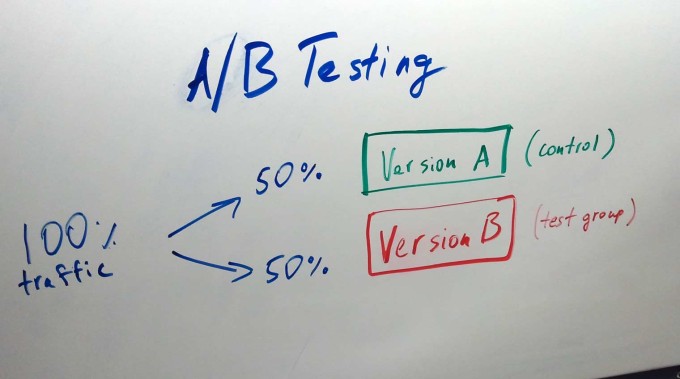
A/B testing is the act of running a simultaneous test between two or more variations of pieces of content/landing pages/etc. to see which converts the most leads. In our scenario:

Variation A: “The Control” – Your hiring manager’s job description.

Variation 2:The Treatment” – The job description you really want to run.

How A/B Testing Works

ab-testingYou have a candidate pool of 500 folks sitting in your marketing database (aka your ATS), you want to send an email blast to promote an open role at your organization. You send two emails—both with the same content (for now)—with a call to action and link to apply.

The first 250 candidates in your pool are redirected to Variation A to apply.

The second 250 candidates are redirected to Variation B to apply.

If you don’t have a robust talent community, let the variations run their course on aggregators, paid sources, your other outreach methods, etc.

Measuring Your Recruitment Marketing Success

After you’ve run your test cycle, log into your ATS and compare your pipelines. The variation with the greatest conversion rate (number of applicants) is your winner!

Boom. Instant marketer. And you didn’t have to sit through 4 levels of stats in college like this gal did to do it!

One of my favorite things about A/B testing is that it can be applied to almost any facet of your recruitment marketing strategy to determine the best route to move forward with a particular job or campaign.

  • InMails and pipelining scripts
  • Social media ads, posts, status updates
  • Banner advertisements
  • Video
  • Referral requests

The list can really go on…

However, it’s imperative to remember that candidate preferences evolve with market trends and therefore, you should leverage the A/B testing process on a recurring basis to gauge continued performance.

Dig into the slides from our presentation below for more great ways to think like a marketer!

Read more from the Glassdoor for Employers Blog.

3189a95About the Author: Holland Dombeck is currently an Employment Branding Specialist for Cox Enterprises, focused on developing a unified brand for the Cox Talent Acquisition function both internally with Cox employees and externally to future talent. She is also former Editor turned contributor at Fistful of Talent.
You can connect with Holland on Twitter at @Holland_Dombeck or connect with her on LinkedIn.


How To Train Your Hiring Manager

How To Train Your Hiring Manager

Let’s face it. As a recruiter, you’re out there on the front lines, rolling up your sleeves to source.  You have to screen and slate the top talent on the market. You’re able to do whatever it takes to find that always elusive purple squirrel.

Jobvite LogoToo bad you can’t get your hiring manager to even e-mail you back feedback. While they’re twiddling their thumbs, you’re losing money, time and ultimately, the candidate you worked so hard to fill those impossible requirements.

Although every recruiter has had a req (or hundred) derailed by those “hiring managers” who just don’t get it. They don’t know how to communicate with candidates, how to close the loop with recruiters, or how to conduct a meaningful interview without turning off a potential hire.

The good news? Bad hiring managers don’t have to be a necessary evil. Because you’ve just got to learn some tips and tricks for whipping those problem stakeholders into shape.

In this complimentary webinar, you’ll learn:

  • How Great Hiring Managers Interview and what you need to do to make sure that yours are ready to make the right hire.
  • Driving Faster Decision Making to help reduce the recruiting lifecycle. Get offers out faster and partner with your hiring team to cut days to fill and cost per hire.
  • Setting Expectations from intake meeting to developing a requisition-based SLA. We’ll look at some of the things you can start doing today to make hiring manager best practices a part of your process.

If you’ve ever dealt with a problem hiring manager (and what recruiter hasn’t), this is one webinar you won’t want to miss.


50 HR & Recruiting Stats Talent Acquisition Pros Need to Know

Talent acquisition is evolving – are you keeping up with the trends? Learn about the latest stats and industry standards.

50 HR & Recruiting Stats Talent Acquisition Pros Need to Know

Employer branding, employee engagement and social recruiting are impacting talent acquisition professionals’ ability to hire great talent.

GlassdoorBut sourcing the latest and greatest metrics in each category to make the business case for recruiting initiatives and strategies is a chore.  Wouldn’t it be great if you could streamline your efforts?  Let us make it easier.


So we’ve done it for you, curating our favorites from a variety of key sources, including Glassdoor surveys, for these and other important trends like mobile and Millennials.  Thanks for joining us.  In this webinar you will learn lots.  A good employee is hard to come by.  You have to make sure that you are sourcing in the correct talent pools.   How do we qualify our candidates if we don’t know anything about them?

For example, did you know that:

  • 64% of Millennials would rather make $40K a year at a job they love, than $100K a year at a job they think is boring?
  • 69% of job seekers would not take a job with a company that had a bad reputation, even if they were unemployed?
  • 95% of candidates say reviews from those “on the inside” are influential when deciding where to work?

Raising the Bar: Why Barriers to Entry Are A Big Deal for Recruiting.

sailor_says_there_be_a_shit_storm_brewingThere’s always been plenty of talking, tweeting, blogging, venting, ranting and raving about the sad state of recruiting – but lately, it seems like the topic of what’s wrong with talent acquisition has become an even more pervasive trending topic. It’s no secret that as recruiters, we rank somewhere near the bottom of the professional respect scale as an industry, somewhere between used car salesmen and telemarketers (although, cynics would say recruiters happen to be a bit of both).

The fact is, recruiting is a pretty easy target, primarily due to the misperception that this is an easy job that anyone with half a brain can do (and even that’s not always necessary) – probably because, well, anyone really can become a recruiter.

There’s no clear path to get here, and those of us in the business most likely ended up here by accident, considering that there’s really nothing required in the way of professional preparation.

You don’t need a certification, or even an education – just a willingness to learn on the fly, the ability to handle rejection, and, most importantly, those intangible skills for managing people and processes probably best referred to as “hustling.” And there are plenty of people knocking this particular hustle – even though the fact is, nothing hurts our reprehensible reputation and poor public perception more than the fact that there’s no real discipline behind this discipline, or at least not one can be consistently applied from one person or one place to another.

This means the requirements for a role tasked with the responsibility of improving professional lives and livelihoods are about as stringent as those prerequisites for scoring a gig whose primary duties involve folding sweaters at the mall. Which, no matter how you look at it, makes absolutely no sense whatsoever.

But the reality is there is an extremely low – or, in most cases, completely non-existent – barrier to entry in the field of recruiting. I’m not going to add to the growing canon of copy dedicated to this issue (like this one by Derek Zeller, or this one by Steve Levy) and illustrating the implications implicit to the complete lack of professional quality control inherent to this industry. So, instead of adding to the abundance of articles out there, I’m going to skip that stuff for now.

My intention (this time around, anyway) isn’t to point out all of the egregious behavior so seemingly endemic among those whose jobs are even tangentially related to recruiting. You know all about recruiters behaving badly – and likely, have had the misfortune of working with one. Instead, I want to talk about how all this translates to the bigger business – and bottom line.

Waiving the Standards

downloadInstead of standing on my soapbox and decrying the lack of professional preparation recruiting really requires, I want to talk about an interrelated, but alternative, barrier to entry, one that holds all of us to the standard that most of us agree we should be abiding by – and one that, if upheld uniformly and consistency, would help alleviate many of the extraneous employment related challenges created by crappy recruiting:

1. Ignorance Isn’t Bliss: Most recruiters have no idea about what the position they recruit for actually does or what the role really entails. This means that many talent practitioners are likely unable to identify what the hiring manager (or business) actually need, nor can they effectively or credibly message or market the position to their target candidates.

2. Our Greatest Weakness: The days of formal training or certification programs in core competencies like behavioral based interviewing or assessments are pretty much a thing of the past. Without having any actual interviewing or screening skills, recruiters often don’t know what to ask, or don’t have enough information or insight on the person or position to actually analyze and interpret responses to decipher what really matters and why.

3. Common Courtesy: Recruiters suck at following through or paying attention to details, like, you know, letting candidates know if they’re no longer being considered for a position or giving even the most minimal modicum of feedback as rationale for why, exactly, they’re not moving on in the process. Most recruiters talk about following up with candidates as some sort of utopian ideal that’s a pipe dream – but none of us should ever be too busy to handle this most essential of responsibilities.

4. Common Sense: Recruiting and common sense are often mutually exclusive concepts – and so much of what we do is based on intuition that actually applying a method to the madness seems, well, counterintuitive. This lack of common sense, however, means recruiters aren’t capable – or in some cases, willing – to effectively partner with hiring managers, push back on unrealistic expectations or improve an obviously odious candidate experience.

5. No Brain for Business: Let’s face it – our eclectic and diverse backgrounds means that while we may have a wide set of experience and expertise, most of us enter recruiting with limited business experience, and consequently, lack basic business-savvy. The lack of business acumen means many recruiters have no ability to proactively identify issues or opportunities, measure results or understand the bottom line impact – and business consequences – that their roles directly entail.

How This Hurts the Hiring Process

1349717645864_6811928Simple. The five factors above, in any combination, lead to wasted time, money and opportunity. Period. The impact of this can sometimes appear immediately, but sometimes, the real repercussions are a little less tangible and take quite a bit more time to manifest.

But ultimately, the low barrier to entry for recruiting means an unnecessarily high barrier to entry for qualified applicants and candidates when they have to navigate the many obstacles created by crappy recruiters. Which means that we’re failing at the most fundamental part of our jobs.

When a high performer or highly skilled candidate starts searching for a new job, he or she has a (reasonable) expectation that the people responsible for screening and selecting them to have some degree of ability or expertise which qualifies them to be the primary arbiters of the hiring process.

That’s why writing a realistic and compelling job description is so important – a bunch of buzzwords and boilerplates means that they won’t bother applying – and if your jobs ads are incoherent or idiotic (as so many are), then stop bitching about how you can’t get any qualified applicants.

If that high performer actually somehow manages to make it through to interviewing for the position, then, similarly, they should also expect that the person on the other side of the desk “gets it” and can actually ask relevant questions and meaningfully interpret or gain insights during the interview process.

Asking asinine or generalized questions (“If you were a car, what kind of car would you be and why?”) is not only an immediate turn off and time waster for anyone with any actual “talent.” It’s also insulting to them – and harmful for your bigger business and brand, particularly if their first encounter with your company is with some mouth breather asking specious stuff like their greatest weakness.

Looking for work is almost as much work as the job most candidates are seeking, and the intensive amount of time required to apply and interview for new opportunities is a huge investment that’s pretty painful. Being a job seeker is no fun whatsoever, not in any way, shape or form.

No one in the history of ever enjoys running the recruiting gauntlet, but in the case of those high performers who you need worse than they need you, a blatant disregard for the basic stuff like regular communication, respectful interactions and timely feedback demonstrates the hubris that they’re not really important to your company – and if they’re that proverbial purple squirrel, that perception means you’re probably screwed. You’re not going to be making great hires, just bad impressions.

Along those lines, high performers know their value, are aware of the market demand, and don’t have the time for your crap. Unrealistic expectations and overly complex hiring processes are hoops that no one worth hiring will be willing to jump through – they’ll just move onto opportunities at your competitor whose process is less cumbersome.

While a recruiter or an employer reliant on any recruiter’s services somehow get that these problems are pervasive, for some reason, they almost never recognize that they’re part of the problem, and these flaws are flaws that exist in their own talent organizations. Ignorance, in this case, isn’t bliss – it’s a huge liability.

What’s the Big Deal?

090914_Signals_promoThe big deal is that recruiting’s lousy reputation is being justified by your colleagues, counterparts and coworkers, who repeatedly earn the piss poor professional perception that plagues the entire industry. It’s their actions, their laziness, their hubris that’s causing the problem, day in and day out.

The talent those “recruiters” purport to trying to attract are, in fact, repelled by this abhorrent behavior. High performers or highly skilled professionals, unlike recruiters, will always be in demand.

Once recruiters realize that these candidates are really the ones in control, and arrogance is replaced by an understanding that employers aren’t the ones driving this market, then they’ll realize there’s no reason for anyone to tolerate the unnecessary barriers so many of us build into our processes and best practices – nor is there any incentive for continuing to behave badly.

So, What’s the Solution?

Problem_Solving3The most obvious, and most widely suggested, seems to hold that some sort of licensing or certification would solve this dilemma. Others recommend additional, formalized training or professional development program to proactively address the skill shortages pervasive to the recruiting industry, like those I’ve already outlined.

And then there are the fatalists, the ones who think that bad recruiters will just disappear on their own, dropping out of the business without any need for intervention.

Even worse, there are those recruiters who think that they’re so good that bad recruiters do THEM a favor by making them look great by comparison – no need to do anything when the competition seems to be self-sabotaging, right? Wrong.

I’m not convinced that any official credentials or standard, consistent training will entirely eradicate the worst offenders from the recruiter ranks.

Selling a job is way easier than selling Amway or Avon, and way more lucrative – and with limited options for doing anything else, they’re likely in it for the long haul And, I certainly think that the idea that bad recruiters make good recruiters look better is anything but complete bullshit.

So what I’m saying is: I don’t know if there’s any single silver bullet or quick fix for this problem, but I do know it’s a problem worth fixing. Even if you’re not a recruiter yourself, you’re going to have to interact with one at some point in your career, and when you do, trust me – you’re going to wish that someone had stuck up some sort of barrier for entry, because you don’t want to place your career in the hands of someone who doesn’t know what the hell they’re doing.

How would you rebrand recruiting to make it a reputable profession occupied with reputable recruiters?

talenttalks

About the Author: Leveraging her unique perspective as a progressive thinker with a well-rounded background from diverse corporate settings, Kelly Blokdijk advises members of the business community on targeted human resource, recruiting and organization development initiatives to enhance talent management, talent acquisition, corporate communications and employee engagement programs.

Kelly is an active HR and recruiting industry blogger and regular contributor on RecruitingBlogs.com. She also candidly shares opinions, observations and ideas as a member of RecruitingBlogs’ Editorial Advisory Board.

Follow Kelly on Twitter @TalentTalks or connect with her on LinkedIn.

Searching Patterns and Understanding Your Sourcing Strategy

Searching patterns and understanding your sourcing strategy is an essential part of any search you are undertaking. Boolean Operators, Boolean Search, Ninja style back flip search, however you want to slice it, it’s still a trending topic across many recruiting circles. Be this as it may, most recruiters are simply lacking in their ability to perform the most basic of basic searches.

Does this sound familiar? Over the past couple of weeks we’ve been sharing a lot of information and guides to help recruiters understand the basics of Boolean Search.

This has sparked some debate on the social channels so we thought it would be best to address a few best practices that have been debated as share a couple of examples of how you might use these best practices in a real life search.

We’ll cover:

  1. 3 best practices to consider as you embark on your search
  2. 3 key pattern searches I use to track the untracked

Here are 3 debated best practices that I think you can benefit from:

Best Practice # 1

Hiring mangers are not really hiring experts. At most, a typical “hiring manager” will hire 2-3 times per year with 1 of those hires being a replacement for a previous hire in the year.

What does this mean?Grunge Stempel rot quad BEST PRACTICE

  • That hiring managers are not hiring experts
  • That hiring managers often give you unimportant information to source on
  • That hiring managers deep down inside…may believe that they are an expert but in reality, they are just like you. They are not super human with all knowing powers.

It’s your job as a recruiter to systematically lead your hiring manger through your requisition review. This means, that you absolutely 100% must have a goal in order to have a successful call that will be beneficial to both parties.

3 questions to consider:

  1. What is your goal during this call?   —>  To get to a next step
  2. What is the next step that you are trying to get to on this call?  —>  To understand the why (this is skill is important) as opposed to the what skills are needed. This helps to translate your search.
  3. What is meant by we need to understand the why?  —>  Why it is important that the candidate has what (the skill set) the HM is asking for

Best Practice # 2

Scenario: You are having a conversation with the hiring manager and you ask the HM to tell you what the top 5 skill sets are that they absolutely must see on this individuals resume in order to be considered.

  • The hiring manager responds (as he/she reads the job description)…. I need someone with a background in a, b, c and that has d, e and f.
  • The recruiter responds… that’s great so you really need someone that is a top performer…. (Really?)

Tip:

Tell (ask) your hiring manger to give you 5 interview questions that they will be asking the candidate as the go through the interview process.

Best Practice # 3

Recognize candidate patterns

A candidate pattern is very simple to understand.  It’s the sentences, the words, the skills, the details they share over and over and over and over again…

When you speak with a candidate keep track of common words, phrases, comments and expressions (especially when you are having a technical conversation). These are the candidate patterns that you will use in your searches.

  • I have experience with…
  • My background is in…
  • I have worked for…
  • I have managed…. I oversaw…  I achieved…

How does this translate into a real search?

This-is-How-We-doUnderstanding candidate patterns are important but if you cannot translate this information into a real search, you are still left with nothing. Here are a few key patterns to consider when building your search.


There are 3 main channels for candidate patterns I like to look for:

[tab]
[tab_item title=”Responsibilities”]Responsibility pattern’s are words and phrases that are used on resumes or in conversations with candidates that describe what they are perceiving as their oversight within work.

Commons word patterns:

  • Lead
  • Oversaw
  • Managed
  • Project Managed
  • Team Lead
  • Responsible for
  • I was
  • I lead
  • I directed

Here are a few examples of how you may find or read these phrases on actual resumes. Searching these phrases will help to narrow the field to you target hire.

Example resume snippets for responsibilities:

  • I’ve lead 15 engineers
  • I have the responsibility to oversee
  • I direct a group of
  • In my last role, I was responsible for
  • It was my job to

[/tab_item]
[tab_item title=”Accomplishments”]There are many patterns or phrases that can describe someone’s accomplishments. These are words / phrases that candidates use to brag about themselves on their resumes. Leveraging these accomplishments in your search will allow you to search outside the skill set box often landing you leads that are less bombarded by recruiters.

Common Phrases Used To Describe Accomplishments

  • Awarded
  • Achieved
  • Presidents Club
  • Exceeded
  • Quota Buster
  • Appointed
  • I was honored with
  • My work was noted
  • I’ve been featured

Here are a few examples of how you may find or read these phrases on actual resumes. Searching these phrases will help to narrow the field to you target hire.

Example resume snippets for accomplishments:

  • I was (am) an overachiever
  • I am a quota buster
  • Because of this I was awarded
  • I was honored with
  • My work as featured in (on, as, for etc.)
  • I was appointed

[/tab_item]

[tab_item title=”I Have an Interest”] If you are searching for specific needs within your job scope, you need to think about what your target candidate have in common with your search? This means that you should consider searching phrases that incorporate the phrase “I have”.

Common Terms Used to Describe Someones Interest

  • Technology
  • Skill Sets
  • Projects
  • Magazines
  • Blogs
  • Education
  • Journals
  • Online Groups
  • Online News Forums
  • Conferences
  • Workshops
  • Symposiums
  • Webinars
  • Training and certifications

Here are a few examples of how you may find or read these phrases on actual resumes. Searching these phrases will help to narrow the field to you target hire.

  • I am interest in xyz technology
  • I am interested in learning more about xyz skill sets
  • I have an interest in working on xyz projects
  • I read blogs relating to xyz
  • My educational background is in xyz (usually their interest)
  • I participate in online……forums, groups, chats etc.

Standard Phrases:

  • I am interested in java development and GWT
  • I have a strong interest in pursuing a career in application development
  • My expertise falls within …..

[/tab_item]
[/tab]


Here is an example of how an “accomplishment” search might look like when used on Google:

(intitle:resume | inurl:resume) (“I was awarded” | “I have exceeded” | “I was appointed” | “I oversaw”) -~job -sample -free -example -services -~submit

In this example you can see that we are not searching any specific skill set (we’ve added that into the second example). This example will show you how the lead will use these phrases freely on their resume. They are using these phrases to brag about themselves, so think with an ego and you will have a much easier time identifying leads.

Boolean 1

Here is this same example adding in the job title “Software Engineer”

(intitle:resume | inurl:resume) “software Engineer” (“I was awarded” | “I have exceeded” | “I was appointed” | “I oversaw”) -~job -sample -free -example -services -~submit

Boolean_Search_Example_2

Conclusion

Remember it’s not how fancy or how long and exhaustive your search can be, it’s about the technique that you are using to identify leads that have not been hoarded by the masses. These techniques are certainly not new, but I am not so sure many recruiters are taking the time to search outside of the exhaustive list of standard keyword searches.

From ATS to Hiring Success: Why Applicant Tracking Systems Don’t Have to Suck.

“In ’99, the homeys goin’ drop to the number 1, wid ya gun, so run, run, run run.”

Bone Thugs & Harmony, East 1999

Bone_Thugs-n-Harmony_-_East_1999It’s hard to believe, but online recruiting was relatively nascent back in 1999, that seminal year when Y2K, stained blue dresses and Slim Shady were dominating the popular culture landscape – and applying for a job was pretty much just the fax, ma’am.

That is, if you didn’t have to print off a ton of resumes and send them through the actual mail, the last time cover letters were actually relevant. By the last year of the last century of the millennium, the fundamentals of recruiting hadn’t really changed in the centuries since the first help-wanted broadsheets appeared in the late 1700s.

Apparently, even in pre-Industrial Revolution England, finding skilled labor and high volume, low skill domestic workers required investing in recruitment advertising. And at no time was that more true than during the days before the dot-com boom went bust and our bubbles hadn’t yet been burst.

We were changing the way the world communicated and connected, but when it came to job search, newspaper classifieds were pretty much your only option if you decided that, just maybe, the gig at Pets.com or Lycos looked increasingly like it might have a limited shelf life, at best.

The internet was still in its infancy, but even in its initial consumer explosion, recruiting remained well behind the times, clinging to outdated technologies and anachronistic processes, a pattern that continues to this day.

But for recruiting, 1999 was something of a watershed year, giving rise to the entire industry of online talent acquisition and management (or “the cloud,” if you want to bring the buzz-words) that’s one of the fastest growing and most lucrative corners of the technology space today.

See, during that year’s “Big Game” (which was so long ago John Elway was actually under center), a relatively obscure start-up called “The Monster Board,” decided to bet the bank on a series of Super Bowl ads.

The price tag: a cool $4 million, which sounds like a bargain by today’s standards, but at the time represented fully 10% of Monster’s total net worth of $40 million at the time, which represented most of the online recruiting industry at the time (it’s now estimated to be around $90 billion annually in North America alone).

The campaign, “When I Grow Up,” featured vignettes of kids talking in very adult terms about the mundane realities and everyday disappointments of the kinds of careers you actually end up in when childhood dreams give way to grown up realities.

And those realities, as we all know, kind of suck, which is why the message stuck. In the day after the ads ran, Monster’s traffic spiked between 30-50%, numbers that continued to grow for over a decade.

The recruiting technology gold rush was on, and while job boards were the public face of the revolution, the shift from paper-based, manual processes to digital, automated applications created the need for specialized systems to help employers deal with the process and compliance demands created by the increasing onslaught of internet applications.

Enter: the applicant tracking system, better known as the ATS. These were great in theory, designed to help automate applications and, as the name would suggest, help employers track applicants.

That’s what they were designed to do, and for the most part, they served as serviceable systems of record. The problem is, that while recruiting has fundamentally changed in the intervening 15 years or so since these legacy systems first hit the scene, these systems remain stuck in absolute stasis.

But like the Monster commercial that gave rise to these recruiting monstrosities, applicant tracking systems really beg the question:

“What Do You Want to Be When You Grow Up?”

The answer has profound implications for recruiters and candidates alike.

Building the Frankensuite: The Problem With Point Solutions

Wasting-Time-ButtonAs stated before, the problem with applicant tracking systems is that they were designed as system of record, which was the entire raison d’etre driving their development. Which, in the days when Taleo and Brassring were considered cutting edge, meant that these more or less delivered as promised. But those promises have long since been broken, at least where the end user is involved.

Talking about how much recruiting has changed has become a cliché, but the ubiquity of that conversation evidences just how little the systems where we spend most of our time – and invest most of our money – have fallen so far behind the needs of employers and the top talent they’re looking to attract.

Today’s recruiter doesn’t simply need to reactively track candidates after they apply – they have to proactively attract top talent, with applications being more of an afterthought than a departure point for most hiring processes today.

This requires something with a little more robust functionality than, say, a payroll solution or a time & attendance system. It requires a system of engagement, but the ability to engage across multiple channels and touch points, to develop actionable analytics and align recruiting with the bigger business picture – and bottom line – falls well past the outer limits of most legacy systems.

Of course, companies have made a significant investment in their ATS, and feel like migrating to a better solution would be some kind of implicit admission of failure (not to mention having to go through another pain in the ass implementation), so recruiters continue to suffer with systems that royally suck.

Rather than start from scratch, employers are increasingly purchasing a plethora of point solutions designed to overcome the limitations of obsolete, outdated ATS systems.

These tend to be highly specialized, highly siloed software solutions that require recruiters to use a dozen different credentials to sign on to these disparate systems, managing divergent data streams and often, manually migrating information like candidate records and contact history.

This means busy recruiters do busy work instead of meaningful work like building meaningful relationships and talent pipelines, generating referrals and facilitating internal mobility and, perhaps most importantly of all, improving the ease of application and personalized, timely communications so essential to improving the candidate experience.

Starting From Scratch: From ATS To Hiring Success

file-2494930627It seems like half your life is spent cutting and pasting stuff from one system to another – which really, really sucks. But if you think there’s nothing you can do, think again. No recruiter should be stuck with a crappy ATS.

If you’ve ever talked to any “cloud” vendor (which is a fancy way of saying that they don’t store your data onsite and access is network agnostic), then you probably know that rolling out new features, functionalities or even implementing new systems is easier and cheaper than ever before.

In fact, for true multi-tenant, single instance software solutions, turning on tech often requires little more than a few mouse clicks. There’s no timely, expensive implementation process involving process mapping, data migration and teams of consultants for even the simplest customer requests.

This not only drives down costs, but also removes many of the most compelling arguments for sticking with a shitty system and shittier customer service so endemic to enterprise software – not to mention the pain in the ass of having to deal with a hundred different point solutions on a hundred different tabs requiring a hundred unique log-in credentials, contracts and customer service contacts.

If you think this sound too good to be true, think again. If you’re shopping for a system designed for recruiting today (and if you’re on anything owned by SAP, Oracle or IBM, you should be), here’s a Yellow Brick roadmap for finally finding an applicant tracking system you don’t have to hate. For real.

The Future of ATS: One System to Rule Them All.

From functionalities like LinkedIn integration and sourcing/CRM capabilities, from employee referrals to reporting,, the product roadmap today’s recruiters would want if they were building the system of tomorrow looks a lot like solutions already out there today – with products like SmartRecruiters actually transforming recruiting fantasy into reality.

12c9a428b393255b8183ffd4a3d8e0b0b2274f9cdfb6064036e2bceb44f14fbf (1)1. Gotta Keep ‘Em Integrated: 92% of enterprise employers have LinkedIn Recruiter licenses, and even for those who can’t shell out these kinds of boucoup bucks for some of the priciest seats this side of the Super Bowl, over 95% report using this platform as a primary tool for sourcing and engaging candidates.

The problem is, making the investment in a LinkedIn license pay off (or even just keeping track of profiles you’ve viewed or conversations you’ve had) can be nearly impossible. Not to mention the fact that none of that data lives within your actual system, meaning that you’re more or less losing out on any activity or associated records that might occur before that passive lead becomes an active applicant.

The system of the future would transform LinkedIn from a stand-alone network into what it really is: an integrated, integral component throughout the full recruiting cycle, turning public information into proprietary leads, more effectively tracking data, building better referrals and optimizing on-site spend – and overall efficiency & efficacy.

ddb72338452178be6c40fe0314f30232b45344c41832ea5888b71fce4c6fe5602. Sourcing Without Seizures: Yeah, we know. You’re probably tired about hearing how recruitment is marketing, but it’s largely true: recruiting is more or less consumer marketing built around a career related call to action. 

Sourcing has traditionally involved lead generation – finding targeted candidates and building a database – but traditional applicant tracking systems have no way to automate, scale or segment communications and nurture those leads so that they ultimately convert into hires.

Instead, they often sit untouched in an applicant tracking system, long forgotten candidates tied to a long forgotten requisition. But don’t forget – your ATS doesn’t have to be a black hole.

By adding CRM capabilities, you can help breathe new life (and make new hires) out of old applicants. Because unlike just-in-time hiring, a candidate might be right for your company – even if they’re not right now. The ATS of the future makes it just-in-time, all the time.

asset_company_workplace_ecard_someecards3. Refer Madness: As the old aphorism says, people don’t work for companies – they work for people. Which is kind of trite, until you consider the fact that employee referrals have represented the top source of external hires for well over a decade, and by a wide margin across industries, functions and company sizes. 

Referrals work – but too often, companies have no way to efficiently incentivize, track or even keep employees in the know about what opportunities are open and how employees can help put their network to work.

By integrating referral capabilities and applicant management directly into the ATS of the future, companies can stop worrying about building brand ambassadors and start building bench strength – without constantly asking who your coworkers and colleagues know. After all, it’s not what you know or even who you know – it’s about who knows the people you know.

basic-math4. Doing the Math: Relying on a ton of point solutions, each with differing data sets, disjointed tracking and diffuse dash boarding, makes it impossible to find actionable analytics and make metrics meaningful.

To get the full story, data and reporting must cover the full cycle, from sourcing to selection to onboarding – and provide the information you need to control your budget, optimize your strategy and standardize the statistics that help recruiters make smarter hires faster.

That’s why the ATS of the future will give talent practitioners all the information they need, all in one place – and automate data aggregate to enable better analysis – and better align the impact of recruiting on bigger business and bottom line initiatives. That’s one formula that makes for pretty obvious math.

If you hate your ATS, you’re not alone. But the good news is, the future of is now. To learn more about how to get with the system, click here to check out SmartRecruiters and see why companies are choosing hiring success over applicant tracking. Because turns out, the choice is a no brainer.

Disclaimer: Recruiting Daily was compensated by SmartRecruiters for this post. But their data and action items are actually pretty priceless, so in this case, the facts and opinions contained herein do, in fact, represent those of the publisher. Because we’re all about making applicant tracking systems suck less, too.

Hiring Tools Are Evolving: What Is The New ATS?

What is an ATS? Really Chris, what’s an ATS? Of course we all know that an ATS is an Applicant Tracking System, but what we often fail to realize is that the evolution of the ATS has changed the game in the HR Tech space.

Today’s ATS is more than an application processing machine. They’ve been redesigned to handle your process, your marketing, your automation, hell some systems may even cook you some pot pie (chicken) like our friendly space age Jetsonshero’s the Jetsons.

HR Tech has evolved. Gone are the days of basic necessity and employers are demanding more. Automation is no longer the shiny new tool, social applies… so 2008. Today’s ATS market is about job distribution, true CRM capabilities that allow your team to become instant marketers (well sort of), assessment capabilities and prediction based filtering resulting in a higher quality candidate.

The game has changed; employers are demanding more form their technology and vendors have accepted the challenge.

I have recently spoken with Mitch Solway, VP of Marketing from ClearFit, based in Toronto about this evolution. He says, “As far as the ATS has come, it’s still primarily serving the HR Manager as a process tool.  Hiring managers have very different hiring behaviors and needs. They want less software, not more.  For perspective, most hirers have no idea what an ATS is.  Looking ahead, there’s a real need for software that is easy to use, designed for the hiring manager and delivers faster, better hiring decisions.”

 Here are 2 strong solutions to look at:

ClearFit

ClearFit combines ‘ATS like’ features with job distribution and personality indicators.  When a user applies for a job the system they are led through a survey process that serves as an assessment tool. They’ve patented the technology behind the “job success” predictions tool and based on their case studies it’s 5 times better at predicting job success than traditional hiring.

The end game here is that a tools like this (and there are others) allows your team to post your job to the masses, filter the lead as it comes into your ATS with an assessment and have an accurate prediction on potential job success.

[youtube url=”https://www.youtube.com/watch?v=O8NTJuBujcQ” width=”500″ height=”300″]

Survey Image

[quote]ClearFit Survey: Applicant fills in 5 pages of these survey questions before they can submit their resume in order to qualify them for fit inside your organization.[/quote]

Looking at tools like ZipRecruiter, which have taken job distribution to a new level, you’ll see the advancement in features that have all but piqued the interest of buyers holding them captive to the tool. We’ve seen advancements with metrics and reporting, predictive analysis, tools that allow recruiters to converse with candidate, even rating systems that allow recruiters to match talent from their external social networks. Vendors have taken charge and have invested in expanding their infrastructure to support their market.

Heck even job boards like Indeed are playing the game. You can post a job on Indeed and they organize and store all the candidate data, you can even email and send a rejection message. One day I predict Indeed will even buy another ATS (or build their own) to offer a more comprehensive hiring suite.

Expect companies like LinkedIn to do the same.

RecruitersMap

RecruitersMap is another new startup that is trying to redefine the value of an ATS. The system itself is free for recruiters and comes with an amazing amount technology including job board distribution to more than 30 boards, mobile friendly career page, applicant tracking and unlimited resume search.

Note: This is a shared resume ecosystem. This means that you can benefit from viewing resumes that have entered the system from other recruiters. It’s an interesting play and I am sure one that will be debated.

It’s interesting to see where this new evolution of hiring tools is headed. I for one am excited to watch.

You can see the full list of features here.

Recruiters_map


chris


Chris Russell is the founder of Career Cloud. CareerCloud is a social recruiting start-up whose mission is to connect job seekers with employers through social and mobile technology. Launched in January 2013 with a Social Resume system that aggregates your online social media accounts into one page.

Learn more about Job Master

Talent Hacks from The Second City: 5 Lessons In Attracting, Onboarding and Developing Top Talent From The World’s Biggest Improv Theater

Talent Hacks from The Second City

Second City has been attracting & developing top talent in our field for over 55 years.  Most noteworthy Tina Fey, Bill Murray and Steven Colbert, we clearly have an eye for talent. And along the way, our exceptionally talented performers have taught us how to use the philosophy of improvisation to impact the organizations with which we work. Since we are recruiters after all.  While so many of us rely on the same old scripts, some use improv.

Improvisation creates a powerful connection with the audience, involving them moment to moment so that they feel part of something larger than themselves: After two full acts of a show, we ask our audience “Do you want to stay for more improvisation?” and they scream “YES!” At 10pm. On a Tuesday night.

The same methods that we use to cast, develop and deliver our comedy can elevate the way you attract, onboard and develop your talent. Making your company stand out from everybody else on this Webinar. Making a candidate feel as though they are part of something larger than themselves.  Empowering them for success in the organization. At 10AM. On a Tuesday morning.

Join us for our webinar.

Email Address Lookup: Validate Any Email Address For Free

Shared by Dean Da Costa

Why is validating an email address so gosh darn confusing? Email address lookup tools are plentiful to help you with this process, but most of them have fees and when you are recruiting on your own, run your own firm or you simply have a budget tight leadership team $30 / month can be a stretch.

I often wonder is my time (or a recruiters time) more valuable to the company speaking to qualified leads or chasing down an email with hacks that take time….. Either way when you couple the power of Vibe and Gmail you have a easy to follow 4 step email validation process.

Using Vibe For Email Address Lookup:

  1. Download Vibe and download this excel spread sheet to power your validation process
  2. Identify the username of the person you are searching on one of the social networks
  3. Open Gmail, click compose and paste the generated email address from the excel sheet in to the “To” line of your new email
  4. Hover the emails with your cursor and wait for Vibe to identify a verified email address for you

Email Address Finder Tutorial

[youtube url=”https://www.youtube.com/watch?v=G9zjDqt3W18&feature=youtu.be” width=”500″ height=”300″]


dean_dacostaAbout the Author: Dean Da Costa is a highly experienced and decorated recruiter, sourcer and manager with deep skills and experience in HR, project management, training & process improvement.

Dean is best known for his work in the highly specialized secured clearance and mobile arenas, where he has been a top performing recruiter and sourcer.  Dean’s keen insight and creation of innovative tools and processes for enhancing and changing staffing has established Dean as one of the top authorities in sourcing and recruiting.

Connect with Dean at LinkedIn or follow @DeanDaCosta on Twitter.