

Blog

Dark Patterns and Data Privacy: Inside the LinkedIn Spam Machine.

In December of 2013, I closed my LinkedIn account. As I retold in an emotional post Facebook post, I had discovered that I had been sending those annoying “Dan Schlosser has invited you to join LinkedIn” emails to my friends. Confused, I spent several hours digging around in LinkedIn settings and menus to figure out why.
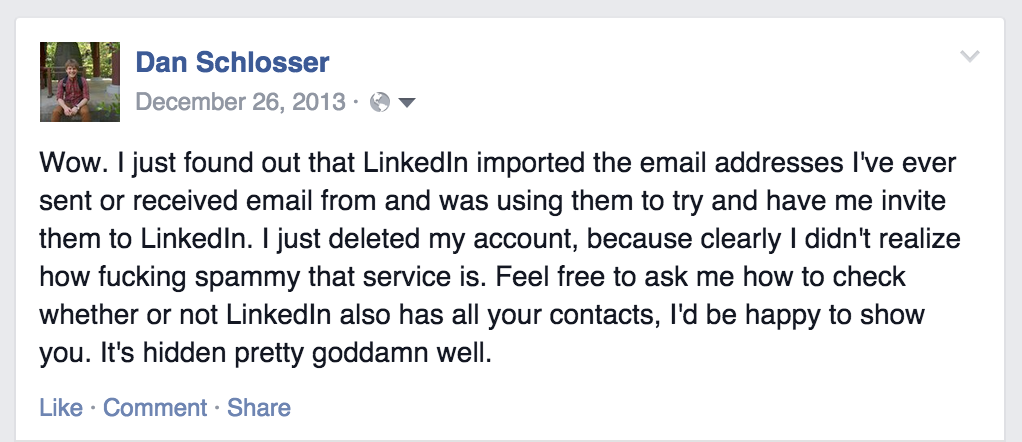
My emotional Facebook post. (Pardon the language.)

It turned out that when I made my account years earlier, LinkedIn had tricked me into importing my address book. If they had used the contents of my address book just to suggest contacts on LinkedIn, I might not have minded, but they went further.

On the “People You May Know” page, LinkedIn had inserted a few buttons to invite email addresses from my address book to LinkedIn, and made those buttons look a lot like people already on LinkedIn that I could connect to.

The difference between these two kinds of buttons was negligible, and as a result I had been sending spammy emails when I thought I had been sending connection requests. This feature has since been refactored (why I felt comfortable joining the service again recently) and these two buttons do not show up next to each other anymore.

Instead, they make it one-click to invite every one of your contacts unknown to LinkedIn to the service.
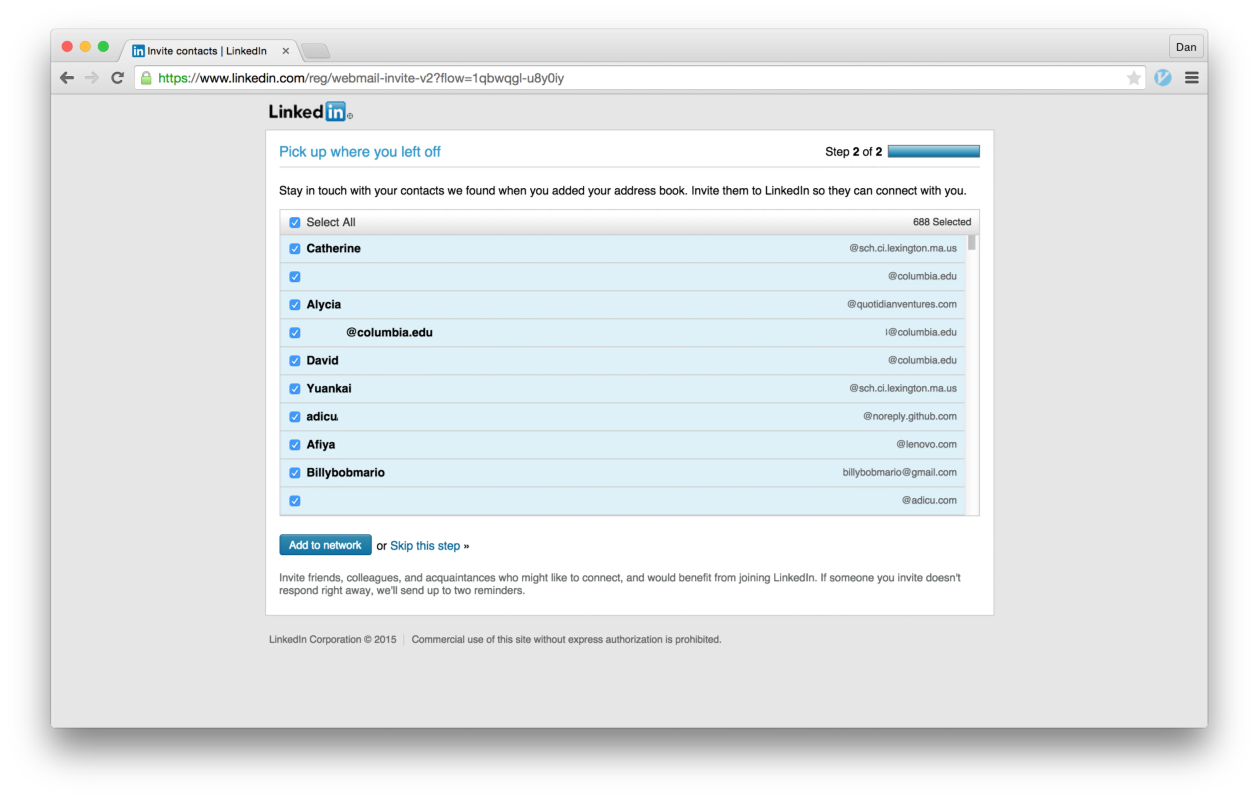
When they say “Add to Network,” they really mean “Send 688 emails.”

It also shows up in the contacts manager, where it only takes one click to both connect with every person in your contacts who is on LinkedIn, and to send a “Join LinkedIn” email to every person in your contacts who isn’t.
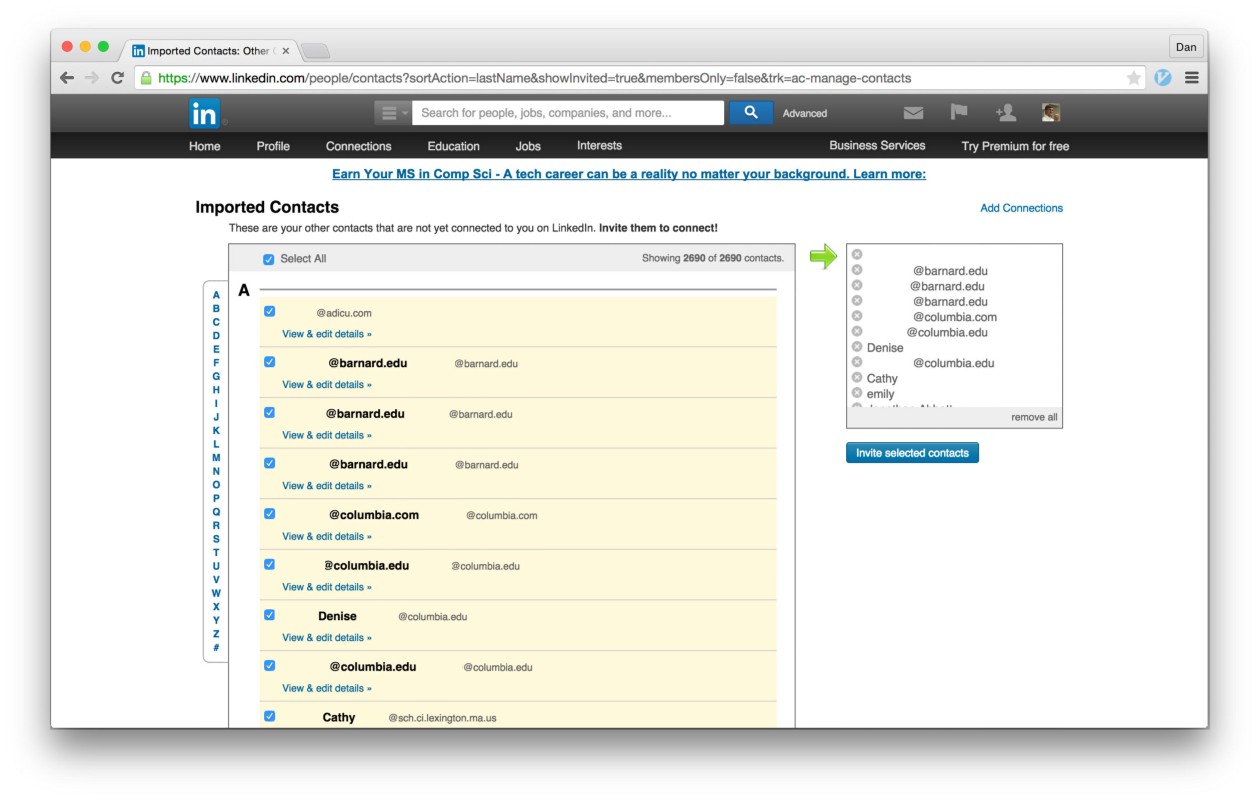
“Invite selected Contacts” will send 2690 emails: some inviting to connect, others inviting to join LinkedIn.

This system, setup to trick me into inviting people in my contacts to LinkedIn, is called a dark pattern. In UX design, a dark pattern is design that works against users. It might trick them into doing the wrong thing, or just confuse them to the point where they can’t figure out how to do something that the designers don’t want them to do. This could be making it hard to delete a user account, or in LinkedIn’s case, making it really hard to use the service without importing your entire address book.

Worst Practices: What’s Really Behind All That LinkedIn Spam.

In order to bring LinkedIn’s spammy practices to light, I’ve walked through all the steps needed in order to sign up for and use LinkedIn without importing your address book. Check it out, it’s near impossible.

Along the way, I’ll take a look at how LinkedIn uses design to trick its users.

Account Creation.

For most people, this is where they get you. The big offense throughout this whole process is conflating OAuth with address book importing. Take a look…

The Landing Page.
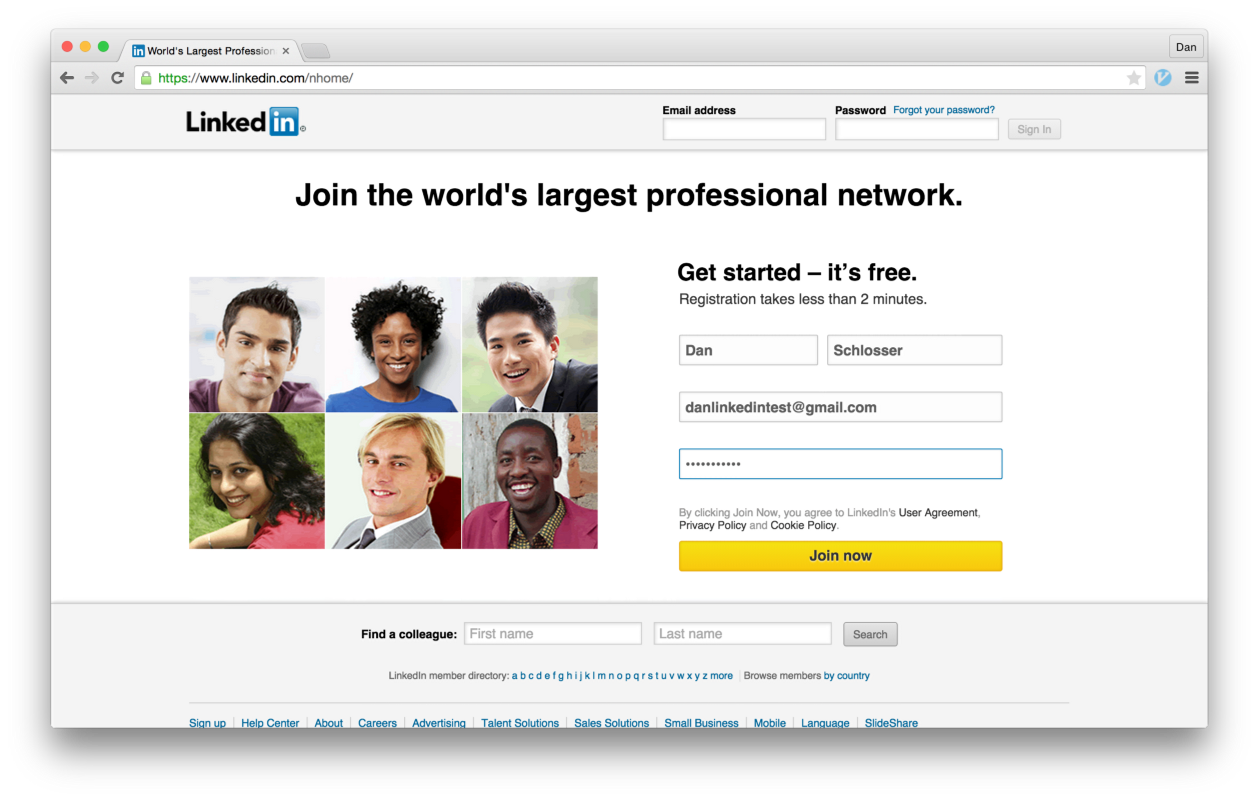
This page is pretty simple. There aren’t any dark patterns at play here, unless you count the User Agreement, Privacy Policy, and Cookie Policy that joining the service entails. This page is clean.

Basic Profile Info.
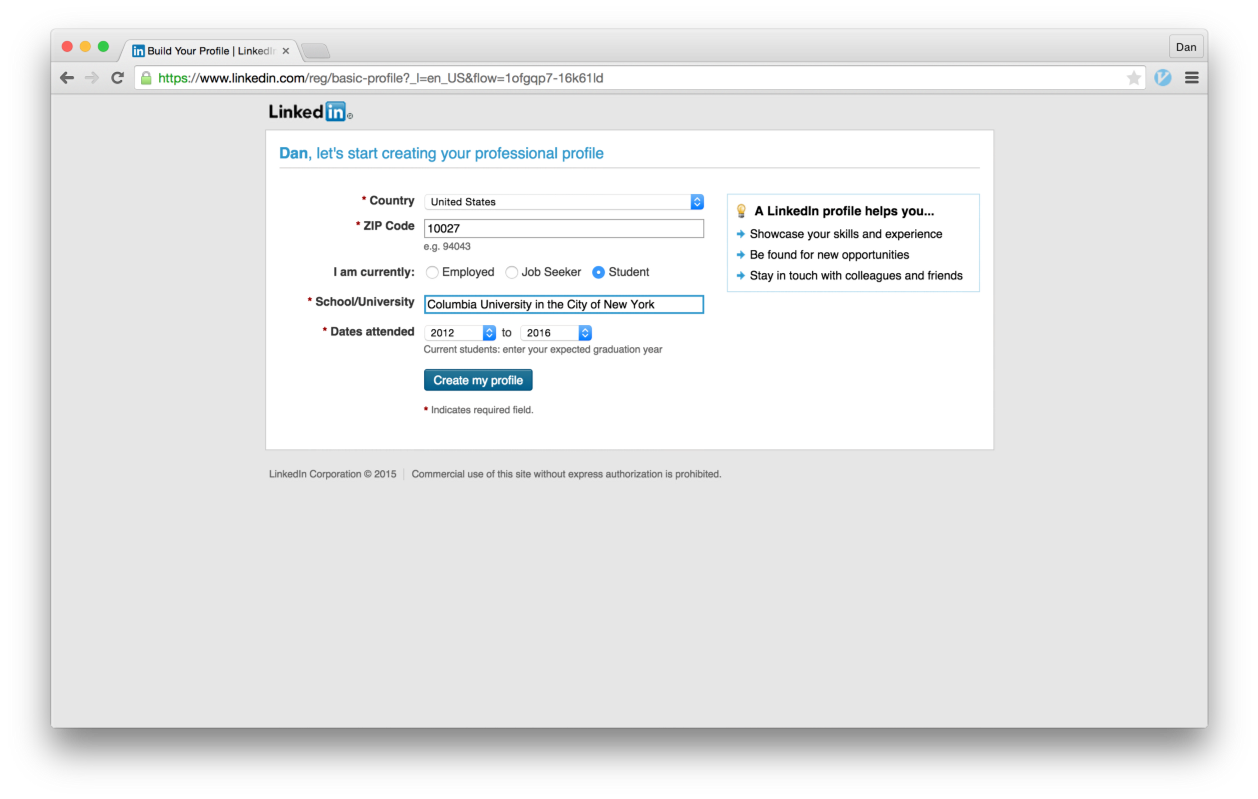
This page is also clean. LinkedIn uses this info to connect you with other people that work at your company, or went to your school, and that’s to be expected. They give a nice explainer in the box on the right side.

Simple and straightforward, right? Yeah, right.

LinkedIn Data: The First Dark Pattern

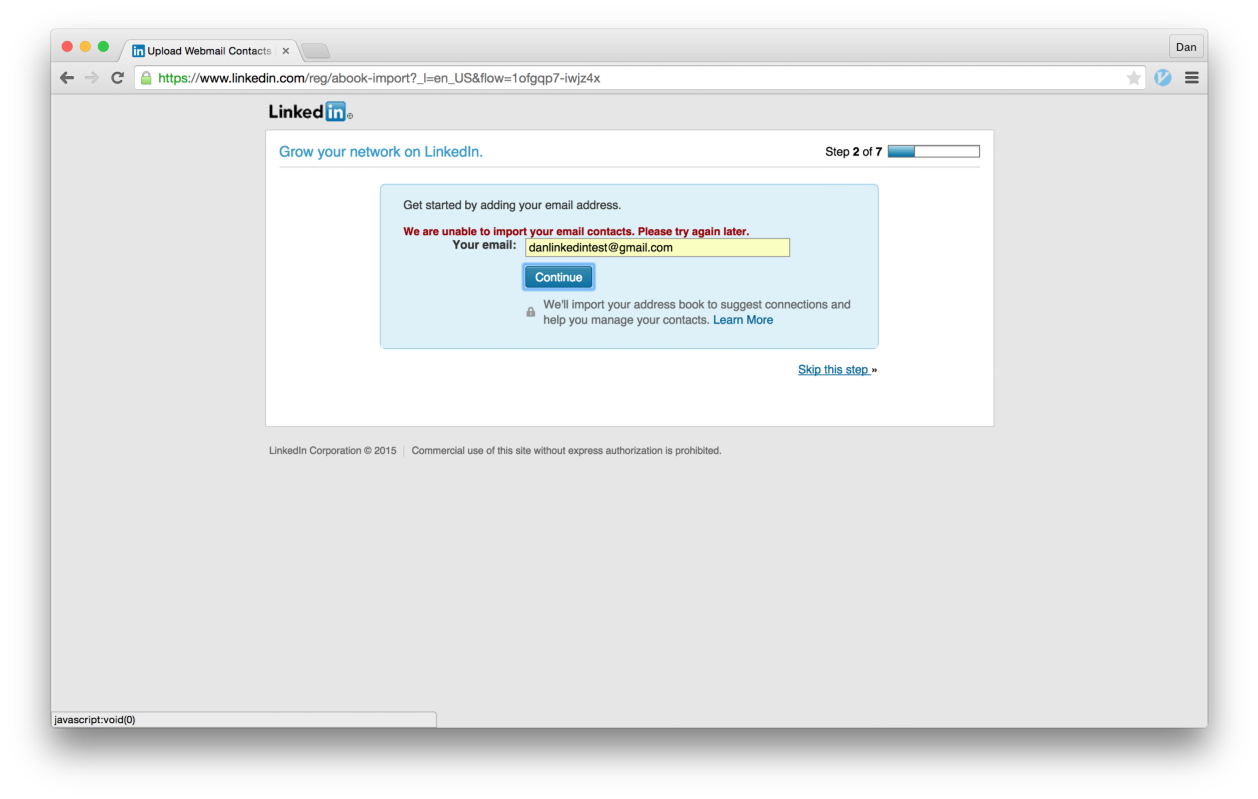
Here’s where things get messy. After filling out basic profile information, LinkedIn asks you to “Get started by adding your email address.”

There is a note explaining what this button does, but because it is put in light gray text next to a bold blue “Continue” button, they get most people to blindly click ahead.
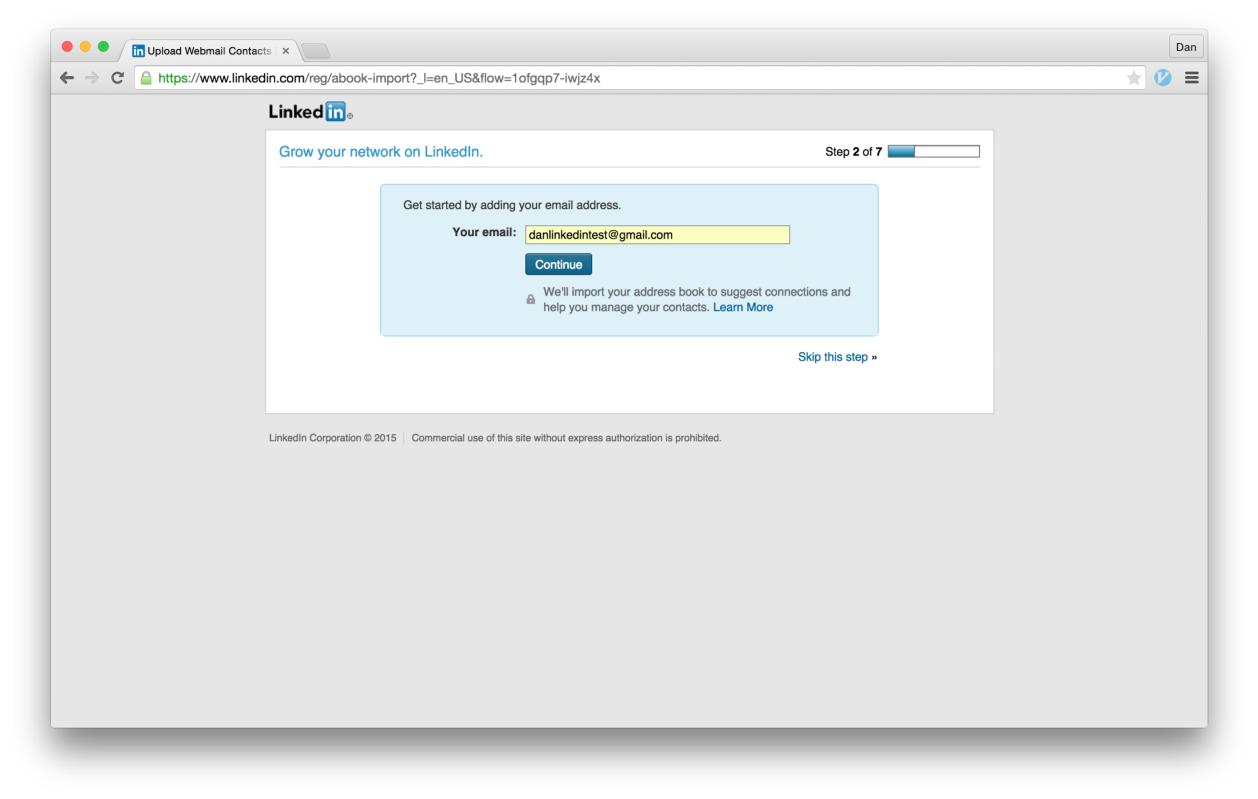
This is definitely a dark pattern. In fact, it’s really a lie. This page is not for “adding your email address,” it’s for linking address books.
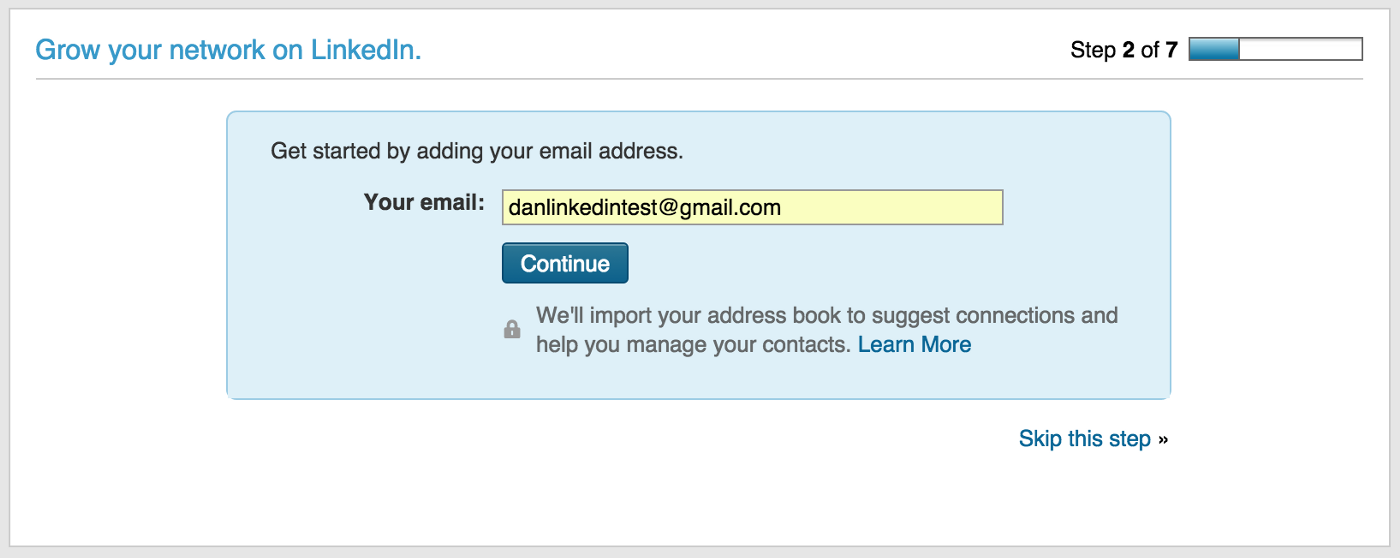
A closeup of the dark pattern in question. Note the use of color discourage users from reading the explanation text.

OAuth Dialogue.

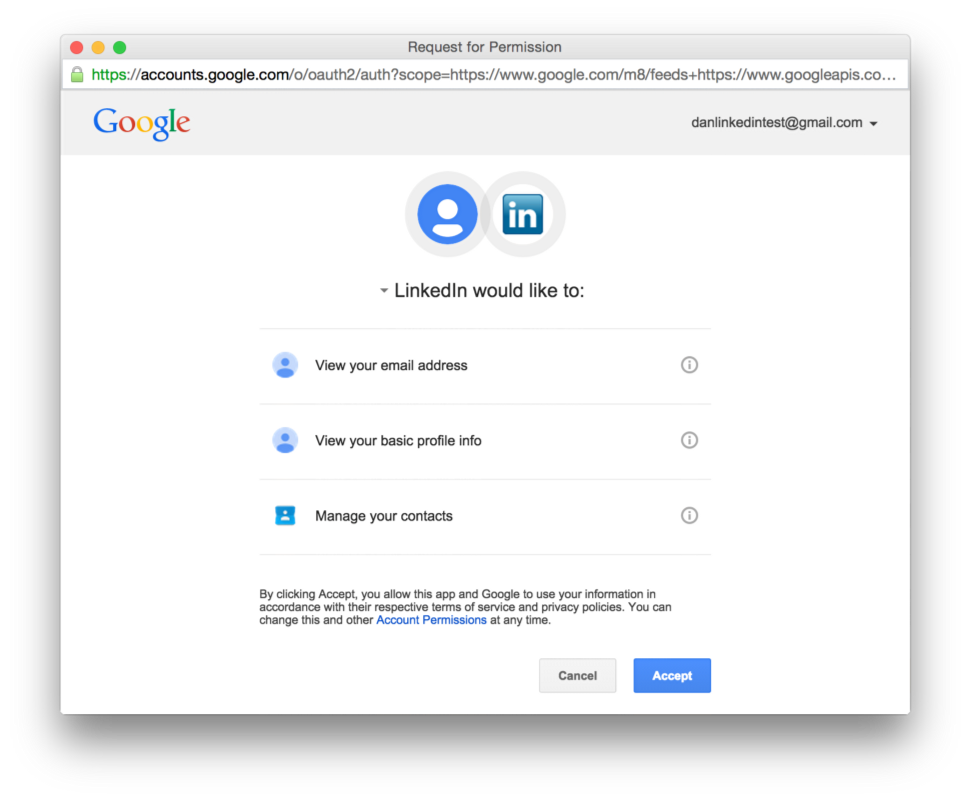
After clicking the blue continue button on the previous page, the Google OAuth popup appears. Note that one of the permissions being granted is “Manage your contacts.”

Google hasn’t done an amazing job highlighting this fact, but it’s pretty good. If someone were to click “Accept” at this stage, the user’s entire address book would be imported into LinkedIn.

This is where I went wrong the first time. Here, LinkedIn is taking advantage of the fact that Google uses the same OAuth popup for address book import as they do for the “Log in with Google+” dialogue. LinkedIn knows that most users just click through these windows without reading the permissions.

LinkedIn hopes you won’t notice this additional permission.

The Failure Screen.

If the OAuth flow is cancelled, an error appears. It reads “We are unable to import your email contacts. Please try again later.” The continue button brings the OAuth window open again; you need to find the tiny “Skip this step” link at the bottom right to proceed.

Moreover, the link is placed outside of the blue box which ostensibly contains all relevant info or controls. This page is excellently designed, but it’s designed to trick users.
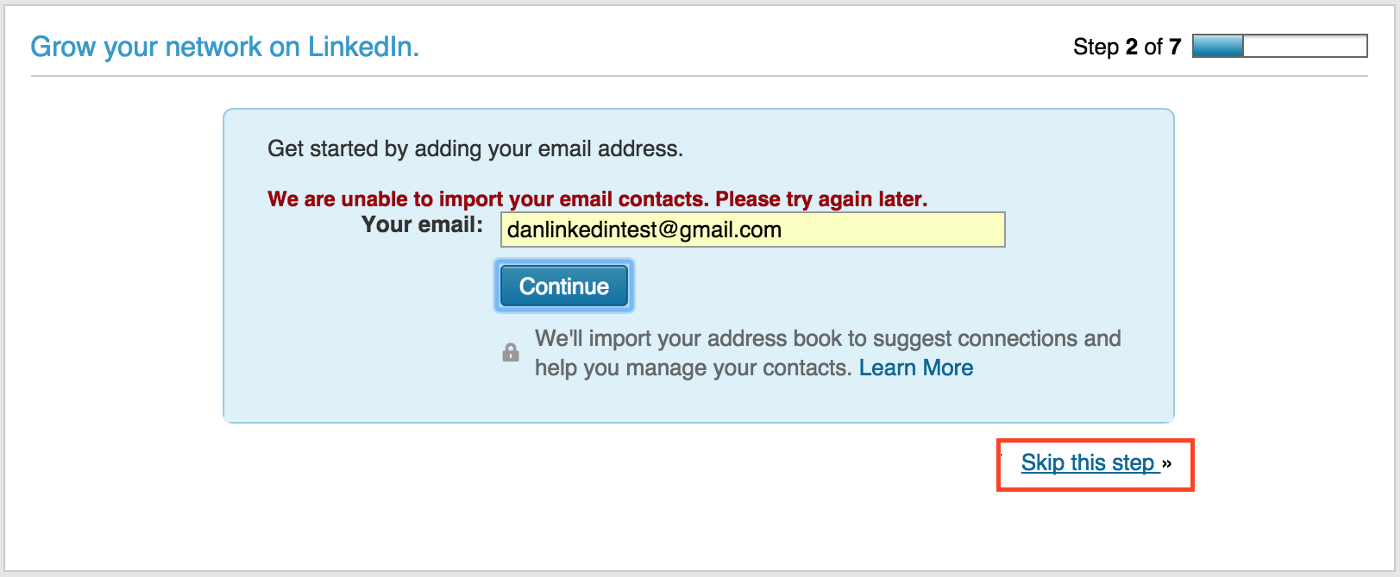
You need to find the tiny “Skip this step” link at the bottom right to proceed.

Are You Sure?

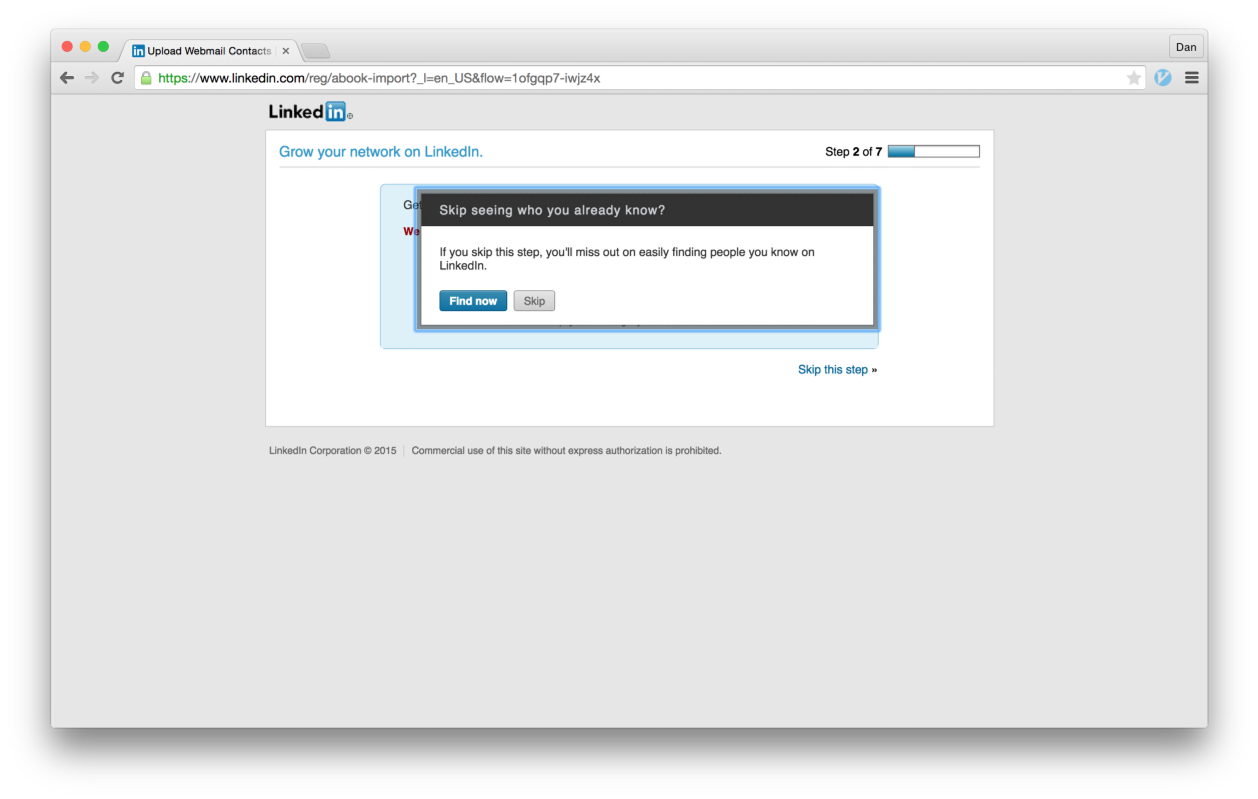
Just in case you found the hidden link by accident, LinkedIn asks you to confirm that you do indeed want to skip the address book import. Notice that “address book” or “contacts” show up nowhere in this popup window. Instead, you’re prompted to “Find now.”

Wouldn’t it be nice if LinkedIn gave this kind of warning dialogue when you click the button that gives them your entire address book?
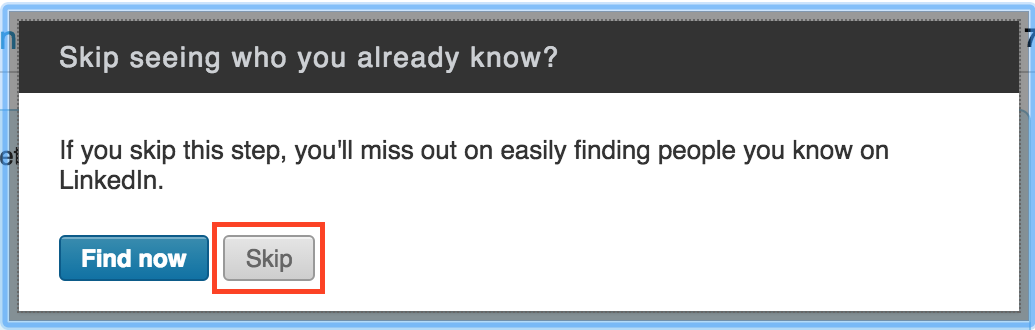
Why on earth would you want to skip seeing who you already know?

Confirm Your Google Account.

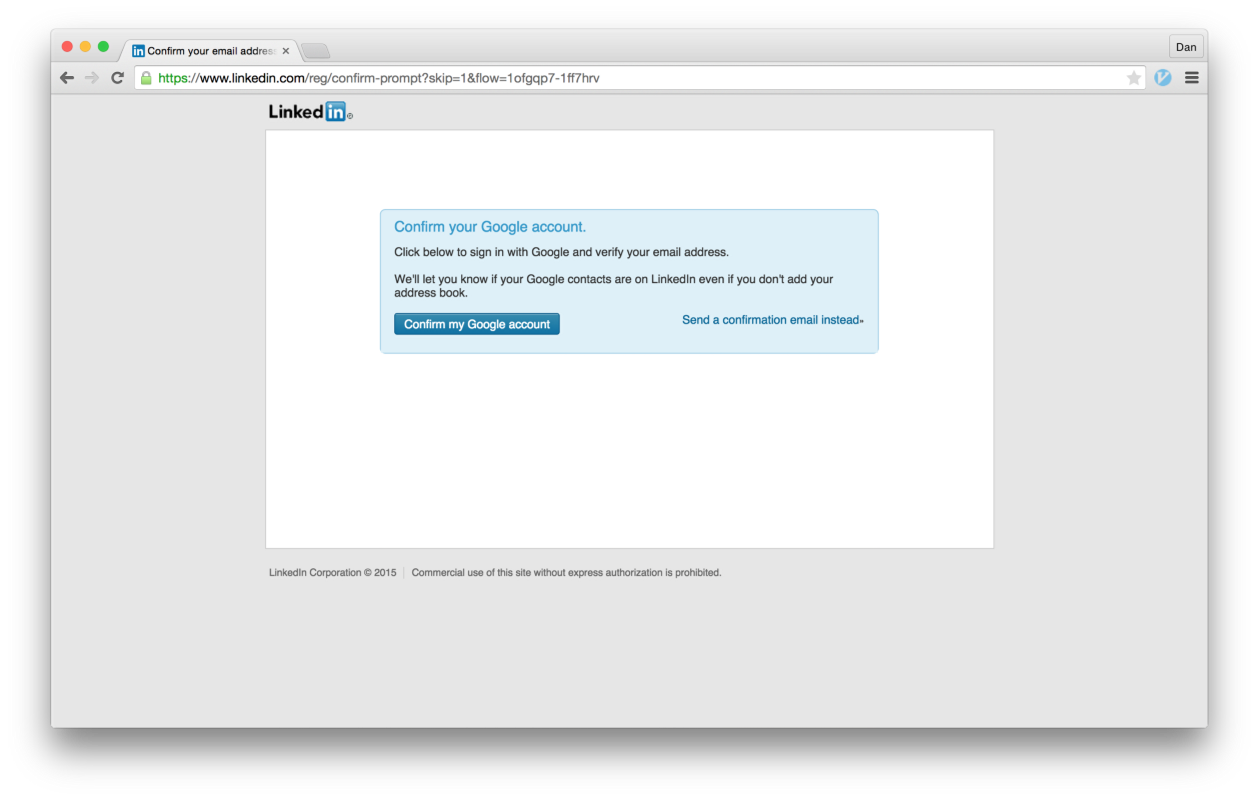
This next page is pretty insulting. The text asks the user to “confirm” their Google account, and “verify” their email address, but what LinkedIn is not saying is that clicking “Confirm my Google account” will sync the user’s address book with LinkedIn.

The user has already indicated on the previous page that they do not want to sync their address book with LinkedIn, but they try again anyways.
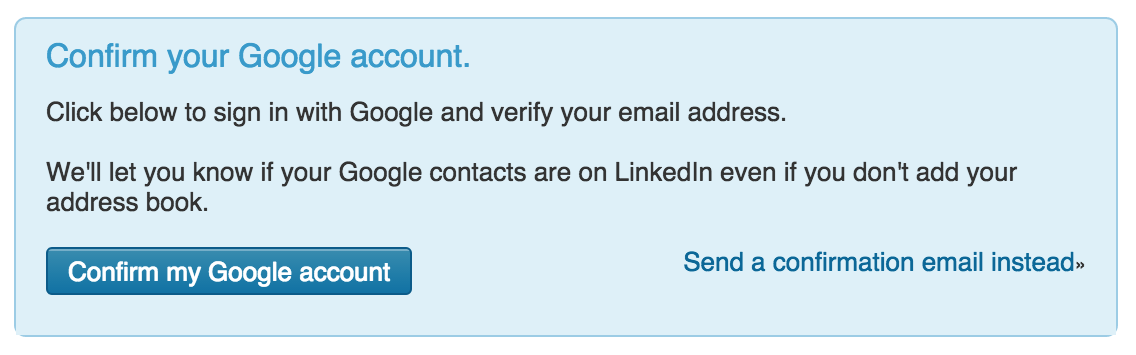
One of the most insulting screens of this process. Since when does “Confirm my Google account” mean “Give us the entire contents of your address book?”

We Could Not Confirm Your Email Address.
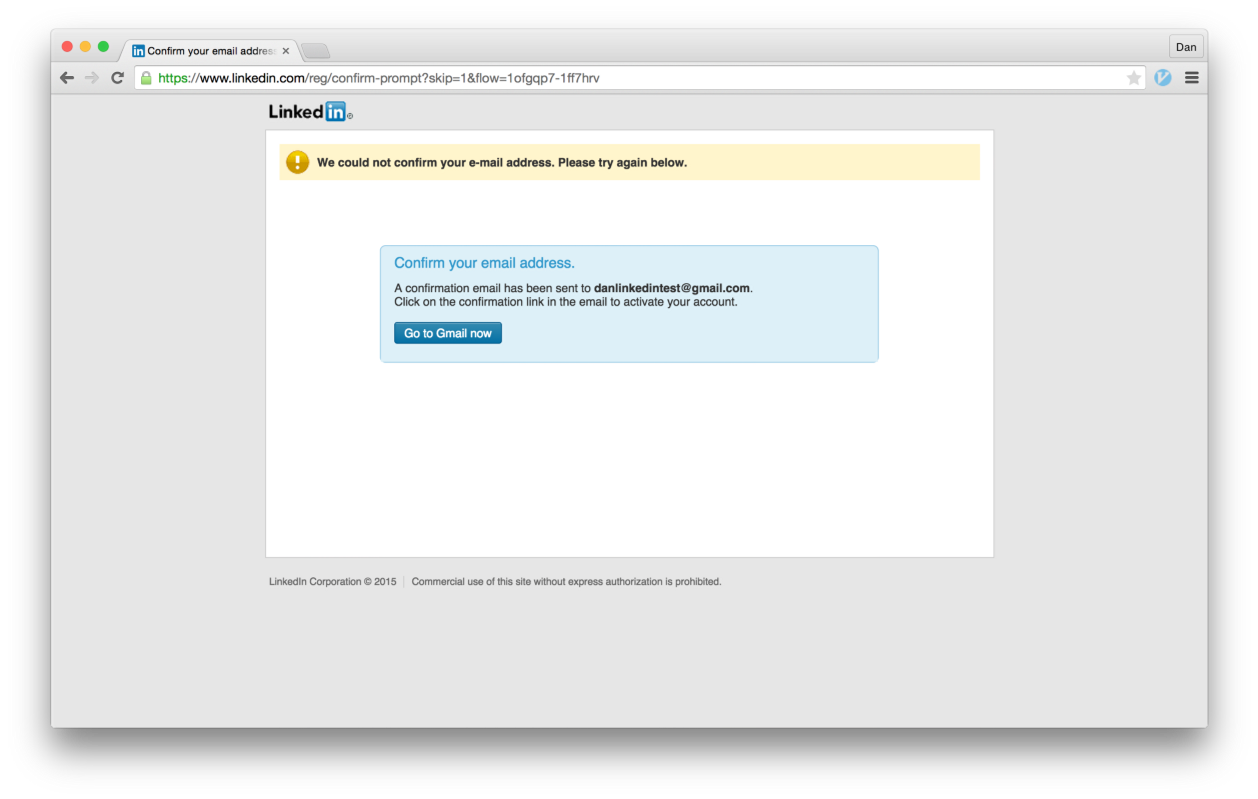
If we cancel out of the OAuth dialogue on the confirmation page, a warning appears indicating that a confirmation email has been sent instead. For once, the blue button on the page doesn’t import all your contacts, and instead links to Gmail.

Confirmation Email.
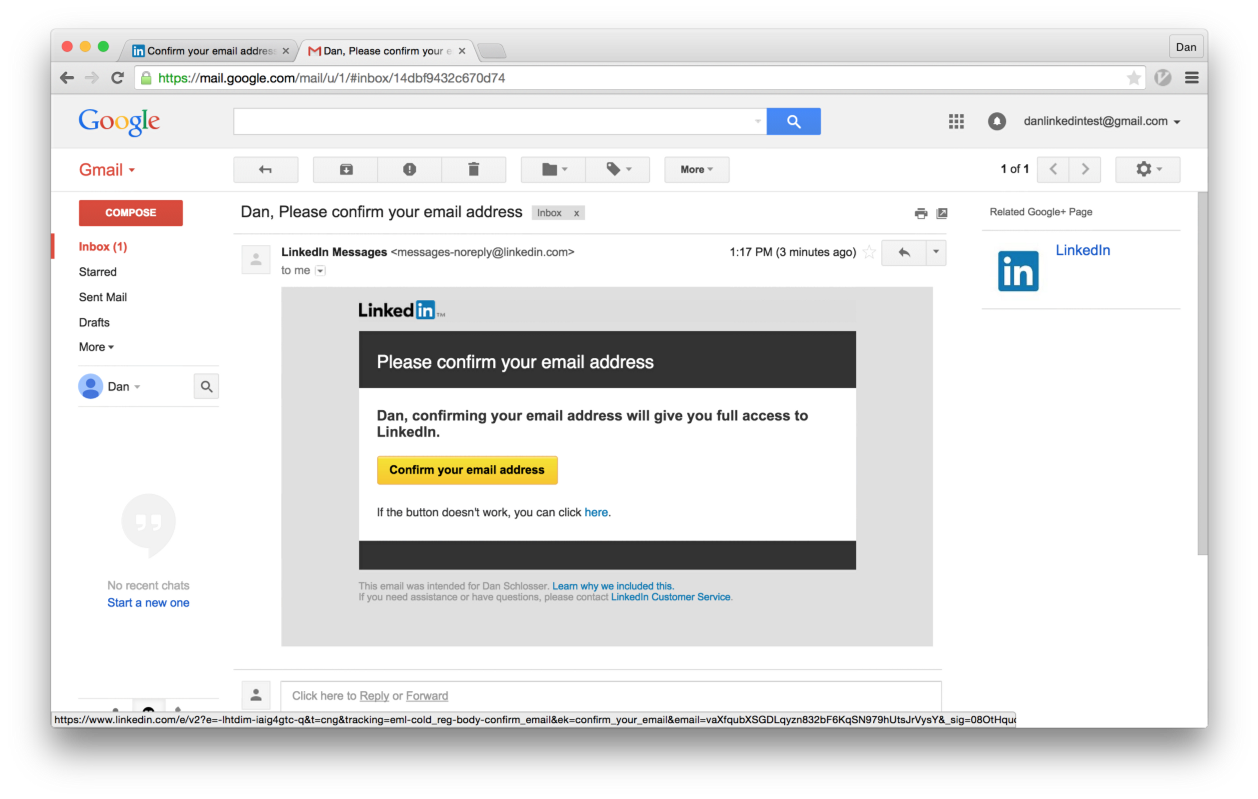
This is the email that LinkedIn sends to confirm your email address. If you click the yellow button, it links to the next page shown.

Add Your Email Address… Again?
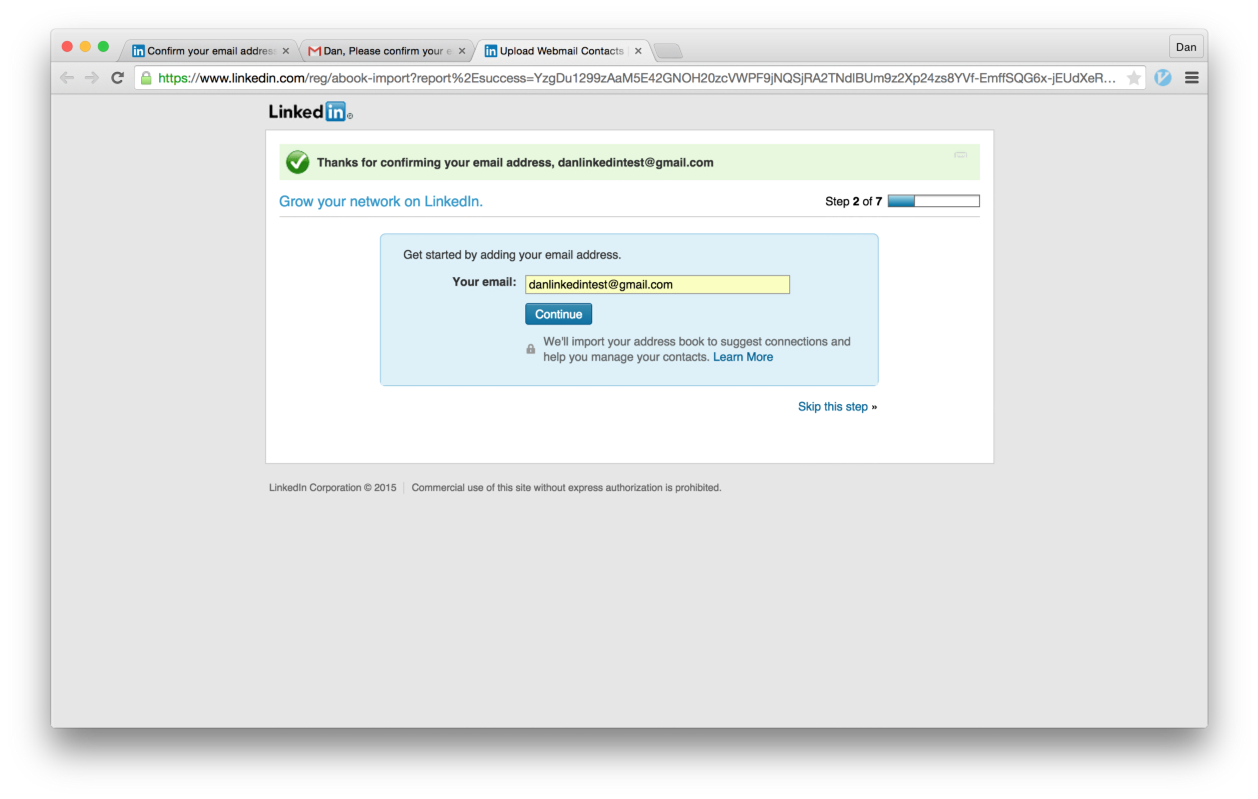
Following the link in the email shows a success message which reads “Thanks for confirming your email address…” right next to a box asking you to “Get started by adding your email address.”

Recognize this screen? It’s the same one as before. Once you confirm your email address, they try a third time to get you to “add” it. After the first two times that the user explicitly skipped adding their address book, it is overwhelmingly clear that they don’t want to.

This page is included just in case it happens to trick users into clicking “Continue.”

Are You Sure… Again?
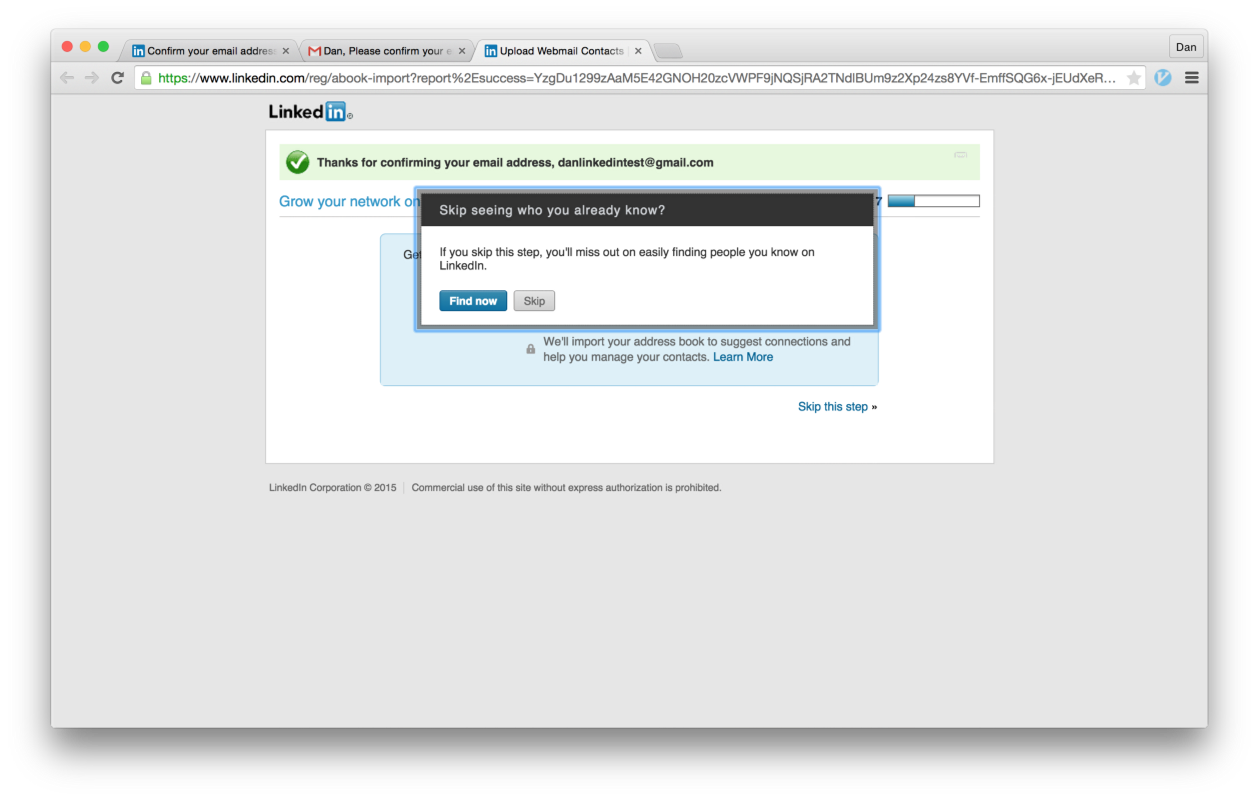
Just like before, if you click “skip this step” at the bottom of the page, a warning popup appears making sure you didn’t skip accidentally.

Just in case you didn’t mean to skip this step the last few times.

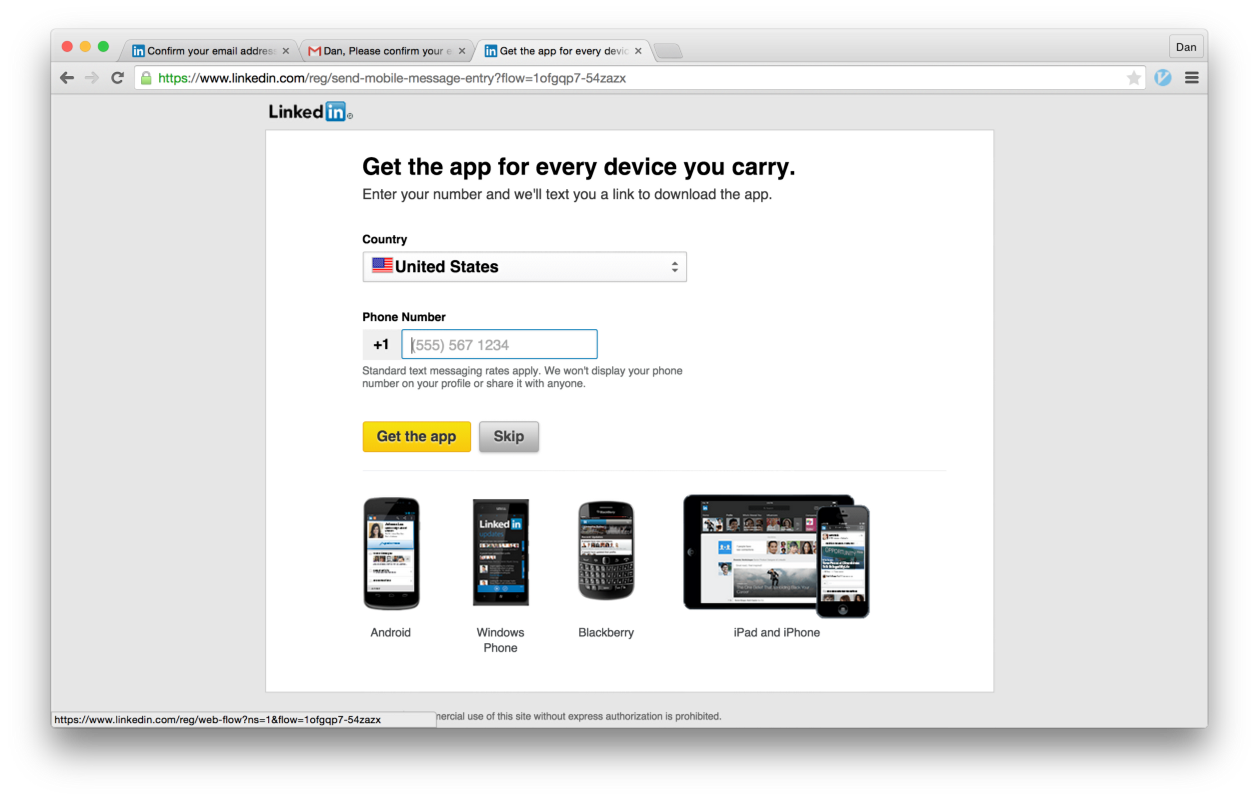
Get the App.

On the next screen, they offer to send you a link to download the LinkedIn mobile app. If they don’t get your address book on the web, maybe they’ll get it through your phone.

The Home Stretch.
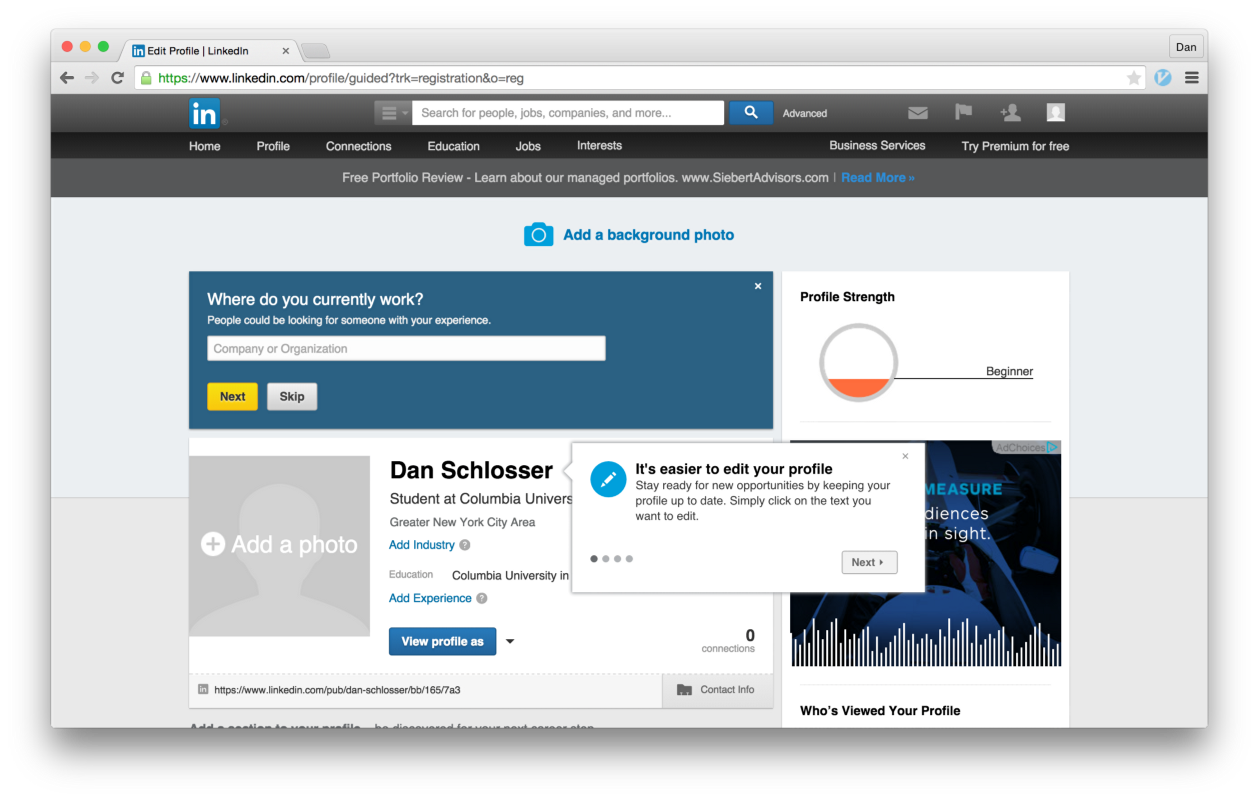
There we have it, finally signed up and signed in to LinkedIn. The next part of the new user experience is filling out your profile. Depending on how you count, LinkedIn tries to import the user’s address book three to eight times. It shouldn’t be this hard to sign up for a product without giving away any unnecessary information.

Worst Practices: The LinkedIn New User Experience

In software design, a new user experience, or NUX, is content that is driven to make the service valuable for new users who likely don’t have any connections or friendships on the service.

For my experience with LinkedIn, this started with a welcome email. Let’s take a look at how they use dark patterns to get you to sync your address book, even if you made it this far without doing so already.

The Welcome Email.
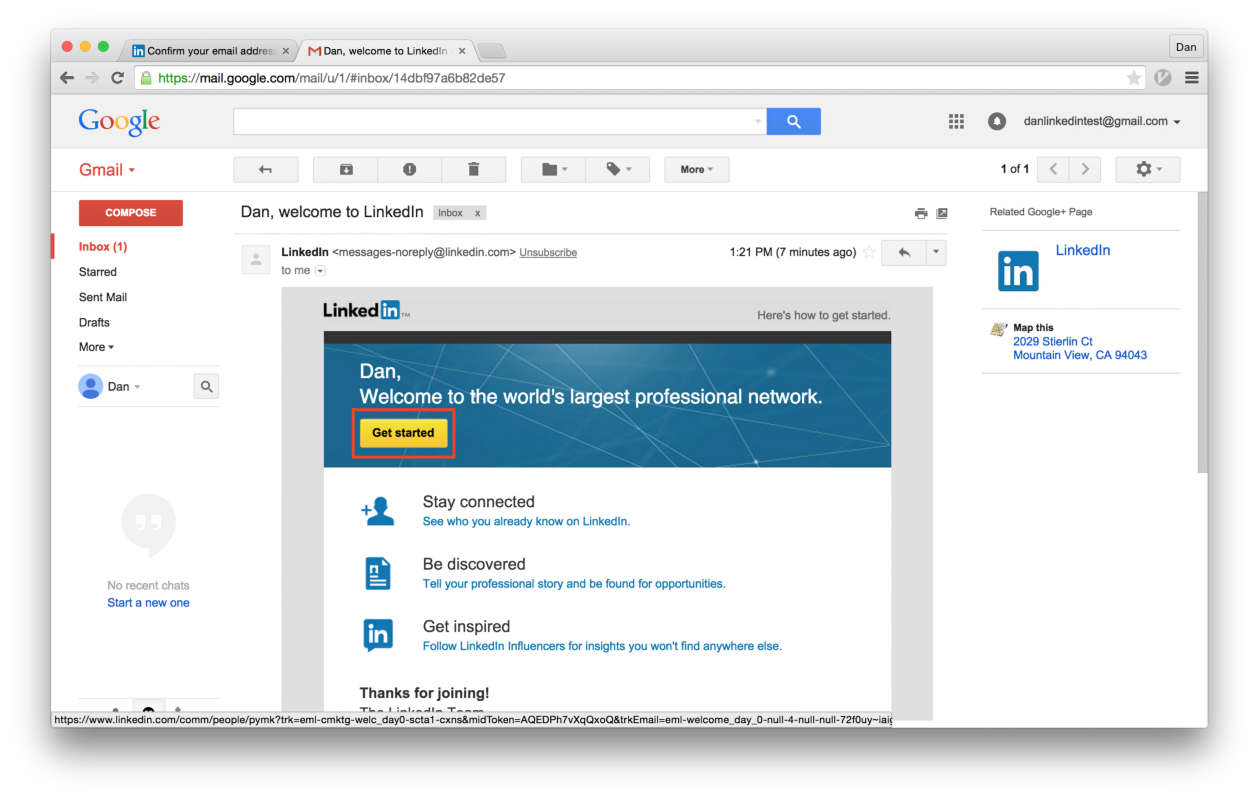
It turns out that the “Get Started” link and the “Stay Connected” link both go to two different screens that both do the same thing.

First, let’s follow the big yellow “Get Started” button, as I’m sure that’s what most people clicked.

Every Career Needs A Strong Network.


Big surprise. Yet another way to import our address book. In fairness, this is the page where the copy is most descriptive of what’s happening. The sub-header reads “Build yours by looking for your email contacts” and there isn’t any mention of “adding your email address,” which would have been very confusing.

Again, we see a big blue “Continue” button that just begs to be clicked.
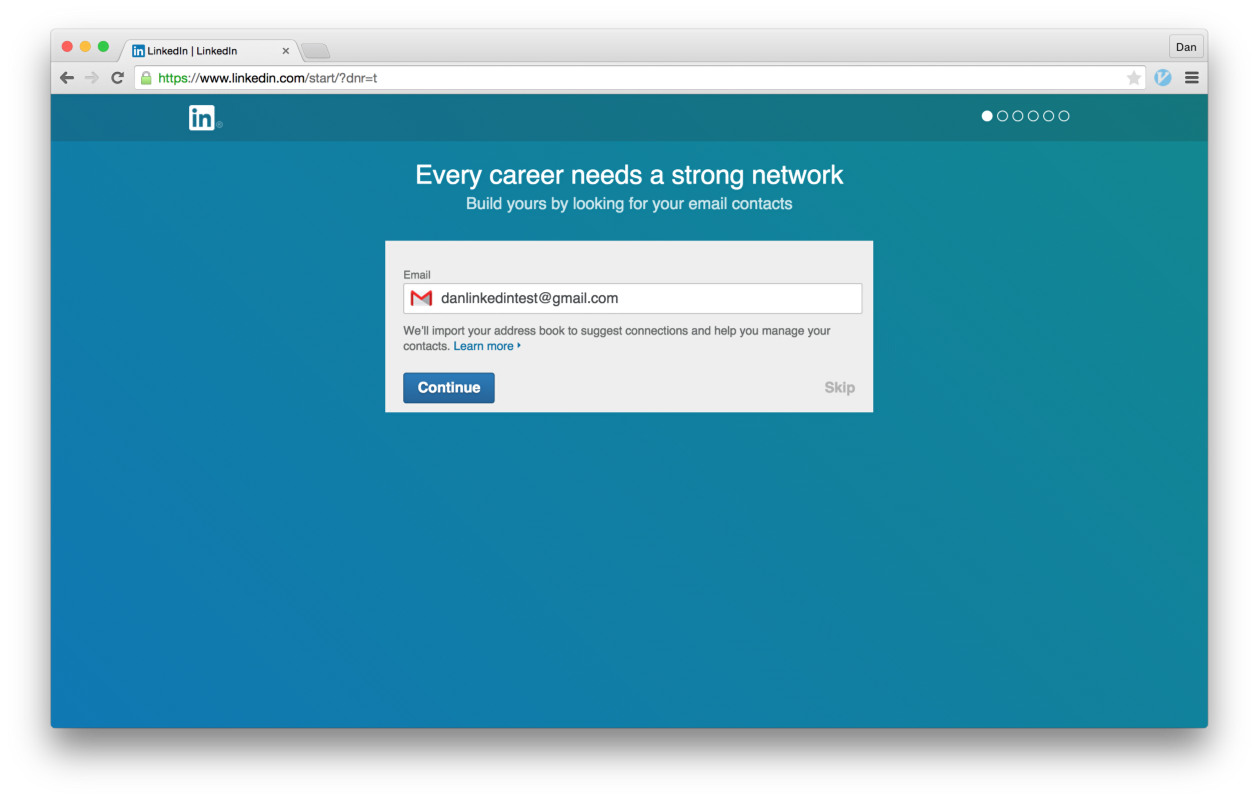
Also, LinkedIn is using traditional NUX designs to trick users into thinking that this is more of a tutorial than an attempt to get the user’s address book. Notice the dots up in the far right, and the solid blue background? This is different from every other screen we’ve seen before. It feels different than every other part of LinkedIn we’ve experienced so far.

For users of other web or mobile applications, this might feel like a first-time tutorial screen, where you click through the six screens that teach you what the app is, and then you get to actually use it at the end.

Most users are trained to click through these tutorial screens, and LinkedIn is counting on that. In case you hadn’t guessed it, the “Continue” button launches the Google OAuth popup again.

Wait…You Don’t Want A Strong Career?
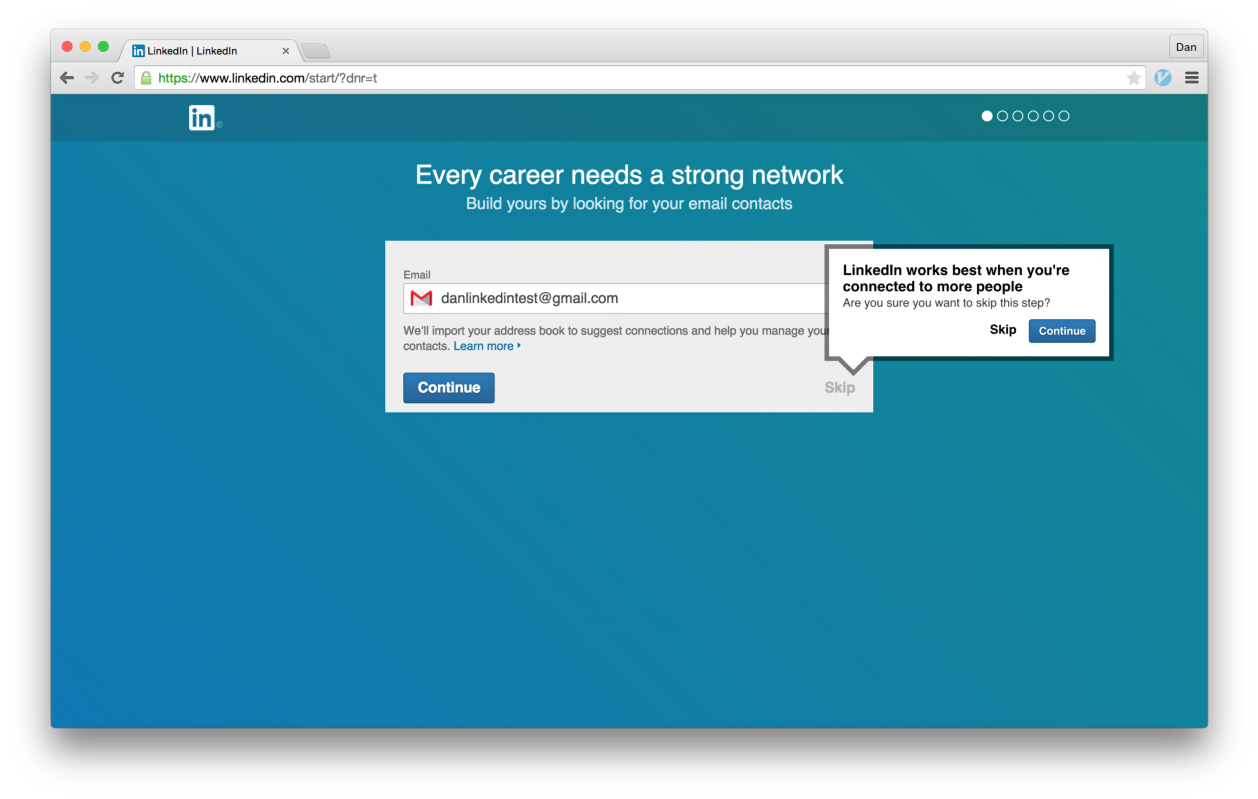
If you managed to find the skip link, LinkedIn asks you to confirm that you want to skip importing your address book. Once again, the blue “Continue” button in the popup is actually the “No never mind, I do want to give you all my contacts” button. We’re looking for the “Skip” link. This is a textbook dark pattern.

In the last screen, the skip link was hidden on the right, and the continue button was highlighted on the left, where it’s more noticeable. Here, that positioning is flipped, so if you happen to find the skip button, you have to reverse your thinking, and notice that this time the skip button is on the left.

To add insult to injury, the wording of the question is such that “Continue” seems like the answer we want. The word “Continue” has an affirmative connotation for most people, so when being asked “Are you sure you want to skip this step?” it seems unnatural that “Continue” doesn’t get us what we want.
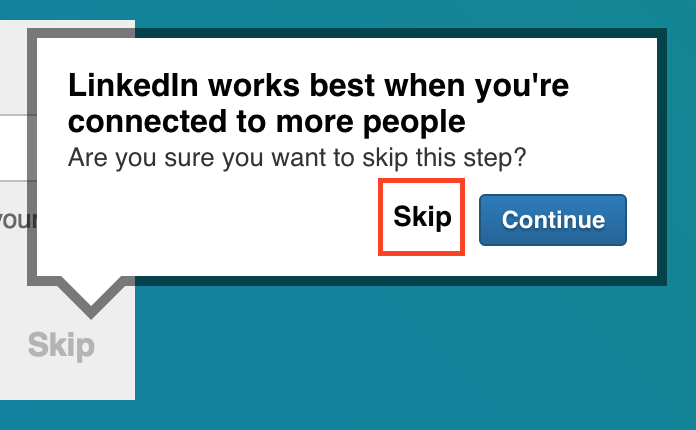
This popup is fantastically designed to trick you.

Let’s review everything this popup does.

  1. The big blue button is the “give us all your contacts” button.
  2. The skip link we’re looking for (and have already clicked once) has been moved to the other side of the button, which confuses the left-right association that was subconsciously built in the previous screen.
  3. The popup essentially asks “Are you sure?” and “Continue” here means “No,” which feels unnatrual.

Pretty clever.

The Rest of the LinkedIn NUX.
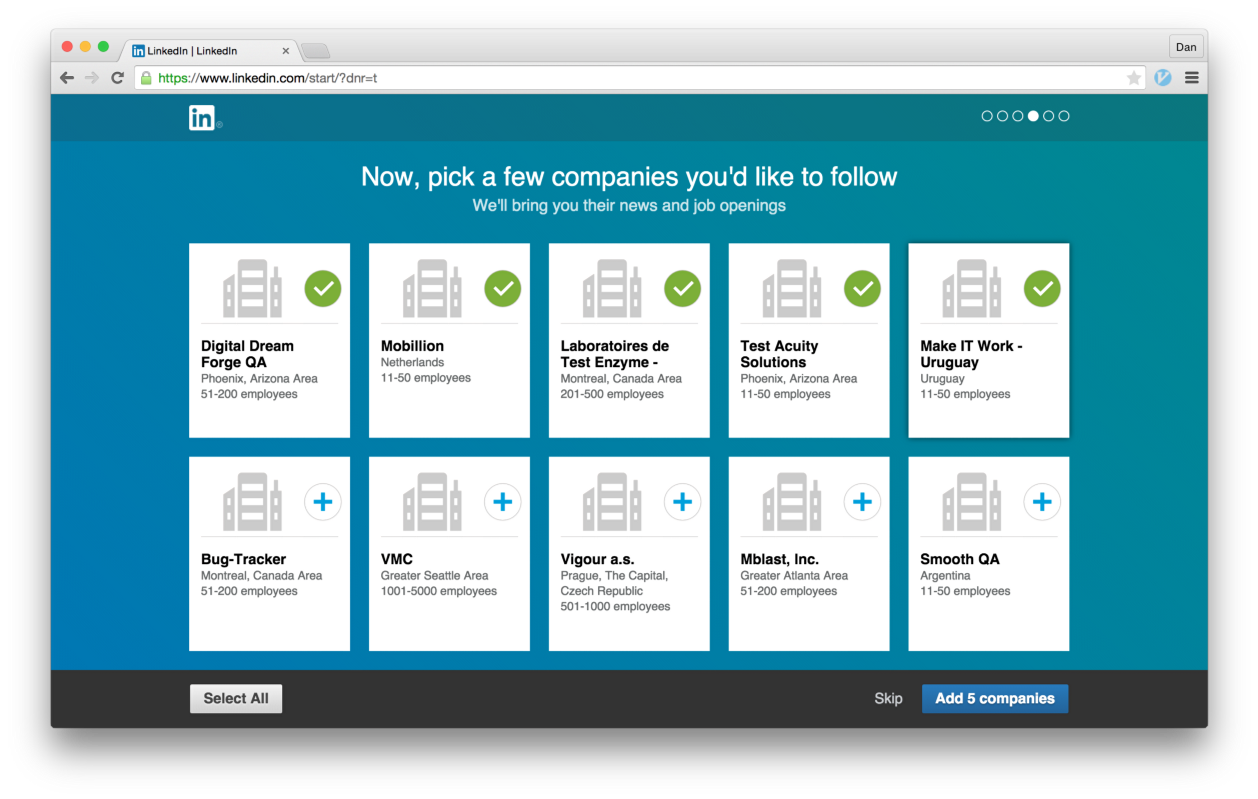
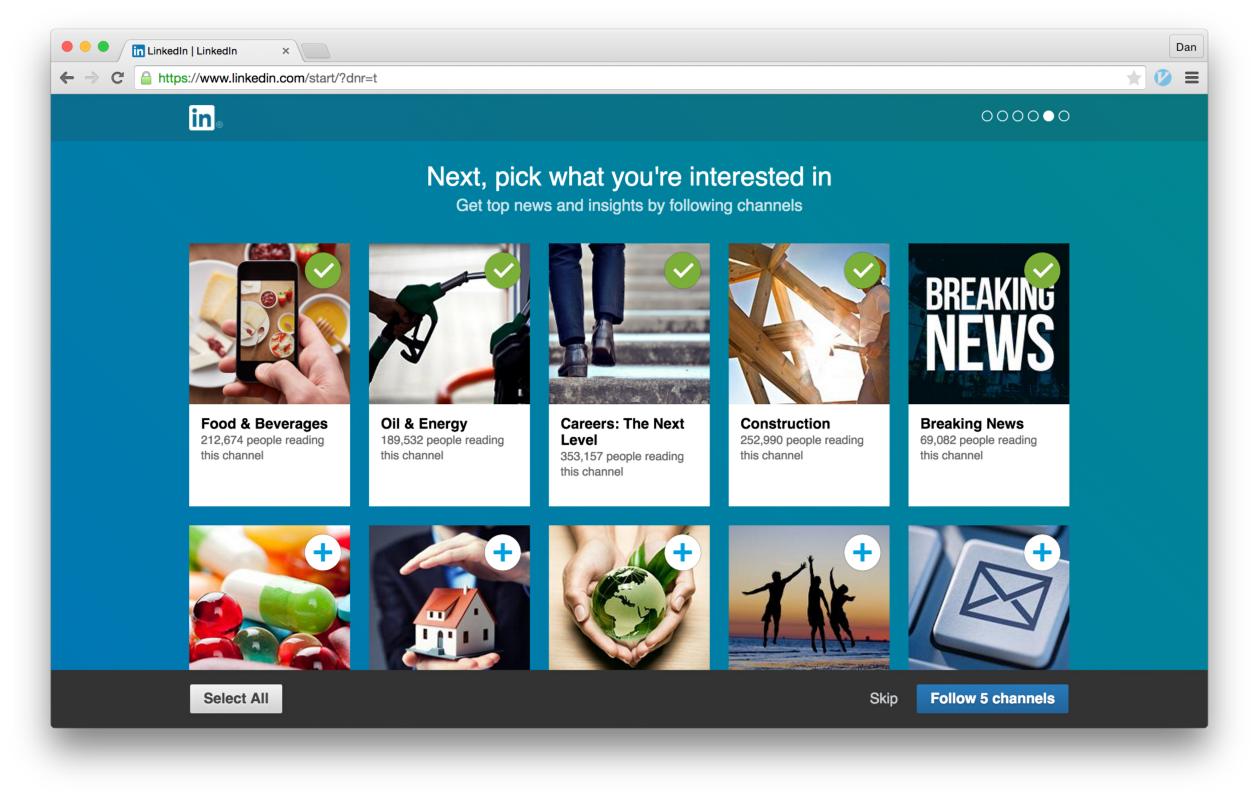
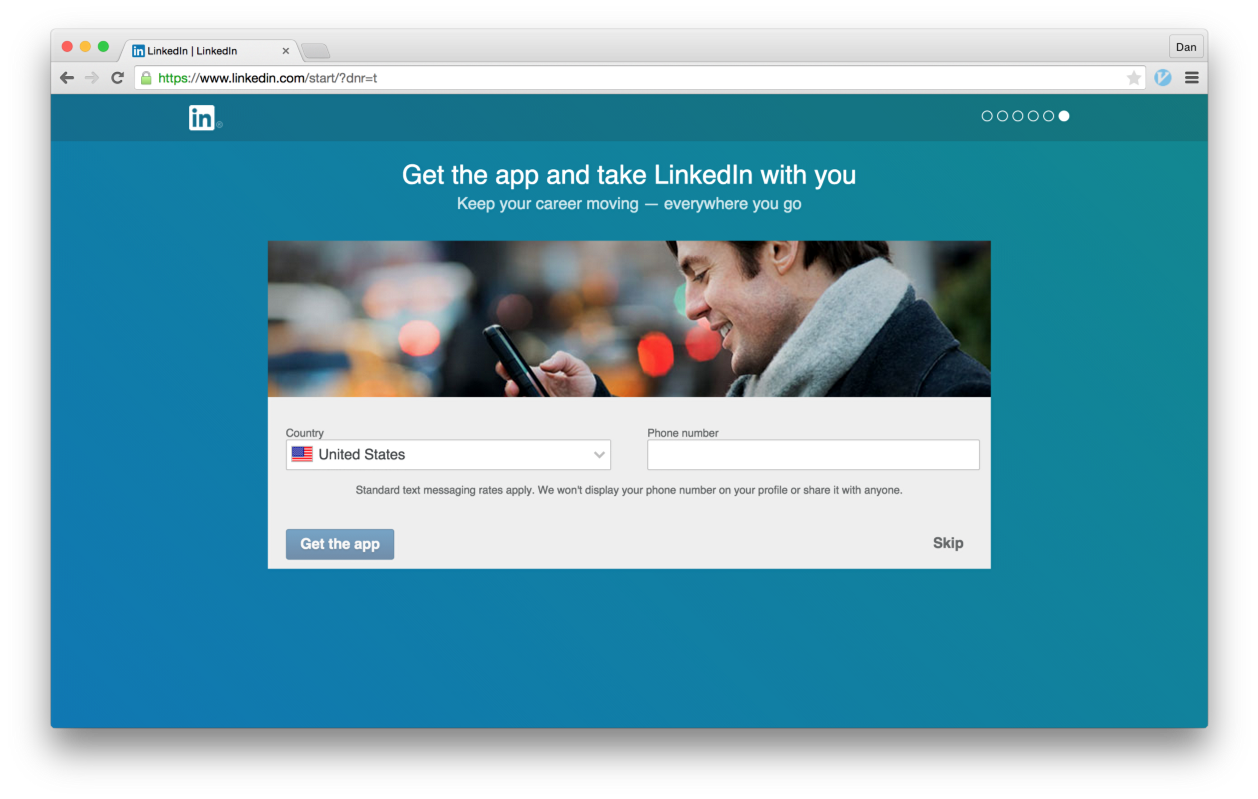
The rest of this flow is harmless. If you happen to make it through the previous screen without getting fooled, the rest of the new user experience screens serve to connect you with more companies or interests, or to get you to download the mobile app.

Done with the NUX? Wait, There’s More.
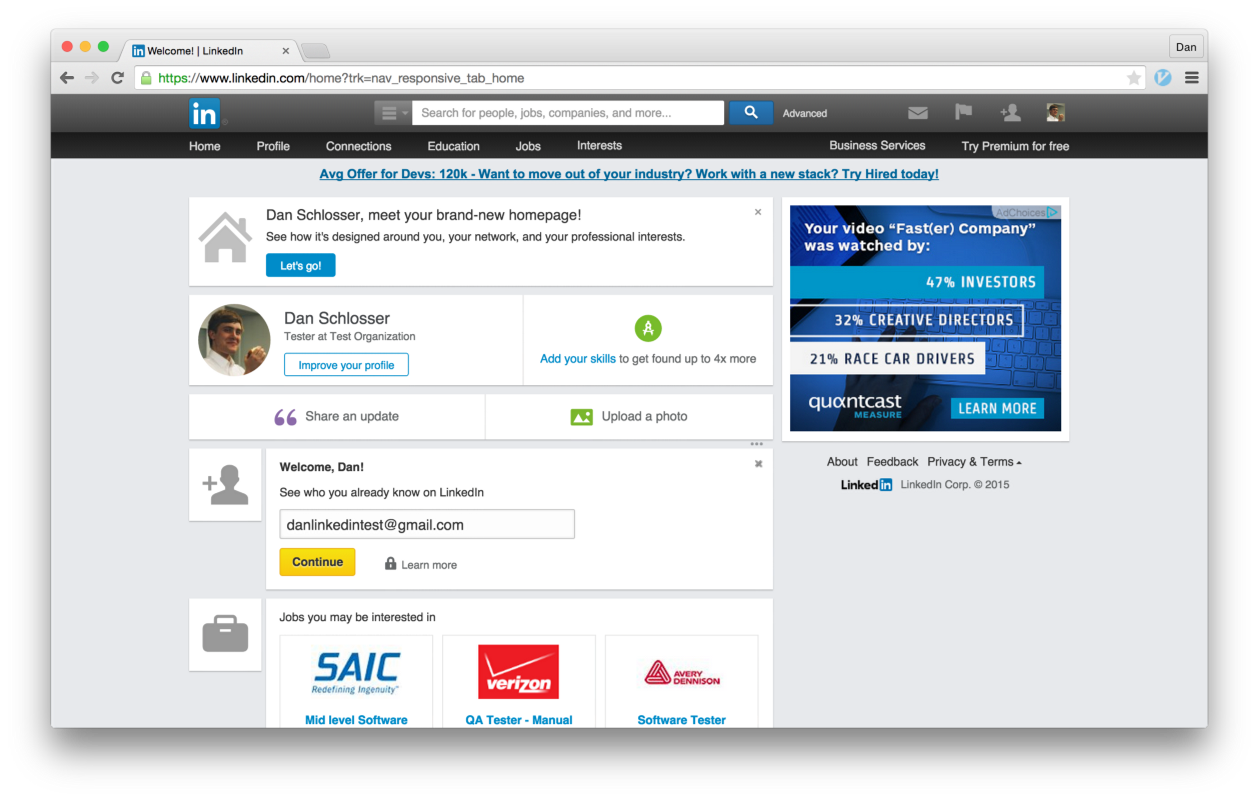
So we’ve finally finished, and we’re on the LinkedIn homepage. Now this page is a total mess design wise, but I’d like to draw attention to the “Welcome, Dan!” card that shows up, which has a big yellow “Continue” button.

By now, I’m sure you know where that goes…
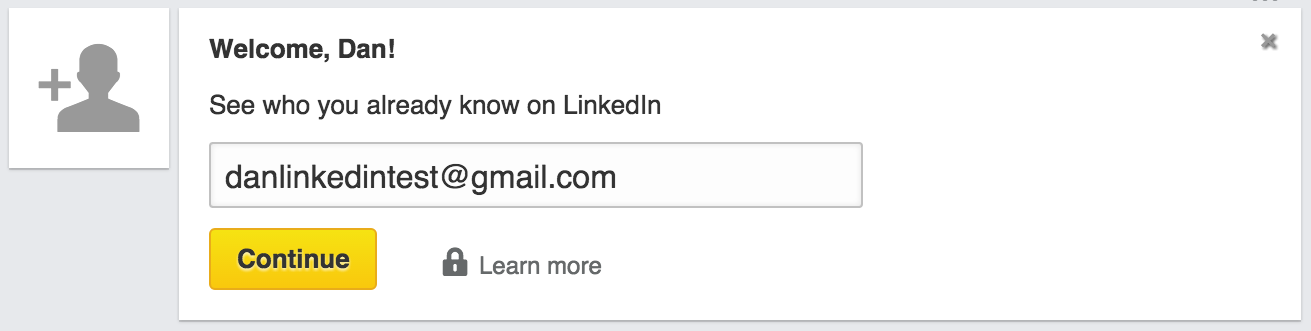
Deja vu, right?

The only solace I can find here is that the page is so cluttered that I doubt that most people would end up finding this link on the first time. Thankfully this card sticks around for a while…

What About That Other Link in the Welcome Email?
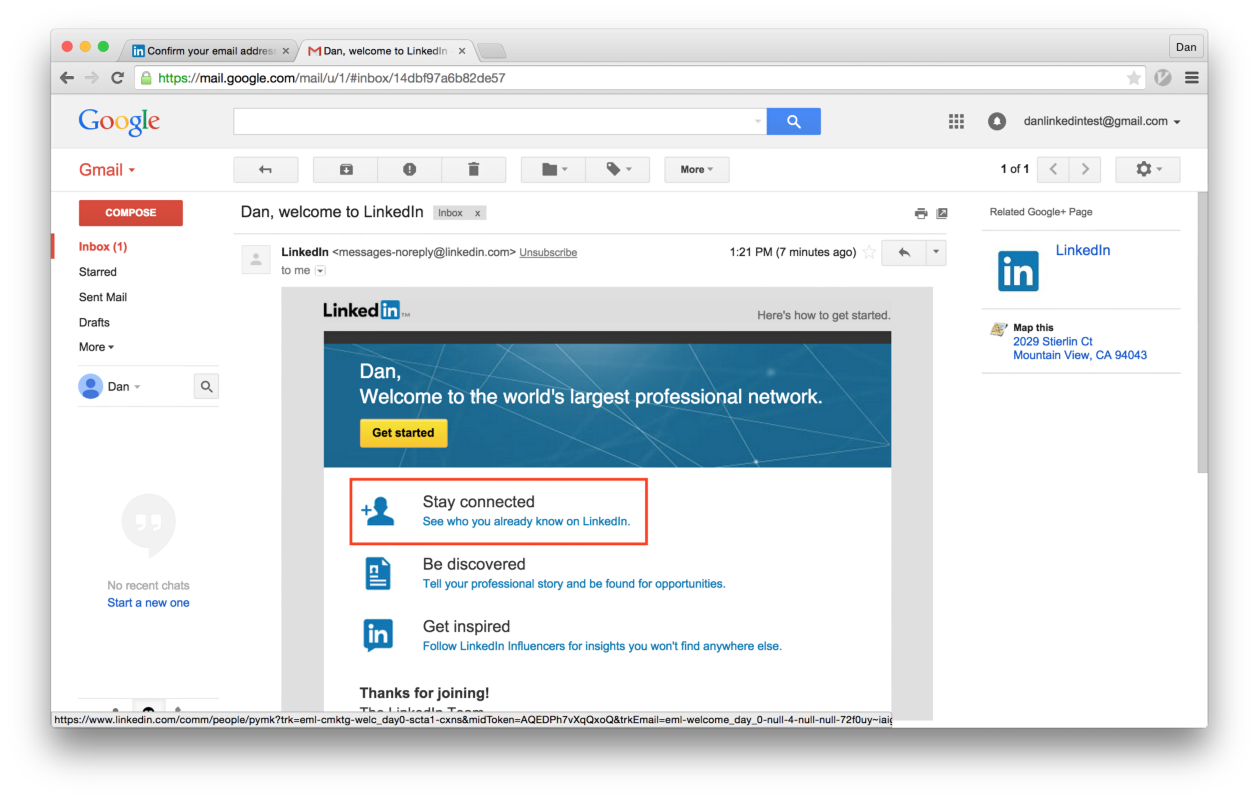
Remember the “Stay connected” link? Turns out that takes you to a completely different screen that also gets you to import your address book.

Yet Another Way to Add Your Email Address. Awesome.
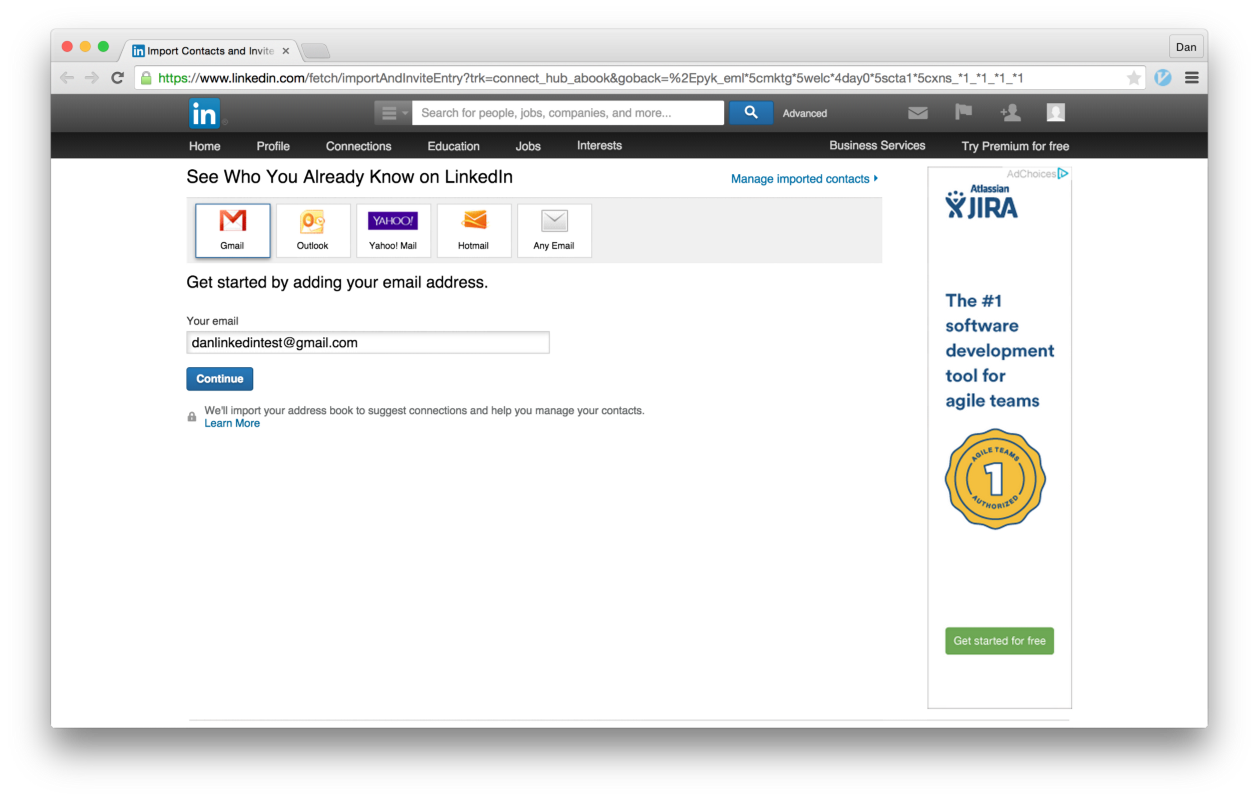
This page is no longer new user experience, rather it’s the permanent home for the “add your email address” flow. We see a return of the original copy which hides the true function of the “Continue” button.

LinkedIn Dark Patterns: A Final Word.

I hope you understand now that when you get spammy emails from friends inviting you to LinkedIn, it’s LinkedIn’s fault, not your friends’.

Many smart people have written about how dark patterns damage brands, and are harmful to user trust. I can unequivocally say that LinkedIn’s address book import design is harmful to their brand, even if it’s better for business in the short term. They make money when their network is more strongly connected, and so it is in their best interest that users connect their address books.

LinkedIn isn’t the only social network that uses dark patterns to grow their social graph, far from it. However, LinkedIn is an example of doing this to the extreme. It made me quit the service for two years, and has harmed my image of the company. Dark patterns are bad design, and bad design is bad business.

I guess I’m disappointed that LinkedIn doesn’t agree.

unnamed (14)PSA: If you’re wondering if LinkedIn has your address book imported, I wrote a short tutorial on how to find out, and how to remove it. Check it out here

Dan Schlosser is a computer science major at Columbia University in New York and is currently participating in the Associate Project Management (APM) internship program at Google. Maybe you’ve heard of them.

Read more from Dan on Medium or check out his personal blog, Schlosser.iofor even more awesome. You can also follow Dan on Twitter @DanRSchlosser.

5 Healthcare Recruiting Challenges and How You Can Overcome Them

5 Healthcare Recruiting Challenges and How You Can Overcome Them

Recruiters in the healthcare field face all kinds of talent challenges.   The retention and engagement of the current workforce is hard.  HR and talent acquisition are not known to be early adopters on the technology cycle either. There are a host of technologies available to help. Whether you are focusing on sourcing and finding candidates or networking it can be hard. Wading through the ocean of available software can be a challenge in its own right.

Join us for this webinar. Julia Abell explores 5 healthcare recruiting challenges.  She will also share some practical advice about how her organization has been addressing them.  In addition to that she digs into which technologies will give you the biggest ROI .

In Their Own Words: Top HR & Recruiting Leadership Lessons from Top CEOs.


ipMahNRaO3MwLast week, Glassdoor released our annual report on the Highest Rated CEOs, now in five categories including U.S. large, U.S. SMB, UK, Canada and Germany.

This report is designed to honor CEOs who have truly gained the trust and admiration of their employees and are proven leaders in their fields. But why does a top CEOs report matter for HR and recruiting?

Because today’s job candidates are not just looking at a job listing, they’re actively researching what the company culture and work environment is like, along with how promising, or not, the outlook is for business – all factors that are heavily influenced by the CEO.

Since this report is based entirely on employee feedback, it’s a true testament to these CEOs and their ability to gain the trust and support of an entire workforce.

So we asked them to share advice to the rest of us on what it takes to be a great leader, run a company and get employees onboard to help move their vision forward; below are their unedited responses.

In Their Own Words: Leadership Lessons From the World’s Top Leaders.safe_image

Since this report is based entirely on employee feedback, it’s a true testament to these CEOs and their ability to gain the trust and support of an entire workforce.

So we asked them to share advice to the rest of us on what it takes to be a great leader, run a company and get employees onboard to help move their vision forward; below are their unedited responses.

1. Be Honest, Transparent and Help Others.


 “We have faith in people’s ability to hear the truth, whatever it might be. Support from our workforce is not something we expect, but something we hope to earn in time. We work to serve everyone the business touches in a positive way- that begins with honesty and good intentions.”

Corey Schiller, CEO of Power Home Remodeling Group, #25 with 91% approval rating on the U.S. Large Company list.

“I know that our people value our culture of transparent communication and access to our leadership team – it’s one of the things that’s regularly praised in our employee feedback surveys. As a result, I visit virtually every one of our employee training sessions for the opportunity to talk with them in person.”

Joseph A. Tarantino, CEO of Protiviti, #40 with 90% approval rating on the U.S. Large Company list.

“Help others find and live their purpose.”

Brad Jackson, CEO of Slalom Consulting, #45 with 89% approval rating on the U.S. Large Company list.

2. Feedback is the Breakfast of Champions.

“Everyone needs to believe we are truly in this together. Everything we do here, from the exec team having the same desks and no offices like everyone else, to talking to everyone we can to on a daily basis, reinforces that we are all one team. Each with distinct roles, but a team working together.”

Tobias A. Dengel, CEO of WillowTree, #2 with 98% approval rating on the SMB U.S. list.

 “Trust and support starts with open communication and listening to what matters most to your employees. Be transparent and unified on company goals, solicit feedback regularly, and make decisions that evolve your company culture based on input from your employees.”

Renaud Laplanche, Founder and CEO of Lending Club, #3 with 98% approval rating on the SMB U.S. list. 

“If an environment is created, at work, for people to become the best version of themselves, they will often choose it… and be grateful.”

Dave Durand, CEO of Best Version Media, #5 with 98% approval rating on the SMB U.S. list.

“I believe that it is the job of the CEO to build an infrastructure that supports the companies core values, core purpose and to create an environment that creates engagement in the TEAM. Combined these create what is called the culture of the business. The CEO owns this function and in order to create trust, the company must live up to these values and not compromise these values at any expense. That is the only way I know of to create trust and support in the workplace.”

Darius John Mirshahzadeh, CEO of Endeavor America Loan Services, #9 with 95% approval rating on the U.S. SMB list.

“Feedback is the breakfast of champions, and the sooner CEOs and companies embrace candid feedback from employees and candidates, the faster you’ll earn their trust and support. What employees and candidates say and post on Glassdoor mirrors what they tell their friends about their experience with your company, so it’s a great opportunity to hear directly what’s working, what isn’t, and where you can continue to improve–the “advice to senior management” section is one of my favorite parts of any Glassdoor review for that reason.”

Brian Halligan, CEO of HubSpot, #10 with 94% approval rating on the U.S. SMB list.

“We value a flat organizational culture at Signpost and of our five company tenants…”acting like an owner” is what we look for most as far as culture fit. Working at a startup can be hard, and I’m glad to see that current and past employees know my door is always open to help.”

Stuart Wall, CEO of Signpost, #16 with 92% approval rating on the U.S. SMB list.

“Ask for help improving your work. Ask your co-workers, your supervisor, or anyone who might be able to help. Don’t ask “Is this good enough?” or “Do you like it?” Ask, “How can this be better?” Even if you think it’s perfect already. This simple change in phrasing gives others permission to help you improve your work without criticizing you. It doesn’t assume there’s something wrong with the work. It is just an invitation for suggestions on how to make it better. And that’s no criticism at all, because everything can always be better.”

Bob Pritchett, CEO of Faithlife Corporation, #22 with 89% approval rating on the U.S. SMB list.

50-Highest-Rated-CEOs-2015

3. Begin With Goals, Invest the Time, Encourage & Repeat.

“First, have a clear strategy, goals and values that inspire your people and are relevant to their work and their aspirations. Second, invest time in regularly talking with your people about your strategy, making it a two-way conversation and creating joint ownership. Build a culture of mutual support and trust where people understand the value of their contribution to the goals, and are encouraged to recognise a job well done. And finally, continue to invest the time to keep the conversation going; be engaged, be real and be there for them. It’s an investment that pays dividends.”

Martin Bennett, CEO of HomeServe UK, #4 with 97% approval rating on the UK list

“Regularly, honestly and very openly share with all colleagues how the business is doing, what is on your mind – good and bad – and what needs to be done next. Tell them this in plain, authentic language and do it yourself, not via a communications department or via middle management.”

Alistair Cox, CEO of Hays plc, #15 with 88% approval rating on the UK list.

4. Don’t Underestimate the Power of Transparency & Integrity.


“The trust and support of the workforce is built on a foundation of transparency and integrity. Leaders who communicate openly and honestly create an opportunity to develop trust. By listening, understanding and then acting on what is heard from the workforce, the leader builds trust and support. Not all employees will agree with every decision; however, when a leader is trusted, you will find that they are supported even amidst disagreement.”

David Ossip, CEO of Ceridian, #3 with 93% approval rating on the Canada list.

See the complete report of Glassdoor’s Highest Rated CEOs in 2015. For questions about the report’s methodology or how to get your CEO in the running next year, email [email protected].

glassdoor logoAbout Glassdoor: Glassdoor is the world’s most transparent career community that is changing the way people find jobs, and companies recruit top talent. Glassdoor holds a growing database of 6 million company reviews, CEO approval ratings, salary reportsinterview reviews and questions, office photos and more.

Unlike other jobs sites, all of this information is entirely shared by those who know a company best — the employees.

For employers, Glassdoor offers effective recruiting and employer branding solutions via Glassdoor Talent Solutions. We help more than 1,500 employers promote their employer brand to candidates researching them and advertise their jobs to ideal candidates who may not be aware of them. What differentiates Glassdoor from other recruiting channels is the quality of job candidates we deliver and our influence on candidates’ decisions as they research jobs and companies.


I’ll do the Recruiting, You do the Marketing

I am a recruiter not a marketing expertGreat marketing and branding can be the ultimate recruiting tool. Face it, before applying for your job opening, candidates are Googling you. What are they looking for in their search? Anything they can find that will give them knowledge of the inner workings of your company. It can be someone’s family YouTube video of the last company picnic, a Glassdoor review stating that your CEO is an idiot, or it could be a beautiful well thought out career and company page. What they find is really dependent on what is out there. Why though, is the burden of how cool the company looks like on the Internet so often left up to the recruiters? Isn’t that the function of the Marketing Department?

At one time, marketing and recruiting were not mentioned in the same sentence but today, without proper marketing, you are missing out on top talent. No one wants to work at or for a company with a crappy website.
What drives me crazy is that with all of the new branding methods and data information out there, recruiters are not recruiting! I stick by the mantra, do what you are good at and outsource the rest.I mean really, sure I CAN do it but, “not my circus, not my monkeys!” For the love of all things bright and beautiful, stop trying to make recruiters thought leaders, social media gurus, data managers, reporting analysts and marketing experts.
For marketing to be a successful recruiting tool, there has to be synchronization between Human Resources and Marketing. Yes, Recruiters understand the pulse of what the online perception is of their company as well as what competitors are doing to attract talent. Recruiters also are online (or at least should be) looking at LinkedIn, Twitter, etc. for find candidates. That is part of their expertise. What that does not mean, however, is that recruiters have the time or resources to build out a full social media recruiting campaign.

The Chief Marketing Officer Council along with the Executive Networks Inc. came out with a study entitled “Making the Workplace a Brand-Defining Space.” The study took a stab at answering how marketing and HR leaders can engage employees in a way that will help, “better radiate and reinforce a company’s brand values, ethics, commitments, and qualities.” The survey asked Executives from organizations such as Comcast, Deloitte, Whole Foods Market, British American Tobacco, Mitel, CA Technologies, Opus Bank, WageWorks and The Walt Disney Company participated. Even though the majority of companies thought that a good company brand is essential to gaining new talent, less than 65% actually felt that their branding encompassed “a formal brand platform that defines shared values, ethics and collective buy-in to a singular value proposition.”

Brand Concept BlackboardGone are the days when the marketing department can create marketing campaigns in a vacuum. If the image you portray on the outside does not match what is going on the inside, employees will call you on it. Publically. Not to mention bitter ex-employees.

Branding should also engage existing employees causing them to share why they love the company they work for and want others to have the remarkable experience they are having from 9 – 5 each day. In a survey sponsored by CultureSphere, the main advantages for crowdsourcing employee or partner-contributed social media content for internal or external conversation include:

Turning employees into active advocates and brand champions (50 percent)
Reinforcing brand authenticity and corporate credibility (41 percent)
Unifying, engaging and activating the organization (40 percent)
Gaining visibility and recognition for employee effort (30 percent)
Humanizing the organization to customers, partners and the world (28 percent)

“According to insights aggregated by UNC’s Kenan-Flagler Business School and the Young Entrepreneur’s Council, one in three Millennials prioritize social media freedom, device flexibility, and work mobility over salary in accepting a job offer. It’s research notes that “Millennials can be a social media megaphone for your company…friends of fans represent a set of consumers 34 times larger than fans themselves.”


Let recruiters mic-drop (1)recruit. Don’t have a marketing team that can handle making a good career page and social media campaign?  Let a recruiter find one for you.



Jackye Clayton Contributing Editor Recruiting ToolsAbout the Author: Jackye Clayton is recognized as a people expert who puts the Human in Human Resources. An international trainer, she has traveled worldwide sharing her unique gifts in sourcing, recruiting and coaching. She offers various dynamic presentations on numerous topics related to leadership development, inclusionary culture development, team building and more.Her in-depth experience in working with top Fortune and Inc 500 clients and their employees has allowed her to create customized programs to coach, train and recruit top talent and inspire others to greatness. Follow Jackye on Twitter @JackyeClayton or connect with her on LinkedIn.

Building An Army: The 5 Habits of Highly Successful Recruiters.

How_to_succeed_movie_posterAs anyone who’s been in this business of ours long enough already knows, recruiting success doesn’t happen overnight. In fact, if you’re going for quick wins and instant gratification, brother, you’ve chosen the wrong line of work entirely.

The fact is that actually making it in recruiting can take years, and while anyone might have some initial success when they enter the industry, staying on top and replicating that success search after search, year after year, for an entire career, is never a matter of innate skill, extrinsic factors or even dumb luck. Sure, these factors might work in your favor once in a while, but really successful recruiters established those stellar track records by, put simply, working their asses off.

Big picture recruiting success really only happens after countless cold calling, constant networking, continuous consensus, and putting in the time to build the right kind of relationships with the right kind of candidates, clients and colleagues.

The recruiting relationships that lead to filling reqs, the kinds that drive positive word of mouth, personal referrals, professional respect and interpersonal rapport aren’t transactional or temporal.

The most successful recruiting relationships develop over a period of years, and maintaining these (and your recruiting reputation) takes a constant effort and conscious commitment, because the thing about meaningful relationships is, they only work when you’re willing to put in the work – and disappear the moment you start taking them for granted or stop realizing just how important reciprocity really is.

You’ve got to always be willing to give anything if you ever want to get anything of actual value in return. Which is why I thought it might make sense to write this post to share some of the lessons, good and bad, I’ve learned about what it takes to be a successful recruiter after having spent so much time in this business. The first lesson is that if you want to succeed, you can never really stop learning.

Life Lessons Learned From A Life in Recruiting.

Now, I’ve already learned quite a bit in my two decades or so ensconced in the talent trenches, and like any recruiter, I’ve made some really good decisions along the way – and some really, really piss poor ones. But it wasn’t until this year that I had that light bulb really go off in my head. I had finally arrived, after a lot of introspection and a ton of experience, what I truly believe to be the true formula for recruiting success.

I think after years recruiting for other companies, actually launching my own likely provided the impetus for realizing what it really takes to be a world class talent practitioner and hiring partner. Sure, I’d made more placements than I care to count, but even after 20 or so years following the familiar pattern of sourcing, screening, selecting, of opening reqs and closing offers, I look back at those hundreds of hires with a bit of embarrassment.

The reason I’m slightly ashamed at this long list of candidates I’ve closed, and realize that there are a large percentage of them – more than I’d care to admit, actually – that I have no recollection of whatsoever.

I mean, I  don’t even remember hiring them, much less their names, their professional backgrounds or their personal stories. I knew them, and used these to build affinity, trust and a successful offer to close ratio, but my memories of these people – who at some point trusted me enough to trust me with their careers. Most of those career stories, I’m sure, are still being written by the candidates I’ve placed at one time or another. But hell if I could pick many of them out of a line up.

Who’s to blame for this lapse in memory, the depersonalization of those people who I at some time took the time to actually get to know on a personal basis, the fact that my successful candidates at some point have become essentially ciphers and that once powerful relationships have long since lapsed, inevitably and irrevocably, with the passing of time?

Am I, the recruiter, the one who’s at fault? Can corporate structure or company processes be blamed?

I wish I knew, but all I know is that my memory increasingly disserves me – no matter what the root cause of my professional amnesia might be, this phenomenon has become a part of my recruiting reality. And I suspect I’m not the only one, either.

I do suspect, in part, that much has to do with the manifold metrics inexorably intertwined with any corporate recruiting function, meaning that it’s easy to get lost in spreadsheet hell or become too focused on making your numbers to realize what these numbers actually add up to. And no recruiter should ever completely forget, as many of us are wont to do most days, WHY we’re even in this business to begin with.

Time to fill, source of hire, candidate response rate, cost per hire and all the other stuff that provide some modicum of method to the recruiting madness and the foundational structure for most staffing strategies are all, at the end of the day, completely irrelevant. When all is said and done, truly, no one gives a rat’s ass about whether or not you beat some benchmark or outperformed on some business-related baseline.

None of this stuff we care about so much really matters – what does matter in recruiting is the fact that we’re dealing with people, and they can’t be succinctly summed up or reduced to a number or a set of performance metrics. Sure, it’s nice to have some statistical validation that you’re performing, but if you lose sight of the fact that you’re growing organizations by helping them find and develop the talent they need to succeed, then you fail.

Because what really matters – all that matters – in recruiting can’t be captured in a dashboard nor transformed into big data nor leveraged as part of predictive analytics. And that’s the people we touch every day, on every search, in ways more profound than we might ever realize.

The ROI of those interpersonal relationships is one that no reporting package could ever truly capture, no matter how hard HR Technology companies seem to be working to convince all of us otherwise. Hey, if math came naturally to most recruiters, there’s a hell of a good chance we wouldn’t have found ourselves in recruiting at all.’

The 5 Habits of Highly Successful Recruiters.

But I’m glad I found recruiting, because in finding candidates, I’ve also found some of myself I never knew was there – and compassion has become one of my passions, because empathy and emotional intelligence are what make recruiters great. These personal traits also largely define our professional success – it’s just we’re so busy complexifying everything in our industry, it’s easy to ignore the basics.

Here are five simple, straightforward strategies for recruiting success – at least in my personal experience- that none of us should ever forget if we want to do well by doing what’s right for our candidates, customers and colleagues.

1. A Little Personal Touch Goes A Long Way.

imageOne thing I’d gotten away from as my career progressed – at least until I went to the dark side of third party recruiting after years spent in house – was actually getting to know the candidates I was placing just as well, if not better, than the jobs I was placing them in.

I was too busy constantly trying to meet the demands of the business to remember what business really demands – and the simple fact is that any company is nothing but a legal entity on paper without its employees, and no matter what your end product may be, every business must be in the people business (to some degree).

The story of any product is the story of people, and it’s getting to know that story from the candidates I’m working with that, at the risk of sounding like a total nerd, I think is the most fun, most rewarding part of recruiting. Seriously, I love that process whereby a resume transforms from a piece of paper into a real person with a real story that far transcends any cover letter or objective statement.

And most of them are actually pretty cool, once you get to know them a little. It’s too bad so few recruiters place a premium on this, because this is what recruiting is all about.

Now that I’m in agency recruiting, I’m acutely aware that if I place 10-15 candidates in a year, I’m kicking some serious ass. Search is all about quality, not quantity – the latter result can be achieved by simply pushing out a job posting, most of the time – and the low volume of candidates I need for the much tougher, albeit much lighter, req load I’m juggling means I have the luxury of getting to know every candidate I represent.

There’s no calling them and dropping off the face of the earth after a perfunctory phone screen anymore; instead, I know I need them worse than they need me, and take the time to take detailed notes about all that stuff that isn’t on their resume – their STORIES – but that’s just as important, if not more so, in determining whether they’re a fit or not.

And if they’re not, well, that’s cool, too. Not every candidate deserves a great big bear hug. In fact, most of them just hang up the phone on me after berating me for calling them about a job, or, more frequently, I hang up the phone thinking to myself, “Dude, there’s no way I can go to bat for you after hearing some of the shit you just said.” 

But for the candidates who are worth it, who you absolutely NEED to get to know, are the ones who might not be right for your role today, but who, with a little personal touch and a brief conversation, can turn into some of the best connections any recruiter has in their network. Almost always, candidates you’ve passed on but taken the time to get to know won’t hold hiring decisions against you, but if you treated them right, will do almost anything to return the favor.

Because with the personal touch, it’s never all about business. And really, it never should be.

2. People Talk. It’s Up To You To Listen.

e2c904466e494dcd8ba7f0dee7f0655bI no longer have the luxury of saying that personal brand doesn’t matter to my recruiting success, because, well, it does. I am running my own show, and the only employer brand I can speak for as a third party recruiter is my own. I’m no longer calling on behalf of Rosetta Stone, eBay or Dell; I’m calling on behalf of myself, and by extension, the clients I represent.

Let me tell you, when it comes to representing my own business, turns out it not only matters, but I really do give a shit about what people think. I know every single person I interact with or encounter at work will walk away with an experience, and it’s up to me to make it a good one, because they’re going to tell someone they know, and word of mouth travels fast.

My business is built on reputation, and reputation is built on ensuring a kick butt experience working with me whether or not they work out as a candidate. Recruiters, you’re constantly being evaluated, too – and people will inevitably share their experiences with their professional and personal networks, meaning that you better be damn well sure that you do what you can to exceed what they expect out of a recruiting relationship.

The more people talk – and they do, incessantly – the more exposure you get, good or bad. What I’ve experienced in the past few months is that, without really trying, people have started coming to me with business instead of my having to go out and find it simply because I took the time to go that extra step or did something special that other recruiters don’t do. Even if that’s something as simple as giving them timely feedback or respecting their time.

3. Sweat the Small Stuff.

221b32499e485f72083cd18c084ec8594ff2ffe2eabd7cca37edd19936815915When you’re making a big ticket purchase like a car or a house, chances are you do enough research to know what you want or have some idea of the parameters you’re looking for in your purchasing decision.

There are the things that are nice to have, and there’s the stuff you absolutely can’t live without. The rest, really, is matching those requirements to what’s out there on the market. Candidates, obviously, are no different.

Recruiters really need to listen to what they want, what they need and what’s driving their career-related decisions if you want to help make sure that you’re doing what’s right for them as people, and by extension, what’s right for the companies you’re recruiting for. A little listening will go further than you probably ever imagined.

Ask tough questions, dig deep and be willing to take “no” for an answer when it’s the right answer, and you’ll almost guarantee yourself recruiting success. But if you just ask them the same asinine questions or probe no further into what they want than making sure they meet the qualifications and may be interested in your role, you’re eroding what can be a significant edge over your recruiting competition by simply caring enough about someone to get to know them beyond how well they match any given job spec.

You don’t have to close a candidate to open a door.

4. Accentuate the Positive.

2015-06-17_07-22-00There’s a ton of negativity in recruiting, and there’s no need for it. Really, it’s just a lot of energy and time wasted on stuff that doesn’t add value or matter to anything remotely related to recruiting.

If you’re a recruiter, there are likely a ton of people already competing for your attention – it’s a professional hazard, and every candidate or client thinks they’re the priority (meaning you have to treat them as such, even if it’s not exactly the truth).

With everyone fighting for your limited bandwidth, don’t waste your most valuable recruiting asset on people who bring you down, extract value without returning the favor, or who simply suck to work or interact with.

There are a ton of haters, and since haters gonna hate, make sure to stay away from them. It’ll be that much more satisfying when they see you shoot past them on your way to the top knowing that you got there without having to bring anyone down to get there.

5. You Are Building An Army.

you-give-us-the-fire-well-give-em-hellPeople do business with people they like. People do business with people they trust. People will do business with people they sense will go above and beyond the call of duty to help them out in really any way, no matter how insignificant it might superficially seem.

This means if you don’t act like a total dick, and treat people like, well, people, your job as a recruiter is going to become infinitely easier, because the more you offer to help people, the more people will help you out without you having to ask. Amazing how that reciprocity thing works, right? But thing is, it always does.

These alliances that go into building an army willing to go to battle for you aren’t forged overnight, which is why the only way to win the war for talent is by doing what’s right, and doing so again and again.

Anyone can do the right thing once in a while, but it takes years of consistently being a good person doing good for people that makes the best recruiters stand out and build a reputation as someone worth working with (and fighting for).

Do what’s right and don’t’ get lost in the corporate bullshit that turns recruiting from dealing with people to dealing with politics, and don’t get so caught up in red tape that you’re not able to put the people who matter most first. Be different, be daring, and be yourself.

Because at the end of the day, that’s really the only thing you’ll carry with you consistently throughout the course of your career. Trust me. 

will_thomson-1-200x300About the Author: Will Thompson the Founder & President of Bulls Eye Recruiting, a recruiting agency that focuses on recruiting sales, marketing and IT professionals for organization.

He has been in recruiting for 20 years and has worked for organizations such as Rosetta Stone, Dell, eBay, & Rainmaker Systems.

He can be reached at [email protected] or by following him on Twitter @WillRecruits.


The Digital Candidate Experience: 5 Hacks for Recruiting Success

The Digital Candidate Experience: 5 Hacks for Recruiting Success

You already know that the way candidates look for a job is changing. Most candidates are likely to look you up and research your company before they ever express interest directly to employers. Since the job search process happens completely online, this means failing to deliver an outstanding candidate experience. Before the recruiting process really begins this is critical for converting passive seekers into active leads. That’s why the digital candidate experience is so imperative for success. Improving this critical core competency means applying some proven online marketing best practices.

Also

This recording will cover some of these top tips and tricks to make sure your digital candidate experience stacks up, along with some key considerations every recruiting pro should know for putting these best practices into action – and the 5 checkpoints you can use to optimize your online candidate experience so you can stop losing out on top talent and start producing real results with these real takeaways and some examples of case studies from recruiters and employers getting it right right now.
Watch this recording to learn:
  1. Make your jobs easy for the right talent to find online.
  2. How to apply user experience & user interface best practices to online recruiting.
  3. Using social networks, candidate relationship management, talent communities and other online engagement platforms to build relationships (and your recruiting reputation).
  4. How to audit, improve and manage your online application process while packing your pipeline (and why it’s so important to the digital candidate experience).
  5. The bottom line impact of the digital candidate experience and how to measure and maximize the return on your recruiting investment with meaningful metrics and actionable analytics. 
If you’re not putting the digital candidate experience at the heart of your online recruitment marketing, job advertising and employer branding initiatives, you’re costing yourself candidates – and facing an uphill battle when it comes to fighting, and winning, the war for top talent today and tomorrow.

Mind Games: Why Recruiting Is Personal Development Disguised As A Job.

thoughts-create-realityWhen I was just beginning my recruiting career, I was lucky to encounter some great trainers early on who inexorably impacted my talent acquisition mindset and methodology.

While their strategies and styles were vastly different, all shared the same advice with me that I carry with me to this day – you can’t get ahead in this business without constantly learning and looking out for what’s new and what’s next, and the only way to do that is to become a voracious reader.

My trainers charged me to read a veritable library of literature, a litany of books on business, on communication, on sales and on personal growth.

And while we rightfully credit hands on experience and practical expertise as the proving ground for top talent acquisition professionals, the truth is, for me this profession can’t really be mastered without the perspective I’ve personally found perusing the pages of countless texts and tomes, most of them completely unrelated to recruiting – at least, superficially speaking.

For me, this profession is like running a grueling marathon while subjecting yourself to a brutal contact sport, simultaneously – and recruiting, in my experience, at least, requires a few critical core competencies for success. Most prominently is the need for recruiters to develop credibility and rapport with candidates, customers and clients; the capacity to not only find the right candidates at the right time but also the innate ability to close them; and, last but certainly not least, the intrinsic need to constantly navigate change and successfully negotiate conflicts while juggling dozens of competing demands and deadlines.

This business isn’t easy, and keeping these skills sharp requires constantly honing our craft and proactively developing these critical professional traits as the best driver for success in an industry where that outcome can be kind of hard to come by.

As Scott Love so succinctly summed it up in one of my all time favorite quotes, “Recruiting is personal development disguised as a job.”

True, that.

Putting the “Mental” In Recruiting Fundamentals.

One-Flew-Over-the-Cuckoo-s-Nest-jack-nicholson-31068173-1786-1340Recently, I’ve really begun to look critically at one of the most overlooked, but essential, tools any recruiter has available: their minds. Interestingly, it’s our innate, inherent intelligence, our intrinsic intuition and other matters of the mind most recruiters keep out of mind, entirely – although this is one professional competency any of us would be remiss to keep out of sight, too.

When people ask what makes me a successful recruiter and kick butt business woman, I immediately tell them it’s my habit of practicing meditation – and I know, some of you just cringed a little or clucked softly to yourselves.

And I get it – if you haven’t been exposed to mindfulness, it’s hard to get your mind around just how essential this practice is – and how it’s consistently led me to concrete, sustainable bottom line results throughout the course of my career.

Over the years, I’ve developed a very different relationship with my own mind the more I’ve meditated, and it’s this introspective insight that has made me, by all measures, a more efficient, more effective and ultimately an infinitely more successful recruiter.

That phrase, “my relationship with my mind,” is as good a place as any to start; I suspect most people in general, and recruiters in particular, don’t give a moment of thought to the fact that they indeed have one, and that relationship matters more than perhaps any other in driving better business outcomes.

Most of us don’t think about how and why we think; hell, some of us don’t think at all. But most of us just think without thinking, and in doing so, lose the learning opportunity that comes with taking the time to observe ourselves internalizing and intellectualizing information. Let’s agree, for a moment, to set aside the second person and any questions of who “us” is, and what it means “to think.” These might seem like small points, but they’re more or less the foundation of Western philosophy, which is a little too ambitious of a scope for this particular post.

No, I’m going to stay focused on practical recruiting, not abstract theories, I promise. Even if we are talking about a topic as ambiguous as the way we think and our relationships with our own mind. Just bear with me a moment.

Winning the Recruiting Mind Game.

177873An experienced recruiter can almost instinctually map out the full lifecycle of a hire, charting out the main drivers and decision points that will inevitably arise along the way, anticipating and proactively preempting the most common, consistent talent challenges, which remain more or less the same no matter how disparate the job description or different the hiring stakeholders involved might be.

We recognize the taste and texture of potential problems and plan for these predictable, yet pervasive, hiccups long before they happen.

The best predictive analytics tool any recruiter can have is the insight you can only get from years spent slogging away on the talent front lines, extended exposure that almost inevitably leads to practical experience and deep expertise.

But while we’re obsessed with looking at “big data,” managing recruiting metrics and forecasting future workforce growth, we rarely question our own minds and assumptions with the same intense questioning and process mapping we reserve for every other component of our respective recruiting tool boxes.

Over the years, I’ve made watching myself think into something of a subconscious habit, and I’ve made meditation as much of a part of my professional life as cold calling candidates. As I’ve learned to incorporate these lessons in mindfulness into my recruiting routine, one of the most salient mottos that’s always stayed with me is this one:

The purpose of the mind is to secrete thoughts.”

This seems self-evident – what did you think minds do? Minds think, after all. Now, what they actually think isn’t necessarily true, of course – something I’ve learned the hard way after spending so much time watching my own thoughts. I’ve also noticed how much noise goes on inside all of our heads, a constant cacophony of competing demands, thoughts and ideas consistently banging around more or less unchecked – and multitasking only makes matters worse.

This discordant interior din is best illustrated in another of my favorite phrases, “Don’t believe everything you think.” Most of the stuff that floats through our minds is junk. Some of it is old stuff we consciously know to be wrong, and some of it are habitual patterns driven subconsciously as just another part of our daily routines. Even after all these years, I still uncover new areas for improvement that I wouldn’t have even noticed if I didn’t know to look for them in the first place.

Most of our mental habits remain largely unexamined, but whether or not you’re in tune with or out of your mind, the way you think and your relationship with your thoughts still inexorably shape your behaviors, actions and business outcomes.

Often, the lens with which we see the world has hardened to the point where we can’t see the faults in our own assumptions, which is why continuous professional improvement requires the benefit of conscious personal examination. If we don’t question our faulty assumptions, it’s our own fault entirely.

Don’t Make An Ass Out of You and Me.

694fa9eeaea52280eb955abc48a6e5b4If narratives are the context by which we consume the content we continuously come into contact with, than assumptions are in many ways the basic premise upon which the entire story of our existence is predicated. Problems arise when we ignore our own ignorance and aren’t even aware that our foundational views of the world are fundamentally faulty.

The only way to uncover assumptions is to skillfully frame arguments and positions from every side, unpack any existing bias or preconception, then work on putting a concept back together by building a stronger case.

So, I know what you’re thinking: what, the hell, does this have to do with recruiting? Only everything.

Let’s return to the example of the hiring roadmap every experienced recruiter can navigate with some degree of expertise.  The recruiting process might start with reviewing resumes, or sourcing profiles of potential candidates and then making a decision on whether or not it’s worth pursuing that particular candidate for whatever req you happen to be working on.

Now, I’ve trained a fair number of my fellow recruiters over the years, and one of the most telling exercises I’ve always employed is to ask recruiters to explain exactly why or why not they made a decision whether to call or e-mail any given candidate. This exercise is an ideal way to not only examine our thought process, but also, to understand how many assumptions most of us naturally make. Think about it.

“No one would leave that job at that company to take a chance on my client.”

This candidate looks way overqualified for this role and wouldn’t be willing to take a step back.”

I don’t see a degree, so chances are there’s no way this candidate is even remotely qualified.”

“There’s not one single keyword in this profile that’s listed on the job description. While they could probably do the job, it doesn’t look like a perfect match on paper.”

I could go on, of course, but you know the laundry list of reasons you justify passing on or passing along candidates with that are fairly entrenched, largely uninformed and almost always based on erroneous assumptions. The obvious answer isn’t always the right one, and the right choice is rarely the easiest or most obvious.

A Think Piece: Unlearning Bad Recruiter Behaviors.

UnlearnThe key for recruiters, particularly when considering candidates, is to take a step back and consciously question why a choice is being made, and consider all available information to make the most skillful and most objective decision possible.

This exercise in challenging personal bias and professional misperceptions is particularly pertinent as we continue to wrestle with issues related to diversity recruiting and workforce inclusion.

It’s a fine line between screening out candidates who aren’t a fit, and letting your own assumptions preempt you from considering perfectly reasonable candidates without any real reason other than your own mental biases.

Talent practitioners know it’s one that must be walked carefully, because this is just one of the many battlegrounds in an industry that’s fertile ground for innumerable conflicts and intense competition.

Perhaps recruiting is just an extension of our existence in general, and the manifold dramas constantly unfolding in all of our lives aren’t limited exclusively to work, although they inevitably impact the quality and outcome of that work. The complexity of our work as recruiters, of course, emphasizes situational decision making, subjectivity and abstract approaches predicated on potential rather than reality, all of which make us much more likely than most other professional cohorts to give into faulty assumptions and thoughtless, processless thought processes.

Rethinking Thinking: The True Test of Thought Leadership.

mind-control1Every day, for example, I catch myself overreacting to some perceived slight, or getting wound up as the result of something I see as bad behavior, even if the imagined impunities I’m forced to suffer are entirely imaginary.

Over the years, I’ve gotten better about taking a step back and opening up enough space to explore the gap between my personal perception and my reaction – meaning sometimes, in observing my mind, I get to choose how I act.

This exercise alone has saved me several tantrums a quarter, at least – and a lot of heartache and hair pulling, too.

Have you ever gotten an e-mail that pisses you off so much you literally shake with anger? I have.


These often come from clueless internal recruiters I’m forced to interface with who––when I’m looking through my darkest lens–– I’m convinced have made it their mission to do everything in their powers to piss me off. I’ve learned, though, never to dash off an angry response or immediate reaction, but rather, to take a moment and take a step back. It’s just good business hygiene, after all, even if it does take some of us some brushing up once in a while.

Perhaps one of the most valuable practices I’ve employed while examining my recruiting mind has been making a habit out of reviewing old e-mails (many of which had me seeing red and smelling blood when they were sent), and noticing how my reaction differs along with a different state of mind.

It’s always humbling – and eye opening – to notice the situations that set me off the most in the past were, with a little perspective, clearly not some malicious plan to harm me and my business, but instead, to realize what reactions are actually appropriate for any given situation – and hindsight is probably the most valuable teacher of this critical recruiting lesson.

By understanding how to change your mindset, even the same e-mail can lead to drastically different reactions, which is why it’s up to all of us to question what and how we read – and react – before reading too much into anything. Question your approach, and unquestionably, your approach will improve – as will your decision making capabilities and, ultimately, your recruiting outcomes.

Sometimes, changing your mind by paying attention to it can change your relationship with reality – and if there’s one thing I’ve learned over the years, it’s how much I still don’t know. I’ve become acutely aware of the limitations of my personal perspective and biased, narrow point of view and conscious of the innate need to step back and look at the bigger picture instead of sweating the small stuff.

This realization has consistently helped me salvage offers gone awry, heal broken relationships with candidates and clients, and keep me relatively calm in even the most stressful of staffing situations and survive – and thrive – in the face of even the most daunting or complex recruiting challenges and talent crises that inevitably accompany almost any search any of us ever undertake.

Now, granted, I’m still not where I’d like to be, and my improved insights and increased mindfulness might be only a mere fraction, but it’s a start, and if there’s one thing I know about meditating, it’s that self-actualization doesn’t happen overnight.

And if you think getting in touch with a candidate or hiring manager is hard, try getting in touch with yourself and your own thoughts. It’s not easy, but I promise you this: it’s worth the work, and if you don’t think you’re capable of changing the way you think, then think again.

rokusek_profile_pic2009120907444597Lisa Rokusek is currently serves as a Managing Partner for the St. Louis office of the AgentHR Recruiting Group, where she is a top ranked recruiter who has almost 20 years of experience connecting top talent with top clients after initially starting her career as a successful tech entrepreneur prior to finding her calling in the business of talent.

Lisa specializes in creating sourcing, recruiting and retention strategies, and she is passionate about sharing best practices and learning from her recruiting peers. An incessant networker both online and off, Lisa cares deeply about the current state and future direction of the recruiting industry.

Click here to check out Lisa’s blog, follow Lisa on Twitter @LisaRokusek or connect with her on LinkedIn.

A Recruiter’s Guide To Email Marketing: Making Passive Candidates Care Enough To Click.

Do_This-Return-to-SenderWhether or not you love or hate the often contentious candidate categorization into “active” vs. “passive” job seekers, the truth of the matter is that employers today are increasingly looking for new ways to find, attract and engage those estimated 75% of the workforce who are currently employed, but open to exploring new opportunities.

Since these often elusive, always in demand passive candidates are, by definition, currently in full time roles, the competition for their limited attention is only getting more heated; conversely, since many employers on the market are using the same tools and subscribing to the same systems and software, the playing field for pipeline building has more or less been leveled.

This means it’s becoming easier and easier for recruiters to identify the names, social profiles and contact information of potential new hires thanks to the proliferation of manifold talent tools and recruiting technologies designed to make sourcing and slating more effective and efficient.

So how can a recruiter stand out from the competition when everyone’s going after the same limited subset of workers? Instead of embracing accepted best practices and standard strategies, try looking for and learning from their mistakes – especially when it comes to creating compelling passive candidate communications through targeted email marketing campaigns.

From Cold Call To Warm Lead.

recruiting-funnelThe real challenge facing organizations trying to convert passive candidates into active applicants is actually standing out from the competition and getting top talent to stop listening to the noise long enough to hear, and respond, to your recruiting call to action.

Given the challenges of talking on the phone to a recruiter at work about other roles or companies and the sensitive nature of most passive candidates’ searches, an overwhelming majority of workers who self-identify as ‘passive’ indicate a strong preference to receive recruiting communication in the form of a direct e-mail that clearly lays out not only the details of a job opportunity, but also, why the recruiter or employer believes their experience and expertise to make them uniquely qualified for the role.

Passive candidates know when a recruiter contacts them they’re ostensibly being considered for a relevant job opportunity, but beyond simply personalizing the message, it’s incumbent on recruiters today to let candidates know exactly why they’re being targeted to begin with.

That said, when trying to craft a message that’s actually going to connect with passive talent, it’s imperative not to be cold and impersonal, but rather, targeted enough to leverage the vast amount of data at the fingertips of modern recruiters and use a candidate’s digital footprint to create a compelling conversation that’s got the potential to attract only the most qualified and valuable candidates available on the talent market today.

Recruiting Passive Candidates: When Personalization Meets Automation.

2015-06-16_10-34-37With today’s recruiting technology extending far past the traditional job boards and legacy applicant tracking and human capital management systems that have dominated the HR technology landscape for so long, it’s easier for companies to make sure they’re able to connect with the right candidate on the right channel at the right time, all the time by searching across platforms, databases and networks at the same time, from the same single, simple, search.

Finding them is only half the battle, though; once you’ve identified a passive candidate worth contacting, it’s critical to make sure you’ve got the messaging required to actually engage and attract them, too. Although e-mail might be one of the longest tenured communication tools in the digital world, and one that’s often seen as decidedly unsexy next to tools like search and social, the fact is e-mail remains the single most effective medium recruiters have for successfully connecting with top passive talent.

Two Mistakes Every Recruiter Should Avoid When E-Mailing Passive Candidates.

IgnoreEmailFromDeathAccording to a recent research report from survey software provider MailChimp, the average open rate for recruiting and staffing emails sits a little above 21.2%, with a click through rate on these recruiting related messages a paltry 2.6 percent.

In other words, only 2 out of every 10 candidates a recruiter tries contacting ever opens a recruitment e-mail in the first place, and only around 1 in 50 will actually take any action outside of their inbox.

These numbers might not look great, but the good news is, there’s plenty of room for improvement.

Here are the top two mistakes recruiters should avoid when trying to attract passive candidates via e-mail and craft candidate messages that beat the odds and are not only opened, but powerful enough to convert a passive job seeker into an interested, active applicant – even if they’re not actively looking.

 Mistake #1: Lack of Clarity

 A recent post on the LinkedIn Talent Solutions blog highlighted the need for recruiting related e-mails to be crystal clear about the role, its responsibilities and some sense of next steps in order to get a passive candidate to take any sort of action whatsoever. Don’t simply shoot potential candidates over a list of bullet points or a boilerplate job description listing the skill set your ideal candidate needs to succeed in the role.

This uninspired, uninteresting and impersonal approach is unlikely to inspire anyone who’s actually employed to change jobs – although these kinds of poorly written and uncompelling job advertising historically has been very successful in generating a deluge of “active applicants” – the kind recruiting organizations rarely really want, anyway.

If you’re targeting passive talent, it’s much more practical and useful to explain the daily tasks, departmental structure and organizational mission, vision or values so that the candidate can get a realistic picture of what your company is all about, and the way that the position supports or drives bigger business or bottom line initiatives.

Be realistic about the job at hand, but make it clear that it’s important not only because it’s open, but because it’s imperative to the success of your organization today while creating career and development opportunities for the candidate in the future.

Remember, it’s much easier to attract candidates to a career destination than it is to simply fill just another job. Be personal, but just as importantly, be aspirational, too.

Mistake #2: Going Through the Motions.

If you’ve ever received a generic recruiting e-mail or automated, templated message about an “opportunity” that sounds like anything but, you already know that not personalizing and tailoring your message for your target audience is a sure fire way to guarantee you’ll immediately lose the interest of any candidate with even the slightest inclination that they might be considering making a career change.

As many articles and industry reports have suggested, simply blasting candidates with a one-size-fits-all send simply doesn’t work – and rather than attract top talent, might actually repel them from considering opportunities at your company. If the goal of connecting with a passive candidate through e-mail is to open the door to more meaningful engagement and deeper conversations, it’s important to appeal to each individual on a highly personalized level.

This requires recruiters to have a complete view into their professional and personal profiles, as well as the insight into any associated interests, pastimes and passions indicated by a comprehensive view of a candidate’s aggregated social and digital identity.

Social media might not be a great tool for generating more active applicants, statistically speaking, but when it comes to giving recruiters a complete picture and enough talking points to open the door to a one on one interaction, these networks represent one of the most powerful tools recruiters have for researching with and connecting with top talent today.

Ultimately, if you’re targeting passive candidates, you should know that the odds might be pretty good that they’re keeping an eye open for other opportunities, but are unlikely to be so dissatisfied with their current positions that they’ll jump at every opportunity that ends up in their inbox or tolerate the intolerable state of candidate experience so many employers subject job seekers to as part and parcel of their current hiring process.

The reason that they’re ‘passive’ in the first place is because, largely, these highly valuable candidates are more or less content staying put in their current roles, and are only open to the most compelling and interesting opportunities out there – which puts the onus on recruiters to take the time to craft a targeted, thoughtful and personalized e-mail pitch to at least have the chance to convince them to at least entertain a conversation.

Recruiters today have many challenges, but while you might be dealing with 99 problems, avoid these top mistakes to make sure that your  passive candidate pitch ain’t one. Check it.

unnamed (13)Robert Carroll currently serves as the Senior Vice President of Marketing for Gild, where he is responsible for crafting and executing Gild’s marketing strategy including brand, sales enablement, press and analyst relations, events and demand generation programs.

Robert has more than 20 years of strategic marketing experience at both startups and Fortune 500 companies in the software, media, cloud infrastructure and SaaS industries. In addition to holding executive positions at GoGrid, Clickability, AOL, Ziff-Davis (ZDNet), Ofoto (now Kodak) and Wind River, Robert was a founding team member of GNN, the world’s first commercial website.

He is also a guest lecturer at the Haas School of Business at the University of California-Berkeley and a former multi-year board member of the Software Information Industry Association (SIIA) Marketing Executive Council.

Follow Rob on Twitter @RobCarroll or connect with him on LinkedIn.

RecruitingTools Software Review – JobAdder

JobAdder-logo

This tool is niiiiiiccccceee. That is the best word I can use to describe it. Feature for feature, it exceeded my expectations and offered things I didn’t know I needed.

Headquarters:
Level 3, 19 – 31 Pitt St, Sydney, Australia 2000
US Location (est. 2014) 1500 Wynkoop Street, Denver, CO 80202

What it does: (Vendor Description) JobAdder is a comprehensive cloud-based recruitment management platform for recruitment professionals, offering simplicity, mobility, and superior support.

Pricing
(contact for pricing)

Keep-it-simpleSizzle:

Online Timesheets
Great built in reports (My fav best performing job ads)
Mobile Friendly (Smartphone and Tablet)
Job Board Integration: Integrated with 200+ job boards
Easy visual report on current placements
JobAdder for Gmail
Task Calendar

Drizzle:

No spell check On Company Page (Data Integrity at Risk)
JobAdder Social for Chrome Extension only Parses LinkedIn data
Manual input of several fields to candidate page.

One such feature that I did not know I needed from an ATS  is job board quota management. This add-
on looks at how many job postings you have purchased  and lets you see from JobAdder how many available positions you have left. That is a huge time saver!

FireShot Capture - Jackye Clayton - Candidate sent from Ja_ - http___msg.jobadder.com_submissions_Getting hiring manager feedback in a timely manner is a constant complaint. JobAdder came up with a great solution to this common concern. When submitting a candidate, JobAdder sends a link to the submitted candidates information including any notes you may have attached to this candidate, a date stamp of when the candidate was submitted,  and a spot to download the candidate’s resume. The hiring manager then can send feedback simply by clicking “Yes”, “No,” or “Maybe.” Boom! Don’t worry, there is still room for the hiring manager to add additional feedback. Another enhancement will let the recruiter know when and if the email sent was opened. Built-in, you can send customizable SMS messages and emails. When you submit a candidate to hiring manager, not only does JobAdder track to see when and if the email was opened, it also

For candidate communication, there are built-in,customizable SMS messages and emails. Speaking of emails, you can use JobAdder straight from your email. It is integrated currently with Gmail Outlook and Office 365. InspectorJones.com wrote,

“This integration allows you to:
• Interact with JobAdder right from your inbox
• You can create new Candidates and Contacts directly from your email account
• Add notes to existing records
• Add attachments to JobAdder from your email
• Read JobAdder notes from you email inbox.”
041715_Jobs_Self-Service-DashboardI scoured the Internet and could not find anyone who had a negative thing to say about JobAdder. I dug in deep and found a few small picky things. I found it to be a little slow and clunky.  I am blaming this on it being so feature rich.  I also found that there, is no built in spell check for the Company page, only the candidate page.  Picky I know, but data is only good if it is accurate and without this built in, the integrity is at risk.


The last noticeable aspect was that although it parses information and attaches the resume to the record, you will have to input manually the candidates social media links. When I asked Ryan Tierney., Account executive with JobAdder, he explained that they only parse information that is approximately 99% accurate. Rather than risk bad data, they will leave it up to the user to make sure the data is correct.

The product is fun to use.  Apparently, JobAdder is a fun place to work too! I spoke to Kaitlin Olson Reno, Marketing Executive for JobAdder during testing and here is what she had to say about her job at JobAdder:

At the end of the day, JobAdder is pretty, mobile optimized, easy to use, fun and affordable.

About JobAdder: Headquartered in Sydney, Australia, JobAdder.com is a leading web based recruitment management company that helps recruiters simplify their recruitment processes with easy-to-use technology.

Media Contact:
Kaitlin Olson
7203167533
[email protected]

Jackye Clayton Contributing Editor Recruiting ToolsAbout the Author: Jackye Clayton is recognized as a people expert who puts the Human in Human Resources. An international trainer, she has travelled worldwide sharing her unique gifts in sourcing, recruiting and coaching. She offers various dynamic presentations on numerous topics related to leadership development, inclusionary culture development, team building and more.Her in-depth experience in working with top Fortune and Inc 500 clients and their employees has allowed her to create customized programs to coach, train and recruit top talent and inspire others to greatness. Follow Jackye on Twitter @JackyeClayton or connect with her on LinkedIn.

Work Human: Building A Company Culture of Collaborators.

s_2fiNFTLast week, I spent a few days on the road in Orlando, where I attended the first ever WorkHuman event, a conference on the “future of the human workplace” produced by rewards and recognition provider Globoforce that was ostensibly dedicated to accentuating the positive parts of human nature rather than fighting against our better nature, as is so often the case in HR and recruiting.

The conference’s content was centered around the almost utopian premise that by accepting the innate humanity and celebrating individual workers and their contributions instead of continually stressing the collective, companies will achieve increased engagement, employee satisfaction and bottom line results.

This sounds, in theory at least, pretty compelling, and the content focused on the enabling and empowering individual humans instead of treating them as amorphous and interchangeable “human resources.”

This included a lineup of speakers that definitely took a page out of the TED playbook, including several TED Talks alumi, such as Wharton Professor Adam Grant and author Shawn Achor, anchoring the agenda along with big name keynoters like actor Rob Lowe (not the creepy one) and media magnate Arianna Huffington (who, let’s face it, is always kind of creepy).

Throw in some thinly veiled sales pitches from Globoforce executives – hey, it’s their show, after all – and you’ve got the basic premise behind WorkHuman.

What Worked at WorkHuman.

unnamed (9)In breaks between the various sessions, I kept an eye out for any Recruiting Daily community members who were in the house, and my mom will be proud to know that out of the fairly packed house of HR and recruiting leaders, I found a grand total of four – yes, 4 – of you who actually read my blog.

To my four special friends, please, take the advice I gave you to heart: please never show up at the same HR event again. Seriously, God forbid there’s an accident, and my entire audience is wiped out in a single unfortunate, untimely incident. Hey, stranger things have happened.

Because there were so few people who I knew (or who knew me) in attendance, WorkHuman offered a great chance to connect with and have some really interesting, insightful conversations with other attendees. Of course, I was watching the program unfold with a critical eye, having scored a press pass to cover the event, so I was particularly interested in hearing what, exactly, drove the leaders and practitioners in attendance to splurge for a fairly pricey pass to this particular conference, especially given the manifold and seemingly mandatory alternatives, like the SHRM Annual Conference or the HR Technology Conference, crowding the packed events calendar.

What I discovered were a lot of people with a particular passion for driving culture change and making their workplaces work better. For instance, there was the librarian I met who was there to get ideas for how to go about attracting younger talent with her core workforce all swiftly approaching retirement age.

And the attendee whose corporate culture was fragmented into three distinct cultures forged by the distinct styles of the CEOs forming the company’s core business and people strategy over its 80 year history. I even met a CEO and CHRO who had flown in all the way from Monterrey, Mexico, in a quest to improve their office culture so that their engaged employees would give them a competitive edge in a tight professional labor market, proof that company culture transcends national cultures, and the world of work truly is universal.

What It Means To Work Human.

unnamed (12)So, what the hell does it mean, exactly, to ‘work human?’ I was actually a little surprised at the similarities in the sessions delivered by both Rob Lowe and Arianna Huffington, two fairly dissonant public figures with a fairly unified message.

Both these luminaries, obviously, have a pretty impressive track record of success in their respective fields, but both revealed that the path to success might require hard work, but the easiest way to lose your way is by burning out.

Both evangelized the importance of work-life balance, and why sleep might be the biggest competitive edge any workforce can have when it comes to getting work done. In fact, the importance of sleep was a surprisingly common recurring motif throughout the keynotes but then again, maybe they share the same soporific speechwriter.

Either way, I walked away from both keynotes with the idea these speakers felt that true success is defined not just by what we do as professionals, but what we achieve as people, too.

One shouldn’t come at the expense of the other, and that the path to peak efficiency means ensuring we feel fulfilled in both our personal and professional lives. It’s not an either/or if you’re doing work-life right.

Building A Culture of Contributors.

Adam Grant continued this human-focused narrative by presenting a keynote entitled, “Driving Success by Building A Culture of Contributors,” a presentation that vaguely reminded me of Freakonomics in both subject, tone and underlying ideas.

Grant explained his theory that the world can be divided into three basic types of personalities, which he classifies as Givers, Takers and Matchers, respectively, categories reinforced by research on which of these types are the most proficient top performers and consistently productive workers, and what companies can do to recruit and retain the talent they need to develop the culture they want.

If Grant’s name sounds familiar, it’s likely the result of a recent New York Times article, Madam C.E.O., Get Me a Coffee, which he bylined with Facebook’s Sheryl Sandberg. The widely circulated op-ed offered an eye opening examination of how women who fall into the Giver category tend to be unnoticed, unrecognized and unrewarded at work, despite their prominence in all levels and segments of the workforce today.

The interplay of how Givers, Takers and Matchers interact at the workplace, to hear Grant tell it, reads a little bit like comparative game theory, the interchange ultimately resulting in zero or positive sum gains, but as interesting as all this smart stuff was, what honestly had me hooked was a well placed Seinfeld reference included in the presentation.

Grant explained how if you want to boost those all important organizational metrics like profit, retention and customer satisfaction – and trust me, your CFO cares about that stuff – then it’s imperatives for organizations to create a culture that causes more workers to act like Givers.

Accepting the negative impact created by Takers, despite their often high performance as individual contributors, on the collective psyche, Grant stressed the need for firms to actively manage out and eliminate Takers from their ranks – an initiative inherently incumbent on HR taking the reins of their company culture and driving change. The Jim Collins fans in the room seemed to enjoy Grant’s off the cuff proclamation:

“It’s nice to have the right people on your bus, but it is essential to keep the wrong people off your bus.”

Grant shared a forward facing forecasting tool for building organizational roadmaps that he has dubbed The Reciprocity Ring, because alliteration has a nice ring, after all. You can find out more about this method here, but in a nutshell, the Reciprocity Ring is an exercise designed to make Givers more visible by creating opportunities for recognizing their contributions to their colleagues and the company.

The program encourages Matchers to compliment the Givers’ behavior, which effectively eliminates any way for Takers to continue hiding out and keeping their free ride going.

By rooting out the employees who aren’t contributing while recognizing those whose individual impacts matter most, the Reciprocity Ring creates impressive impact and bottom line benefits for any employer, improves workforce engagement and ensures improved succession planning and organizational development initiatives by rooting out underperforming or problem employees.

Grant concluded his keynote by offering this sage advice:

“If you invest in a world with more Givers, paranoia changes into pronoia – a believe that others are plotting for your well-being.”

This seemed an apt outlook, and apropos mission statement, for a conference singularly dedicated to increasing the sense of humanity our workers feel when they’re at work and improving the culture of the companies they work for.

Making Work Human Work Back At Work: Top Tips & Takeaways

unnamed (10)While much of the WorkHuman agenda was obviously filled with a lot of inspirational, empowering sessions and uplifting messaging, the ultimate goal of any conference is not to talk about change, but provide attendees with actionable advice and tangible takeaways to take back and use to drive change when they’re back at the office.

I have to say, judging from many of the attendees’ questions, it sounded like my friend, the CHRO from Mexico, was in a unique and enviable position to drive culture change: his CEO was already on board and didn’t need to be sold.

But even in a limited Q&A, all 3 audience questions after Huffington’s address were focused on how to ensure leadership buy-in in adopting the conference’s underlying ethos of putting humans first in Human Resources.

“How can I help get these changes adopted when it’s not my last name on the side of the building?” one attendee asked Huffington, with a sense of frustration and futility underscoring her question. I felt that in following up with this fairly direct query, Huffington dodged giving an actual answer a bit, considering that two other people more or less reworded the exact same question, and her response continued to fall flat with attendees.

Huffington threw back some softballs about “needing to start the change with ourselves,” and “just taking everything from the ground up.” Yeah, right – I’ll hang that right next to my Successories poster.

Now, in fairness, I’m not sure exactly what answer she could have provided I would have necessarily found at least somewhat satisfactory. I mean, it’s not like she’s going to keep it real and answer with the actual truth: “Sucks to be you, dude.” “Welcome to the City of ‘Ain’t Gonna Happen, Population, You.”  

At least those answers would have showed a little humanity, in keeping with the overall spirit of the event.

Work Human: Changing Culture, Changing Values and Changing Minds.

o-ADAM-GRANT-WHARTON-facebookOther conference sessions addressed the fact that at any organization, any leadership team’s actions set the de facto company culture, not that list of cliched ‘core values’ that’s slapped on your careers site and stuck in the employee handbook you were given during onboarding.

If leadership isn’t fully aligned with the vision of the culture you wish to create, you’ll never create anything but a disconnect.

Various attendees had their own anecdotes to share about their own experiences trying to get executive buy-in, and their various war stories reminded me of that old tale of the Zen Master and the Tea Cup:

Nan-in, a Japanese master during the Meiji era (1868-1912), received a university professor who came to inquire about Zen.

Nan-in served tea. He poured his visitor’s cup full, and then kept on pouring.

The professor watched the overflow until he no longer could restrain himself. “It is overfull. No more will go in!”

“Like this cup,” Nan-in said, “you are full of your own opinions and speculations. How can I show you Zen unless you first empty your cup?”

From a purely psychological perspective, what we’re really talking about when we talk about lack of consensus around culture is really just Cognitive Dissonance.  Social psychologist Leon Festinger theorized that:

“cognitive dissonance focuses on how humans strive for internal consistency. An individual who experiences inconsistency (dissonance) tends to become psychologically uncomfortable, and is motivated to try to reduce this dissonance—as well as actively avoid situations and information likely to increase it.”

For those of you who don’t speak shrink, this sums up the idea that when we hear something we don’t agree with or doesn’t match up with our preconceived notions, earlier experiences or defined expectations, we tend to dismiss an idea regardless of its relative merit, and ignore any counter argument, no matter how valid.

I think we’ve all found ourselves in this situation, whether it’s convincing your colleague that just because you’re working on the same roadmap doesn’t mean you’re both facing North, or with your roommate over the fact that a dishwasher should not, in fact, be used like a garbage disposal and to stop sticking those leftover rib bones in there, already.

If you can’t find a way to get your C-Suite to see where you’re coming from, and at least come to a consensus that there’s value in treating employees as “humans,” then you’re probably in for a tough time as an HR or talent leader – and it might be time to start polishing off that resume, frankly.

Until The Robots Take Over, Our People Are Our Culture.

mirror21WorkHuman reinforced the idea that culture isn’t something that should only be addressed during onboarding, or something employees sign off on annually as an acknowledgment they’ve at least seen your firm’s mission statement or employee value proposition.

Culture has to be fluid to function, and in action is a bit like sailing a boat. If you simply state your direction and sail away, you’re never going to find your way. Instead, you’ve got to constantly plot your course, understand your position and adjust your trajectory as necessary.

If you think for one moment that one conversation one time a year is going to identify, much less fix, your company’s culture problems, you probably deserve to go down with that inevitably sinking ship.

Effectively developing and controlling company culture comes from creating and communicating a clear picture of who you are, what you value and how these drive what you do – not to mention the reason you’re in business in the first place.

And no, making money isn’t enough. Anyone in OD can tell you about the relative importance of employee recognition and positive reinforcement, but when it comes to missteps, we can all do a better job of dealing with these in the moment instead of letting these problems build up – similar to the way we’re largely already dealing with informal recognition and rewards, only adding a proscriptive element that actually helps the positive stuff have even more of an organizational impact.

I like to think of this a little bit like house breaking a puppy. If you come home from a long day at work to find a little surprise on the floor, and react by rubbing his face in it and yelling at him for the accident he forgot even happened, you won’t actually succeed in doing anything but making the dog wonder why the hell is master is such a sadist. If you don’t help him connect the dots between cause and effect, between your current frustration and his previous actions, you’ll end up cleaning up shit forever, frankly.

Come On, People Now.

Youngbloods_Get_TogetherIn closing, my top WorkHuman takeaway is the same as the Youngbloods: C’mon, people now. Smile on your brother, everybody get together, try to love one another right now. But then again, I’m a BART ride away from Berkeley, so I might just be biased towards the hippie mentality and worldview. But the stuff that Work Human focused on seems to be pretty in line with the free love spirit.

Work Human taught attendees to do what you can to pay it forward, because that’s how you make things pay off when it comes to driving real progress. A rising tide lifts all ships, and while you can focus on changing the bottom of the ladder, you’ll never climb up until you’re supported at the top, too.

A firm’s culture is only as strong as its leadership, and is defined daily by the dozens of small decisions that ideally add up in aggregate to a dynamic, defined workplace and dedicated, devoted workforce. What is tolerated, what is praised, and what is reprimanded are key signals of success – or failure – at moving the culture needle forward.

Sure, this seems a bit like tilting at windmills, so maybe for now the most we can do is follow Huffington’s advice, channel our inner Michael Jackson and take a good look at the Man in the Mirror. Look at yourself as someone who’s capable of making culture changes, but if the image staring back at you isn’t also the one who’s actually in charge, it’s not reflecting the reality that you’re up against steep odds.

But unless you’re the boss, it might be best to put up, shut up and keep on keepin’ on – at least until you can find another job at an organization that actually treats its workforce the right way: like humans.

Daniel Circle HeadshotAbout the Author: Daniel Fogel serves as the VP of Content and Community for Recruiting Daily, bringing 10+ years of experience in both the HR realm at large and talent acquisition specifically. Previously Director of Digital Content Strategy at HCI, Daniel builds communities and relationships organically through crafting thought-provoking content, networking constantly, and connecting people and groups to common purposes and goals. Don’t be surprised if you see emails from him looking to chat.

A well travelled and culturally savvy foodie, you’re likely to find him on his fourth coffee of the day discussing how candidate and employee engagement go hand in hand or why storytelling needs to be key in your employer branding.

Follow Dan on Twitter @daniel_trending or connect with him on LinkedIn.

Connectifier Announces Series A Funding, Launches New Sourcing Software

photoBy now, if you’re in recruiting or sourcing at least, you’re probably already aware of Connectifier. For those of you who haven’t caught onto this hot recruiting tool by now, Connectifier’s multi-faceted feature set simultaneously solves two major recruiting technology challenges many talent pros face today.

First, it acts as a social aggregator which can deliver data such as direct contact information on individual candidates from across the internet by tracing their digital footprints.

Connectifier also offers a powerful sourcing tool which allows recruiters to use a single, centralized and simple search feature to return deep web results on candidates from across multiple social networks and talent communities.

Pay To Play: Putting A Premium on A Formerly Free Tool

14839Most recruiters who have installed Connectifier instantly saw the value in this tool, but just as quickly as they got hooked on their product, the company suddenly shifted directions and stopped offering a free version, instead demanding that even those users who had already populated their databases and dashboards on the formerly free tool had to start anteing up after their trial time with the tool had expired.

This was always the game plan, it seems – it’s just that the trial period was so much longer than most products using this model, most sourcers weren’t aware of the fact that the firewall would eventually go up. As long as their enterprise free trial period is, in an effort to help the little guy, the company makes it even longer for those one person mom and pop shops, allowing them to potentially even the playing field with more powerful competitors. But even they must eventually pony up and pay if they want to play with Connectifier past the trial run expiration date.

Early on in the product’s development, there was some discussion among the sourcing and recruiting technology communities that Connectifier was in fact populating its database by harvesting the data from users’ address books and LinkedIn accounts without their explicit permission (although in fairness, it’s in the terms of service users have to agree on to download the tool in the first place).

When I caught wind of this, I decided to put the rumor mill to the test, and looked up someone on LinkedIn who I knew for a fact was not in my address book, and for whom I had no additional information other than his public LinkedIn account.

When I used the Connectifier sidebar, however, it showed that there were no other results for that person in terms of contact info; I even had a friend of mine look them up to see if they had similar results, and they were also not able to see any other information than that same public profile.

I tried this with several of my colleagues recently, and for the most part there was no profile information, or the information returned to them was based off their own address books and personal networks but was not being shared externally, so I can say that if this was ever the case, Connectifier has put an end to this practice.

This is important, because they’ve evolved significantly from just another point solution into a full suite of sourcing and recruiting tools, and today, the company has announced even more changes are on the horizon for Connectifier.

In the Money: From Sourcing Tool To Software Startup.

CD899ZTUsAAKNb7Starting today, end users will notice even more changes to Connectifier. The newest product update from the company rolls out today, bringing with it a much more user friendly, clean and intuitive UX/UI on both the “Connectifier Sidebar,” which in this update is now called “Auto Search,” as well as in the actual search tool itself, which can be easily accessed directly from the Connectifier sidebar.

Additionally, Connectifier has gone to great lengths to retain some of the best and the brightest minds in the fields of search, AI, predictive analytics and data science, quietly picking up a pretty stocked bench of talent whose impact is immediately evident in the new update – there’s a huge increase in the amount and accuracy of data available through the Connectifier tool.

Some other features that Connectifier has indicated will be on their future roadmap include a new search layer which utilizes AI and machine learning to increase the quality, accuracy and speed of every recruiter’s search, and personalizing those results to the preferences of each individual end user.

Connectifier also plans to offer direct integrations directly with any CRM or ATS system through an API that allows for real time updating of candidate records, the ability to search internal databases along with external platforms, and many more enterprise-grade features that suggest this simple sourcing tool is about to emerge as a major player in the recruiting technology market.

Connectifier also announced today that it had completed its Series A round of VC funding, adding to the $4 million in Series A it announced back in September 2014, adding to the 1.2 million in seed the company started with in August 2012. The VC infusion announced by the company sends a strong signal – and obvious reminder – that where the money goes, so goes the market, and the market for sourcing technology continues to be red hot.

Given today’s news, which serves as something of a public announcement that Connectifier is becoming a full service recruiting solution, this is one company that should be interesting to watch in the months ahead. But if its great word of mouth, proven installation base and best-in-class sourcing functionality have already shown, it’s got one heck of a head start in a crowded marketplace, and I’m interested to see what’s new and what’s next from this already powerful sourcing solution.

dean_dacostaAbout the Author: Dean Da Costa is a highly experienced and decorated recruiter, sourcer and manager with deep skills and experience in HR, project management, training & process improvement.

Dean is best known for his work in the highly specialized secured clearance and mobile arenas, where he has been a top performing recruiter and sourcer.  Dean’s keen insight and creation of innovative tools and processes for enhancing and changing staffing has established Dean as one of the top authorities in sourcing and recruiting.

Connect with Dean at LinkedIn or follow @DeanDaCosta on Twitter.


Colorado Supreme Court Ruling Sparks Blunt Precedent on Weed at Work.

marijuana_legal_gavel_620x350In a landmark decision on Monday, the Colorado Supreme Court decided that an employer is justified in firing an employee for prescribed, medical marijuana use. The employee, Brandon Coats is a quadriplegic who used marijuana to control leg spasms.

His employer, Dish Network, maintains a zero-tolerance drug policy. Although Dish Network does not dispute that Coats was legally prescribed marijuana by a Colorado licensed physician and he only used the drug while off-duty, he was fired in 2010 after failing a random drug test.

Marijuana has been legal for medical use in Colorado since 2000 and for recreational use since 2012. Coats argue that the drug policy was discriminatory under Colorado law. Specifically, the Colorado statute that outlines “Unlawful prohibition of legal activities as a condition of employment,” declaring that:

“It shall be a discriminatory or unfair employment practice for an employer to terminate the employment of any employee due to that employee’s engaging in any lawful activity off the premises of the employer during nonworking hours…” 24-34-402.5(1), 14 C.R.S. (2014)

In Coats v. Dish Network, the state Supreme Court ruled against Coats, affirming the lower court’s decision and holding that

“under the plain language of…Colorado’s “lawful activities statute,” the term “lawful” refers only to those activities that are lawful under both state and federal law. Therefore, employees who engage in an activity such as medical marijuana use that is permitted by state law but unlawful under federal law are not protected by the statute.”

Pass the Legislation to the Left Hand Side.

barney-got-fired-for-smoking-weedMany legal experts contend the court got it right, because its job is to interpret the law, not create new legislation.

By defining “lawful” under both state and federal law, the court avoided the widespread implications of exempting the application of any federal crime that is not mirrored by state law.

Specifically, the decision is precedent setting for any future situation where an employee is fired in Colorado for failing a mandatory drug test.

Because of this ruling, unless the legislature adds a provision that exempts the use of substances that are legal for medical use in the state of Colorado, or marijuana is finally allowed for medical use under federal law, the court’s interpretation will

stand.

marijuana


Given the nationwide movement to legalize the use of marijuana (see map), in particular for medical use, it might be time to exempt marijuana in the same way that other federally controlled substances are allowed when a valid prescription is provided. For example, most employers will exempt a positive result for amphetamine if an employee proves he has a prescription for the drug, despite the fact that it is undistinguishable from Meth on most drug tests.

Adderall is a Schedule II federally controlled substance (Cocaine is also Schedule II). Marijuana is classified as a Schedule I federally controlled substance, the same as heroin or LSD. On many drug tests, heroin shows up as an opiate, the same as many legally prescribed pain medications. Again, if an employee then provides proof of a prescription for Vicodin or Tylenol 3, the positive result is thrown out.

In light of this ruling, HR professionals may either celebrate the win, or start revising drug use policies. At least with medical marijuana patients, an employer knows exactly what they are dealing with, instead of accidentally employing a heroin addict that got her hands on a prescription for Vicodin.

NicoleGreenbergSTreckerAbout the Author: Nicole Greenberg, Esq. serves as Managing Director at STA Worldwide, a global professional services firm specializing in IT staffing, project management and consulting services. A licensed Illinois attorney and member of the American Bar Association, Nicole has over a decade of experience in talent acquisition and recruiting strategy.

Recognized as “the world’s only lawyer with a focus on sourcing,” Nicole is a highly sought after public speaker, presenting on compliance, sourcing and technology topics to industry audiences around the world, and her writing on these subjects has been recently featured by top publications like SourceCon, Recruiting Daily and HRExaminer.

A lifelong native of Chicago, Nicole is a graduate of Lake Forest College and received her Juris Doctor from the John Marshall Law School. Follow Nicole on Twitter @NGSEsq or connect with her on LinkedIn.

Talent42: Why The Future of Tech Recruiting Does Not Suck.

talent42_feat1For the second year in a row, I made the trek to Seattle to attend the #Talent42 event, one that stands out among the busy recruiting calendar as one can’t miss talent acquisition conference.

Given the fact that I was no longer a #Talent42 newbie, the butterflies building in my stomach this time were not from being nervous at what to expect from this event, but rather, from excitement knowing exactly what was in store.

A year ago, I wrote about my first experience at #Talent42, and if you couldn’t tell then, I was floored by the amazing speakers, learning opportunities, and the unique chance afforded by this conference to network with new colleagues, connect with other tech recruiters and build lasting relationships with some people who, a year later, I’m lucky enough to call friends – friendships that all started in Seattle.

I thought, one year in, it might make sense for me to do a double take, as it were, and provide another recap for those of you who might not have been able to make it to the conference, or a roundup for those attendees too busy drinking from the firehose of actionable information and insights to stop, step back and look at the bigger tech recruiting picture.

Put simply: #Talent42 delivered again, living up to my already lofty expectations – ones that weren’t dampened by the fact that, in full disclosure, were a little less focused on ROI than last year, considering I had scored a free ticket to this year’s event by virtue of winning last year’s Recruiting Slamfest competition.

This golden ticket provided a golden opportunity to see what, exactly, was going on in the world of tech recruiting, what had changed over the past year and what the next year might have in store for myself and the hundreds of other tech recruiters from around the world who gathered to talk shop, swap war stories and exchange ideas at the 2015 edition of #Talent42.

#Talent42, Part Deux: Sleepless in Seattle.

IMG_5040This year, unlike last, I wasn’t a passive attendee, but rather, was flattered to be asked to lead one of the sourcing roundtables offered during the breakout sessions, which quickly turned into the kind of tool time hack-a-thon that geeks like myself (and anyone else whose idea of fun involves sourcing and slating candidates).

This kind of collaborative learning is rare at many conferences, but #Talent42 is one event where information sharing and insight gathering aren’t limited to the manifold Powerpoint presentations and keynoters on the agenda.

The attendees largely drive this show, which is a big part of why this conference lived up to the promise made by conference organizers John Vlastelica, Carmen Hudson and their partners in crime over at Recruiting Toolbox that #Talent42, to quote their hashtag, #willnotsuck.

Vlastelica, who served as the emcee for this two day event, not only did an outstanding job bringing his passion, knowledge and, uh, dry sense of humor to the proceedings, preventing even the most familiar or cliche of topics from being dry, boring or coming across as repetitive. Hudson, similarly, provided a shining example of how to keep great content coming while still making sure that the needs – and expectations – of attendees were constantly met and that the #willnotsuck promise was not only being met, but exceeded. Mission accomplished.

Here’s what went down in Seattle, and some of the biggest takeaways and lessons learned from this edition of #Talent42 every recruiter, tech or otherwise, needs to know.

#Talent42: Location, Location, Location.

seattle-talent42Conferences, like real estate, are all about location, and #Talent42 is one conference that doesn’t switch venues, but rather, perpetually draws tech recruiting’s best and brightest to Seattle.

This tech hub is too often overlooked by the Silicon Valley, Silicon Alley or Silicon Prairie technorati but one that is home to some of the original powerhouses in the industry (think: Microsoft, Amazon, Redfin) and one that’s continuing to attract a wealth of startups, VC cash and top tech talent.

I hadn’t been to Seattle before last year’s event, and since then, I have been back to the shores of the Puget Sound many times, drawn by both the natural beauty and one of the most vibrant, close-knit tech communities blossoming outside the Bay Area. Granted, the stereotypes about Seattle – the perpetual gloom and dreary weather, the seasonal depressive disorder wrought by constant rain – are pretty much true, which is one reason that few can survive the doldrums there without being constantly caffeinated (there’s a reason this is the home of Starbucks).

But the gloom almost always lifts in June, right in time for #Talent42, and this year’s brilliant sunshine and perfect weather cast Seattle in its best light – literally. The breathtaking view from the conference center, held directly off of the harbor, was like something off of a postcard, with pristine, azure waters lapping up against the dramatic skyline of downtown and, just a bit further, the snow capped peak of Mount Rainier, rising like a sentinel in the distance. It was perfect, one of the most scenic backdrops of any conference conceivable.

Add to that the comfortable, computer friendly set-up inside (think: multiple powerstrips, mostly reliable and free WiFi and plenty of places to set up and catch up on those inevitable e-mails piling up from the office), and you’ve got the ideal context for recruiting content.

Throughout the event, you could hear the clicking of dozens of keyboards, frantically taking notes or frenetically filling up the #Talent42 Twitter feed, but unlike, say, SHRM, where attendees are told to turn off their cell phones before the event, this interactive, immersive event experience was heavily encouraged by both the organizers and the technophile attendees as an essential element of the #Talent42 experience.

Before the event even began, Vlastelica threw down the gauntlet, offering a “prize that the winner will love,” (ambiguous, right?) to the person with the most #Talent42 tweets over the next two days. The game was afoot, and from the looks of it, the challenge to “tweet your asses off” was readily accepted, and the contest was fierce. Interestingly, however, when all was said and done, it was a newcomer (and up and comer, in my opinion), Erica Larson, Recruiting Manager for Amazon, who pulled an epic upset in unseating the champion of the world, Matt Charney, who finished a close second.

This was no easy feat, despite Charney’s claim that his loss was due to the fact he was tweeting from multiple accounts, but Larson’s win should show that you don’t have to be an “influencer” or “thought leader” (although she’s both, she does so primarily offline) to add value and starpower to the social conversation, and while I love Matt, it was great watching him lose to someone who actually still recruits.

Editor’s Note: While the editor feels like his loss was in error, he tips his hat to Ms. Larson, whose account, @Tea_Addict13, is one he’s a big fan of, and took a little bite off the shame at losing his social crown. This publication highly recommends connecting with Erica and getting to know her, as she kicks ass.

#Talent42: Listening Into the Puget Sound.

speakersLet’s face it, if there’s one reason most people go to conferences, it’s because of the speakers on the agenda – even if the actual content is only part of the draw of said conference, particularly if there are some other recruiting degenerates there – and while I had plenty of partners in crime at #Talent42, the speakers were once again spectacular enough to command my attention – and everyone else lucky enough to be in the room.

The event kicked off with Elwin Loomis, Director of Engineering for Target, who discussed the many challenges of recruiting top tech talent to a mainstream consumer brand trying to establish itself as a destination for the best programmers and coders in the business as it repositions itself to become, in his words, “a technology company with some store fronts.”

He was followed by such outstanding speakers as Danielle Monaghan, who faces similar challenges as head of consumer talent acquisition for Amazon; data guru Andrew Gadomski of Aspen Advisors, who took a deep dive into the analytics informing Candidate Experience; GoDaddy Chief Architect Arnold Blinn, who spoke of the company’s tech-centric rebranding and repositioning; Transform Talent Acquisition founder Mark Tortorici, who spilled his world-class tech sourcing secrets; and last, but not least, the Boolean Black Belt himself, Glen Cathey, who spoke about candidate engagement and communication best practices, to mention just a few of the many amazing speakers cramming the agenda.

Now, in case you weren’t able to tell from the brief run down above, what makes Talent42 so unique from other recruiting related conferences out there is that these aren’t the same old speakers you see and hear at pretty much every event on the HR calendar. There were few “thought leaders” or “influencers” or “gurus” or “ninjas” or any of that shit on the agenda – instead, this was folks who spend their days slogging away in the talent trenches actually sharing their tech recruiting experiences, personal anecdotes and lessons learned.

This ensured that the topics were not only fresh and unique, but actionable and relevant, too. Which, as a recruiter giving up valuable time at my desk in order to actually learn something, is greatly appreciated. I know I am not alone in sharing this sentiment.

Talent42: A Break Out Event for Tech Recruiting.

derekLike last year, the main stage wasn’t the only place where attendees could learn; instead, there were also dedicated breakout sessions, two tracks dedicated to talent acquisition leadership and management, and another for the in the trenches type sourcing and challenging recruiting work that are the unglamorous, but essential, elements of being a day-to-day tech recruiter.

I LOVE these breakouts; last year, the only pet peeve I mentioned was that there was only a single breakout session offered, forcing me to choose between the two.

I was relieved that this slight complaint was rectified, and the breakouts were repeated so that I could interact with both tracks and learn both the strategic and tactical takeaways from each distinct breakout session.

What I personally like most about this approach is that as opposed to many conferences that force you to simply sit quietly and listen, with maybe a chance to participate in limited Q&A, this offers all attendees the chance to contribute to the conversation, addressing real questions and real issues in real time. There was no getting home, reviewing notes and asking how, the hell, you were supposed to apply any of this to anything you actually do at the office. Instead, it was all about education, empowerment and learning the whys and hows of tech recruiting instead of simply the “what” that’s the exclusive purview of far too many events.

The breakout topics ranged from new recruiting tools, how to build a better Boolean string, and candidate engagement best practices, all relevant and pertinent topics led by some of the best minds in recruiting and sorucing today.

The “Master Sourcers,” as myself and other breakout leaders were labeled, were an all-star lineup, featuring such luminaries as Sara Fleishman (Sr. Technical Recruiter at HP), Amybeth Quinn (Global Strategic Sourcing Manager at HP), Dean Dacosta (Strategic Sourcing & Research Technologist for Lockheed Martin), Recruiting Toolbox consultants Matt Grove and Carmen Hudson, Stacy Zapar (Global Employer Branding Strategist at TripAdvisor), growth hacker Hakon Verespej and yours truly.

This is a rare lineup to see at any conference, even those dedicated exclusively to sourcing, and it was frankly refreshing to listen to the level of knowledge being dropped by people who actually know what they’re talking about, and don’t mind sharing, teaching and enabling other recruiters, even if, as is the case in tech, they’re also sometimes the competition, too. I love to see this sort of collaboration, even if, as a participant, I was also a little biased, too – and honored to be a part of the sourcing lab action. Added bonus: we all got white lab coats to wear, which was a nice touch and an even nicer souvenir from Seattle.

Since I led a discussion both days, I didn’t get a chance to attend the other track, which involved leadership panel discussions, but my friend and fellow snarketeer Amy Ala did, and had nothing but good things to say about the content focused on what it took to move up or manage a global recruiting function.

The featured panelists, representing companies such as AirBNB, TripAdvisor, Workday and Target, further demonstrate the kind of blue chip brands that make this such a special conference.

The Real Tech Recruiting Tools.

toolsI get it. Sponsors are kind of a necessary evil at conferences, since they’re the ones who more or less underwrite these gatherings and make professional development opportunities possible through their largesse. Of course, for those who chose to invest in #Talent42, it seems like a pretty good source of spend, considering they got the chance to showcase their products in front of 250 technical recruiters and talent leaders over two days, which is kind of a coup for most vendors.

In my opinion, though, the promotional content and shameless selling that so many vendors so at these events is often their primary drawback and potential downfall – there always seem to be too many, and everyone wants to sell you something, which is something that myself and many recruiters truly hate. I mean, we get enough unsolicited sales calls and e-mails at work where you don’t have to also ruin our time out of the office, too. But Talent42, wisely, eschewed quantity of vendors for quality, and the result was that the carefully curated sponsors showcasing their tools were all good matches for the challenges and needs of attendees.

The only repeat vendors I noticed from last year were Dice and Recruiting Toolbox; the former, who has become pretty much a ubiquitous feature of any recruiting conference, announced this year that their Open Web Tool was being launched as a standalone product and not just as an integrated part of their posting or resume database solutions. I have to say, I’m a big fan of this, and it will be interesting to see how this stacks up against Stack Overflow, another vendor whose appearance in Seattle showed their commitment to entering the recruiting market and careers space formerly dominated by Dice.

Other sponsors included Jobvite, Hired.com, Piazza Careers and Greenhouse, all of whom touted pretty impressive products and killer tools that I personally thought were worth checking out – and did a good enough job selling themselves where I never really felt like I was being sold to. Which is an approach I wish more vendors would buy into, frankly.

Top Tech Recruiting Takeaways from Talent42.

nerdsOne big difference that makes Talent42 distinct from many other conferences, as mentioned, is its encouragement of audience interaction and participation. There’s no sitting and listening to speakers pontificate for hours on end; instead, the agenda was broken up into bite size chunks alternating between the standard keynote fare, interesting breakouts and innovative, unique programming.

One such agenda addition this year was the Tools of Fortune competition, a game show like approach to tech recruiting tools and technologies led by Carmen Hudson and Matt Charney.

In this session, three random contestants from the audience were pulled onstage and asked to identify what the most cutting edge sourcing tools and hottest recruiting technologies on the market were all about. These random audience members were assisted by one of the senior sourcers who “mentored” them onstage.

The ensuing discussions and insights on recruiting tools were awesome, and extremely useful to attendees, providing badly needed exposure to the litany of free tools out there that every recruiter needs to know – and use to increase their efficacy and efficiency.

The many tools discussed covered the gamut from sourcing to scheduling and recruiter productivity, to name a few, but all were impressive enough to share with the audience, and the competition approach to this “Cool Tools” run down made sure that this session was lively, fun and informative.

Last but not least, what really made Talent42 for me wasn’t the stuff that went on during the conference itself, but rather, the amazing networking opportunities presented by the event and its eclectic, world class mix of attendees, who represented a great cross section of the tech recruiting landscape and industry today. I have found that social media makes it easy enough to friend or follow someone, but it takes an event like Talent42 to really get to know them in real life.

I was reminded again and again in Seattle that recruiting has always been social, and it takes face time to really build the kinds of meaningful relationships and lasting connections that make networking actually work. It was great seeing so many old friends, making so many new ones, and, of course, finding a bunch of fellow geeks who get just as excited about tech recruiting as I do to talk shop and swap stories with. I’m not going to name everyone, but let me just say, any conference where I can find someone who’s not afraid to publicly engage in a fierce lightsaber duel is my kind of conference.

It’s too rare I get the chance to let my geek flag fly, and can’t wait until next year – but know I have plenty of new tools, tactics and relationships (not to mention a ton of awesome memories) to keep me busy in the interim. One thing’s clear, though: this is one conference that, truly, #DoesNotSuck. And that, my friends, is a #TrueStory.

I hope to see you next year in Seattle!

Derek ZellerAbout the Author: Derek Zeller draws from over 16 years in the recruiting industry. The last 11 years he has been involved with federal government recruiting specializing within the cleared Intel space under OFCCP compliance. Currently, he is a Senior Sourcing Recruiter at Microsoft via Search Wizards.

He has experience with both third party agency and in-house recruiting for multiple disciplines and technologies. Using out-of-the-box tactics and strategies to identify and engage talent, he has had significant experience in building referral and social media programs, the implementation of Applicant Tracking Systems, technology evaluation, and the development of sourcing, employment branding, military and college recruiting strategies.

You can read his thoughts on RecruitingDaily.com or Recruitingblogs.com or his own site Derdiver.com.  Derek currently lives in the DC area.


Employer Branding: Turning Up The Volume for High Volume Hiring

brandcampIf your business hires high volume, non-exempt workers, or your workforce is made up mostly of hourly employees, it’s easy to assume that due to the inherent level of turnover these positions entail, actually engaging the front lines seems like a waste of time and resources. But in today’s constantly connected, increasingly interconnected world of work, it’s not just hard-to-fill or exempt workers whose voices matter when it comes to recruitment marketing.

Every employee at every level is increasingly expecting their voices to be heard – and are taking to channels like social media as an outlet to share stuff like labor practices, the candidate experience or company culture, and as every talent pro knows, when it comes to recruiting, word of mouth matters most. It’s why referrals are so much more likely to get hired, and why review sites like Glassdoor are booming.

For hourly workers, the work related issues impacting their employee experience (and, consequently, your employer brand) are likely drastically divergent from the highly skilled, highly paid white collar workers that form the disproportionate focus of many organizations’ recruitment marketing efforts and spend. But ignoring this critical employee segment can come at a steep cost – particularly as so many turn to social as a way to organize their efforts at driving increasingly agitated demands for higher wages and a better quality of life (and work) across the board.

The silent majority has found its voice.

This One Time, At Brand Camp…

If you’re among the unanointed, Summer Brand Camp is the can’t miss industry event for hospitality and food service leaders at some of the world’s biggest brands. Hosted by hospitality industry think tank TDn2K and innovative digital marketing agnecy BTC Revolutions, Summer Brand Camp focuses on the intersection of employer and consumer branding, and brings together marketing and human capital leaders around the trends and topics that matter most to the current state and future viability of both functions.

One of the sessions I was the most excited to attend was not one of the laundry list of big time CEOs or compelling case studies which dominated the event’s agenda, but rather, a breakout session on The Voice of the Employee, a panel discussion dedicated to helping talent and marketing organizations better understand the bigger political and economic picture impacting hourly talent today.

With mainstream news and public scrutiny increasingly shining a spotlight and pushing sentiment towards the adoption of what’s looking like an increasingly likely boost to a $15 minimum wage ahead, along with the increasing impact front line workers are having on both employer and consumer brands now that their long ignored voices have found an outlet to air work related dirty laundry employers could previously keep hidden from public view.

The democratization and ease of communication social media affords hourly workers has put an additional onus on employers to listen, learn from and improve working conditions and worker engagement for this critical segment of the global workforce – a workforce that’s often overlooked, but whose collective power – and collective voices – can no longer be ignored by employers.

The Voice of the Employee Panel was moderated by James Fripp, the Sr. Director of Diversity and Inclusion for Yum! Brands, and featured panelists Michael Vandervort, Executive Director for CUE, Inc.; Scott Hicks, Director of Business Intelligence for SnagAJob and Avery Block, Customer & Team Engagement Manager for Taco Bell.

The View from The Front Lines.

To give a bit of context for those of you unfamiliar with the dramatically evolving employment landscape and associated labor issues impacting the food service and hospitality industries, Vandervort gave some context on a few events that had happened in just the prior month, underscoring the breakneck rate of change. These included:

  • Nationwide Protests of workers from the nation’s largest food service employer, McDonald’s, whose fight for the $15 minimum wage has largely been tied to the plummeting market share in a space once dominated by the Golden Arches. This has caused revenues and shareholder confidence to plummet. The battle for an increase to a liveable minimum wage isn’t one that only impacts the food service industry, however; it’s one that’s politically charged, with workers starting to come together and offer their employers a formidable foe whose arguments are beginning to dominate and shape the public conversation around this contentious topic.
  • Worker Walkouts due to the #FightFor15 movement weren’t limited to McDonald’s. Olive Garden workers, for instance, have banded together to challenge the $2.83 an hour they currently make with tipped wages, and like Popeyes’ workers who staged a walkout from a restaurant kept at a balmy 94 degrees (hard for cooler heads to prevail in that kind of working environment), decided to speak with their feet.
  • Change Is Coming with bellwether decisions made last month by the cities of Seattle and Los Angeles to raise the minimum wages to $15 an hour, by far the biggest #Fightfor15 coup in terms of the number of workers impacted. Other cities, like St. Louis and Chicago, are exploring joining their ranks and voluntarily changing their pay rates ahead of what’s expected to be an immediately impending nationwide increase. New York Governor Andrew Cuomo, meanwhile, announced the formation of a statewide wage commission, one he claims will help address the profound (and widening) income equality gap that’s become so endemic so quickly.
  • Employees Voices’ Are Powerful, as Ashville, North Carolina area food service employers learned when disgruntled area workers united to call public attention to predatory labor practices, proving that even while explicitly forbidden to unionize, they can present a united front by leveraging digital and social to ensure that their demands agitating change can no longer be overlooked.

What’s Next for Non-Exempt: The Future of Employer Branding.

tom-fishburne-target-market-cartoonFast food, fast casual and fine dining restaurants alike share common challenges in the months and years ahead when it comes to responding to the increasing demands and tightening pressure impacting their collective workforce, both current and potential.

Simultaneously, these challenges are being compounded by two other major conversations; an increased focus on improving candidate experience for hourly workers, and how to manage employment related social media policies, procedures, online employer brands and overall expectations.

Hicks addressed the candidate experience conundrum by highlighting how the hospitality industry lags far behind its core workforce demographic, one that’s made up largely of Gen Y workers. 94% of this employee contingent report relying on smart phones to find and apply for jobs, but only 54% of industry jobs are optimized for mobile applications.

This trend isn’t limited to the food service industry, however; when considering all major applicant tracking systems (ATS) and human capital management (HCM) solutions on the market, only 10.85$ of applications started via desktop are ever completed; for mobile, with a shockingly low 2.28% mobile completion percentage. Look at it like this: if 100 applications were begun by candidates via mobile devices, only 2 of them would ever get through the application process. Yikes.

Hicks pointed to businesses like Uber, Yelp and Facebook, which have emerged as potential candidate experience disruptors, given these have largely shifted the public’s perception on what a good user experience looks like by hugely raising the bar and the UI/UX game.

Hicks challenged employers in attendance to rethink their hourly application process, and warned without a major shakeup to the status quo, those “rockstars” every employer is looking for are likely to look for gigs at other hourly employers who have successfully undergone a major overhaul to reflect the recruiting realities of today’s digital age.

Make A Run for the Twitters.

PrintBlock, meanwhile, used her own experiences to offer attendees a wake up call on the importance of getting ahead of the competition – and the changing social landscape – by creating online experiences that are actually meaningful to actual employees. Taco Bell, for example, has a whopping 175,000 global team members, but still asks their employees to get involved in the online employer brand conversation in ways that are meaningful, relevant and collaborative.

Taco Bell, Block said, has a philosophy and strategy to empower employees to share their voices online through external communities and social platforms to let team members use their own words to describe how they live the company’s culture of Liv Mas.

Block believes this success is largely due to the company’s decision to eliminate boring or bureaucratic social policies and find a way to use the power of social to their benefit and change the conversation by finding an engaging way to “educate to mitigate.”

Long story short: your employees are people, and people are online. When they’re online (or when they’re offline), people are social, and therefore, are going to be talking about your employer brand  whether or not you’re listening – which means it’s entirely up to your organization to proactively direct these conversations to something more positive and address concerns in an authentic, transparent and meaningful fashion.

Doing the Right Thing Is Not A Political Issue.

Do-The-Right-Thing_lAs someone who consistently watches and passionately engages in anything related to the political and HR landscapes alike, it’s been a really long time since I can honestly admit I had any envy whatsoever for companies who continued to build their businesses on the backs of a minimum wage workforce.

Regardless of your political beliefs or affiliations, there’s one thing we can all agree on: attracting, engaging and most of all retaining minimum wage, low skilled or hourly workers is almost always a losing battle.

That’s why it’s so important for organizations to improve their odds by taking a few simple steps to change the way they engage with this critical workforce segment, and offer some hope to the employees that, in reality, matter most.

Reinventing the candidate experience, giving employees an online outlet and the tools to give suggestions and share their experiences and actually listening to the voice of these workers – not to mention addressing their collective concerns and individual insights – are an important first step in making sure that even in a political environment out of their power, organizations can control the collective voices so critical to talent attraction and employer branding.

lizzieLizzie Maldonado is a strategic social and content marketing professional with significant experience developing and leading B2B and social business functions, having served as Sr. Manager of Social Media for Radio Shack and the Starr Conspiracy, in addition to a long list of consulting clients.

Lizzie is a digital storyteller who uses social media and digital marketing to make B2B brands stand out with B2C panache. She writes about the truth in B2B social media atResnarkable and is a contributor to Social Media Today andThe Glass Heel. She was also suspended 32 times in high school. So she means business.

Follow Lizzie @Lizonomics or connect with her on LinkedIn.


More Science than Art: Quantifying the Role of Culture in Candidate Engagement

More Science than Art: Quantifying the Role of Culture in Candidate Engagement

The hiring market has shifted. Its emphasis on the needs of your organization are of greater focus. It has become more complex, for you, from both sides.  Infinite numbers of candidates have more access and visibility into your company than before. Once they have even hit your career pages, thanks to social media and networks like Glassdoor and LinkedIn they know you.  The transparency that this limitless pool of talent now has – with the tight budgets, the reactive nature of the internal demands on recruiters and the speed at which the right talent must arrive ready to work.

How can you keep the best candidates engaged in their job search? Is there a way that also allows you to determine which candidates would be the right fit for your organization’s culture and productivity?

John Whitaker and Pamela Teagarden will offer new, meaningful insights to those of you who stand at the gate.

Attendees will learn:

  • The central role recruiters may now play as gatekeepers to the culture of your organization
  • How to leverage the needs of your candidates in line with the needs of your organization
  • Some new research that goes beyond traditional psychometric assessments