
Blog

The One That Got Away (And How I Got Them Back): A True Recruiting Tale

one that got awayThere’s nothing worse than being rejected by a candidate – and don’t lie, it’s happened to all of us in recruiting, unless you just started last week or are somehow the world’s greatest closer this side of Mariano Rivera or Alec Baldwin’s character in Glengarry Glenn Ross.  So, since we’re all in agreement that getting spurned by a job seeker sucks, I’d like to pose a question: how do you react?

If you’re like most of us in recruiting, your instant reaction was likely to write them off and add them to the “do not hire” blacklist every recruiter mentally maintains, or shot them back a pithy note that said something to the effect of, “nice knowing you,” or, “you’ll never work with another recruiter in this industry ever again.” Because, you know, that’s kind of how recruiting rolls when a search rolls downhill.

While rejecting candidates is basically the core competency (and professional necessity) of most talent acquisition practitioners, being on the other side of that rejection stings worse than a Dear John letter or those overly candid Glassdoor reviews that nail just how bad your company sucks. Breaking up with a candidate you or your company are hot on is never easy, but getting dumped can be devastating.

Hey, they might just not be that into your company, but that doesn’t prevent us from taking it personally.

And like any bad breakup, the first response most of us have is almost always out of spite – admit it, we’ve all gone straight into our ATS and put a “red flag,” (the HRIS version of the Scarlet Letter) on their candidate record, meaning that they’re forever dead to you and your company. Sure, you won’t admit it (you’re different from other recruiters, just like everyone else), but you know I’m right. And you know I’m right when I say that sometimes, having the power to push back with pettiness feels pretty damn good. But even though most of us have, at some point, fought fire with fire when rejected by a candidate, I’m here to tell you how wrong this worst practice really is.

Are you ready, boys and girls? It’s story time.

Turning Rejections Into Relationships

A few years ago, I was assigned one of those really tough reqs that you instantly know is going to be a fight just to find a single qualified candidate, much less get one of them through the process and to an accepted offer. In this case, the job was for a Program Manager with full software development lifecycle experience. But it gets better. This needle in a haystack also had to have full scope polygraph clearance – no lie. If you’ve ever filled secure roles, you know just finding cleared candidates is enough, but in this case, they had to understand both deliverables and development. Basically, hunting for a unicorn is easier than finding this candidate.

When I got the requisition, the job had been open for a little while, and after it sat shockingly unfilled, the master service provider originally tasked with filling this position opened the search up to outside staffing subs. Which follows the general process flow of government contracting – it always looks like this. The larger firms, the ones selling themselves as search experts and pulling in lucrative contracts for beaucoup bucks, can’t actually find or attract the talent their clients need, so therefore, they turn to subs to fill in the gaps – and fill their hardest reqs. Many specialized staffing firms, in effect, act as private, white-labeled subcontractors tasked with keeping the candidates (and ultimately, the contracts) coming to the bigger, better resourced master vendors whom they often work for exclusively, albeit not as direct employees.

Since I worked for one of these specialized, smaller subs, of course I had a magic database of perfectly pipelined warm leads just waiting around the phone with baited breath for me to call them about their next great gig. And because we have a relationship, they’ll take my advice – and any position I offer them, compensation, commute or complicating factors be damned.  Yeah, right. If you believe that, I’ve got some beachfront property in Arizona you should take a look at.

Of course, this is how most managers seem to think specialty recruiters really operate, but the truth is, tilting at windmills to find that proverbial purple squirrel is always a grind, no matter how experienced or well connected you happen to be. This search, of course, would be no different – and it took several days to find two candidates who were close enough fits to warrant further consideration. Of course, neither were exact matches – the fact that there’s such a thing as a perfect candidate is a perfect lie, a myth invented by career coaches and management consultants.  But these two were really pretty close, as far as things go.

I proceeded to reach out to them, and after the initial opportunity conversations and phone screens, I knew that they were going to get an interview – and when I followed back up to invite them to advance to the next step in the process, they and the client seemed equally ecstatic. Of course, as often happens, the hiring team liked both candidates after meeting them in person, but after a very close call, one just nudged the other out as the one who would be getting an offer.

Recruiting, like football, truly is a game of inches – and I let the candidates immediately know the feedback I’d received from the clients, since I believe in the importance of preclosing candidates – and I knew after our conversation, that I had their top choice locked, loaded and ready to accept the inevitable offer. Or so I thought.

Getting Back The One Who Got Away

In recruiting, shit happens. Often times, that shit comes in the form of a candidate. In this case, that candidate had gone through the complete process only to finally reveal that, in fact, they had no real desire to work for this client – after the interview and some due diligence, “it just didn’t feel like the right place” to continue his career. OK, dude – thanks for letting me know, because after passing on this kind of news to my client, I’m not sure I’m going to be able to continue my career, either.

Needless to say, I was shocked. Totally blindsided, which I try to do everything in my power to preempt. I tried in earnest to get him to take the position, and pulled out every trick in the book to try to use my powers of persuasion to get him to change his mind – or at least take another look. But I remained at a loss as to what the hell, exactly, happened with this guy. Luckily, I still had my other candidate, who, fortunately, remained interested in the job – and we were able to get him in there and make a hire.  But as successful as this outcome ultimately was, it left me wondering about the one who got away.

So we met up for lunch. I grilled him about his rationale and reasoning, the recruiting process and his thought process, and what, exactly, scared him off from the role. He told me that, even though I was working for a sub, he had no desire to work for our prime contractor who passed along the search to my firm – he had some major issues with them and although he would work for our firm, not theirs, he just didn’t feel comfortable with them involved in any capacity.

Which is an issue that even the best recruiter can’t fix – and I got that it had nothing to do with me or the process. So, no harm, no foul, and no reason to angrily red flag him or in any way jeopardize our relationship or respective reputations. After all, this guy is one tough find, and even if this wasn’t the search, jeopardizing our relationship because of one requisition would be silly – particularly if that search ever came up again.

Just about a year later, a new contract came out, and we were awarded as the prime – stepping up from our secondary status and getting a bigger piece of the pie by going against the same prime we had been working against – this guy’s sentiments, turns out, were no anomaly.  Those guys sucked, and everyone, including him, knew it.  And wouldn’t you know it? The person who turned me down for a job a year ago became my program manager. Why? Because we stayed connected, and I gave him the benefit of respect, professionalism and never closed the door on future opportunities. The same advice we give candidates but rarely ourselves, as recruiters, really reciprocate.

I did right not writing him off, and when we went to bid on this contract as a prime a few months later, I kept him in the loop every step of the way. That relationship, in no small part, led to him ultimately accepting an offer to join our team – a fact that I think won us the government contract and new business. After all, we knew the client liked him before as a candidate – so why not now as part of our project team? They had no reason not to reward us the contract, and a candidate rejection actually paid off as new business – even if it took a full year for that hard work to directly impact the bottom line, with no guarantee that there would be any reward whatsoever for keeping this relationship alive. Which, turns out, is actually easier than posting, praying and starting a new search for scratch.

The Moral: Morals Matter in Recruiting

As recruiting and sourcing professionals, we seem obsessed with constantly finding new tools, techniques or technologies instead of optimizing the ones we’re already working with – the same goes for candidates.

We post jobs before we search our ATS; we source externally well before we turn to our own extant network which took so much time and effort for us to build explicitly so we can leverage those connections in just these kinds of situations. But even if they’re not right for a job, or not interested in a specific opportunity or company, doesn’t mean that you should retaliate when a candidate rejects you – instead, use it as a learning experience and opportunity to stay in touch with a good candidate.

Because as we all know, good candidates don’t come along all that often – unlike, say, vindictive recruiters who’d rather burn bridges than build relationships. Remember: sometimes, it’s a marathon, not a sprint. And playing the long game almost always pays off.

 

Pandadoc Review

Have you ever heard of Pandadoc.com before?

Neither had I until a few days ago. They were one of the first companies I have heard of that are doing something truly dynamic and different.  This could be a major time saver for HR departments and Recruiters.  Are you ready for the review? Cool let’s take a look under the hood as they say.

Pandadoc.com is a great resource to send and store documents on line

Without having to email back and forth between two parties. Once you have sent the document it comes up like a usable PDF, Word Doc, PDF, or any file of your choosing that people can fill out information on like name, DOB, dates, etc. The sender has the ability to change the document while discussing it with a chat format box alongside the document or form in real time.

This would be an excellent use of time for a recruiter who needs an NDA signed before you can discuss the company or position.

Here are a few great features:

  1. You can send all the HR forms we know and love such as an I9 and a W2 have them fill it out on line real time and if they have questions they can just IM you through the site, with no emailing back and forth.
  2. You know when they receive the document AND when they are working on it. This way you can track the information. The whole thing is done online and can be stored digitally on your personal server. That means less paperwork folks.
  3. Another killer feature and my person favorite is the signature feature. When you type in your name it converts it to an actual signature on the page. I love this.
  4. You can also upload a picture of you signature or use your mouse or finger to sign online on your tablet, phone, or touchpad. If you are signing up a new client over the phone there is literally no delay in getting an agreement signed with this tool. Send the agreement over they sign on line and boom new client.

Ok, so you do have to do some actual selling to get that client but this sure makes life easier, especially if they are not in the same town as you.

Security is a big part of this as these could be legal documents you are working with or applications with personal information etc. I asked about this and was told that they use a 256-bit SSL encryption protocols to keep your connection safe. Documents are sent using secure encrypted links. No data is disclosed to third parties.

They keep a full log of every transaction with IP address, user information, and timestamp as well as signature certificate with a unique identifying barcode specific to your document so that your information is always safe.  There are also constant backups done to maintain the site and all of its information.

The only downside I saw with the tool was that you cannot send multiple documents. That was kind of a hold up from the HR process I was thinking about since we do send multiple documents to a new hire. However they told me that they are working on this and hope to have this ability in the near future.

That being said this really is a great tool for recruiters in my opinion and something that would really be worth a look.

Recruiting From Within: How Hyatt Hotels Engineers Talent Mobility

NSMHAs one of the world’s leading hotel operators, Hyatt Hotels knows a thing or two about hospitality. Since its start in 1957 in Chicago, the company’s portfolio has expanded to include nearly 600 properties across 48 countries. But no industry is immune to change, so the ability to respond to new challenges (like tech-driven tourism solutions) and identify new opportunities (like the influx of job-seeking Millennials) are key components for continued success.

In today’s environment, this type of agility is a better predictor of success than company efficiency. Hyatt has long recognized that exceptional guest service, crucial to maintaining a competitive edge, demands a highly engaged workforce. In an age of rapid change, Hyatt wanted to answer one question: how can we make our employees feel as welcome as guests?

Internal Mobility: 21st Century HR for a 21st Century World

Hyatt already has a reputation for being one of the best places to work, thanks to perks like free hotel stays and international work opportunities. However, the workforce will undergo a massive generational switch in the next decade, and employee engagement is sure to take on a different flavor. As Baby Boomers ease into retirement, Millennials will make up nearly 50% of the workforce by 2020 and, as has been widely noted, this generation has a very different outlook on work.

Gone is the idea of the linear corporate ladder. Instead, Millennials expect to chart their own unique path up, down and across a career lattice. According to research by MTV, half of all Millennials believe that “switching jobs helps you climb the corporate ladder faster,” compared to 37 percent of Baby Boomers. Millennials also crave more frequent performance reviews and development opportunities.

Talent mobility — identifying the best internal candidates for the jobs that align with their evolving career goals — can be a key driver for both employee engagement in the Millennial age and company agility in a fast-changing business landscape.


Hyatt Careers: Engineering Talent Mobility

One of the biggest challenges in cementing a culture of talent mobility is gathering and acting on real-time data. Hyatt’s talent team worked with Cornerstone OnDemand to accomplish three main goals: gain a better understanding of associates, source internal talent more quickly and more fully engage employees.

Here’s how Hyatt and Cornerstone built an online infrastructure to help enable talent mobility across the organization:

  • Career preferences: The team added a career resumé and preferences option that allows employees to tell internal recruiters more about their goals. The impact of this on talent mobility has been swift and impressive. Since implementation, the Hyatt talent team has seen a 53 percent increase in movement between Hyatt brands and hotels in North America.
  • People Finder Report: Using Cornerstone’s software, the Hyatt team created a People Finder Report that allows managers to quickly match employees approved for promotions with their career preferences and available positions. Prior to software integration, sourcing the right internal candidate could take as long as a month. Now it takes the Hyatt talent team as little as a few days.
  • More frequent, higher-quality talent reviews: With thousands of employees across the US, keeping up with performance reviews was a constant challenge for the talent team at Hyatt. Cornerstone’s online platform helps ease the process and Hyatt is now able to conduct talent reviews every six months.
  • Increasing transparency to increase engagement: Transparency on employee evaluations is crucial to building employee engagement. Cornerstone allows Hyatt employees access to full performance reviews with a touch of a button. Since software implementation, the Hyatt team reports that employee engagement scores have actually increased.

You don’t have to look far to realize that there are big changes happening in the world of work, but when talent management can efficiently access the best data and employees can truly engage in their own career planning, both groups are liberated to perform their best.

kirstenAbout the Author: Kirsten Maas Helvey is senior vice president of client success for Cornerstone OnDemand. Helvey has an extensive background in the implementation of hosted and internal enterprise software applications. Helvey is responsible for overseeing all aspects of the client experience with Cornerstone OnDemand.

Helvey came to Cornerstone OnDemand from PricewaterhouseCoopers and IBM Business Consulting Services where she was a member of the Supply Chain Operations Strategy Group. She has extensive experience providing operational expertise to Fortune 500 companies for large-scale, complex, re-engineering and cost reduction initiatives using enabling technologies.

Helvey holds a BA in English Literature from Skidmore College in Saratoga Springs, NY. She is a member of Women in Technology International (WITI) and the American Business Women’s Association (ABWA).

Follow Kirsten on Twitter @kirstenmaas or connect with her on LinkedIn.

2014 Global Social Recruiting Activity Report: Top 5 Trends Worth Watching

acquisition_hp_banner_0_1Bullhorn recently released their fourth annual Global Social Recruiting Activity Report, detailing the activity of both candidates and recruiters across social networks like Facebook, Twitter and LinkedIn. This report provides an interesting read, and even more interesting insights, into social recruiting trends, particularly around usage of these “Big 3” social networks supported by Bullhorn Reach.

The study also looks at how the activity and usage of these three social networks differs across the many different markets where Bullhorn Reach registered users recruit, from Canada to China, providing a holistic look at the global social recruiting picture.

Although, statistically speaking, the sample size was relatively small, the findings of the report reiterate what many recruiters – myself included – already implicitly suspected when it comes to social media; the trends identified by the Bullhorn report seem to just feel right. To give you a sense of the scope of the study, Bullhorn Reach claims to have over 260,000 registered users. While that’s a lot by staffing standards, compared to LinkedIn’s 313 million or Twitter’s 271 million registered users – and Facebook’s whopping 1.3 billion – this study’s scope has to be taken at face value, although granted, unlike these other networks, those 260,000 users are all recruiters. More important than sample size, however, taking a deeper dive into the data reveals some interesting insights about social recruiting.

Let’s take a look at the top 5 takeaways from the 2014 Bullhorn Reach Social Recruiting Activity Report:

1. Mobile Recruiting Is All The Rage (Well, Some of It):

Finally, after years of theoretical discussion and basic business cases, mobile recruiting is finally getting its day in the sun. Mobile seems to be truly emerging as a key engagement tool, with smart companies leveraging smart phones to reach potential candidates, both active and passive.  Which is an interesting trend, but, let’s be real here.  Recruiting has always been predicated on “fishing where the fish are,” and proactively engaging qualified talent wherever they might be. It just so happens – with our cell phones now being something of an extension of our upper limbs – that ‘going where the candidates are’ has become exponentially easier.

Potential candidates, like the rest of us, spend most of their time on their phone, an appendage always at the ready. This has given rise to the recent social recruiting trend highlighted in the report, which suggests a strong correlation between ease of process and candidate engagement. In other words, the simpler employers can make mobile recruiting for candidates, the more likely recruiters will be to actually engage them, and ultimately convert them into candidates.

This trend’s emergence, of course, has spawned a cottage industry of companies, from startup point solutions to feature sets from established enterprise players, all focused on mobile optimization for career sites and online recruiting. But with only 20% of companies currently claiming mobile-optimized career sites as yet, one has to wonder why such a disconnect actually exists. And when you consider the report’s claims that  that 45% of candidates apply for a job via a mobile device, this 20% seems extraordinarily low.

If mobile recruiting truly is the wave of the future, why aren’t more companies adopting this technology more rapidly? When you look at the collective jump in mobile applications generated by all three social networks outlined in the report (representing fully a fifth of all applications generated through social recruiting), the growth of mobile is clear as can be. It stands to reason that companies providing multiple avenues for candidate access are reaping the rewards – and recruiting ROI – in the form of more traffic to their career sites and, ultimately, more applicants.

The bottom line is, as far as mobile is concerned, recruiting still seems to be working out the kinks. It’s a technology that’s still scary to some recruiters, but the early resistance seems similar to what we’ve seen before in terms of adopting and adapting new tools to the recruitment process. Remember the early days of career sites? It’s not all that different. Expect to see more growth as mobile recruiting moves from the margins to the mainstream – in fact, you can count on it.

2. Twitter Has Potential, But Will Users Have the Patience? 

Twitter Network Size by Country

Once again, the report’s findings should come as no surprise in suggesting that a significant number of recruiters are still looking for a quick-fix solution rather than a long term social recruiting strategy.

The results are that, on a network like Twitter, adoption hasn’t necessarily led to engagement; the report finds that   64% of U.S. based recruiters on Twitter still had less than 50 followers (see chart onr right).

Which ain’t great, but…wait. Not so fast.

Astonishing though this may seem, this baseline has actually jumped 50% year-over-year, raising an interesting social recruiting question.

Are users simply not taking the time to build up their network on Twitter, or is the increased adoption of the network simply showing that most are still in the early stages of building out a following? This trend will be interesting to watch over the coming years; ideally, Bullhorn can pair this data in future reports with some usage and average activity statistics to make all things relative in social recruiting and Twitter to definitively answer this question.

Side note: Another interesting finding missing from the report is the number of users recruiters on Twitter actually follow. From a sourcing perspective, that’s likely a much more telling metric than the absolute number of users following them.

3. We Really Need To Define What “Social” Recruiting Really Means

Job posting activity and the relative size of a recruiters’ network don’t really fully explain the full spectrum of social recruiting. For instance, if a recruiter does nothing more than simply post jobs through an automated feed to Twitter or Facebook, does that really constitute “social” recruiting? The graffiti artist who tags a freeway overpass isn’t expecting to get chatted up (and probably wants to avoid it), but that still doesn’t mean they don’t want their message to be seen. Social recruiting seems to be doing essentially the same thing.

While the law of averages dictates the inevitability that eventually, you’ll have a measure of success with any given tool, social recruiting seems to really be, at the moment at least, the old “post and pray” methodology with some extra makeup on. What’s more important than simply having a social recruiting presence is creating content that engages the audience and endears them to your brand. Building an emotional attachment between consumers and brand is key to B2C marketing, and that same emotion-based engagement should form the core focus for recruitment marketing, too.

Meaningful content isn’t a trend, but rather, a recruiting reality; content will remain king, to quote the old cliche, continuing to hold its throne. That means for social recruiting, posts with little or no content – or, substance, for that matter – are likely to be lost with the continued “rise of the machines” in recruitment. Consider Facebook’s Edgerank algorithm, which uses engagement (in the form of likes and comments) to determine the shelf life of an individual post. That means that the more likes and comments a post has, the more viewers, and visibility, the post will have, meaning for recruiting, engaging content directly correlates with the number of candidates your message will reach.

And it’s not just Facebook that’s putting a premium on engagement; Twitter, for example, is considering implementing a similar filtering algorithm, to the great dismay of what appears to be many members of The Flock. Couple this with the competition for organic reach with the rise in sponsored or “promoted posts, and this means that getting seen on social won’t be getting any easier. But even with all the automation and algorithms, here’s the rub: social shouldn’t mean inhuman. In fact, just the opposite – this is one medium where personalization continues to trump automation almost every time.

4. Is Social Recruiting Poised To Explode in China?

Percentage of Recruiters Connected by Country

The Bullhorn report reveals that LinkedIn retains its sizeable margin as by far and away the most popular social recruiting channel in China (see chart). Good news for LinkedIn, since domination of the recruiting market in the largest job market in the world seems like a key to the company’s continued growth.

But that’s also dependent on the continued restrictions of the Great Firewall, where networks like Twitter aren’t even allowed to operate.

Should those restrictions ease up, we’re likely to see an OBSCENE amount of new users flooding the market on Facebook and Twitter, significantly eroding LinkedIn’s market share and leveling the playing field for social recruiting while increasing its overall reach and efficacy in this booming economy.

I wouldn’t expect any immediate action here, but times are constantly changing, and China seems to represent a bellwether for the future of global social recruiting. Keep an eye on the East.

5. Blackberry. WTF?

The most surprising finding of the Bullhorn report that really shocked me is the fact that Blackberry users still makes up 39% of mobile applications coming from social networks. When you consider the fact that not only are most developers designing their mobile recruiting platforms and processes around iOS and Android, but also the fact that the users of the latter seem much more likely to serve as early adopters and active users of mobile recruiting apps, this number seems simply astonishing.

Think about it: who the hell has a Blackberry anymore? Do you know one single person still busting out this device which has only 1% of overall mobile market share – a percentage that’s still plummeting? I’m rounding this up, by the way – I’d really love to see the data on this one.

Although maybe I shouldn’t be so surprised. After all, like in everything else in social and mobile, recruiting is way behind the times in technology – and the lag of consumer usage to social recruiting seems likely to only continue costing employers the talent they need to succeed in the new world of work.

Click here for a full copy of Bullhorn’s 2014 Global Social Recruiting Activity Report.

radloffAbout the Author: Pete Radloff has over 13 years of recruiting experience in both agency and corporate environments, and has worked with such companies as Comscore, National Public Radio and Living Social.

With experience and expertise in using technology and social media to enhance the candidate experience and promote strong employer brands, Radloff also serves as lead consultant for Exaqueo, a high-end workforce consulting firm.  An active member of the Washington area recruiting community, Radloff is currently a VP and sits on the Board of Directors of RecruitDC.

Follow Pete on Twitter @PJRadloff or connect with him on LinkedIn.

Glassdoor Employer Branding Summit: 5 Reasons To Tune In Today

By now, you’ve probably heard about Glassdoor’s first ever Employer Branding Summit happening today. You might have even seen the amazing lineup of speakersregistered for the live stream and hopefully marked your calendars for what we anticipate being a very exciting inaugural event.

This summit is huge for us – it’s the start of something really big for Glassdoor. While this year we’re hosting a small, exclusive event made up of 100 in-person attendees, we do have over 5,000 people live streaming the event from their offices and homes all over the globe. This year is really about simply setting the stage for years to come. Be a part of the start of something great and join us for the first ever #GDSummit!

reasons-to-attend-glassdoor-summit

Why we’re hosting the Summit

As a recruiting leader, I receive invitations to many different conferences almost weekly on topics surrounding recruiting and sourcing specifically. But we asked ourselves – why isn’t anyone hosting a conference about employer branding? Your employer brand is is one of the most crucial elements to the success of your recruiting strategies and your organization as a whole, which is why we’re spending a whole day talking about it.

If you hadn’t noticed, employer branding isn’t going anywhere. We wrote the book Employer Branding For Dummies®, Glassdoor Special Edition and have built our business encouraging employers to maintain their employer brand. To say we’re big believers in investing in your employer brand is a vast understatement.

Investing in your employer brand will ultimately lower your cost to attract top talent, help you differentiate yourself from your competition and truly allows you to tell your story before others tell it for you. Consider this: 69% of Americans would not take a job with a company that had a bad reputation, even if they were unemployed. So: is investing in your employer brand worth it? We sure think so.

In the words of Lars Schmidt, our MC for the Glassdoor Employer Branding Summit, “In recruiting, evolution = iteration. Our behaviors and approaches change slowly. Our practices are built upon workforce assumptions that aren’t keeping pace with candidate behaviors. 9/10 job seekers say they will use a mobile device in their job search within the next year, yet 90% of Fortune 500 career sites don’t support mobile apply. We’re not keeping pace with these changes in candidate behavior. It’s time for recruiting to evolve. What if… we started over. What if we built recruiting today, based on current job search behaviors and expectations? What would it look like?”

Screen Shot 2014-08-04 at 4.29.06 PM

What you can expect to learn

So now that you all understand why we stress the importance of employer branding, let’s talk about what you can actually expect to learn at the inaugural Glassdoor Employer Branding Summit. We have everyone from Lars Schmidt from Amplify Talent to Josh Bersin from Bersin by Deloitte coming out to teach all of you different lessons about employer branding.

With speakers presenting all day from 9 AM to 4 PM on topics such as “3 Secrets to Employer Brand Storytelling”, “Using Video to Share Your Company’s Story and Attract Talent” and “Getting Your Brand Out of the Box”, you’ll have plenty of options and topics to choose from. Hop on and hop off whenever you choose – we just want to see you on the live stream!

So what can you do now?

The first ever Glassdoor Employer Branding Summit is an incredible opportunity for you to learn how to better set yourself apart from your competition, tell your employer brand story and optimize your resources, including Glassdoor solutions. Make sure you’ve registered for our live stream – we’ll see you all at Summit!

Read more on The Glassdoor Employer Blog.

willstaney21fb2ddwstaneyWill Staney is the Head of Global Recruiting (Head Talent Warrior) at Glassdoor, the world’s most transparent career community that is changing the way people find jobs and companies recruit top talent.

Prior to Glassdoor Will was the Director of Recruiting, Strategic Programs at SAP (previously SuccessFactors) where he was responsible for driving the success and continued development of their strategic sourcing strategies, social recruiting, recruitment marketing, web strategy, employer branding, social community management, career site development, candidate experience, as well as keeping up with the latest emerging social, recruiting and HR technologies.

Follow Will on Twitter @WillStaney or connect with him on LinkedIn.

Back Door Man: Shutting Down Backdoor Placements in Recruiting

backdoor_placementsI’ve been doing my research on the dreaded “bad weasels, “more commonly known in the recruiting vernacular as “backdoor placements.” In a previous post, I mentioned some other potential names for backdoor placements, but “bad weasel” is not only my favorite, but probably the best description of this despicable, yet inevitable, recruitment worst practice.

After doing a little bit more digging into these weasel holes, however, I’ve found through my research is that despite the fact that backdoor placements are all too common (ubiquitous, even), very few recruiters have a formal process in place for dealing with them.

I’m pretty flabbergasted! It’s an oversight that’s quite shocking, but I’ll admit, a bit exciting, too – getting the backdoor placement bit of the process right represents a pretty incredible opportunity to nail down fees, and if you’re a recruiter, chances are that’s really the bottom line.

Backdoor Placements: A Fact of Life

One has to wonder why the back door has shifted from black hat tactic on the recruiting margins to the mainstream, a practice that’s something akin to the “norm” (if such a thing really exists in recruitment).  Why has the back door become front and center – and how is this phenomenon seemingly seen by many as a fact of life?

After doing some thinking about back door placements, I’ve come to some possible conclusions about what’s driving this worst practice. Here are some theories, but I believe it’s because so many recruiters deal with one or more of the following challenges:

  • Tech Overload: We’re bombarded by systems and software, which can create a dangerous codependency.
  • Paralysis by Analysis: For once, recruiters have too many options and outcomes to choose from.
  • Leadership Disconnect: There’s a pervasive disconnect between recruitment and HR leaders and the front line recruiters who have to execute on processes and technology of which leadership often has little or no operational knowledge.
  • Low Vacancy Fill Rate: The current average in the UK for recruiters is 2/10 vacancies, or 20%. While recruiters are actually filling most of our jobs, most of us work with too many reqs, meaning that percentage wise, we don’t fill enough.
  • Candidate Chicanery: Candidates often bypass the process by going directly to our clients.
  • Client Chicanery: Similarly, many of our clients try to handle recruitment on their own, disrupting their relationships with recruiters.

Backdoor Placements: Who’s Fault Is It?

660229I’m keen to see how much cash and time (the two things recruiters never have enough of) is being wasted on bad processes which provide the opening for the increasing phenomenon of backdoor placements – and believe it or not, it’s not always the client who’s ultimately at fault. Here are some questions every recruiter should ask themselves to try to slam the back door shut:

  • Do we have have a process for clearly communicating not only our value prop to clients, but also that those services come with a cost?
  • Do your clients understand that a recruiter isn’t just some lovely, charitable resume or CV database for them to mine at will?
  • What processes are in place for ensuring consultants communicate effectively with clients? Even when I used to be an IT Director at a recruitment firm, this was a massive problem. I remember regularly trawling through e-mail archives and trying a litany of searches just to find the one e-mail with terms that may or may not actually be in the body of said e-mail.
  • Is your CRM scaleable and sustainable enough to handle the strain of keeping up with candidates and clients? Have you effectively created automated e-mails, resume sends, interview templates and other self-service capabilities to minimize any chance of a supposed misunderstanding by a client or candidate?
  • Are you effectively training your recruiters on how to actually deal with and proactively prevent back door placements?

And finally, the most important question of all – and also the quickest win: how are you keeping your candidates from doing something stupid? It’s incumbent on recruiters to educate their candidates as to why they need to work with you instead of against you and what value you create for them?

Backdoor Placements: What Is It You Do, Again?

If all you’re doing is feeding candidates junk content about what to wear, what questions to ask, and the sort of specious stuff that anyone can easily find in the millions of similarly superfluous career advice articles that should be common sense to anyone with any sort of professional experience or even tact, then you’re offering nothing. At least not anything of value. Here’s how to help understand what you really do as a recruiter:

  • You’re an advocate for the candidate’s career, and offer them help, guidance and negotiation skills they won’t get going direct.
  • You not only know the client, but you also have invaluable insights and expertise on the industry – not to mention connections.
  • You’re there for them, whether or not their candidacy results in an offer or fee (damn that free replacement term!). This is crucial.
  • You are an advocate for them (going direct means they have less help / advice / negotiation powers

Backdoor Placements: Cold Calling Their Bluff

As mentioned previously, when I was an IT Director at a recruitment firm, I also had to roll up my sleeves and get my hands dirty with our systems and scripts. We also had over 200 recruiters “using” the system to power their desk and let them run their reqs – although I’ll let you interpret to what degree they actually were “using” said systems.

In that capacity, I had built a script within my CRM which provided recruiters a list of candidates who had been through the interview process, only for the requisition to go unfilled or the company ultimately cancel the job opening after going through pretty much the whole process.  The administration team would then get on the phone, call the client directly, and ask to speak to the candidate directly.

If the receptionist confirmed that they were indeed able to put them through the company switchboard, indicating that candidate had, in fact, become an employee, that admin immediately hung up and started getting the data necessary to initiate the process required to recover the fee. That process was admittedly a big crude, but you should have seen how excited those recruiters were once the admin hung up that phone!

It worked like clock work, and often enabled teams to recover fees for back door placements that they actually earned.

Has Social Media Made Backdoor Placements More Common?

With social media, digital profiles and other online platforms, the ability to find an AWOL candidate could be seen as being easier – but is it really? Let’s return to the top of this post and look at the daily challenges the average recruiter has to deal with and ask yourself when the hell, exactly, they have the time to do this investigative work?

Has technology made backdoor placements more acceptable, or has the transparency inherent to social media made candidates somehow more opaque?  Has 330 million profiles on LinkedIn given recruiters the excuse to just keep going and source new candidates while forgetting the ones we’ve already found and worked with?

Now is the time to get back to the basics and build a more robust, sustainable process for preempting backdoor placements. None of us should work for free – and this practice hurts everyone involved in recruiting. What are you doing to finally slam the back door shut?

Thoughts from the floor, please.

Lisa JonesAbout the Author: Lisa Jones is a Director of Barclay Jones, a consultancy working with agency recruiters on their recruitment technology and social media strategies. Prior to Barclay Jones. Lisa worked in a number of Recruitment, IT, Web and Operations director-level roles. She is a technology and strategy junkie with keen eyes on the recruitment and business process.

You’ll see Lisa speaking at many recruitment industry events and being a recruitment technology and social media evangelist online. She works with some of the large recruitment firms, as well as the smaller, agile boutique agencies.

You can follow Lisa on Twitter @LisaMariJones or connect with her on LinkedIn.


Recruiting Daily Appoints Derek Zeller as new Managing Editor

Derek Zeller Editor RecruitingToolsNew Haven, CT – September 9, 2014: Recruiting Daily, LLC announced that it has appointed Derek Zeller as a Managing Editor for Recruiting Daily properties including RecruitingDaily.com, RecruitingBlogs.com and RecruitingTools.com. Noel Cocca, CEO and Owner of Recruiting Daily LLC, made the announcement.

“Derek has an extensive background in our industry, and is one of its most talented writers and recruiting technology experts,” Cocca said. “With his unique mixture of technical and compliance expertise, front line recruiting experience, Derek has already built a reputation and track record that makes him the perfect addition to the Recruiting Daily team.”

Zeller will be a senior member of the editorial team and will help set the content agenda for RecruitingTools.com and RecruitingBlogs.com, including originating and commissioning content, planning product reviews & vendor coverage and assisting with managing Recruiting Daily’s active community and social media presence.

“I’m beyond thrilled to welcome Derek to the Recruiting Daily team,” said Matt Charney, Executive Editor of Recruiting Daily.  “As the HR and recruiting technology continue to evolve, Derek will play a key role in delivering the world class content we’re known for to our clients and community while helping us to take our growth as a business to the next level.”

Zeller will also serve as the Director of Business Development for RecruitingTools.com to drive strategic growth and expansion of the industry’s premiere content destination, managing vendor and HR technology industry relations, sales optimization and enablement.

 “I’ve been working with the Recruiting Daily team for a while now, and I’m stoked to help drive their long term growth and business strategy as a full member of the editorial team,” Zeller said.  “Recruiting Daily has continually demonstrated their commitment to cutting edge, world class content that adds value to recruiting and HR leaders, and I’m excited to add my voice to the mix of one of the industry’s top brands.”

About Recruiting Daily: 

Recruiting Daily LLC is one of the world’s leading destinations for content dedicated to recruitment, staffing and talent acquisition. In addition to its flagship site, RecruitingDaily.com, Recruiting Daily is also the parent company of RecruitingBlogs.com, which the largest dedicated social network for recruiting and talent acquisition professionals.

With over 30,000 pieces of content from over 10,000 contributors, our 100% organic community serves as the top destination for content and conversation for staffing, recruiting and HR shop talk in the world.

Our members choose Recruiting Daily because they trust us to deliver only the best content, advice, insights and expertise designed with the talent professional in mind.  For more information, visit http://www.recruitingdaily.com or follow @RecruitingBlogs.

Tilting at Windmills: Curing Perfect Candidate Syndrome

If it seems like your clients are dragging their feet when it comes to hiring, it’s not your imagination. The average time-to-fill is at an all-time high of 25 working days, according to the Dice-DFH Vacancy Duration Measure.  The lead time is even longer (58.1 working days) in companies with 5,000 or more employees.

Much of the blame for the delays has been focused a on supposed skills shortage. While that may be true in some sectors, it appears that the real problem is that many employers are still unsure about the economy. In fact, 28% of small business owners in a CNNMoney-Manta survey named the economy as their biggest challenge.

Citing a National Federation of Independent Business monthly survey, CNN also reported that a number of small business owners expect the economy to get worse, not better, in the next six months.

5 Tips for Combating “Perfect Candidate Syndrome”

In light of all of this uncertainty, companies are reluctant to hire. If they have to hire , it appears they will only settle for the “perfect candidate.” This can be very frustrating for you as a recruiter, especially when a client keeps asking for more candidates after you feel you have provided some great options. So what is the solution?

There is no easy answer, but here are some tips that can help:

  1. Request an estimated timeframe from clients before taking on a search assignment.
  2. Get the client’s definition of a “perfect candidate” upfront so you can be sure to aim at the right target.
  3. Make sure the client is aware of the risks associated with a lengthy hiring process. The longer it takes, the more likely it is that quality candidates will drop out. Great candidates may even avoid apply for a job that has been open for too long. A recent Randstad survey showed that candidates start to think something is wrong with a job posting once it has been up for more than 72 days. Plus, understaffing can result in the loss of business opportunities and the burnout of existing employees.
  4. Hire for fit, train for skills. Open positions often require such specific skills that a candidate could only qualify if they had done that specific job before. You may want to remind your clients that skills can be taught and point out the intangibles your candidates possess that can’t be taught. These include positive attitude, proven track record, flexibility, and critical thinking skills.
  5. Offer contract-to-direct arrangements to your clients so they can “try-before-they-buy.” This is a great way to get your client to give a candidate you feel strongly about a chance. In this scenario, the worker is employed by a contracting back-office during a trial period that can last anywhere from three to nine months. If they like what they see, they can extend a direct hire offer. If the candidate does not meet expectations, they can end the contract assignment and try another candidate.

It may be tempting for your clients to play it safe in this economy.  But by doing so, they could be missing out on great talent. By employing these techniques, you can help them find their true perfect fit without the drawbacks that come with a lengthy hiring process.

debbiefAbout the Author: Debbie Fledderjohann is president of Top Echelon Contracting, Inc. (TEC), a full-service contractstaffing back-office. Founded in 1992, TEC allows recruiters to establish or expand their contract staffing services with no ramp-up time, no upfront financial investment, and no additional staff.

As the legal employer of the recruiters’ contractors, TEC handles all the legal, financial, and administrative details of the contract placements, including employee paperwork, legal contracts, time sheet collection, payroll processing, payroll funding, tax withholding, Workers’ Compensation, invoicing, collections, background checks, benefits administration, and ACA compliance. The company places technical, professional, and healthcare contractors in 49 states.

Follow Debbie on Twitter @DFledderjohann or connect with her on LinkedIn.

How To Spot A Fake Employment Reference

fake referencesAs I sat down to a hearty chicken dinner and some prime time viewing last Wednesday night, I didn’t expect to see what I did amongst the imitation cigarettes and dodgy builders of BBC’s Fake Britain. But it wasn’t the home made diesel being sold at knockoff prices or the consignment of drug-laced children’s toys that horrified me, it was something much closer to home: cheap, readily available fake employment references.

Nope, you heard me correctly. It turns out that little white lies in the form of fake references, are big business and there are now several websites providing the service to those job seekers who come looking for it. Thousands of companies are being routinely targeted in Britain alone on a daily basis, and as a result, thousands of jobs are going to the wrong people and the right candidates are losing out.

So, in an effort to determine how widespread the problem of fake references is within the UK, the BBC in conjunction with the Federation for Small Businesses, carried out a survey that would provide some very startling results for the recruitment and HR industry.

Fake Employment References: Facts & Figures

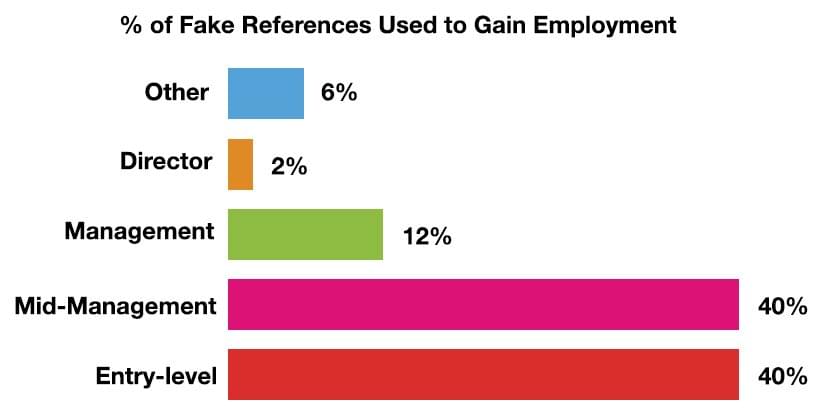
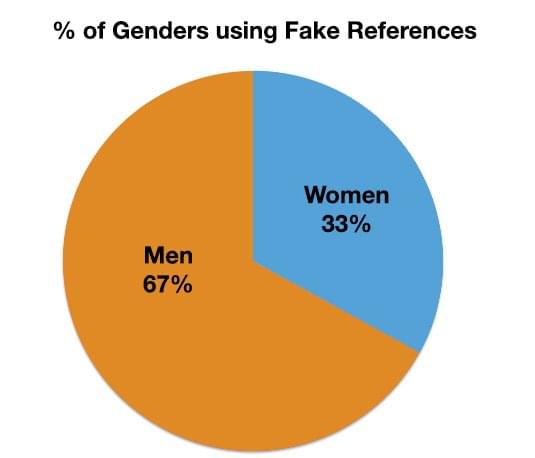
Astonishingly, the survey showed that 17% of the 1,000+ companies surveyed, found that some of their employees (and particularly those at mid-level) had provided fake references when applying for their jobs. Of that seventeen percent, 76% had received fake references from applicants on more than one occasion! However, the BBC were quick to point out that the true figure associated with employees providing fake references is likely to higher, as the survey found that the majority employers don’t actually check references thoroughly.pinkpanther(lyingdown)fake referencesWhen broken down, fake references were primarily used by those seeking entry and mid-management jobs, but worryingly, 12% had provided fake references for management positions and 2% for roles as company directors! Men were also twice as likely to provide fake references than woman.fake referencesfake referencesBut the most worrying fact of all, was that 70% of companies were not even aware that this type of service was available to candidates daring enough to seek it out and use it.


How Fake Employment References Work

fake referencesFor a small fee (around $150), CareerExcuse.com for example, promise to not only craft an elaborate fake written reference based on your exact job specifications, but they will also provide a live HR operator, a staged supervisor as well as a fully functioning fake company website, complete with a local phone number and a toll-free fax number. The company will even go so far as to ensure fake businesses show up on Google Maps!

Deceiving hiring managers isn’t particularly difficult” according to the site’s founder William Schmidt. That’s because almost half of the reference inquiries he receives are from 3rd party staffing firms that are hired to do the initial round of vetting for a company. And most of those companies, tend to follow a standardised script when assessing potential employees, a script that Schmidt knows and can therefore manipulate to his advantage. The process is made even easier for Schmidt, when you consider that the most common form of employment verification method he tends to encounter is just the filling out of a form that involves little to no human interaction. All he has to do is fill it out with notes about how wonderful the employee is, and send it straight back.

When DailyDot writer, Aaron Sankin, paid CareerExcuse.com to create a fictional accounting firm to back up his false claims of being a qualified staff accountant, he was shocked and amazed by just how impressive the operation was:

When my editor contacted the number of Thomas, Pickford & Thomas (a fictional accounting firm) provided by Career Excuses for employment verification, an automated message system directed him to a series of extensions. He was transferred first to a receptionist, and then another one named Jamie from the office of my supposed supervisor, Jack Ford. He was told to fax his verification request to an 888 number, but kept pressing for call back instead. Not long after he got off the phone, I received an email detailing the conversation, informing me that someone had inquired about hiring me. My editor repeated the process, and around it went again, circling back ad infinitum like an animated GIF. The scale of the operation and the attention to detail was impressive. The company has created a Kafka-like labyrinth for recruiters to navigate through, all seemingly purposeful on the surface.

But while CareerExcuse.com seem to have some lines they won’t cross when it comes to providing fake references i.e the service won’t impersonate an already existing company and refuse to provide recommendations for fields where someone’s life could be at stake, as with firefighters, private military contracting, and doctors for example, others lack any moral fibre.

Just how far do the lies extend?

fake refrencesIn an test to see whether the website TheReferenceStore.com would willingly provide them with a reference for a school janitor, a role that involves close interaction with children, all the BBC’s journalists had to do was fill out a form with job specification details, wait 24 hours, and sure enough, the website responded by saying they would be happy to provide the journalist (posing as a job seeking janitor), with a reference for the position. So, for a fee of just $190 or £115, not only was a fake reference provided, but also a bespoke website for a fictional school.

When asked to access the quality and convincingness of both the reference and the website, Acorn Appointments, a specialist education recruitment agency, were astonished by the level of attention to detail. The website for the fictional school included details of the school’s “50 year history“, the families the school has served, the organisations and universities the school has relationships with, information on primary and secondary level education, and even the school’s admission policy. When Acorn emailed the “school” to request a reference for their “janitorial applicant“, it arrived within 24 hours and everything from the “former employee’s” key duties to performance details to their sickness record were laid out. The website had even gone so far as to ensure that not everything on the reference was perfect.

It’s actually quite shocking that somebody, for a very small amount of money is, within a very short space of time, able to falsify their career and go and get one, two, perhaps more references and seek employment in a school, working with vulnerable children” said Bill Andrews of Acorn and indeed, it certainly begs a pressing question: Are you sure your candidate is who they say they are?

How can I be sure my candidates are genuine?

fake referencesIronically, both CareersExcuse.com and TheReferenceStore.com want to be sure their employees are who they say they are, and insist that any applicants “certify that the information on [their] application is correct and [they] understand that any misrepresentation or omission of any information will result in [their] disqualification from consideration for employment or, if employed, [their] dismissal.” Oh the irony!

But how can you be sure your potential candidates are who they say they are? Well, long story short, it isn’t easy and the process can be a costly one. But if a hiring manager simply does a Google search for the companies an applicant lists on his or her résumé, makes a couple of phone calls to that company, and speaks to someone about the applicant, any falsehoods are likely to pass under the radar. In order to catch a faker, you should ensure you complete a number of checks:

1. Engage a reputable background vetting service

It’s expensive in some cases, but the results that a professional background vetting service, adept at identifying fake references provide, are second to none. Reputable services will also provide some type of guarantee in their statement of work.

2. Validating the candidate yourself

If you plan on doing the validating yourself as a company, there are several steps you can take to arm yourself against fakers:

  • Personally look up the reference the candidate has provided you with via LinkedIn or some other database, and confirm via the information on the person’s profile that he or she worked at an organisation at the same time as the candidate. If possible, look for common connections who can confirm the identity of the reference and or the company in question.
  • For more important positions, try not speaking with the references provided by the candidate, but instead asking the candidate’s references who else the candidate worked for or with, and then contacting that person. Secondary references are often much more reliable and if the reference can’t provide you with a secondary reference you may be on to a rat.
  • At the end of interviews, ask candidates to review their CV/résumé one final time for any errors and specifically mention their references. Then ask them to sign the resume. If a candidate signs their CV/résumé they are confirming that their references are real, and a signature confirming the fidelity of their claims will be legally binding. When faced with the prospect of fraudulent charges being brought against them, they may think twice about the references they provide!
  • Ask the candidate to provide the names of three coworkers in addition to the reference and be sure to note aspects of the coworkers’ details like the area code of the coworkers phone numbers. Do they correlate with the area the alleged workplace is based?
  • Don’t underestimate the power of the telephone. Phone reference checking will provide you with a lot more detail than a completed written form. You can read a lot more into what someone doesn’t say, than what they do say. Hearing someone talk for even a short period of time can also confirm your perceptions of the reference’s quality.

All of this might seem like a lot of extra work in the hiring process, but this kind of diligence might help you avoid hiring people who jeopardise the trust factor even before they walk in the door.

Read more at Social Talent. 

siofraAbout the Author: Siofra Pratt is a Digital Marketing Executive at Social Talent, which she originally joined as an intern in May 2013. In her current role, Siofra manages inbound marketing & content creation, social media management and advertising for Social Talent and is the voice of the Social Talent Blog.

A former banker, Siofra holds an honours degree in Commerce and an honours Masters in Creative Advertising.

Follow Siofra on Twitter @Sioffy or connect with her on LinkedIn.

Building An Employer Brand: Who’s Telling Your Story?

tmpWhen candidates investigate an employer, they are interested in the company’s reputation, culture, the people who work there and whether the salary and benefits are competitive.

But they’re not necessarily looking to employers to share this information. With conversations happening across social networks and platforms, candidates are increasingly getting information about an organization from current employees or other third-party sources.

While official communication still has its role, manufactured messages are often met with skepticism. Candidates are often cynical about company-generated employer brand messaging, which is why current employees or a trusted third-party can be a powerful competitive differentiator for recruiting.

For example, Amazon is a pioneer of the third-party endorsement strategy, having built its business by sharing customer reviews and purchases of products, books and movies.

While third-party endorsements are powerful, their value is extended when they come from someone a job-seeker knows. Activating your company’s internal workforce as part of your recruitment and employer brand strategy can create a powerful set of brand ambassadors, each of whom can deliver high-impact messages about why your organization is a great place to work.

With first-hand knowledge of what it takes to fit in and succeed at your company, brand ambassadors can identify candidates with the right skills and experience, in addition to promoting openings.

5 Ways To Transform Employees Into Brand Storytellers

So, how do you get your internal workforce to tell your brand’s stories?

1. Give your blessing: Some employers still block social sites, but this can be shortsighted. Like it, or not, employment conversations are happening on Facebook, Twitter and LinkedIn. By not enabling your employees to participate on the company’s behalf and during business hours, employers are missing a major opportunity to influence potential candidates and connect with top talent.

If you don’t want to empower employees to actively post on the company’s behalf, at least give them the thumbs up to “like” the corporate Facebook page and share job openings with their networks. Create and share policies for social communications and guidelines for how to share employment brand messages.

2. Know your brand champions: You don’t need an army to amplify your messages; a few influential individuals can help carry your recruitment communications forward. Finding, training, and empowering these people may seem daunting, but it is well worthwhile. Look for people who are already recognized by their colleagues for their passion, energy, and leadership.

Train them on the proper use of social media platforms, the key brand pillars you want to emphasize, and on the use of photo and video tools readily available on their smart phones.  Provide employees with conduits through which they can share their insights and experiences and ensure they understand that you encourage them to do so. Show them you trust them.

Successful social media campaigns are about storytelling. Allowing candidates to experience the organization through the eyes and experiences of current employees is a powerful, and authentic, way to deliver the brand and the culture. When employees share real stories about their work, their colleagues, and their experiences, candidates can visualize the experience and have an emotional connection to why the company is a great place to work.

3. Tap your employees’ connections: Looking for a Ruby on Rails programmer or a community manager with experience in the U.K.? Chances are, if someone in your company possesses those qualifications, they know others who do, too. Leverage employee relationships in alumni or special-interest groups. Employees who already have established networks and relationships will be perceived as credible within those communities when they tell others your organization is a great place to work. Employee referral programs are a great source of candidates.

4. Rack up reviews: Reviews written by current or alumni employees provide insider knowledge of an organization’s career development opportunities, culture, management style, and rewards. Trail-blazing employers are encouraging employees to endorse their companies on review sites like Glassdoor and LinkedIn. These reviews provide candidates with real insight and help promote these organizations as great places to work.

5. Offer incentives to influence participation: Want to get people to plug your company into conversations on Facebook, Twitter and other social networks? Give them an incentive! Reward internal ambassadors for sharing your employment brand messages, referring people from their networks and participating in your recruitment successes.

Getting other people to tell the story of why your company is a great place to work can be an effective recruiting strategy. For passive and active candidates who want to learn more, what better way than to get information from people who live the experience every day?

Learn more from Meshworking by TMP Worldwide

steveehrlichAbout the Author:  Fueled by an addiction (and brand loyalty) to Diet Coke, Steven Ehrlich has spent the past 18 years as a complete “tech geek.” As an early adopter of everything from the Apple Newton and the Compact Disc to Satellite Radio and the iPhone, Steven has focused on the use of emerging tools and technologies to enhance both brand articulation and recruitment for a multitude of organizations including Yale University, Exelon, Walmart, and Enterprise Rent-A-Car.

Steven is constantly on the move, both in the office and out, working with TMPers and clients alike to explore, develop, and implement strategic initiatives leveraging social media, new technology, and innovative employer brand delivery channels. He is one of the agency’s thought leaders and is often found in front of a crowd – large or small – yakking away about some new thing-a-ma-jig or a socially-enabled whos-a-what-sis.

At TMP Worldwide, Steven has met some of the brightest, hardest working, and talented people with whom he has ever had the pleasure to work. He is an advocate and brand evangelist for the agency and loves coming to work every day.

Follow Steven on Twitter @99GR81 or connect with him on LinkedIn.

The September Issue: Fashionable Thinking and HR

bradIf you’ve seen me at a conference, this is going to be hard to imagine.  But when I was immersed in the world of Fortune 50 HR departments, the professional equivalent of a home ec class, I thought the best way to fit into a world where I was an obvious interloper was by simply dressing the part.

I was a sweater vest aficionado, preferably anything in Argyle.  The socks, naturally, matched whatever pattern I happened to be wearing – a fact that makes me want to go back in time just to kick my own ass.  I had 10 pairs (or a laundry cycle’s worth) of Express for Men Producer pants, and a revolving rack of Banana Republic button up shirts.  Plus I always had some cardigan ready, just in case it turned chilly. I wish I could go back and kick my own butt, frankly.

My old boss used to actually call me “Brad” (which got old when she stopped using my real name entirely) after the flamingly fabulous fashionista famous for his role as stylist Rachel Zoe’s sidekick (see pic on left).  That sentence alone is cause enough to mandate my surrendering my man card.  But it was an accurate moniker, since “Beau Brummel” or “Little Lord Fauntleroy” are kind of archaic, if equally accurate, references.

I looked at labels and paid for the privilege of building someone else’s brand equity (“check out my new shades – they’re Armani. Emporio, not Georgio.”)  I got a subscription to Vanity Fair (which I still have, but less for the September Issue and more for Michael Lewis).  I actually went to Fashion Week, where I learned that violent was going to be the next big thing.  And this was well before Instagram or Facebook photos, so this wasn’t for show. It was part of my strategy of making it in HR as a dude, because while we talk about the theoretical construct of gender diversity, truth is that there’s about as many men in HR as your average Tori Amos concert.

I thought that fashion was my key to business success, mainly because I could relate to the women around me, who seemed so preoccupied with it, the perpetual topic of conversation in every HR meeting or even hallway encounter.  No shit – you’re worried about getting a raise, and the person responsible for signing off on it is probably preoccupied with last month’s Marie Claire.

Which is funny, because while it was a constant subject of conversation and fascination – I actually got to go to executive leadership meetings in exchange for dressing in the CHRO’s favorites of the aforementioned outfits at one employer – HR ladies have less actual fashion sense than your average 4H member.

I say this anecdotally, based only on 4 multinational employers’ HR groups that I personally experienced, which is 200 or so HR Ladies, tops (a small sample by volume, if not by weight). While HR looks like a pair of Payless shoes, they spend their time pretending they’re Prada.  It figures fashion is always in fashion with your general generalist.

How things look on the outside instead of how they really are on the inside isn’t a phenomenon that came to companies with employer branding – it’s been a core HR competency since the day the term “Human Resources” came to replace plain old “personnel.”  The ubiquitous use of the word “talent” to describe anyone pulling a paycheck points to proof of this phenomenon.

HR is an insular world, and that I thought what any designer was doing for any particular season was relevant to my life underscores what I discovered the first  time I put on “modern fit” dress slacks.  It might look good superficially (well, used to), but ultimately, they’re a little too restrictive to ever truly be comfortable.

The silo of stilettos and girl talk that was the universal culture of sitting in a big company’s “center of expertise” (not that there was any expertise in said HR centers) are, by design, isolated outposts far from where the workers they work with actually work.  Employees actually had to put up their badges to a camera at one company to get into the recruiting department’s waiting room.  External candidates actually had to go through a metal detector before they even let them enter the building.

Talk about candidate experience – try getting patted down for an informational interview.  That you could see the CEO more easily than your business partner if you were a mid-level manager at that particular employer should tell you something.  At another employer, recruiters literally had to candidates in and out, with a secure door separating the reception area from the waiting room.  At least once they ran the gauntlet, we were dressed professionally enough to abide by the 8 paragraph long policy about work attire in the employee handbook, far longer than the one sentence dedicated to employee intellectual property assignments (hint: they surrender them in perpetuity).

But, you know, employers can get away with that shit, somehow – probably because that’s precisely the kind of policy HR creates, enforces and obsesses over. If they didn’t, they’d likely open themselves up to obsolescence, and it’s pretty hard to afford Lane Bryant shopping sprees without a salary.

Employee Engagement: 7 Key Steps For Success

employee_engagement_tipsIf you’re in HR, you already know the correlation between employee engagement and employee performance; studies and statistics repeatedly prove engagement to be the critical driver for productivity, satisfaction and ultimately, company growth.  Once an employee becomes actively disengaged, however, it can be close to impossible to get these workers back.

That’s why there’s no better success strategy for increasing engagement than by building this benchmark into the very beginning of the employee lifecycle: recruiting.

Employers should want to hire people whose passion, energy and values align with the company and culture; for optimal employee engagement, screening for skills should be secondary. This is why candidate assessments are such a valuable tool for building employee engagement, allowing recruiters to embed behaviors and values into the talent acquisition and selection process.

By hiring for fit and training for skills, new workers will not only be a better long term fit, but also allows new workers to onboard and become inculcated into an organization much more quickly. Recruiters and hiring managers should focus these candidate assessments to uncover the candidates with the right mix of great personality, great sense of humor, great people skills and great emotional intelligence. After all, every candidate could be a future co-worker – and it’s important to keep in mind the kind of person you actually want to work with when assessing candidates for fit.

Here are some 7 key steps every recruiter and staffing practitioner needs to know about how to grow employee engagement (and the bottom line):

1. Get Employees Involved

It sounds obvious, but the first key to increasing employee engagement is simple: listen to your employees. Sure, most companies provide some sort of standardized survey for gauging engagement and accumulating feedback, but this anonymous, aggregate data doesn’t always paint the most accurate picture of employee engagement.  Believe it or not, simply sending a survey might generate some actionable input, but these strategies are designed primarily to measure employee engagement, not grow it.  The key to growth lies in personalizing the feedback experience, particularly in one on one interactions with their managers, internal stakeholders and even HR.

Apart from providing an opportunity to provide praise and reinforce appreciation, workers want to know how valuable they are to the organization – and what their leaders and managers really think of them.  Be honest, be open, and most of all, be open minded to their insights and observations. Keep it conversational, and you’ll immediately improve communication by setting an important precedent for personal interaction.

2. Assess Current Employee Engagement Levels

As mentioned above, if you want to programmatically improve employee engagement, it’s crucial to know where your organization currently stands. That means having a baseline for evaluating your progress at improving employee engagement. Whether through standard surveys or other feedback mechanisms, knowing where you stand can help you identify initiatives and build a business case for employee engagement. After all, actively engaged employees boost your bottom line profits, while actively disengaged employees can sabotage productivity, erode employee morale among colleagues and coworkers, and ultimately cost businesses money, not to mention opportunities. By way of a benchmark, a healthy ratio for employees who are engaged vs. actively disengaged should stay around 8:1.

3. Give Employees A Reason To Get Engaged

One of the key drivers of employee engagement is helping employees understand the reason behind the work that they do, and how their individual efforts contribute to the bigger business picture.  Even if employees know what they’re supposed to do on a daily basis, it’s important to remind them why they’re doing that work in the first place (and why it matters).  Everyone wants to feel they’re doing meaningful work which serves a meaningful purpose. Without that alignment, employees tend to lose motivation, not to mention the drive to deliver anything above and beyond basic expectations. As a talent manager, make sure that you not only provide direction and delegation, but the meaning for the tasks you assign and why they are being selected for these tasks. It’s a great time to reinforce top talent while developing skills for long term success.

4. Empowering Employee Engagement

eepicSome companies, particularly those with a more established, rigid and conservative corporate culture, can have a hard time recruiting, retaining and developing the younger employees who represent the emerging workforce. Studies show Gen Y workers want dynamic leadership and a culture that provides for personalized interactions and professional growth.

One way to improve employee engagement is through employee empowerment, particularly by providing self-driven learning and development opportunities. Online, mobile and on-demand training offer employees a chance to expand their skills, which increases not only employee engagement, but also, employee performance.

5. Connect People

In today’s world of work, many teams are remote or geographically diffuse, meaning that it’s increasingly common to have coworkers and colleagues on opposite sides of the globe.  There are many benefits, of course, to building a distributed workforce model, but the downside is often that virtual work can remove the sense of team spirit, camaraderie and shared purpose that often organically occurs when everyone is working in the same office.

While getting together your team or employees in person might prove impossible, it’s important to utilize technology to enable employee engagement by connecting people.  Technology can encourage communication, collaboration and remove the sense of isolation that’s often endemic to virtual workers – and build employee engagement by demonstrating that out of sight doesn’t mean out of mind.

Remember: no one employee should ever feel like they’re on their own.

6. Leading Employee Engagement By Example

One key factor determining employee engagement (or lack thereof) is how the front line worker views senior management and executive leadership. With layoffs, outsourcing and offshoring increasingly affecting employers, workers can feel that these hard business decisions demonstrate that management cares about profits more than their own people.  This kind of thinking is fuel on the fire for fostering active disengagement. The key to turning around employee engagement is to investigate and implement programs that directly benefit employees and demonstrate a commitment to their welfare. Some examples include ongoing training, personalized development plans and individualized career roadmaps. Make sure management has a direct hand in providing regular feedback and communications; employee engagement happens when workers feel like they’re valued, and leaders’ actions must reinforce this fact.

7. Make Employee Engagement A Continual Process

Any employee engagement program implemented to provide a short term solution or one-time fix is doomed for failure. Employee engagement is a dynamic, ongoing and critical measurement of your organization’s health, which requires continuous planning and flexible strategies for long term improvement. Research studies show that employee engagement leads to happier, more productive employees who provide better customer service and typically stay with companies longer than their disengaged counterparts.

That all adds up to better business results, more profit and a sustainable competitive advantage for companies who can effectively keep employees engaged.  It’s not just in their best interests as employees – it’s in your best interests as a company, too.

unnamed (2)About the Author: Davis Miller is part of the editorial team at PeopleInsight, a UK-based provider of employee engagement solutions and expertise for administering and measuring employee engagement surveys. the writer to this article.  

A freelance writer specializing on business related topics, Miller is a regular contributor at many top sites for human capital management and small business.


Cool Tools Quickie: Riffle

Everything you need to know about Riffle from the Cool Recruiting Tools experts, Craig and Lars.


We demo Twitter user stats app Riffle. Social aggregation and twitter profile data by CrowdRiff, Riffle is a Google Chrome extension that integrates with all major social media dashboards, including Hootsuite. Find Riffle atcrowdriff.com/riffle/

Check out more cool tools at our blog on www.evolverco.com or watch this quick video demo.

Shutterstock Shudders: Why Stock Art Is Killing Creativity

I’ve been working in design for about 15 years and one of the biggest rises to prominence has undoubtedly been the use of royalty-free imagery.  It has grown hand-in-hand with the amount of image-based websites – I remember when I first started working in design in 2000, although websites were far more basic and used very limited imagery, the concept of using stock photos, icons et al seemed alien amongst designers.
Even about 8-10 years ago we weren’t using stock art or canned imagery. Need an icon? Draw one yourself.  Want to find a set of arrows that match your client’s brand identity? Draw them yourself!  Got an idea? Don’t search it…design it!

In fact, I’m going to outline some of the worst stock art habits which are becoming increasingly common amongst not only weekend website warriors and Wix users, but even endemic among professional creative designers and marketers.

Can you relate to any of them?

Women Laughing Alone with Salad (a.k.a. Generic People)

A personal favourite. It’s unoriginal. It’s cringe worthy. It’s downright misleading. Salad is not that funny.


Salad Stock Photos

The problem at hand here isn’t people and salad, but about the lack of creativity when it comes to marketing a product. Another guilty party? Pizzas.


Pizza

I enjoy pizza as much as the next person but apparently not as much as these Shutter-stockers. If you’re designing a website for a pizza company, you should be showing off your own kitchen, dining environment and overall brand, rather than some heavily made-up people with pearly white teeth eating a suspiciously-photoshopped looking pizza (ever seen how McDonald’s make their food in adverts?).

Inane Icons

I’ve got nothing against using these in principle, but it’s so obvious when a website is using stock icons with no bastardization – that is, changing the colour scheme to match the brand or personalising them. Unique icons add so much extra value to a site – take a look at Müller’s, one of the top dairy distributors in the UK:

Muller Logos

The dairy theme is prevalent and is in-keeping with Müller’s brand – far more appealing for a prospective candidate than if they used a stock image of a van or a set of cogs with no individualisation.

Conceptless Concepts

My colleague recently wrote a great piece on the concept of gamification in recruitment and was curious about what would show up when he typed ‘gamification’ into Shutterstock. Some pretty rubbish results to be honest – take a look!


 Gamification Signs

Seriously, what have street signs got to do with gamification?

It’s good to know that I’m going the right way towards gamification on an imaginary road. This sort of stock imagery really harms the creative process – I’d much rather design my own image than use one of these monstrosities. Needless to say, my colleague shunned these too!

Is it killing our creative spirits?

Without a doubt, stock imagery has been a great time-saver when designing websites. They work perfectly as placeholder imagery when presenting websites to clients in alpha stage, but from then on, the right amount of work must be put in to conceive a bespoke design. And by the very definition of ‘stock imagery’, that can’t be achieved with, ahem, stock imagery in an unadulterated form. In the creative industry, there has been a dangerous lean towards laziness – something that is antonymous to the word ‘create’. If we’re not constantly pushing ourselves, we’d still be using websites like this:


BBC Homepage


Almost every web designer uses Shutterstock to some extent – but for me, the challenge is how to use Shutterstock to complement and benefit the website being designed. If I need to, I will spend an extra 30 minutes looking for that perfect icon – that I can then customise further, rather than just searching ‘people icon’ and choosing one of the first few results. It’s down to the designer to ensure laziness doesn’t creep in.

Next time you use a stock art database or image agency, ask yourself this – does this photo really sum up what I’m trying to achieve?

Read more at the 4Mat Blog.

2b9ba19About the Author: Neil Calcutt is a Senior Designer at 4Mata leading recruitment marketing and online recruiting firm based in the UK. 

A graduate in Visual Communication – Graphic Design at KIAD (Maidstone) in 2000, Neil has amassed over 14 years experience in advertising, branding, corporate identity, digital, marketing, packaging, retail POS and websites.   Neil has worked for some of the best design agencies throughout his career. He has a passion for design in the field of branding and typograhpy.  

Before 4MAT, Neil worked for agencies such as Ogilvy One, Fruition London, Dr Martens, FKC (Fox Kalomaski Crossing), Porter Novelli and The Football League. He is responsibility for hitting a client brief and the exposure the brief to a diverse client and project base.

Follow Neil on Twitter @calcky9 or connect with him on LinkedIn.


Like Mike: How To Become A Talent Marketing Superstar

just-do-itThe best recruiters complement their talent acquisition efforts with talent marketing and employer branding initiatives to keep their talent supply chain healthy.  Unfortunately, it takes a lot of work and time to create great talent marketing campaigns.  You know, talent marketing campaigns that successfully build your employer brand (and candidate pipeline) by:

  • Using beautiful images and infographics that attract the eye of job seekers
  • Providing professionally designed freemium content like eBooks or white papers
  • Highlighting the great work of your engineering or technical team (like this post from ZocDoc)
  • Using the right Twitter hashtags to ensure job postings are seen by the right audience

Unfortunately, these employer branding best practices are rarely implemented because there just aren’t enough hours in the day.  So “talent marketing” ends up meaning “re-posting jobs to social networks” – and not much more that that. But don’t give up on talent marketing just yet.  I’m going to let you in on a little secret.

i-dont-always-have-money-but-when-i-do-i-got-5-on-itGot Five On It: The True Cost of Talent Marketing

Let’s imagine that time was no object and you actually had hours to spend crafting resources for your candidates. Not only that, but let’s also imagine that you magically learned how to code, produce compelling videos, and design awesome graphics.

With your (now) unlimited time and these new skills under your belt…you’d be a talent marketing superstar.

You’d be able to easily and rapidly create all sorts of really useful talent marketing resources, like:

  • A slick new WordPress theme for your personal or professional blog
  • A new Careers page that highlights all of the cool stuff your company is working on
  • A whiteboard animation about what it’s like to work at your company for posting on YouTube or on Vine
  • A great infographic about recruiting trends
  • An eBook about something your candidates care about
  • A devastating crossover dribble (just kidding)

The best part? It only costs $5 (or 3.72 euro, or 2.97 pounds, or 512.95 JPY) to become a talent marketing superstar.  And you’ll do it by using something called Fiverr.

Fiverr is a marketplace where you can access low-cost creative, administrative, and technical services. Their marketplace consists of ‘gigs’ – in essence, short freelance jobs – all of which have a starting price of $5!

Here’s a great description of the power of Fiverr from one of my team members:

“I’m not a graphic designer, but I create compelling imagery. I’m not a developer, but I can modify CSS and HTML. I don’t have time to listen to audio and carefully write it out, but now I can quickly transcribe it. Through Fiverr, I hire people for all of these jobs, and for less than the price of a coffee.”

Talent Marketing: The Seven Step ProgramFiverr

I’m assuming by now you’ve grabbed a few $5 bills from your wallet and you’re itching to get going. Here’s what you need to do:

  1. Come up with a strategy. Think about what kinds of resources would be most useful to the kinds of candidates you’re typically recruiting.What resources could you build with some help from the people on Fiverr? Let your imagination run a little bit wild. Then pick one you’re really excited about.
  2. Visit Fiverr and browse through their services to bring your idea to life. Make sure your seller has high ratings from other buyers. Send them any questions you might have to see if they’re a good fit for your project.
  3. Do whatever prep work your Fiverr gig might require before buying so your seller can get right to work. If you’re going to hire someone to format your eBook, you might want to write it first. Pro tip: Here’s an example where Scott Britton had a ghostwriter turn a bunch of emails into a full manuscript.
  4. Buy the gig. Sit back. Relax. And be confident you’ll have something awesome to share with your candidates soon.
  5. When the seller comes back with a completed product, let them know about any changes it may need. If you don’t give them a 5 star rating, they’ll almost always ask you how they can revise your order to make it better.
  6. Incorporate the work from Fiverr into your final product. For example, if you had the Fiverr seller create you an awesome image for your Careers page, you’d need to put that image up on the page.
  7. Wait for a pat on the back from your boss. Not many recruiters are able to switch from recruiting to talent marketing in the blink of an eye. Well, except you!

Don’t stop there!  With the army of sellers from Fiverr at your disposal you’ll be able to move faster with almost any project you’re working on – personal or professional. Now you’re a recruiter AND a talent marketer.  And you didn’t sacrifice your hiring goals in the process because you’re using the army of folks on Fiverr to help you get stuff done.

So if you wanna be like Mike and transform yourself into a talent marketing superstar, three words: Just Do It.

Read more on the Hire Nurture blog.

john gannonAbout the Author: John Gannon is CEO and co-founder of HireNurture, a SaaS platform that automates talent marketing and relationship management.

He interviews startup leaders at StartupCareerAdvice.com, wrote the Amazon 5 star rated book Road to a Venture Capital Career, and is a guest author on leading careers website The Daily Muse.

His latest book, Finding Startup Jobs, will be published next year by FGPress.

Follow John on Twitter @JohnMGannon or connect with him on LinkedIn.