Blog

HR’s Dirty Little Secret

PR peopleAs the dust settles post Ashley Madison hack, it has left quite a few people with a public relations problem. Having worked on PR teams before, I can imagine there were a lot of publicists for the rich and famous searching for their clients in the database to try and get ahead of the story. See, the thing about PR people depending on their role, but especially when their client is in the public eye, is that they always want to be ahead of the latest headline. Knowing what you’re up against is half the battle.

If you’ve never experienced a publicist in real life, think of it like the role of Olivia Pope on Scandal. The one question her gladiators always asks, regardless of who the person happens to be: “is there anything else I need to know.” And every time someone withholds information, there’s a vicious backlash and an inordinate amount of coaching that has to happen to make sure they’re playing the right cards to win the favor of the public back.

The goal on the show and every day for PR is to only have one negative headline, not a rolling headline – where your client is on the homepage of every TMZ-esque site for weeks at a time. Why does that matter? Well, it’s easier for someone to come back from a one time issue and seem sincere in an apology and their intent to do something better if you can’t prove a track record of fucking up. It honestly just makes it worse to have a new story every week.

Digging A Hole

Duggar ditchCase and point: Josh Duggar. He has easily fallen the farthest of the names leaked. In fact, I feel for their publicist – even if I have to assume that he or she is a conservative bigot for ever signing on to do publicity for a family who got famous for skimping on birth control and supporting overly conservative organizations. It’s safe to say that publicist and Josh have had the worst last few weeks. To begin, a police record was released from many moons ago that revealed Josh inappropriately touched several girls, including two that were his own sisters. That’s disgusting but somehow, someone convinced these girls to go on the Today show and tell they world – to quote 2Pac – I ain’t made atcha. I wanted to throw-up writing that because I have to assume that convincing, of course, was the job of their publicist. A disgusting, awful human-being of a publicist.

But, the downward spiral didn’t stop there. Shortly after this news started to settle down, Josh’s name was found in the Ashley Madison hack. Suddenly, the world realized he wasn’t a boy who needed forgiveness but a man who made a mistake the general public wouldn’t condone. How cheating on your wife is worse than sexually assaulting young girls is beyond me but if you’ve read any of the Facebook or blog posts released by family members, that’s really what sent his in-laws and siblings over the edge.

The latest update? Josh is now in rehab trying to atone to his sins. I, of course, just stopped to sing a little Amy Winehouse in my head because I’d bet Josh said “no no no” to heading off to rehab. Fun fact. Rehab? Most likely a publicist’s idea too. It’s their job to find a way to bring Josh and the family back into the limelight and rehab is perceived as him putting effort towards fixing himself.

Besides making it obvious to all of you that I read a few too many trashy magazines, I do have a point. HR, too, has a PR problem.

HR has a PR problem.

Now, to be fair, this is not a Josh Duggar kind of PR problem, but a PR problem no less. HR is perceived as less of an industry of choice and more of an industry of annoyance – at least that’s word on the street. I’m not saying it’s fair, but it does exist.

annoyingOver drinks at HR Florida just a few weeks ago, I was sitting with a group of people who either managed HR or currently work in HR and let me tell you – even their opinion of the community was bad. From the general comments on physique (“why are most HR ladies fat and white?”) to diversity questions (“wait, where’s the diversity?), it was pretty obvious to me – the outsider – that HR doesn’t even have a good reputation amongst their own. At least the conservatives rally together to protect their own. HR? Not so much.

And much of the underlying issue, at least it appears to me, is how HR talks about their role to each other – and how that translates to the rest of the company.

Perception is Everything

PerceptionSee, a public relations problem always starts with perception. When I started my career, I thought HR was a confidential resource, a confidant, the person who knew everything and could help me build my career. In fact, I’d say I thought of them as the center spoke. HR helps people get great jobs and changes lives. It’s the only function in the business that’s solely dedicated to building great cultures and great teams while the rest of us benefit from their labor. I thought HR has tact, grace and elegance. They know how to manage people and can help everyone in the organization to do better. I have worked with a few HR people who have absolutely met that expectation but I’ve switched companies and HR reps often enough to know that broadly, this just isn’t the case.

Rather, HR is widely known as an annoying babysitter of sorts. While appreciated by senior leadership – the “parents” of a company – as kindly taking care of the dirty work and keeping jobs filled and “best place to work” awards filling the walls, the kids aren’t so complacent. I’m sorry, we all really do appreciate that you are getting our benefits set up and direct deposit but generally, I know that talking to you is trouble. If we’re talking more – that’s a bad sign.

And who really likes talking to the annoying babysitter anyway? No one. The reputation is also associated with being a gossip and no one wants their business spread around. I’ve even overheard an HR team gossiping about pending layoffs. HR departments have dug a bit of a hole for themselves and nowhere is that hole bigger than when it comes to the people “at the table.”

HR’s “Seat At The Table”

seat at the tableWhile the “seat at the table” concept itself is a little cliche, it’s still a concern for these leaders – so let’s get right to it. The bottom line reason I believe HR is not getting their seat at the table is because between all of that gossip and gab, you’re not speaking the language at the table – data. This came up in my bar banter from a former VP of HR. I’m not naming names because I would hate for her boss to read this and cause any trouble but she knows who she is.

So, let’s call her Sally. Sally was a VP of HR until they started doing cuts at her last company and voila – there she was without a job. A year after the layoff and a lot of travel to see her siblings and kids, her dream job came on the market. This job was working for people she used to work with and a 5 minute commute so she applied and accepted the job – but it was a manager role, which means she would now report to the VP of HR. This VP of HR of course had to make sure that her new subordinate would be, well, subordinate and luckily, Sally passed the test and was hired.

Now, this was all well and good until the senior leadership started asking Sally, not her boss, for advice. The VP’s subordinate test did not work and the frustration was building. Finally, a few months into the job, her new boss moved past a series of passive aggressive moves to ask Sally how she already had a seat at the table. And Sally’s answer was exactly what inspired this post.

[quote]“Stop asking for a seat and start speaking their language. No one on our executive team measures anything in warm and fuzzies.”[/quote]

Sally went on to say that metric she brings to every meeting to make sure she’s heard is also the biggest part of the company’s operating budget – payroll. Every week, she brings data about payroll. And if you work in a company where payroll isn’t your biggest expense, I’d be surprised. You, HR, control more budget than anyone else in the business yet you’re still wandering around asking how you get a seat at the table and what data you have to make people think you’re important. You HAVE a seat at the table. The people with the cash will always have a seat at the table and you need to start acting like it.

Like I said, perception is everything.

About the Author: Katrina Kibben is the Director of Marketing for Recruiting Daily, and has served in marketing leadership roles at companies such as Monster Worldwide and Care.com, where she has helped both established and emerging brands develop and deliver world-class content and social media marketing, lead generation and development, marketing automation and online advertising.

An expert in marketing analytics and automation, Kibben is an accomplished writer and speaker whose work has been featured on sites like Monster.com, Brazen Careerist and About.com.

A graduate of Pennsylvania State University, Kibben is actively involved in many community and social causes – including rooting for her hometown Pittsburgh Steelers.

You can follow Katrina on Twitter or connect with her on LinkedIn.

Don’t Start None, Won’t Be None: Build a Better Relationship with Your Hiring Manager.

Don’t Start None, Won’t Be None: Build a Better Relationship with Your Hiring Managers.

Even the most famous of adversaries -Rocky vs Apollo Creed. Donkey Kong vs. Mario.  Dr. Dre vs. Eazy E. – reserve a bit of mutual respect for each other.  It’s the same fora manager.

While recruiters often find themselves in what can be contentious relationships with a hiring manager, adversarial interactions with both parties viewing the situation as a zero-sum game.

The manager/recruiter working relationship operates better as a partnership, but it takes work to get there.  If you are struggling with a hostile hiring manager and need a practical and diplomatic hand to start your détente, watch this webinar.

The fact that recruiters are actually helping hiring managers do their job instead of giving hiring managers another job to do seems like a point that many miss. They blame the recruiter for not surfacing that diamond in the rough, even after submitting dozens of perfectly qualified, interested and viable candidates, and then wonder why it’s taking so damn long to make a hire.

Amy will explore:

  • Why partnerships between hiring managers and recruiters matters
  • Divide and conquer – who takes what role in the recruiting process
  • Leveraging expertise and networks
  • Sell calls and closing
  • Managing pushback
  • How to “sell” your hiring manager so they actively supporting recruiting efforts

Recruiting on A Prayer.

bon joviAnother day, another recruiting tool, and it’s always the same shit. This is the silver bullet that’s going to solve everything. 

The problem with a quick fix, of course, is that these solutions almost never work over the long term, trading superficial style for substantive change. Even the best technology can’t fix flawed fundamentals, or compensate for an incompetent recruiter.

While it’s convenient to scapegoat your shortcomings on the absence of some recruiting system or point solution, the truth is sometimes we just need to accept that recruiters periodically fail for reasons other than not having the right technology.

False promises are easy, but true progress in recruiting takes more than using the right technology. Success really depends on the end user, no matter what tool they happen to be using.

And many of these end users are sick and tired of being deluged with meaningless marketing messages, suspect sales pitches and pithy products.

For many of us in recruiting, the preponderance of platforms and point solutions haven’t made recruiting any easier; instead of solving our existing problems, often they just create new ones instead.

It’s overwhelming, and most of us are feeling decidedly overloaded and overwhelmed by the deluge of emerging and established players, startups, has been and never will be providers, all fighting for the same small sliver of spend.

You Give Recruiting A Bad Name.

1331753823404_378218The noise, frankly, is deafening, and it’s far easier for most recruiters to tune out then opt in when it comes to recruiting and HR technology today.

Besides, we’ve got way more important stuff to do than sit through demos for solutions to stuff that’s not actually a problem.

Not all of our professional frustrations can be commoditized or productized, but that doesn’t seem to be stopping anyone from trying.

Of course, nothing changes – which is why, at this point, with the daily deluge of new product announcements, you can’t help but feel the software fatigue settling in in the industry.

Take CRMs, for example. There are literally dozens of new recruiting focused candidate relationship management point solutions and SaaS suites flooding the market, but despite their efforts to make their offering stand out or seem special, there’s never really anything that’s particularly great (or unique) about any entrants in this category, really.

Sure, there are a ton of options, but with the right end users and the right case use, Excel can be every bit as effective as any slick CRM SaaS stack out there, even if it’s decidedly less sexy. Having the right tool is only half the equation – you’ve got to have the right recruiters using those tools, too.

By now, you probably have the fundamentals in place – the old school tools like applicant tracking system (ATS) or human capital management (HCM) solutions really make all the difference. If your system of record sucks, no point solution or systems integration in the world can truly make shitty recruiting software shine. If that system doesn’t work, forget about making it work better. Focus on fixing the fundamentals, first.

Don’t worry about what’s new or what’s next in recruiting without getting right now just right, right now. For example, if you’re considering buying a profile aggregator or premium sourcing software, but don’t know how to build a basic Boolean string, then you’re more or less buying a solution without actually solving the real problem. And if you’re like pretty much every employer out there, that’s time and money you probably don’t have to waste.

For some reason, tech companies seem to feel the need to build elaborate business cases to justify the importance of big data, but we all know what a struggle finding meaningful metrics or telling a narrative through numbers actually is. The problem at most organizations, though, isn’t not having the right tool to deal with data, it’s not having the right data to deal with in the first place.

You can’t manage what you’ve never measured.

Recruiting & HR Technology: We’re Halfway There.

bon-jovi-funny-bon-jovi-21611388-500-376I know this is hard to believe, but according to Career XRoads, as of last year job fairs still accounted for almost 3% of all external hires – an old school strategy that’s still about about twice as effective a source of hire as social media. Employers still go to job fairs to meet potential candidates, and still make hires from these in person meetings.

Of course, the most advanced technology at most of these events is a spreadsheet and a few ballpoint pens for candidates to fill out, information that’s later mostly manually migrated to an Excel spreadsheet before any additional follow up occurs.

That mountain of paper resumes you walked away with still must be properly parsed and uploaded to your system, but that’s done after the fact, not as a requisite step in some automated screening process. No technology out there can replace a handshake; no algorithm can replace the highly personal art of talent acquisition, only the science of recruiting.

But soft skills are still hard, and nowhere is that more evident for candidates and talent pros alike than at a traditional job fair or offline networking event.

Sure, it’s easy to pitch to a candidate when they’re online or on the phone, but real life is makes or breaks real recruiters. Your mouth is dry, you’re talking a mile a minute, and most of the time your mind is pretty much switched to autopilot, reciting the same company careers pitch by rote, and doing so dozens of times in quick succession.

You’re parched, you’re tired, you’re so sick of your own schtick you disassociate with your body so you can tune out the sound of your own voice saying the same thing over, and over, and over again. We get to the point, at some point in the day, where we disappear, replaced, if even for a moment, by some recruiting audio animatronic perpetually programmed to recite a loop of the same few asinine lines.

We talk to candidates, but we’re too busy tuning ourselves out to hear them, and eventually, all but the best blur together, their faces forgotten, real people with real stories reduced to rows on a spreadsheet or records in a system. So, you set your favorite resumes aside, because it’s just in time all the time in recruiting, and if a candidate is right there’s no better time to start figuring out fit than right now.

Of course, as you fervently follow up with the best candidates outside of the system through direct e-mails and phone calls to get a step ahead of the career fair competition, without any documentation or notes on these candidates, your hands on approach still won’t ensure that other recruiters in your organization keep their hands off those prospects who are already in process.

So they reach out, the candidate gets confused, and you get pissed at other recruiters (and “vice versa”) for unintentionally “stealing” your potential new hire. Everyone’s feelings get hurt, trust gets broken, and relationships get damaged. And for what? It’s really dumb, when you really stop and think about it for a second.

We’ll Make It, I Swear.

bjThe point is, no matter how shitty we think systems are, no matter how inordinately complex or overly complicated recruiting tools may be, they make the work we do work better, which is why it’s up to us to make them work, no matter how much work that might take. Without a method, there’s only madness. And recruiting is insane enough, in my experience.

All of us sit on dozens or hundreds of different data sources, from private folders in our inbox to unshared Excel spreadsheets to candidate prescreening notes handwritten on the margins of printed resumes.

Recruiters have long discovered how to workaround, rather than with, the limitations of their shitty system of record – which means that the more recruiting technology changes, the more business as usual in the business of hiring seems to remain the same: largely manual, heavily siloed and highly inefficient.

And for most individual recruiters, all of this still works great. It’s your candidates, colleagues and clients who are the ones getting screwed. We talk a lot about the concept of the “black hole,” but this phenomenon, in reality, is not the result of shitty systems, but because recruiters so often work outside of them. They become an afterthought for compliance, with many candidates only entering the system after the fact instead of at the front end of the funnel.

If you’re frustrated at your inability to find the right talent, build pipelines, properly segment and engage talent networks or even search for resumes in your ATS, you’re not alone. But what you don’t realize is that while you’re blaming these systems for your recruiting related shortcomings, the technology isn’t at all at fault.

Leave the system out of it. You’re the real screw up screwing up recruiting. Technology is designed to be an enabler, not an excuse. So shut up and learn to get with the system, no matter what system your company happens to be using.

Because at the end of the day, no tool can fix what’s really broken in recruiting – that, my friends, is entirely up to you.

Buying a pre-hire platform is a big decision that can revolutionize the way you recruit. Let us help you do some due diligence for you. If you’re ready to address your biggest recruitment pain points today, it’s time you met CareerBuilder Talent Stream. 

Click here to learn more about the easiest way to integrate all your recruiting technologies into the industry’s most comprehensive (and powerful) pre-hire platforms.

Editor’s Note: The use of Bon Jovi imagery in no way constitutes an endorsement on behalf of the author or publisher, as, in fact, they totally suck. If they are truly wanted dead or alive, in fact, this publication endorses the former option.
Disclaimer: Recruiting Daily was compensated by CareerBuilder for this post. But their data and action items are actually pretty priceless, so in this case, the facts and opinions contained herein do, in fact, represent those of the publisher. Because we’re all about making candidate experience better, too.


7 Awesome Talent / Recruiting Hacks

Recruiting Hacks

So most of us are now reaching out to people directly, shunning the reactive side when they see how much they can accomplish when they go for active reach outs to people who can do the job.Because this is such a qualitative process, people become innovative with their talent / Recruiting hacks. I thought I would share some of my favorite ones.

1. Spotify reach out to developers

First, take a look at Andre Hellström‘s  Twitter page. Ladies & gentleman meet Andre Hellström, Recruiter @ Spotify and one of the most creative talent / recruiting hackers I have seen in my career. Famous for: ‘I used to be a recruiter like you, then I took an arrow in the knee’. Check this shit out:

2. Unclegray.dk hunting for developers in online game Team Fortress 2

This one is pretty classic, also featured in my first ever sourcingmonk blog post and still one of my favorites. Check this shit out:

Brilliant idea by Daniel Nicolajsen, Unclegrays’ former Art Director.

3. Find almost anyone’s email address on Github

The Github API is so open you can virtually get anyone’s email address out of it who did a public commit over the last 12 months (even the people who hide theirs). Pretty neat talent hack.

Go to https://api.github.com/users/XYZ/events/public and replace ‘XYZ’ with the username of the guy. ⌘ + F Email and voilà, the email. Or automate it, check this shit out:

4. Javascript bookmarklets to quickly cross reference people

Add this simple Javascript to a bookmarklet, the text you will select will be found on LinkedIn. You can also use these for Github, Stackoverflow, etc., etc.:

javascript:(function(w,d) {w.open('http://www.linkedin.com/vsearch/p?keywords='+encodeURIComponent(d.getSelection()), '_blank');})(window,document);

Check this shit out:

5. Using your WiFi to let talent know you are hiring

When I was in Atlanta I did this simple hack; my Mac was discoverable on open networks with the name: ‘Do you code Javascript? Come see the guy with the long hair ;)’

And my phone was sending out an SSID with the name: ‘Javascript pro? Come see me (knot)’

Also, Jobbox.io is sending out a strong WiFi SSID in their building, well done Pedro Oliveira:

FireShot Capture 5 - Pedro on Twitter__ - https___twitter.com_pcbo_status_563391490979016704_photo_1

6. Stackoverflow SQL search

This one is not for the “normal” people out there, so I urge you founders, CTOs & managers to get you brightest SQL guy and write you some queries. Check this shit out:

7. Billboards next to competitors buildings

Old, but I like it. Check this shit out:

The billboard was placed in front of a competitor’s building. The headline tells (in ASCII code): “Now Hiring”.

Recruiting Hacks

The final answer takes you to a recruiting page. Pretty clever hack from Google right?

Recruiting Hacks


That is it, my list of nice recruiting hacks. If you have some, share them with me in the comments!

Recruiting ToolsThis article was originally posted on Sourcingmonk.com and was written by Willem Wijnans About the Author: Willem Wijnans Willem builds the product and platform teams at Improbable.io, an a16z backed startup from London. He is also a mentor at Rockstart, a startup accelerator in Amsterdam. Follow him on Twitter or add him on LinkedIn! 

Tech Battle : LinkedIn vs Extensions

With increasing regularity over the past couple of months I am receiving emails like this:

“Hey Bruce, have you heard of these guys? They claim their software can view LinkedIn profiles automatically, and export the Profile details to a spreadsheet, and it will also send automatic status updates to my network. Is this too good to be true? Does LinkedIn allow it? Should I buy it?”

LinkedIn ExtensionsThere is a particularly nasty little struggle going on between LinkedIn and the makers of add-ons like this. I call it “nasty” because the move and counter moves by the players involved can affect every LinkedIn user. And almost no one is aware this little war is going on at all.

In this post, I will explain what these add-ons do (nothing you couldn’t do yourself, just automated.) Then go into whether you should use them (probably not), and the implications for LinkedIn users (most likely scenario: everybody loses).

What Extensions Do Vs What They Say They Do

First things first: no names. You can find all of these pretty easily, but I not here to shill for these products. Second thing: they all cost money every month, and most of them cost a lot of money as they require a LinkedIn premium subscription to work adequately.

Here are some of the things the different add-ons and browser extensions claim  they can do:

   1. View profiles and save info from those profiles:

With these tools, you set up a LinkedIn advanced people search. Turning the profile viewer on starts, it scrolling through the profiles in the search. The theory is that when you view lots of profiles, some of them will view yours in return, see what a fabulous person you are, and invite you to connect. These tools also save the info on the profiles viewed and you can export it to a spreadsheet. As the number of profiles a free account can see in search results i670px-Update-a-Linkedin-Status-Through-Twitter-Step-2-Version-2s limited, this tool requires a LinkedIn premium subscription.Automatically send messages to fellow LinkedIn group members


2. Automatically send messages to fellow LinkedIn group members

This software uses the in-group messaging system whereby LinkedIn group members can send each other private messages. It allows the user to send the same message to multiple people at one time. Last month, LinkedIn cut back the number of messages any member can send other groups members to a maximum of fifteen a month, regardless of whether it is a premium subscription or not. Coincidence? Maybe.

  3. Automatically send invites to connect to fellow LinkedIn group members

These tools send invitations to connect to subsets or all of the members in one of your LinkedIn groups.

  4. Status update blasters

Software that sends out pithy inspirational crap (though I am pretty sure they didn’t phrase it that way on their promotional material) as a status update. This may explain some of the junk we see on our homepages every day.

 5. Group status update blasters

Enter a status update and the software automatically posts it in all of your groups. (So much for the concept of groups as a place for “discussions!”)

Endorsements  6. Endorsement blasters!

Send dozens of endorsements to your connections every day. Automatically. Yep, this is just what we all needed. 

  8. Software that automatically accepts any invitation to connect you receive

And now, a short editorial on this idea: “Yikes.”

  8. Auto send messages congratulating on new job // anniversaries / happy birthday

Yes, now you don’t have to do this yourself anymore, the software does it for you.

  9. Find and add connections automatically

Set up a search for people with who you would like to connect. The software sends an invite to every single one of them.

 10. Bulk message senders

Blast your poor connections into submission.

LinkedIn  11. Email scrapers

Set up an advanced people search. The software scrolls through the search results and if it spots an email, scrapes it off the profile.

In theory, if you used these tools in combination, you could set up these various pieces of software to automatically invite people to connect, automatically accept invitations from others, and send thank you notes to those that do connect with you. Then automatically send notes of congratulations on work anniversaries, birthdays, and new jobs. And finally, automatically send out status updates to both your connections and all your groups. In summary: create and maintain relationships you don’t know you have.

Are they legal?

Nope.  By LinkedIn’s definitions, almost everything I have listed above is a variation on scrape or spam. The following is a portion of section 8.2 of the LinkedIn user agreement, which is titled “You agree not to:”

Scrape or copy profiles and information of others through any means (including crawlers, browser plugins, and add-ons, and any other technology or manual work);

Use manual or automated software, devices, scripts robots, other means or processes to access, “scrape,” “crawl” or “spider” the Services or any related data or information;

Use bots or other automated methods to access the Services, add or download contacts, send or redirect messages;

Well, that pretty well nails that door shut.  The problem (for LinkedIn) lies in the fact that all of these plug-ins and tools are doing something that LinkedIn users would otherwise do manually. How can they tell the difference between a browser extension doing it automatically versus me doing it manually? I had my account frozen a couple years ago when LinkedIn thought I was scraping profiles. I wasn’t, I had decided my network was getting unwieldy and was motoring through nine hundred connection profiles adding tags to each one.

But the bottom line here is LinkedIn created this little world, and people that visit this world have to abide by their rules. And with all the news about hackers stealing data, LinkedIn can’t turn a blind eye to scraping tools.

So according to LinkedIn many extensions are illegal.  But people use them figuring they won’t get caught. Or worst case, they will get a slap on the wrist from LinkedIn. Maybe. Note that a couple of weeks ago LinkedIn took away the ability to export your connections on demand. After an uproar from users, they restored it, but in their note to users after they restored it, they stated that this was part of their efforts to stop scrapers.

There are people – some of them high profile independent LinkedIn trainers too – who have enthusiastically endorsed these things. How can you support an activity that can result in you losing your LinkedIn user privileges?

I live near an intersection with a traffic light. I see people cross against a red light every day. Low-risk behavior. In three years, I have seen two of those jaywalkers get hit by cars. Low risk but severe consequences.  My position on these tools is that they are low risk but bad consequences too. Not worth it.

trick1Insidious effects of these tools

Obvious side effects will be observed by some users:

  • Some of the functionality offered is dumb and self-policing, Sending invites to all the members of a LinkedIn group or people found in an advanced search will result in two things: an immediate restriction on your account when too many of those people respond that they don’t know you, and possibly using all of the finite number of invitations that LinkedIn grants you.

So now your account is restricted, or you have used all your invitations to connect. I hope you didn’t pay for a year upfront.

  • The status update blaster will just result in people selecting “hide” for this person’s status updates.

And more subtle ones:

  • These tools belittle profile views. Was that you that came and saw my profile, or your “bot” that did it for you?
  • These people have also found a way to take LinkedIn’s most useless feature – endorsements – and make them even more useless.
  • And my software bot says congratulations on your new job.  I remain blissfully unaware of your career move.

And then there are the truly nasty effects…as I mentioned earlier, in July LinkedIn announced a limit to the number of messages you can send to other group members. A month or two before that, LinkedIn announced the Commercial search limit for the number of search results you could view in a month on a free account.

When LinkedIn released the commercial search limit, I thought it was just a cash grab – make more people opt for premium subscriptions. But combined with the limitation on group messaging, and LinkedIn’s comments on scrapers, I wonder if these are reactionary moves on LinkedIn’s part to the threat these tools pose. And LinkedIn has a habit of reacting somewhat violently to the behavior it dislikes (Educate yourself about “LinkedIn SWAM”).

So who will win?

LinkedIn can change the rules whenever they want. But LinkedIn is also big and unwieldy.  And LinkedIn’s lack of interest in serving small companies will always leave them vulnerable to other’s filling that void.

On the other hand, the bots, add-ons and browser extensions may very well kill themselves. Last week, when I was researching this post, I came across Viewer/Scraper company “A” advertising they had a cheaper monthly price and naming companies “B” and “C” in their comparison. When I went to company “B’s” website they had already dropped their price lower than company “A”.  Price wars never end well.Linkedin Extensions

But if the bots and add-ons don’t consume each other, what can LinkedIn do? Or what should LinkedIn do?

I usually offer my ideas at the end of these posts, but I want to leave this one open-ended for you to comment.

User agreement implications aside, do these bots and browser extensions add value or demean the user experience on LinkedIn?

What should LinkedIn do? Ignore them? Continue playing whack-a-mole? Could LinkedIn come up with new or different premium products that incorporated some of these tools? What say ye?

And now for the fine print:

About the Author Bruce Johnston: I am a sales coach and strategist specializing in LinkedIn. I believe LinkedIn is not all about your profile, it’s not all about being found. It is about being proactive. LinkedIn is a contact sport. The highest compliment you can pay to someone who writes is to share their content. If you liked this post, please do so. Thanks. I accept invitations to connect on LinkedIn from like-minded sales and marketing professionals. If needed, use my email address – [email protected] And always read the fine print.

Edited by Jackye Clayton Follow Jackye on Twitter @JackyeClayton  and @RecruitingTools or connect with her on LinkedIn.

Recruiting Is A Pain in the Neck.

2015-09-15_07-29-29There is perhaps no greater luxury in life as getting a massage once in awhile. I’ve personally always loved massages – I know, who doesn’t – but it’s a love that’s only grown as I’ve grown older, travel more and perpetually carry an ever increasing amount of stress in my neck and shoulders.

While I used to see these spa sojourns as simply a short term way to relax and let go, I now see them as not just an opportunity for feeling better over the short term, but instead as an ideal opportunity to take stock of how well my body is working over the long term, too.

When you’re young, it’s easy to look at your body as a series of standalone parts; it’s only as you age, and these parts stop working together quite as easily as before (or even work at all), you begin to appreciate the fact that our bodies, in fact, are an interconnected, interdependent system, where every function must function together if one has any hope of remaining functional. And some days, it seems, my body functions a little better than others.

Now, when I go for a massage, I realize that those literal pains in the neck I’m experiencing are in fact something like physiological canaries in the coal mine, a clear sign that there are at least several parts of my body that are overtaxed, abused or just plain broken, those minor pains a harbinger of potentially major problems.

Anyone who’s ever met me knows that if there’s one thing I value, it’s my health, which is why I’m always so cognizant of what I eat and remain so committed to my fitness regimen and workout routine. I know that a sound body is key to having a sound mind and spirit, that you can only get your head right if you have eat and exercise right, too.

I know that this sounds like a decidedly roundabout approach that’s a whole lot more work than the approach most people I know seem to utilize; easier to pop a prescription drug, suffer through the pain in silence or wait until some preventable problem becomes so acute that it becomes impossible to ignore and inordinately expensive or complicated to fix.

This is because many of us look at our health as something to be reactively fixed instead of proactively prevented – much to our own detriment, mostly.

The Recruiting Cure: Don’t Solve the Symptoms. Diagnose the Disease.

bec71a41b1e4dd409ad7c695cfb7147aI know what you’re thinking: this isn’t some stupid wellness or benefits blog. So what the hell, exactly, does any of this have to do with recruiting in the first place?

It’s really quite simple: your employer, like your body, represents an integrated system where thousands of complex parts must work together and perform perfectly in perpetuity. When one part stops functioning properly, when just one part is causing the entire system to feel pain, see this as a warning sign indicative of your larger organizational health and well being, an indication that correction is, in fact, necessary.

When diagnosing the problem or discovering what’s needed to fix that problem in order to ensure a clean bill of health throughout your organization, it’s easy to look at making a correction only at the most obvious pain point.

More often than not, though, the problem doesn’t just lie entirely within a standalone part, but instead, throughout your organization’s integrated system.

And while you can massage away the most obvious culprits, it won’t actually fix the system wide problem. Solving for the symptoms without diagnosing the disease can be fatal for any organization. The problem is, there’s rarely such a thing as a quick fix. As much as we’d like to convince ourselves otherwise, staying healthy as an employer takes a ton of work and preventative, proactive prescriptions are pretty much the only cure that’s not all smoke and mirrors and snake oil, really.

There has been an entire genre of recruiting related content written about the impending “tech talent shortage,” and I don’t intend to add to a canon of work that’s already fairly comprehensive. But here’s the thing: as frustrated as recruiters seem to be with this purported skills gap or the rate at which STEM demand among employers has come to exceed market supply, every time I talk with any top tech professional, they express an equal frustration with their own job search and career development process.

While it’s easy to make sweeping claims and statistical stereotypes by looking at the aggregate, these problems are, at an individual level, easily fixable. The problem instead, I have come to believe, is that there is not actually a shortage of tech talent out there, but rather, an increasingly unhealthy ecosystem within companies, the recruiters who represent them and the candidates they’re looking for. And nowhere do I see this disconnect more clearly than in the case of cybersecurity recruiting.

Can Cybersecurity Recruiting Be Hacked?

toon527With well publicized security breaches against both the public and private sectors perpetually in the headlines, the spotlight of public consciousness has come into sharp focus on just how vital the cybersecurity sector truly is, but recruiting and retaining top talent within this industry remains a daunting challenge.

The system is so sick in cybersecurity, in fact, a myriad of “solutions” are being developed to try to not only treat the immediate talent shortage, but also, to find a long term cure.

The cybersecurity space has recently seen everything from the launch of government programs designed to create a sort of national lexicon and standardized career terminology, including recruiting related etymology.

Additional programs have included large grants in order to get the education systems properly equipped and up to speed on training the cybersecurity professionals of tomorrow and creating more professional certification programs for those already in the industry today than you could shake a stick at.

Worst of all, cybersecurity employers themselves seem to be forsaking their search for a sweeping, systemic solution for cultivating and building a successful hiring process and candidate pipeline. Instead, they seem to be taking the slash and burn approach of cleaning out their internal talent acquisition subject matter experts entirely, either cutting off their limbs by outsourcing the function from center of excellence to out of house or else churning through contract recruiters who are given a few months to sink or swim. I’ll give you one guess as to which way that one goes.

As we all know by now, most companies – cybersecurity employers included – regard recruiting more as a necessary evil than a strategic partner, a cost center eating up overhead or a back office department charged with nothing more than tactically sticking butts into seats.

The only problem with this approach in this particular sector, however, is that the butts that these recruiters are putting into seats are the very same innovators, security engineers and cybersecurity experts that these companies need to protect their data, brand integrity and bottom line. One should look no further than Sony for a case study of how every company’s success can be compromised without a strong cybersecurity staff standing sentinel.

Black Hat: Recruiting, MeetReality.

introThe disconnect between recruiting and reality in cybersecurity today was never more apparent than at the recent 18th Black Hat Conference in Las Vegas. Black Hat, put simply, is the big daddy of all cyber security conferences; it’s kind of like SHRM or HR Tech, with several thousand attendees converging for a couple days of cutting edge training and the chance to work (and network) in the busiest expo hall in the industry.

As I was walking through the hundreds of booths lining the expo floor this year, I noticed quite a few who had hung out “now hiring” signs sticking out from the flashy signage and frenetic video displays.

Interested, I approached these companies about these signs, asking each of them exactly how many recruiters they had brought to the conference.

Their answer, unilaterally was “one,” since no one needs more than that, if they brought any at all. Some hadn’t even considered spending money for any hiring specialists to help with that whole “now hiring” thing – as they informed me in a derisive, patronizing tone.

Well, then, geniuses. Let’s see here. You have a sign announcing you’re hiring, along with job postings, recruitment marketing materials and employer branding collateral for several very specific, very hard to fill specialist cyber security roles you need technical staff for.

You know that at any given time at this particular event, there are literally thousands of qualified candidates passing within a 10 foot radius of your booth, but there is, at best, only one staff out of the dozens you’ve got crammed in there that actually knows anything about recruiting (and everyone else thinks the recruiter isn’t worth a damn to begin with).

Makes total sense, right? That’s what the one recruiter I met at an enormous, elaborate and inordinately expensive booth for an exhibitor who had brought 45 staff simply to man the gargantuan display thought, particularly after being told that she was only begrudgingly allowed to attend Black Hat if she paid her own way there out of pocket.

Huh?

Recruiters Who Get It: The Real Tech Talent Shortage.

outside-the-loopI’ve attended Black Hat for years now, and for the last several events at least, the issue of the talent shortage seems to be a fairly unifying rallying cry and call to arms, with attendees proposing solutions calling for everything from repealing immigration laws and restrictions such as H1B visa caps to the creation of a national CyberCorps professional training organization, kind of like a Peace Corps or City Corps, only for hackers.

One of the most widely respected news outlets, something of a journal of record within the cybersecurity space, even decided to create a sponsored “Career Zone” this year, doing so without knowing what the hell the purpose of a career fair is in the first place, much less how to go about pulling one off.

Now, granted, I appreciate the steps that this particular publication went through to bring together a group of concerned executives to provide their Career Zone with some context.

This content consisted primarily of these leaders bitching about the talent shortage, but while they had a litany of complaints, it’s clear they had no real idea what was really going on in their own talent acquisition or staffing departments, nor had they done any actual research. The sky is falling, and that’s all you need to know, it sadly seems.

While making my way through the Career Zone, I happened to strike up a conversation with a security engineer who, while not a recruiter, wasn’t shy about sharing the fact that he was kicking the tires after an incident that had just happened at the conference.

Turns out, his entire senior management team had joined him on the trip to Black Hat, and when he had bumped into them on the conference floor, he was “dressed down” for dressing casually, like every other engineering pro in the room. He explained at length, that if he was going to have any hope of actually talking shop with other techies, he couldn’t show up in a suit. Management didn’t seem to think that outweighed the violation of company protocol and projecting an image that was “off brand,” and he was still waiting to see if the incident would lead to an official reprimand. As you can imagine, he was kind of a wreck.

But he sure seemed to be making friends with a lot of recruiters who didn’t seem to have a problem with his jeans and hoodie, as far as I could tell.

Recruiting and Cybersecurity: Solving The System Error.

c21-work-experience-pdf-1The volunteer organizers at a companion cybersecurity conference, BSidesLV, recently stepped forward to publicly present their own solution to solving the tech talent shortage. Their line of thinking, more or less, is “Let’s educate and do a better job training tech talent on the job search process and what recruiters really do.”

Makes sense, right? Now, I applaud these volunteers for pulling together a full day career track at this year’s BSides event, an agenda that included sessions on everything from how to hang up your own consulting shingle to interviewing and resume best practices, that sort of thing.

It was outstanding career programming, which is why I was so aghast when I found out that only 20 companies had committed to attending this event – for free – and of those, only nine (9!) showed up.

Nine recruiters for a free event full of the impossible to find candidates costing them hundreds of thousands a year in recruiting related expenses, dedicated to careers, held in conjunction with one of the world’s premiere security conferences. They must have a weird way of measuring ROI. Now, of the 9 that even bothered showing up, an even smaller handful (3, to be exact), used what I’d refer to as “good recruiting tactics.” Or as I like to say, only 3 of the employers in attendance were “recruiters who get it.”

One of the ones who didn’t have a clue, a well known tech industry giant and one of the world’s biggest (and most profitable) brands, decided to eschew bringing recruiters altogether, instead choosing to bring a “booth babe” who stayed glued to her phone all day long, ignoring every single participant while staring blankly at her screen. I’ll let you guess what they were staring at. Ugh.

Another company who no showed was supposed to present on career paths prior to bagging out at the last minute. Kudos to Matt Duren, lead technical recruiter at Tenable Security Network, for joining me onstage and filling the gap with tips and tricks we thought every tech job seeker needs to know about working with a recruiter.

One of the recurring themes – and biggest takeaways – was that in cybersecurity recruiting, the system remains broken, and finding a job remains as much of a pain in the neck as ever for these purportedly in demand candidates who can’t seem to have so much as a healthy interaction with anyone responsible for hiring or recruiting for opportunities in the organizations actually looking for candidates just like them.

They were looking in all the wrong places, and too busy cold calling to actually return the call of a warm lead. Bad call. But I personally think the system is possible, and the best prescription for the pain in the neck that is recruiting needs to get back to having a healthy relationship – and positive interactions – with the rest of the organization. Sounds crazy, I know.

Is this even possible, you ask? Yes. Does it work? Hell, yes.

What Recruiters Who Get It Get Right.

4027443168_879c7b7ccfBefore hitting Black Hat and BSidesLV, I had recently moderated a panel of information security recruiters who “get it” at a local cyber security conference here in DC. There, as in Vegas, the need for more tech talent and, consequently, more funding around security in the school systems, seemed to be recurring themes throughout the discussion.

My solution to this is simple: don’t worry about fixing the educational system. Fix the communication and organizational issues that are hindering security recruiting and retention efforts, first. Besides, that approach seems far easier and imminently more implementable.

If we’re going to fix this problem, we need to start now, not wait on the glacial pace of education reform to somehow run its course. We’ll be waiting forever if we don’t do something.

Leslie Taylor, Senior Pipeline Guru at ICF International, shared her best solution: actually let recruiters participate in the business proposal process firsthand. When her company goes after new business, they actually let recruiters sit at the table while the deal gets done, and can get the chance to talk to managers and leaders first hand about the kinds of talent they’re going to be expected to find, recruit, and hire.

By leveraging this approach, her firm has enough information upfront so that they do not bid on any programs they can’t fulfill nor place at a rate where it’s even worth the time to take business. No one knows if a recruiting deal makes sense – or is even possible – better than a recruiter. And perhaps no recruiter knows the cyber security space better than Leslie, who also is active in building professional partnerships by personally connecting with community institutions like veteran organizations or academic institutions.

While these alliances don’t provide an immediate hiring payoff most of the time, Leslie knows well enough to know that playing the long game always pays off, and these partnerships help connect her with, and shape, the kinds of emerging professionals who, after 1-3 years of proactive nurturing, should blossom into a robust talent pipeline for future hiring needs.

Perhaps most importantly of all, Leslie works on building relationships within her company so that every manager, leader or team that relies on recruiting across all departments (well, almost all of them) knows not only who she is, but also how she works and what information needs to be shared to build a successful, smooth talent engagement and acquisition process.

Lifestyle Changes: How To Get A Clean Bill of Hiring Health

70828473ad1387d42bf74e2dea7d8e3eJoining us on the panel was Kirsten Renner, who works in Parsons’ talent management group, and she shared some of her own best practices for building and maintaining strong relationships within the security community. After the presentation, she was headed not only to Black Hat, but also to DEFCON – the 13th time she’d make that trip. Kirsten is so involved in the community that she was instrumental in building some staples of DEFCON programming, such as the Car Hacking Village, which is just as cool as it sounds.

It’s taken Kirsten years to build her reputation within the community, and just as long to get internal buy in by explaining to her management just why, exactly, it was so important for her to attend these conferences and participate not as a recruiter, but rather, as just another techie in the trenches. A colleague.

Kirsten scales these relationships through her influence on social media, specifically Twitter, where she has built a tremendous track record for engaging with passive tech talent and converting them into interested candidates.

Thanks to social, Kirsten now has a clear business case to present, with a digital trail leading directly from her presence at these events into actual recruiting results  – and new hires. Which is really the whole point.

What I love about all these recruiters, why I say they “get it,” is that talent leaders like Matt, Leslie and Kirsten all understand the process of good recruiting, and have worked diligently not just to fill empty seats with back office butts, but to be seen as industry insiders and experts in their own right – and are seen as team members, not another necessary HR evil that’s largely underappreciated, if not completely ignored, within the organizations they’re hiring for. And it’s paid off.

All of these recruiters have known about the value of “candidate experience,” and lived those values, long before this term became en vogue. It wasn’t something they talked about in theory – they just knew what the right approach was in practice, and, as they say, practice makes perfect. These recruiters all instilled candidate experience at the heart of every operation and interaction they had, everyday, and have taken the time to educate their colleagues and clients, too.

Do we need more tech talent? Yes. Are we suffering from a tech talent shortage? Possibly. But in this case, the medicine is almost worse than the illness. Rather than do major surgery, take a lot of drugs or radically change our lifestyle, let’s instead look for a more systemic solution.

And any viable solution must start by changing our mindsets and focusing on the things that really matter in recruiting and hiring.

A note from Kathleen:

“My local community recently lost a great recruiter, Jim Hollister. I have known Jim for over a decade of working in the government contracting community. Jim gave and gave of his time. He most recently served as Treasurer of recruitDC and it was an honor to work with him. As what happens with most long term illnesses, medical expenses pile up and we cannot cover them.

Some of Jim’s fellow recruiters set up a fund to assist his family in covering his medical expenses. Please click here to help: Jim Hollister Crowdrise fundraiser. “

Editor’s Note: Thanks to the support of Recruiting Daily, Kathleen Smith’s writing fee will be donated to Jim Hollister’s Crowdrise campaign. We’d like to encourage our readers to join us. MC.

KathleenAbout the Author: As Chief Marketing Officer for ClearedJobs.Net, a veteran owned company,Kathleen Smith spearheads the community-building, and communications outreach initiatives catering to the organization’s many audiences including security cleared job seekers, military personnel, and cleared facilities employers in the defense and intelligence community.

Kathleen has built key relationships with government contracting and recruiting industry leaders as well as agency insiders over the last 10 years in the community.

Building upon her 20+ years of extensive marketing experience and insight, Kathleen brings a passion to creating unique and interesting ways to communicate with niche communities to build brand visibility, heighten awareness and establish viable, authentic relationships with ClearedJobs.Net’s friends, supporters and followers.

Kathleen is a frequent presenter and blogger on the many uses of social media for marketing and recruiting building upon her years of experience navigating different kinds of social media to obtain program success. She was recently elected President of RecruitDC.

Follow her on Twitter @YesItsKathleen or connect with her on LinkedIn.

Editor’s Note: Recruiting Daily has made a donation to J

Recruiting Hacks with Mark Totorici

Watch to see Mark Tortorici, Founder, Training Manager and Staffing Manager at Transform Talent Acquisition, and Daniel Fogel, VP of Content and Community at RecruitingBlogs share the latest in technology, software and recruiting hacks to make your life easier at work. From productivity hacks and recruiting hacks to the newest chrome add-ons, we will explore what works and what doesn’t as well as the ones you need to get today.

Hacks & Tools in this episode:

Extensity

Searchbar

Connect6

Highlight Keywords for Google Search

LinkedIn Inbooster

Trello

Scrum for Trello


Heard on this video:


Mark Tortorici SquareMark Tortorici,
Founder, Training Manager & Staffing Manager at Transform Talent Acquisition.

A frequent guest speaker at many sourcing & recruiting events, Mark breaks down the most difficult sourcing techniques or technical concepts and make them understandable to anyone.
Twitter:@marknexus


Daniel

Daniel Fogel, VP of Content & Community, RecruitingBlogs

Daniel brings over 10 years of experience in HR and talent acquisition experience to his role at RecruitingBlogs but his passion is meeting and connecting with new people.
Twitter: @Daniel_Trending


Why Recruiters Are About To Pay the Cost for Wage Stagnation.


biggie_mathWe hear it all the time: when the labor market tightens, wages rise. The thinking goes that more competition for good workers leads businesses to boost their pay to attract and retain the best talent possible.

In this model, the best workers make more money, companies benefit from their labor, and everyone goes home happy at the end of another productive work-week.

In the wake of the worst economic bust since the Great Depression, this isn’t happening. Wages are flat and employees are disgruntled.

Pent-up demand for higher pay is building, and according to the findings in our annual job seeker attitude survey, once wages begin to rise businesses are going to lose the leverage they’ve had over workers since the downturn began.

Here’s why:

The Numbers Don’t Lie.

US-Wage-GrowthWith 215,000 new jobs added to the economy just last month and the unemployment rate at a 7-year low, we’ve now recovered the jobs that were lost in the Great Recession and are in the midst of a prolonged economic expansion.

Despite all the good economic news, job seekers have mixed feelings about the state of the job market.

  • 54% selected a 7 or above when we asked them to rate on a scale of 1-10 how confident they were that they could find a job.
  • When we asked them to rate the overall economy the highest percentage gave it a 5, with only 2% rating it a 10.

Why the discrepancy? As we mentioned before, wages – more specifically, stubbornly stagnant wages.

Money Changes Everything.

Job_Seeker_Attitude_Survey_Charts_Infographics_v2-06Job_Seeker_Attitude_Survey_Charts_Infographics_v2-04Wages have been growing at the slowest pace in over thirty years, and job seekers’ experiences reflect that troubling fact.

Here’s the breakdown when we asked how long it had been since their last raise:

  • 47% said it had been more than a year
  • 10% told us they have never received a raise.

The raises that were given out were less than stellar, according to job seekers, with 59% rating their most recent raise at a 5 or below on a scale of 1-10.

Because of that wage stagnation, employed job seekers are looking to jump ship to chase bigger paychecks:

  • 47% cite “looking for better pay”
  • 43% say they are looking for “advancement opportunities.”
  • 27% want to change careers

That dissatisfaction over wages, combined with painful memories of the huge job losses of the recession, factors into another trend we noticed when we asked job seekers how they viewed business as an institution:

  • 78% said “no” when asked if they believed that businesses had worker’s best interests at heart.
  • Government got bad reviews too, with 77% disagreeing with the statement “The Government cares about regular workers, and is trying to make things better for them.”

The New Normal.

Job_Seeker_Attitude_Survey_Charts_Infographics_v2-02Of course, these trends have been noted before. Wages have been on the decline since the 1980’s – and American’s faith in its institutions has been on a similar slide – but it seems that the economic disaster of the last crash has seriously damaged the optimistic belief that every generation will do better than the last.

In fact, only 47% of the job seekers we surveyed thought that we would ever fully recover from the great recession.

What does all this mean for recruiters? Job seekers are now more focused on their personal economic situation.

Recruiters can’t rely on loyalty to the company to keep workers at their desks, as Americans have begun to view the nature of employment as a short-term transactional arrangement rather than a cooperative relationship of mutual growth.

Pay is their primary concern, and if the economy continues to improve retention will become a bigger issue as workers begin to flee lower-paying jobs for higher salaries.

Retention is Often Cheaper than Recruiting.

Job_Seeker_Attitude_Survey_Charts_Infographics_v2-01One way to for managers stop an exodus of employees before it starts is to consider raising wages.

It can be a tough call, but if the cost of hiring, onboarding, and training new employees is in line with, or below, the cost of wage hikes, it makes sense to keep the staff you’ve assembled, who know your company, and whose capabilities are clear to you.

If a company-wide wage increase isn’t possible, you should conduct “stay interviews” with your staff and ask them what would entice them to remain with the company.

Some employees may prefer more flexible schedules, a clear path to eventual promotion, or extra vacation days over a raise. Finally, hearing where your employees are coming from can be a powerful assist.

We created this survey to help employers understand the concerns of their staff, so that decisions can be made in the context of where the majority of job candidates are at in terms of their perceptions of the job market.

By listening to their concerns and adjusting your retention policies to address them, you can keep valuable employees on your team and helping to grow your business, even in a tight job market.

unnamed (8)Allan Jones is the chief marketing officer at ZipRecruiter and leads marketing, analytics and customer service teams with a philosophy that is a blend of science, art and customer happiness.

Allan previously held executive roles at a number of startups, including head of product and subscription at Docstoc (acquired by Intuit) and CEO of venture backed subscription business Fourth and Grand.

His expertise and highly successful track record in subscription businesses has fueled ZipRecruiter’s massive growth as he has worked to build the company’s first ever-marketing organization. Outside of work, his passions are music, politics and the L.A. tech scene.

Follow Allan on Twitter @TheAllanJones or connect with him on LinkedIn.


Recruiting Content Is A Game Any Employer Can Win.

moneyballNot having the ability to market and pay salaries like Google and Facebook doesn’t mean you are relegated to second-tier talent.  
If you tell your own compelling story with recruiting content, you can build engagement and ties that money simply can’t buy.
I love Michael Lewis’ Moneyball, the story about how Oakland A’s General Manager Billy Beane used different metrics to discover overlooked talent to win far more games than his budget should have allowed.I love it so much I started re-reading it (for the third time) again on the plane last night.

Recruiters love to reference Moneyball, because on one hand, it is the story about how the way we measure talent has changed.

Beane was drafting kids who didn’t “look the part” but were still able get on base more than average, while the rest of the scouting focused on trying to see some ethereal sense of “talent.”

But because the scouting community regarded and measured talent the same, someone who fit the expectations of what a ballplayer looked like could expect their price to rise ten-fold because the demand was so high.

Recruiting Content: How To Win At A Rigged Game.

recruiting-content-rigged-game-620x320The company with the biggest budget can buy the most ad space, promote the most jobs, stage the most events, and buy the most recruiter seats.

Would you rather play this game as you or as Google?

But while Moneyball is all about how we measure talent, that’s only the story on the surface.

The real story of money isn’t clear until the sixth paragraph, when Lewis starts to talk about how the playing field for all teams isn’t level – that some teams have exponentially more money to recruit players than others.

A team like the A’s, who had one of the lowest payrolls in the league, was almost expected to lose to a team like the Yankees, who can afford to pay almost without regard to budget.

But the A’s weren’t losing. In fact, they made the playoffs again and again by offering peanuts to talent no one ever heard of.

So in a game where the other players have far more resources than you, the real question the book asks is: how can a underfunded team like the A’s compete and win so well?

How were they able to win a game rigged against them?

To Succeed, You Have To Think Beyond Salary.

Winning a rigged game chanceThe parallels to the nuts and bolts of talent acquisition are pretty clear. In a world where Google and Facebook seem to have no limits on the cost of talent acquisition, how can you possibly compete in this rigged game?

Again, on the surface of it, Moneyball talks about how changing the way we measure and value talent can give someone an opportunity to hire hidden gems and build a winning team. But at a deeper level, what’s happening is that Beane realized he would always lose the game if he played it like everyone else did. He needed to find a new way to play the game.

Taking a step back, the modern recruiting model is that you need to get as many people to see your job openings as possible, then have those job openings lead to an ATS.

You have any number of tools to get people to those job lists: ads, job boards, search engine marketing, microsites, billboards, hiring events, college events, recruiters, etc., etc., etc.

You can see that in this game, the company with the biggest budget can buy the most ad space, promote the most jobs, stage the most events, and buy the most recruiter seats. If I laid this game out in front of you, would you rather play as you or as Google?

Obviously, if you want to win this game, you need to have the most resources to grab the most attention, to generate the most awareness, to drive the most traffic. The lesson in Moneyball isn’t how to change what you measure, but how to move the game to a place where you have a fighting chance – or better yet, a distinct advantage.

You win a rigged game by changing the game.

That’s all well and good, but how can you change a game we’re all already playing? Who will let you change the rules halfway through?

Winners Play Their Game, Not Someone Else’s.

winning rigged game community chestBack in the book, the big change was the use of data to help evaluate prospects, to find candidates who didn’t pass the muster of the recruits. They figured out what skills and metrics lead to wins, not just what common wisdom suggested a ballplayer should look like. In the same way, go back and look at what you are trying to achieve.

You actually don’t want more ads and more traffic and more applications. You want one amazing candidate for every job opening you, not dozens or hundreds of prospects.

That changes the game immensely, doesn’t it? Instead of fighting an ever-escalating arms race of who can put the most ads in the field, who can cast the widest net, and who can get the most applications, you need to think very differently about drawing that one perfect candidate in.

There are a couple of ways you can do that.

First, get specific. If you don’t want a thousand resumes but just want one good candidate, don’t write the broadest possible job description and ad. Picture the right person who would rock that job and try to think of all the traits they possess.

Then think about what they do now, what they like to do, how they spend their free time, etc. It’s not that they can do Excel, or that they know how to build formulas, but that they love building dashboards. It’s not that they have pets, or have dogs, but that they have a shiba inu, or rescue pugs and bulldogs.

When you get specific about what you’re really looking for, it allows you to rewrite the information around the job description to appeal to exactly that person instead of a vague idea of what all people are.

You can’t please everyone, so stop trying. Just focus on that one strange mix of skills and attitudes that will rock the job.

Recruiters might call them purple squirrels, but I’ll quibble with that label. A purple squirrel is a set of needs that are nearly impossible to find.

I’m talking about getting specific with who you want to attract.

Listen to Celinda Appleby, Head of Global Recruitment Marketing at Oracle, talk about why she assembled her own internal team of employer branding pros rather than hire a recruitment marketing agency, her approach to building Oracle’s employer brand and what it takes to sell a recruiting content vision inside a global organization.


The Game Isn’t Money, It’s Recruiting Content.

The second way you can change the game is to excel at something most other companies can’t – something that compels more applications from more selective applicants. You could invest in content.

Most companies ignore recruiting content, or assume that their brand or their marketing team are doing enough to drive and compel applications. To which I say, if that’s true, why are they also spending so much on ads?

Content isn’t magic, but companies treat it like it requires a blue-ribbon committee to even admit that you have a benefits package.

We’re not talking about revealing the secrets of the universe. The first five pieces of content you should publish are:

  • Why I Love This Company, written (not ghostwritten) by the owner/CEO
  • We Take Our People Stuff Seriously, written by your head of HR/TA
  • Every Job Is A Chance To Grow, written by one of your department heads
  • My Career Path, written by the person with the longest and strangest career path within the company
  • I Started Here, written by the most senior person who started their career at your company

None of these pages or articles or essays will be mind-blowing. In fact, some of them won’t be all that well written.

But by publishing these five things publicly and connecting them to every job, you are now in the top ten percent of all hiring companies in terms of telling a story people would want to know. You’ll convert prospects at a higher rate and attract a larger pool of potential applicants just by starting there.

If you show that you are willing to talk about yourself without sounding like a team of lawyers is coaching you, you’ll be light years ahead of the competition.

You Can’t Attract “Special” or “Amazing” If You Aren’t.

content attract candidatesFinally, the willingness to say and publish content is good, but saying something unique and interesting and authentic is how you really change the game.

Think of a big company, having to appeal to millions of customers, hundreds of thousands of applicants and tens of thousands of employees.

With so many different audiences, there’s no way to appease and energize all of them with a single message. And yet, that seems to be what so many big companies want to do.

On the face of it, it must appear cost-effective, but when you get into it, it’s the millions of potential customers who will be served by broad, sweeping messaging.

You need to pull your message away from the marketing team to make sure your audiences are properly served. Otherwise, anything you say will have to be watered down to avoid offending those potential customers. Then, you need to narrow your focus, not just to all potential prospects, but to likely prospects and even likely fits.

If your company is focused on changing the world, your message has to appeal to people who also want to change the world. Just because there are talented people out there who could work for you but aren’t as invested in changing the world, don’t try to fit them into your message. They won’t fit in your culture long term, so stop trying to attract them. Build your message and content around the people who you really want to see in your interviews.

Being specific in your message means you can be real. It means you can tell stories about who you really are without turning them into meaningless “marketing speak” or vague niceties.

Why Recruiting Content Is A Game You Can Win.

monopoly-manContent is often a place where smaller companies, ones who have miniscule budgets, are making their stand. It’s not that they chose content, but much like the A’s, their budgets didn’t give them much choice.

They know their company backwards and forwards, and know how to tell their story in many different ways. They even let their staff tell the story for them.

If you’ve ever seen a job description that was interesting, well-crafted and communicated the emotional heart of the brand, chances are it came from a small company, because they can afford to (and in fact must) be laser-focused on who they want to have work for them.

I’ve seen funny job descriptions that were effective because they reflected the humor of the people who worked there – people who took their work seriously, but themselves less so. That’s the sort of leap that you need to think about taking.

If you started a game of Monopoly with a smaller stack of cash than your opponents, you can’t count on buying up properties with the same speed as they will. Your circumstances dictate a very different strategy.

The trick is to admit you can’t play the game the same way they can.

When you look at the stack of marketing cash in front of you and compare it to that of your rivals, don’t be dismayed to find you are not the fattest cat at the game. The game, no matter how well rigged, can be won.  You just need to find a better way to play the game.

Read more at Meshworking from TMP.

james_ellis_tmpAbout the Author: James Ellis is a Digital Strategist for TMP Worldwide, the world’s largest recruitment advertising agency.

For more than 15 years, James has focused on connecting cutting-edge technology to marketing objectives. As a digital strategist for TMP Worldwide, he helps some of the largest companies in America answer their most pressing digital questions.

Follow James on Twitter at @TheWarForTalent or connect with him on LinkedIn.

Learn more about TMP Worldwide at www.tmp.com.

Have You Discovered ZipRecruiter Resumes Yet?

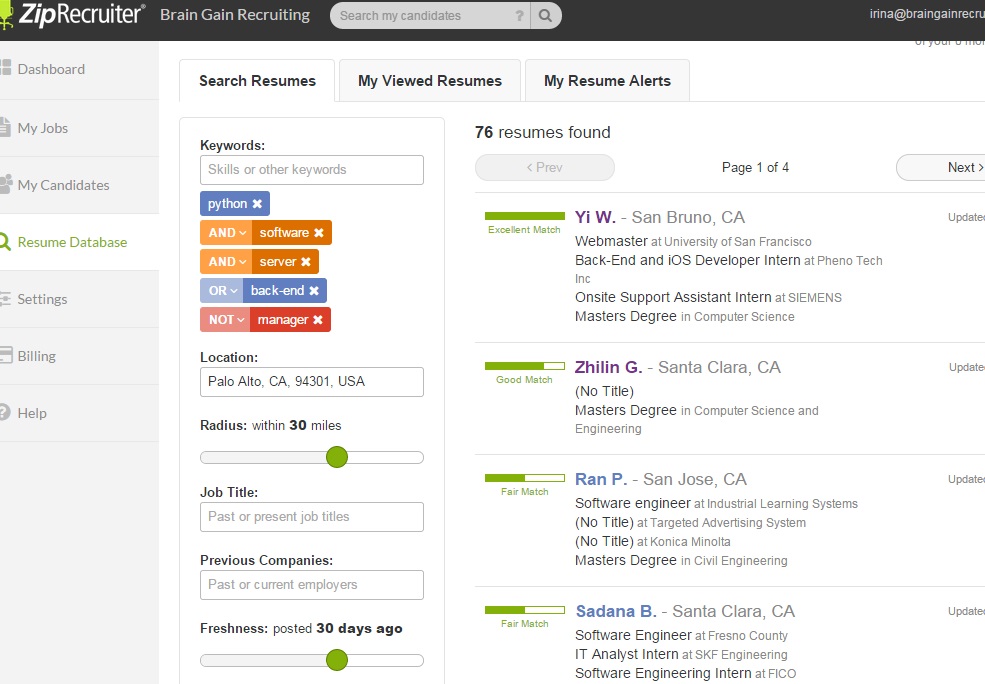
ZipRecruiter, whose name you recognize of course from their job posting and social sharing offerings, now offers a searchable resume database access. When candidates apply for a job, they can opt-in making their resumes searchable by all employers who use the system. The resume search feature is user-friendly and delightfully fast.

ziprecruiter-search


You can also be alerted when a candidate who applies for a position meets the requirements that you choose to be alerted on.
Just a few days ago, ZipRecruiter was showing the lists of jobs each applicant applied to. This was an obvious privacy issue; as of today, that is no longer visible. You can still find that info in Google’s cache, as of today, but it will be gone soon.

It seems like, still, more info is visible than should be. I have not tested enough to verify, but I suspect that all resumes are shown in the searches, whether the person wanted their resume to be found in the resume search or not. Those not-opted-in resumes can be previewed too, but don’t show any info when you to the resume page. If this is the case, it will probably be fixed soon, and we’ll probably see fewer search results then as well.

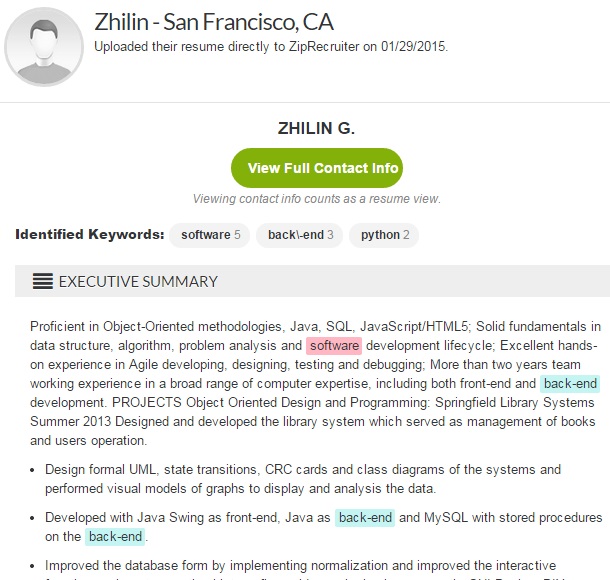
A resume preview looks like this; the last name is not displayed unless you subscribe.

resume

The internal resume search can be complemented by X-Raying: site:ziprecruiter.com/resume/preview <add keywords>. As an example: site:ziprecruiter.com/resume/preview CPA accountant Houston TX

Another great feature is the alert feature. You can also be alerted when a candidate who applies for a position meets the requirements that you choose. ZipRecruiter Resumes is a nice addition to the sites outside LinkedIn to source from.


Written by Irina Shamaeva on RecruitingBlogs.com. You can c0nnect with her on LinkedIn here, follow her on Twitter here.

Edited by Jackye Clayton

Stay TRU: What Keeping It Real Really Means in Recruitment.

Those who can, talk. Those who can’t, listen. And those who don’t give a shit don’t turn up.

recruitment can'tLike so many developed nations, the United Kingdom faces a teacher shortage described by a recent Daily Mail article as having reached “crisis levels.”

A recent survey found that nearly three out of four education authorities in the UK report to already experiencing pains related to recruiting and retaining educators, and the pangs are only expected to become more acute over the months and years ahead.

This looming disaster has prompted the Department for Education and Employment to take ‘decisive steps’ to make teaching more attractive.

These include signing bonuses for new teachers and immediate raises for existing ones, and launching an aggressive recruitment marketing campaign to raise the profile of teacher recruitment.

The campaign’s tagline, now ubiquitous in the United Kingdom: “Those Who Can, Teach.”

If you’re not familiar with this campaign, though, you will almost certainly be familiar with this high concept, a truism that has more or less devolved into a hackneyed cliche.

Last week, TRU once again returned to its prodigal roots in the City of London, and it was against this august, austere backdrop of bankers in suits, cobblestone streets and power lunching hotspots that the inevitable eclectic mix of hats, jackets, shirts, trousers (or lack thereof) gathered in the Old Dutch Church for some recruiting shop talk. Nothing says fashion quite like a recruiting unconference, and I, for one, was not going to let the sartorial side down.

This event was timed to coincide with the half century birthday celebration of its iconic talent talisman, a certain Marmite of a character named Bill Boorman, the internationally infamous brains behind the Global TRU operation.

While the event did a brilliant job of bringing some of the best and brightest minds in recruitment to talk about the top talent topics, trends and tools, here’s what stayed with me after two packed days of #TruLondon (not to mention the full on resourcing-related socialising in the interim):

The UK Recruitment Industry Just Doesn’t Get It.

truHatIconIdent250It doesn’t get Bill Boorman. It doesn’t get the real point of recruitment events, and it certainly doesn’t get the real point of the concept of real ‘networking’ in the real world. The UK recruiting world, in short, doesn’t keep it real.

I know, you probably don’t quite understand what I mean by this seemingly simple statement. Well, then. Let’s go back to the very beginning; it’s a very good place to start. Or as good as any other place, I suppose.

I was never the fastest, cleverest, funniest or best looking, nor did I ever make the mistake of convincing myself or anyone else otherwise. I was never the first team captain, never excelled in anything in particular, and certainly have never been the World’s Top Recruiter.

My record, unfortunately, continues today, where I am not a thought leader, influencer or any of those other silly titles that seem to sell out recruiting events.

But you know what? I’m OK with that. I mean, Donald Trump once shared the same admission, although given the current political picture I’m unsure whether comparing myself with The Donald is necessarily a wise choice for proactive comparison. But if a self-made billionaire can get away with telling the truth, then who am I to hide?

Time to come clean.

I’m not the best at anything, apart from being the best at surrounding myself with the best people.

Being in the room at #TruLondon was somehow like being drawn back to my old Boarding School days, so before I go any further, go ahead and get all your little jokes and one liners about my halcyon days in now. But all joking aside, the eclectic lineup of attendees was like attending a general session of the UN of Recruitment.

The assembled practitioners represented every imaginable professional perspective, with world views as divergent as the actual accents informing the recruitment related shop talk: American, Dutch, Australian, Indian, some more Americans, and Johnny Campbell (below), whose Irish accent has somehow developed into the voice of reason capable of drawing in crowds from down the street and around the world.

There was, however, one badly missed contingent among the global band of recruitment misfits at #TruLondon; while the English were there, I do promise you, for many of us this event was a little like finding yourself stuck in a Shisha Café in Knightsbridge the week before Ramadan. The odd man out in your own backyard.

We were the minority.

And this is not OK.

Planes, Trains and Automobiles. And Hotels, Beer and More (Or Too Much)…

11995965_10153636778224810_532641941475357910_nFor those of you unfamiliar with the recruitment picture over here in the UK, here’s a brief primer. While we have a vibrant industry and packed calendar of recruitment events, conferences and expositions, it’s all centralized in a single location.

And while London maintains such a pull that people will board planes or get passports just to get there, it’s also a quite expensive, often inconvenient destination, particularly for those only coming in for the occasion.

But that doesn’t seem to stop event organizers from maintaining London’s ubiquity, and near monopoly, as the recruitment destination, nor does it seem to stop attendees from converging on the City from around the world.

Just as at TRU, these manifold events do not promise to teach attendees anything of actual value, nor are attendees guaranteed anything for the price of admission. But many of the best in the business simply open their wallets, show up, and hope for the best. No questions asked. Which is extraordinary, really, if you stop and think about it.

This of course begs the question as to why, exactly, people from other countries are only too willing to shell out quite literally thousands of pounds – or, most often, dollars – from their relatively limited budgets and restricted recruitment bandwidth just to come to London to hear people they’ve already heard talk about stuff they already know at an event hosted by someone they’re likely already friends with?

We all know that in this business, there’s no such thing as a Silver Bullet. But if such a thing did exist, my friend, are you more likely to find it here, in a church in the City of London, than any other place, event or venue? Of course not, and if you showed up looking for it, I pity you.

But here’s the thing. Learning is all about surrounding yourself with people who are better than you. Similarly, the only way to truly get better at something is to play with people who are going to force you to raise your own game.

Of course, like in any game, there are rules; the problem in recruitment is that it seems to be so multifaceted that we can’t seem to agree on any universal set of standards for disciplines as diverse as sourcing, engagement, copywriting, networking, negotiation and the host of other issues representing the requisite moving target any silver bullet could conceivably strike.

Even if you’re an expert recruiter, there had to be something you needed to know at last week’s event, or at least one person there that you could have learned something from. If you don’t agree with me, I’m co-opting a saying I picked up at last week’s event and calling BAWLSHIT (which is like Bull Shit, but way more American!).

You have to show up to win the prize. It’s really that simple.

Winners show up, and losers come up with excuses for not showing up. Those who did show up for TRU walked away, largely, as winners. At least from a recruitment perspective, which might not be saying all that much.

The Myth of the ‘Five Percent Rule.’ 

11951289_10153636080209810_1950095298081428698_nI’ve often been told (and too often told dismissively) that I operate in the “5%,” those handful of early adopters, tinkerers, doers and dreamers who represent the outliers at the cutting edge of the recruitment industry.

This is not, of course, because I am brilliant. It is, instead, a reflection of the time and effort I take upon myself to challenge myself to learn about what’s new, what’s next and what I can do right now for my clients, candidates and colleagues.

I think, of course, this is complete and utter bollocks. For example, do you remember when LinkedIn was seen as a “Professional Network,” like Facebook with a tie, or Glassdoor was the place you went to for confidential salary information instead of anonymized dirt digging and/or mud throwing?

Now ask yourself how right that short term perspective turned out to be over the long term.

It takes the unconventional to challenge conventional wisdom, and if you look at the above example, you can appreciate that this much mythologized “Five Percenters” who actually drove these changes, and our industry, forward, often with no end goal other than a crazy belief that recruitment could (and must) do a better job getting its job done. The other 95%, meanwhile, stayed on the sidelines, reading dusty resourcing magazines, attending stodgy CIPD conferences and rebranding bad habits as best practices.

Ignore change long enough, and if it doesn’t go away, it likely will come back to bite you in the ass – or in the case of the aforementioned, force you to spend a lot of money on solving the long term problems this short term apathy too often creates. You could try to see the future, or you can stay stuck in the past. I’m saddened by the choice I see so many of my peers making, for it is the wrong one.

I do not understand the mindset of recruitment leaders and professionals who, given the chance to meet these game changers, choose instead to stay away. Why on Earth do you not choose to vote with your feet, put up a little money and time today, and simply show up with an open mind. What’s the worst thing that could happen by attending? Ignorance might be bliss, but the costs of it should prove far worse than a registration fee and a day away from your desk.

Ignorance Is Not Bliss in Recruitment.

2015-09-15_01-17-26Imagine being able to go back to that office and know what tool you need or who you definitively need to talk to in order to actually improve the way your company recruits instead of sitting back and talking about change. Change, already.

But of course, the 5% aren’t the ones responsible for doing things differently at your company. You are. The 5%, I think, is a convenient crutch and as much of an urban myth as believing that seeing a pair of magpies bring good luck.

Think about it. While a sweeping majority of recruitment practitioners profess to wanting to be better, the reason that only a tiny handful of people actually lead and manage the forward looking conversation is because you didn’t bother to spend a handful of pounds and show up.

I, for one, simply cannot believe that anyone in recruitment in the UK would ever consider this option, not even for a moment. Because the world literally came knocking on your back door, and for some reason, you chose not to answer. Shame on you.

TRU featured game changers, and a sneak peek at the new rules of the recruitment road. Ever wonder how resourcing could utilize the Oculus Rift?

Well, Stan Rolfe travelled all the way from Perth, Western Australia, to show how he’s used this virtual reality technology (pictured) to change the way Barminco, a multinational mining and minerals extraction concern, uses to inform and screen new hires while also presenting a realistic preview to the day-to-day realities of working in a mine shaft to interested prospects.

After seeing it, all I can say is, I have seen something that looks, to me at least, a whole lot like the future of recruitment.

I saw this at a recruitment event. In London. You could have seen the talent technology of tomorrow, but chose to stay away. You talk about innovation and change, but won’t venture out of the office and across town to see these aphorisms in action. It’s mind-boggling.

Let me give you a word of advice, based on Stan’s presentation alone. Next time you see a Resourcing Manager using a prototype piece of equipment for a virtual reality technology that’s not publically available even though it’s owned by Facebook, make sure to let me know, won’t you?

PS, Stan: well played in the cricket.

Why It’s All About Relationships.

11952028_10153636221389810_4646412468948978321_nUm, yes. If you disagree with that premise, then you’re past saving. Relationships are everything, and it’s about old ones, new ones and ones you never knew were going to happen or didn’t know you needed to begin with. It’s about meeting people from different backgrounds and perspectives. It’s about finding new people that like you, and you like in return. People who can learn from you, and you can learn right back.

It’s about developing your own network of people you can mutually admire, to a degree, and in developing that network, develop our own professional careers and personal assumptions in the process.

Look. We’ve all done some cool shit in our recruitment careers. We’ve all had mundane stretches where not much has happened. At TRU, it’s irrelevant.

What #TruLondon affords attendees the opportunity to do is to pull together those many experiences, no matter how esoteric or mundane, into a single place and conversation where you can stop talking about what you’ve done in the past and use those experiences to shape what we’re all doing in the future.

Show up and be ready to share, show and tell. Most importantly, teach. Even if it’s shit, at least we’re getting to talk it out and give it a try – not to mention meet new people with new ideas. Hell, in some circles this discipline actually has a name. They call it ‘conversing.’

I rather like that.

TRU Lessons, Truly Learned.

Build A Personal Advisory Board.

11960164_10153636519329810_3054634517968317102_nStartups who lack a presence in a given market often take the task of building what’s called an “advisory board,” which is more or less granting equity for the privilege of going out and hanging out with the cool kids, the ones who can open doors. The quid pro quos in any given interchange is always actually always fairly blatant, and of course you’ve got to get something in return. Hell, something for nothing never got anyone anywhere, anyhow.

I am going to be building an advisory board myself. Not for a company, but for me. The same approach startups use should be co-opted to build your own personal advisory board. It likely won’t cost you more than a few rounds of drinks, but make sure you get to know the people worth knowing, and they’ll help you stay in the know.

Those in the know, though, know to pay it forward. While they don’t expect anything explicit in return, they also know that making new relationships and nurturing new ones almost always pays off – but you’ve got to give value to get any back in return. Just go in with no expectations and an open mind, and you’ll reap rich rewards in return for a relatively limited up front investment. Oh, and please. Don’t suck.

We’ve got quite enough of that already, thank you very much.

Be The “Something” Guy.

2015-09-15_01-21-00This probably seems pretty obvious at an event hosted by and in honor of a man who goes by the moniker “The One in the Hat,” but if you’re going to be there, you’d better be memorable. Whatever it is, you want to make sure to stand out, and you can’t really do that showing up in a white shirt and power tie – or at least, it’s infinitely more difficult.

Remember, when it comes to building a network and making meaningful connections, you are the product you’re selling. Like all product marketing, success depends largely on two things: presentation and packaging.

So no matter if you’re the drunk guy, the funny guy, the Irish guy, the Chumbawumba Challenge guy, the guy in the black T-shirt or the guy with the jacket, you want to be known for something.

This is why I attended TRU in a Wimbledon blazer that, admittedly, might have been a bit over the top, satorically speaking, but I also had 98 different people (I actually kept count) come up and initiate conversations with me about my jacket.

People may have thought I talked some shit, but good or bad, my takeaway is to be remembered. From genuine compliments about my fashion sensibilities to underhanded snark about my lack thereof, this exercise alone proved that being remembered is better than being right. I have no problems with being known as “Posh James” around these parts, because at the least, I’m known for something. You should be too.

Always, always be remembered. Whatever your something may be.

31871a7James Smith currently serves as the co-founder of Poetry Talent, a recruitment technology startup currently launching a portfolio of new web based resources designed to optimise candidate attraction for leading luxury and retail brands in the UK, including Jobs In Luxury, British High Street, and Christmas Temps, among other properties.

James is responsible for partnering with some of Britain’s leading brands to support, develop and enhance their direct recruitment and talent strategy efforts. Additionally, Poetry Talent offers a tailored micro-RPO model featuring a bespoke platform, CREaM designed to support brands in improving their candidate experience throughout the application and pipelining process.

Prior to his current role, James has over 15 years of experience working with leading Luxury Goods and Retail brands specializing in recruitment, in-house talent acquisition and online recruitment methods such as employer branding, career site design, ATS and CRM technology integration and process improvement.

Follow James on Twitter @ja_smith or connect with him on LinkedIn.

Every Recruiter Should Be a Diversity Recruiter

Every Recruiter Should Be a Diversity Recruiter

Like most things, we love to discuss a topic to no end.  Diversity and Inclusion is no different. Companies are hiring recruiters to focus specifically on hiring diverse candidates. It is as if it isn’t the job of the remaining recruitment team to do the same. Over and over again, we hear studies that explain diverse work forces.  While some companies focus elsewhere, they shouldn’t. Rather than focus on people, they focus on facts.

In this webinar you will learn why diversity recruitment is everyone’s job.

  •  Learn why hiring a “diversity recruiter” is not a strategy.
  • Find out you need to do at an organizational level to ensure you have support for an inclusion strategy from the top-down.
  • How to develop a recruitment strategy that fosters the ongoing recruitment of diverse candidates.


PreSourcingTool by SourcingThing

Keyword finders and tools are not earth shattering new, but the fact remains that many sourcers we speak with simply do not employ the power of these tools. We’re not quite sure why but we want to be sure you have access to as many of these tools to help you in your quest to nail down that hidden lead.

We’ve recently taken a spin with the PreSourcing Tool by SourcingThing.

What is the PreSourcingTool?

The PreSourcing Tool allows you to select a number of profiles online and compare the profiles for keywords based on the frequency they appear across your selected ideal profile.  Once you’ve identified your ideal profiles and the PreSourcing Tool has reviewed those profiles, the tool will provide you with new terms, new training and new jargon that you may not have thought of. Once the search has been completed, the PreSourcing Tool will amend your search, allowing you to smartly target previously missed profiles.

Why a Sourcer would want to use this tool:

The PreSourcing Tool quickly identifies missed terminology and key skills required to fill your position. Though it’s not based on scientific data nor culture it is a great way to embark on your search, especially if you are not an expert in the area you are searching.

Check it out here

Here is how it works:

  • Go to the PreSourcingTool: http://presourcingtool.com/login and log in.
  • Go to LinkedIn: Find at least ten candidates who you think would perfectly match the job description.
  • Save the profiles: Save the profiles to your hard drive as web pages in HTML format in this a new folder.
  • Create a new Talent Pool: Create a new Talent Pool and click on Add Profiles.

Once you have review all of the profiles, you can dig deeper on the search targeting specific skills, functions, and even employers to see what is the most common connection in your TalentPool.

How to use the Pre-Sourcing tool from SourceThing


dean_dacostaAbout the Author: Dean Da Costa is a highly experienced and decorated recruiter, sourcer and manager with deep skills and experience in HR, project management, training & process improvement. Dean is best known for his work in the highly specialized secured clearance and mobile arenas, where he has been a top performing recruiter and sourcer.  Dean’s keen insight and creation of innovative tools and processes for enhancing and changing staffing has established Dean as one of the top authorities in sourcing and recruiting. Connect with Dean at LinkedIn or follow @DeanDaCosta on Twitter


Master of Perception: The Psychology of Professional Advancement.

I grew up back in the day where the same maxims for career success still applied, and even contrarians (and smart asses) like myself knew that there were a few lines at work you never crossed. It’s the same sort of stuff that’s instilled in us from our earliest days, reinforced by our parents, teachers and peers.

Be on time. Dress appropriately. Don’t talk back. Recognize and respect authority. Check your personal feelings at the door, repress your emotion, collect your paycheck and wait out the years before you finally get that gold watch.

No one expected to actually enjoy work – after all, it’s called work for a reason. But sometime between the late 60s and the late 80s, something changed; when it came to company culture, business as usual became anything but.

Shooting the Ladder.

qThe shift in employer expectations around what constitutes the right level of decorum on the job has taken a couple decades, a needle whose movement has been so glacial that the change was often imperceptible, but ultimately indelible, a self-evident evolution evidenced throughout almost every aspect of the employee experience.

We swapped suits for sweats, traded 9-5 for flexible working arrangements and ditched most of our formality when we ditched our physical offices, rigidly defined reporting structures or company hierarchy, and the mindset that work is somewhere you go instead of something you do.

While that might seem like a superficially small distinction, that shift has fundamentally changed the way we approach our work and our careers.

And perhaps nowhere is the impact of this change more readily apparent than in the dramatically different relationships managers have with their reports today, leading to a mainstream leadership style that’s inevitably much less formal, much more flexible and infinitely more friendly than ever before.

Managers, largely, have ditched the stick for the carrot, and chosen to emphasize teamwork and collaboration instead of rigidly defined reporting structures, internal process or policy red tape, and working relationships that ended at the office door. This has been great for workers, particularly given the fact that the line between work and life has become increasingly blurred.

It’s also rewarded employee productivity over office politics, turning internal mobility from something of a nepotistic Old Boy’s oligarchy to a meritocracy where the best workers are recognized and rewarded for the strength of the work they do, not the strength of the relationships they happen to have with their coworkers. It’s no longer enough to just show up and play nice at work if you want to stay on your manager’s good side. Now, you’ve got to actually do a kick ass job at your job, too, if you really want to stand out and get noticed.

The Psychology of Affinity: 3 Keys To Getting Ahead.

This is why, even as most leaders and employers put such a premium on teamwork, the competition for improving your boss’ perception of you enough to beat the cutthroat competition for career advancement that’s still very much every man (or woman) for themselves.

Seriously.

But you don’t have to kiss ass with your manager to have a kick ass career. Trust me on this.

Perception.

You-have-perception-problem-funny-mean-girls-cartoonBefore we talk about how you can improve the way in which you’re professionally perceived, we’d be remiss not to take a step back and define what the hell, exactly, “perception” actually means.

As always, my homeys Merriam and Webster got my back on this one, defining perception as “an awareness of the elements of an environment through physical sensation. The most important components of perception are awareness and the ability to sense.”

Dude. That is some trippy shit, right there, man. But it’s important to frame the perception conversation through the idea that we interpret the actions and feelings of others in different ways, and often those interpretations differ drastically from what was originally intended.

This has led to a bunch of problems, obviously; there’s a reason the moment mankind acquired self-awareness and interpersonal perceptions has traditionally been termed the “Original Sin.” Obviously, if the Garden of Eden wasn’t immune from the malignancy of misperception, there’s pretty much no hope for your office space or workplace.

The good news is, even though it got us banished from Paradise in perpetuity, the power of perception remains among the greatest of human resources, and one of the greatest assets you can have when it comes to making friends and influencing managers on the job.

This involves two challenges: you’ve got to have an accurate understanding of what your manager (and teammates) really think of you, even if this constructive criticism can sometimes be a little tough to handle. Just make sure to remember that this process is focused exclusively on professional performance, so don’t take anything too personally. If you don’t know what you’re doing wrong, you can never get any better. So shut up, suck it up and soak up any and all feedback with an open mind.

Once you’ve got this basic baseline, you can focus on achieving your actual objective: improving the perception your direct supervisor and professional peers have about you, your current work and your future potential. To make sure you’re seen in a more positive light, it’s important to utilize your company’s mission, vision and values as a guide, because these are the building blocks of any corporate culture.

And if you’re not perceived as a good fit for that company culture, you’ll never be perceived as a good fit for any advancement or promotion opportunities that might come along. If you can get the culture piece right, the rest of the perception puzzle becomes infinitely easier.

While you should always be you, you might consider being a different you when you’re at work. For instance, even if you hate ping pong, pick up a paddle, put on a smile and play a set. Even if beanbag chairs hurt the hell out of your back after even a few minutes of crap lumbar support, suck up the pain and sink back with the rest of your teammates. Even if you hate open seating plans, plaster that game face on and put on a scene that’s going to be seen – and hopefully, score some brownie points for you, too.

If you work in a more staid, traditional or flat out conservative company culture, conversely, then see that necktie not as a noose, but as a part of your uniform (and as a point of professional pride). Don’t get around your company’s Facebook firewall by picking up your mobile phone; be the one person with enough initiative to learn how to actually use your company’s intranet and internal communication or collaboration tools, instead.

Sure, it’s going to suck for you, but it’s those little things that almost always make the biggest difference when it comes to determining how others perceive you. Just remember: that which doesn’t kill us invariably makes our managers like us more. The one thing that no one likes, of course, is a complainer, so you’ve got two choices: deal or find a new job.

Don’t be the person who always talks about what’s broken. Be the person who’s always busy figuring out how to fix them. The doers are far rarer than the talkers, and far more valuable for employers. too. Common sense, as it turns out, is anything but common. But without it, you’ll never be perceived by your boss as anything but just another total idiot with half a brain and a business degree. 

Awareness.

c4100bf545ba799b3581f473e8f20bffIf your boss doesn’t know who the hell  you are, or what, exactly it is, you do all day, then chances are you’re not building a business case for career advancement. Of course (as I can tell you from painful experience), being top of mind for your manager isn’t necessarily a good thing. But trust me, you probably don’t want to be perceived as a problem child, no matter how productive or effective you are at your job, since style points count – which is why, on the other side of the spectrum, you probably don’t want to be seen as some brown noser or ass kisser, either.

Building awareness the right way – and making the right impression – involve finding a balance somewhere in the middle of these two extremes. Perception, unfortunately, is a slippery slope that’s completely subjective; you’ll never be the ultimate arbiter of others’ opinions, but you can improve your chances you’ll be personally seen as someone worth investing in professionally.

The first step to a successful strategy at increasing awareness while improving perception is to eliminate one of the most common – and potentially harmful – misconceptions governing interpersonal relationships, workplace or otherwise.

While perception is based largely by our senses, don’t be fooled into believing, as most people do, that these are limited to the five you probably learned in school; in fact, our senses far transcend sight, sound, smell, touch and taste.

In fact, neurologists and psychologists have identified our perceptions are shaped by nine and 21 different senses; capitalizing on these overlooked and underappreciated drivers can be critical to gaining the inside edge on awareness building. For example, in the workplace, one of the senses that most defines the way our bosses and managers perceive us is what’s referred to in neurochemistry as chronosenseIf you’ve ever wondered how one work day flies by before you even realize it and the next seems to drag on ad infinitum, you’ve already seen this phenomenon in action.

The way we perceive time is a neurological process, and can be highly variable, even when working on identical projects or deliverables. This is where the maxim of “work smarter, not harder” comes into play, and the key to working smart involves aligning your chronosense with that of your managers.

Don’t automatically assume just because you’re the first one in the office and the last one out that face time is going to be perceived (or even recognized) by your boss, or that by constantly being connected and on call that you’re going to be perceived as a top employee. Instead, make sure you understand not only what’s expected of you in terms of deliverables and deadlines, but also that the way you allocate time at work aligns with your manager’s’ expectation (implicit or explicit) of speed and their unique, relative perception of time.

You might soon learn that you’ve been wasting a lot of face time to make a good impression that could better be used by taking on an additional workload and/or completing deliverables faster than expected or even slowing up to match your boss’ sense of time, which can often subconsciously be linked to the quality of work, regardless of the actual end product. Either way, complementing your timing with your boss’ workplace preferences and subjective chronosense can be critical for advancing your career.

This, of course, is just one example to illustrate that while our senses are subjective, making sure you understand what senses most shape your boss’ interpersonal perceptions and focusing on these drivers can mean the difference between being promoted or being forgotten.

A quick tip: when building affinity through our primary senses, psychologists have repeatedly found that speaking at a similar pace (just speed, not necessarily tone or inflection) has the highest coefficient for subconsciously improving interpersonal perceptions, for better or for worse. If your boss is a fast talker, has a slow drawl or is anywhere in between, simply adjusting the pace of your speech to match your manager’s is a small step that can make a big impact on your career.

Self-Perception.

hr1090233Even more important than the way other people perceive us is our own self-perception, which is the foundation upon which all our interpersonal behaviors and professional identities are predicated.

Sure, you could go the sales guy route and just front by having a nice car, a bespoke suit and power tie or constantly showing off your spending power through lavish dinners, exotic vacations and the other douchey techniques that often rub coworkers and colleagues the wrong way.

Swagger is worth more than all the swag in the world, because it’s something you can’t buy (or fake). While the material accoutrements of being seen as a baller might seem like an easy way to improve others’ perceptions of you, if you don’t have an intrinsic sense of self-worth and self-esteem, then ultimately, these empty tactics won’t overcome an inherent inferiority complex.

Self-deprecation, conversely, often works as a defense mechanism, but rarely as a technique for improving interpersonal relationships at the workplace. Instead, your self-worth and your net worth are inexorably intertwined. But compensation never comes from compensating for your own lack of self-esteem.

Think of your work as a product, and your self-perception as the principal mechanism for marketing that product. If you believe in yourself and take personal pride in what you accomplish, then you don’t have to show off to make your work seem worthwhile. Your value should speak for itself, and if your work consistently exceeds expectations, then you’re creating not only managerial awareness, but also packaging yourself as a professional whose high-end product is worth paying a premium for.

When you feel good about yourself, and the work you’re doing on the job, then you’ve taken the most important step towards being seen as an engaged, satisfied, productive and successful employee; no employer is going to make an investment in your potential without seeing that you’re mutually invested, too. The reciprocal ROI cannot be overstated when it comes to achieving the positive outcomes inherent to improving positive awareness.

They say you never have a second chance to make a first impression, but that’s not always true – it’s never too late to start changing perceptions in the workplace. Believe in the work you’re doing, believe in yourself, and you better believe your bosses, managers and company leaders will, too.

Because you’re good enough, you’re smart enough, and gosh darn it, if people don’t like you, well, then it’s probably time to start looking for an employer who recognizes what your self-worth is really worth.

Hello Charlie

Charlie App Review Recruiting ToolsEver schedule a meeting with a candidate only to realize you have no idea who this person is or why you scheduled a meeting in the first place? (Please tell me it is not just me!) Don’t worry, the Charlie App has you covered.  I love Charlie. Seriously, it is one of those tools that once you try you have no idea how you ever lived without it.

I am in demo meetings all day.  In the morning, Charlie sends me a daily email telling me who I am meeting with and sends a link to the briefing. On the briefing, I can see shared connections, the last tweet the sent, their company news, big personal news inferred interests and hobbies and more.  This tool can be a game changer for recruiters. Not only does it save time by doing all the research for you but it also helps you not look like an idiot because you forgot who you were talking to. Do you have a team interview scheduled?  Send the entire team a briefing so that they know some discussion points they can use.

I love how the app is so clean.  Although it gives you a ton of information, it is organized in such a way that you are not overwhelmed by it. The tagline for Charlie is “Impress anyone you meet.” With Charlie, I think you can.


Jackye Clayton Editor RecruitingTools.comAbout the Author: An international trainer, Jackye Clayton has traveled worldwide sharing her unique gifts in sourcing, recruiting and coaching. She offers various dynamic presentations on numerous topics related to leadership development, inclusionary culture development, team building and more.Her in-depth experience in working with top Fortune and Inc 500 clients and their employees has allowed her to create customized programs to coach, train and recruit top talent and inspire others to greatness. Follow Jackye on Twitter @JackyeClayton  and @RecruitingTools or connect with her on LinkedIn.


Loading...