Blog

The Only Tool You May Need? A WANTED Analytics review

WANTED Analytics. Do you need it?

The title may be a little misleading but I have to say that WANTED Analytics could be a one stop shop tool for sourcers and recruiters looking for just about everything out there.  If you have heard of them you are probably saying; I thought they just did analytical research?

Well they do that but they do so much more! WANTED Analytics helps you design a better workforce strategy using the facts about the talent marketplace. With WANTED Analytics it is easy to use data to guide your overall workforce strategy. WANTED Analytics shows how many candidates meet your requirements allowing you to decide which tactics to use for hard to fill positions.

So let’s take a look at some of the features that I liked for recruiters:

Using the information that WANTED Analytics has gathered over the years there are some very interesting applications that recruiters and sourcers could use to explain normal managerial annoyances before they even occur.

First you can upload a resume or job description to determine a few things like, hiring scale.

A hiring scale tells you how hard the job is going to be to fill. WANTED Analytics uses an algorithm that scales how long similar jobs in the area you posted would take to fill. They base this on companies that have similar jobs open and how long they have been open in the past as well as what the candidate pool based on the Occupational Employment Survey (OES).

Would it be nice to report information like that back to a hiring manager?

[youtube url=”https://www.youtube.com/watch?v=YFybDH0uyOo” width=”500″ height=”300″]

WANTED Analytics can tell you the pool of candidates with that specific skill set in the specific area you choose.  They can show you where the most candidates would be within the country you are in.  This can possibly help you know where to hunt for that hard to find skill set.

13 Reasons why Wanted Analytics should be on your radar

  1. Hiring Scale: When a job opens, the Hiring Scale tells you if it’s easy or hard to fill. Not enough candidates and too many companies hiring makes a job hard to fill.
  2. Heat Map: The heat map shows hiring scale, job volume, candidates supply, market salary and posting period. Datasets can be shown by MSA or by state.
  3. Global Data: Select your target international countries from more than 20 geographies.
  4. Market Salary: The salary distribution gives a benchmark of the salaries that were advertised for similar jobs in the selected location
  5. Historical Hiring: Historical hiring will list direct employers that have posted for jobs that meet the search criteria over the last 4 years.
  6. Skills & Certifications: Skills and certifications in demand provide a real-time view of tools, technologies, and certifications currently in demand by employers.
  7. Posting Period: The posting period is the average number of days similar job postings remain online. This is calculated using similar expired postings over the last 12 months.
  8. Graduates Programs: Number of graduates of the selected university or college for the most important programs.
  9. Search Criteria: The search criteria allows the user to refine their search using filters like locations, functions, occupations, levels of experience, skills, certifications, and more.
  10. Job Listing: WANTED Analytics has the most complete set of hiring demand data, collected from more than 25,000 job boards and corporate sites.
  11. Hiring Demand Dashboard: The Hiring Demand Dashboard App stores more than one billion detailed data records since 2005.
  12. Candidates Supply: The candidate supply count is the total estimated employable workforce available for the job position entered based on the Occupational Employment Survey (OES).
  13. Candidate Rolodex: View potential candidates on social networks and resume databanks who currently match your job requirements.

LinkedIn: Why The InMail You Know Is On The Way Out

screen-shot-2013-10-22-at-2.59.46-pmWe’re nearing the end of 2014, and it seems a good time for a reminder that the InMail is in for a makeover. In case you missed it, beginning January 1, 2015, LinkedIn is making some core changes to InMail.

Some of the changes are marginal, while some could have a profound impact of how LinkedIn is used by recruiters (those paying a premium for a LinkedIn Recruiter account, anyway).

It’s not to say that the changes are overdue, long overdue, but they kind of are. For the last few years, the chatter among LinkedIn members, both online and off, has centered on the perceived “spam” problem that LinkedIn has.

The InMail system has been beaten, bastardized, and ravaged by users. Messages come across as assembly-line style communications. They are often glaring with errors. There’s a good chance the person sending the messages didn’t even look at your profile, aside from what appeared in the search results summary. So yes, the winds of change are blowing.

Here’s what’ll be different with InMail in the months to come:

Caution: Psychology At Work

The biggest change for InMails is in the behavior that it reinforces. Right now, users get credited back InMails that go unanswered. They are reversing this process, so that if a message gets a response (either accepted or declined) in 90 days, it is credited back their InMail inventory. Essentially you have just gotten a free InMail credit. As for credits for messages without a response? Those are now lost after 90 days. In essence, they are employing a positive reinforcement model now, a complete 180 from the old, rather unintuitive negative reinforcement model.

Who knows, it might work. It might just start changing the way people use InMails, if they know they are just throwing away credits if they just mass-blast. I’m not entirely sure if it will work, but I sure know if I’m LinkedIn, I wouldn’t want the success of my business dependent on the psychology of my member base. Still, score one for LinkedIn for finally getting wise to this.

Mo InMails, Mo Problems

diz24s52yp7dyb3i875qo73zh.540x617x1Each seat will now get 100 InMails a month – up from 50 currently. It’s almost as though LinkedIn is saying “Here, here’s some more. We trust you.” Potentially, people will likely just see that they have more, and carry on spamming, business as usual. Except there’s catch. This time, LinkedIn has a much better scorekeeping system in place. It’ll be interesting to watch the short and long-term results for the response rates.

LinkedIn: The Scrooge Of InMails?

Under the new rules, unused InMails will accrue for 90 days. What? So essentially they are capping the inventory of any particular user at 300 inMails. At least this appears to be the case. Perhaps it’s just confusingly worded. That would appear to be a bit shortsighted. Some high-response rate recruiters may just use their InMails more strategically.

In my experience, an InMail is often little more than a last resort if I can’t find the person’s contact information elsewhere. But, under the current model, some users can feasibly not run out of InMails until 7 years after NEVER. Maybe LinkedIn is trying to reduce hoarding.

It would be interesting to know if they considered a model where the ability to accrue unlimited inMails would be based off of a member’s positive response rate. Again, if they want to increase certain behaviors, they have to reward those behaviors they want.

InMail: Sharing Is Caring

LinkedIn is still going to let you share InMails across your team. Whew. We have narrowly avoided recruiters killing each other in an agency’s pit over available inMails like it was raw meat. This is a basic service, and shouldn’t really be included with all of this. It’s fluff.

InMail: The First Taste Is Free

LinkedIn is also going to give an additional 100 InMails per seat for January 2015. (Control yourself!) Pretty nice introductory gift for inMail 2.0. And, free stuff is cool. End of story.

drevil_finger_fembots2015 Will Bring Some Questions And Answers For LinkedIn

At its core, the InMail is designed to reach out and make a personal connection via a message. So, it appears LinkedIn is making an honest effort at improving quality by discouraging those who misuse the inMail. Unfortunately, the technology is geared to support that misuse. The results to their new approach to inMails and credits will be something to watch, should they make the data public.

It’s also hard to dramatically change the response rates simply by enforcing policy. LinkedIn is filled with people who potentially check but don’t respond to InMails, and people who are registered but inactive users. It takes two to Tango.

It takes a well-crafted personal message from the sender, and a willing, and active response from recipient of the message in order for the process to work just right.

It’s fair to also ask, what’s the revenue angle? LinkedIn is a public company and have clear revenue goals to hit. Perhaps it’s a longer term play to clean up the problem with the spamming, which could increase response rates, allowing them to leverage this is contract negotiations with customers. That would be banking a good deal on something that could” work.

What all this points to, is that LinkedIn is going through a weird “pre-teen” type of thing right now. They’re a big, public company and are operating at a scale that is new territory for them. This is a good litmus to see how smooth they can implement other changes that they think will benefit the platform overall. Data (as always) is going to be king for them in making their case.

I suspect the savvy users will be pleased for the most part with the changes, and will feel minimal impact. These changes are mean to target specific repeat offenders, and not those who actually know how to use the platform the way it was intended.


radloffAbout the Author: Pete Radloff has over 13 years of recruiting experience in both agency and corporate environments, and has worked with such companies as Comscore, National Public Radio and Living Social.

With experience and expertise in using technology and social media to enhance the candidate experience and promote strong employer brands, Radloff also serves as lead consultant for Exaqueo, a high-end workforce consulting firm.  An active member of the Washington area recruiting community, Radloff is currently a VP and sits on the Board of Directors of RecruitDC.

Follow Pete on Twitter @PJRadloff or connect with him on LinkedIn.

Anti-Social Recruiting: Why Sourcing Best Practices Are BS

Old School Logo1My very first job title ever was as a “sourcing analyst,” which had the necessary gravitas at the time to make me not feel bad compared to my B-School buddies who selected, rather than scrounged, for their gigs. This role was, essentially, how sourcing is still largely defined: name generation and verification.

My job was really pretty simple: find as many potentially qualified candidates as possible, verify that their information was correct, and then enter that record into the applicant tracking system. Of course, this was in 2005, and the explosion of publicly available personal information that’s so ubiquitous today was, at the time, still in its infancy.

Back in the Day: The Original Social Sourcing

I had what’s normally known as a bucket req; I sourced for one profile, and one profile exclusively. You think finding developers and techies is hard today – when every one of them has a Sasquatch sized digital footprint – try finding Top 25 MBAs and Big 4 CPAs currently in management roles at Fortune 1000 companies (literally that was the qualified list).

And they have to live in Orange, Los Angeles or Ventura counties and be making under $100,000 a year (chump change for these guys). The employer value proposition: give up a cushy corporate gig and go into project consulting. Which was my job to sell them on, since the sourcing function was also responsible for scheduling second round screens if their vitals checked out. They sadly almost never did – I only direct sourced two candidates a month, shattering all previous records, which is sad, really.

But high end consulting is a high margin business, and perseverance pays off – particularly when you have someone a few months out of college providing the human capital responsible for the entirety of the firm’s cash flow working for peanuts. And I was grateful for those peanuts, too; sure beat working as the assistant to a talent manager whose premiere client was Paris Hilton.  True story.

I think, as much as recruiters complain about an impossible to fill requisition, the truth is the tighter the parameters, paradoxically, the easier it makes sourcing. At a tactical level, ridiculously extensive qualifications make strategy easy. Tactically, the more knockouts there are in a search, the less qualified candidates are out there, the easier direct sourcing becomes. Those Boolean strings practically write themselves (or at least in 2005, when they were still relevant – now, there are a ton of tools which create these searches for you, and a ton more tools who still talk about Boolean techniques in the first place).

When I started sourcing, I had to resort to cold calling candidates through corporate switchboards or validating that my x-rayed e-mail addresses were on the matrix – and at enterprise employers, that’s actually rarely the case.

I went to Deloitte Night at Dodger Stadium in the hopes of picking up a few leads at the tailgate, and to the AICPA networking nights on the other side of town. And nothing says bitching night out like those wacky CPAs. Among whom, by the way, I was an obvious interloper, but ended up snagging a controller from Activision, so it was worth getting blacklisted by their planning committee. I got a placement.

Don’t Get High On Your Own Supply: The Problem With Pipelines

Sourcing back in the day sucked – but it actually required skill that’s largely been replaced by dynamic profiles, personal aggregators and sophisticated search algorithms that make finding really anyone easy, at least by comparison. But the hardest part of sourcing isn’t when you identify a qualified candidate; it’s getting them to return your phone calls and e-mails, because chances are, if you found them, they’re already inundated with recruiting related communiqué.

That’s why InMails aren’t returned, by the way – the low-hanging, but highly qualified, fruit are unlikely to listen to even the most compelling of EVPs or consider the coolest of cultures. The sad thing is, I think that sourcing largely, as a profession, focuses on the wrong part of the process: it’s not about the tools or the technology or the search string or the plug-in or any of that bullshit.

It’s not about contacting the candidate or even qualifying them. It’s getting them to consider another opportunity that they weren’t previously considering – because as the first point of contact, you’re also squarely positioned on the front lines of refusal. And you hear “no” a whole lot if you’re good at the fundamentals of sourcing.  Problem is, those fundamentals will only fundamentally get your sourcing strategy so far.

At this week’s SourceCon, an event which is more or less the ComicCon of talent acquisition (with slightly more savants and slightly worse fashion), the focus of the agenda and topics of conversation are going to be on tools and technology, with some statistics and survey data thrown in because, well, these guys are basically Rain Man.

Those same social skills that make them so good at sourcing, however, also means most of these ‘techsperts’ are terrible at the candidate development part of the sourcing equation.   The part where building relationships matters more than building a database.  The part that actually adds value instead of simply generating more and more leads to suck into the ATS black hole. Without focusing on social skills instead of social recruiting, on products over people, most sourcers are an algorithm change or new product launch away from being more obsolete than fax machines or Ask Jeeves.

Which is too bad, because “social recruiting” doesn’t work for sourcing (and there are stats to prove it) but actually being social always does, even if you’re using the White Pages and a rotary phone. Assuming, of course, that they’re dialing the right number and willing to take a few minutes to listen to your pitch. That’s the lens by which I’ll be viewing SourceCon, but then again, it’s in Denver, so I might just be high enough to buy into the geek speak and the subsequent nerdgasms over Chrome extensions and pen testing tools.

I’m not sure what the hell everyone else’s excuse is.

SST2014-Banner-ND-3

If you come from a Land Down Under or don’t eat Kiwi because it’d be cannibalism, join me at the Social Sourcing Talent Conferences (#SST2014) in November.  I’ll be walking about Sydney, Melbourne and Auckland to talk about some of the things that matter most for sourcing success: engagement, storytelling, inbound marketing and more.  Click here to register (and good on ya).


To BYOD Or Not To BYOD: The Future of Employee Training and HR Technology

to-byod-or-to-not-byodIf there’s one time where talent management practitioners actually get the chance to achieve actual alignment on organizational vision and values (key determinants in employee engagement and job satisfaction) it’s employee training and development.

While HR and talent leaders face a well publicized engagement crisis, employee training might well be the most effective solution for not only solving the engagement epidemic, but also a critical strategy in cultivating internal expertise and the professional development your people want – and your business needs.

Training and Engagement: Two Sides of the Same Coin

A recent Gallup poll found only 13% of workers worldwide are really engaged at work, which means that fully 87% (give or take a few percentage points for margin of error) or all workers are, fundamentally, flight risks.  Or at least a drain on your business morale and bottom line; that same Gallup survey showed that organizations with engaged workforces outperform their less engaged counterparts by up to 202%. That’s a pretty compelling business case – and should serve as a wakeup call for employers everywhere.

Largely lost in the engagement discussion, however, is a surprising, but often overlooked, finding: the fact that training opportunities and employee engagement (not to mention productivity and job satisfaction, among other key HCM measures) are directly correlated. According to the ASTD, 65% of respondents cited the quality or availability of training and development as positively impacting their personal engagement levels, leading the list of factors influencing employee engagement by a wide margin.

That’s why there’s never been a better time than now to invest in developing and delivering quality employee training programs geared towards developing your employees of today into the workers you’ll need tomorrow. But with budgets stretched thin, workforces increasingly decentralized across markets and geographies, and limited resources allocated to employee training, finding new opportunities for development and distributing training content can present a daunting challenge for many employers.

The good news is, there’s a good chance that there’s an app for that – or at least, a way to make training more accessible, and effective, for workers worldwide.

To BYOD or Not To BYOD: The HCM Question

BYODBring Your Own Device (BYOD) policies and procedures have caught on, using smart phones as a smart solution for cost savings and way to maximize the explosion in mobile technologies while minimizing dedicated internal resources or pricy, proprietary platforms. That’s why it’s critical to consider the pros and cons of adopting the same BYOD technology already in use in so many other HCM functions for employee training, too.

Consider that in 2015, the number of mobile devices all around the world will have grown to over 2 billion, ABI reports. The ubiquity, utility and applicability of mobile devices are not only necessary in our culture, but present an opportunity to take employee training to the next level in terms of quality, innovation and employee adoption.

BYOD, of course, has very vocal critics, whose main talking points are, by now, well worn, focusing primarily on the perceived absence of security often erroneously associated with mobile devices – not to mention the perception that these devices can be an on-the-job distraction preempting employees from doing their jobs.

Additionally, a recent California court ruling mandated that any employer requiring BYOD policies in the state is required to compensate their employees for the associated costs, setting a precedent which will likely erode some of the savings that have traditionally been a tradeoff at most employers implementing BYOD.

While the concerns and criticisms levied at BYOD in the workplace have varying degrees of merit, the truth is that if employed correctly, when it comes to training and retaining top talent, BYOD just might be worth the risk to realize real ROI – and real results on your employee training investment.

Here are a few tips on how to use BYOD in employee training.

Beyond the Buzzword: What’s So Great About BYOD, Anyway:?

blue-coat-byod-infographic_10830781First off, the good news about BYOD is that almost everyone, in fact, already has their own device to begin with.  90% of Americans currently use a cell phone for accessing data like text messages and e-mail, according to PewResearch; that same poll found that 58% of those Americans have a smartphone, a number that’s disproportionately higher for working age adults.

The general population is constantly connected and always on, and whether or not your company has a policy in place on staying plugged in at work, it’s relatively irrelevant – workers will just have to be more creative or covert about mobile device usage on the job.

The truth is, the case of access to information anywhere, at any time, means that even the most technophobic Luddites at your company (HR excluded, of course) are already utilizing smartphones and mobile technologies in their daily lives.  Which is why employee training acts as an ideal extension of the BYOD trend, an ideal mechanism for getting employees engaged, educated and edified.

Of course, that’s not to say using BYOD for employee training isn’t without risks.

Sharing documents or storing data on a personal device can breach NDA and non-compete agreements already in force; additionally, these confidentiality issues are compounded by the imposition of yet another on-the-job distraction from the work you hired your workers to do (as if the internet and social networks weren’t enough).

But like with any risk, the potential exists for those risks to be outweighed by the rewards and return on investment many companies are already realizing, early adopters who already utilizing BYOD are taking their training to the next level – and staying a step ahead of the competition.

Implementing BYOD: Best Practices for Employee Training

byod securityForget expensive implementation consultants or costly customer support subscriptions; the good news is, there’s a good chance employees already know how to use, and have a certain level of comfort with, their personal devices.

That means saying goodbye to the common problems associated with HR technology adoption; you won’t have to figure out user errors, report bugs or overcome hurdles like enterprise security or configuring a solution across markets or business units.

It’s the workplace equivalent of plug and play, and by letting employees use the tools they already put to work at work, you’ll overcome one of the biggest barriers for user adoption while cutting the ramp-up time associated with many HR technologies.

It’s also a trend that’s too powerful for even the most controlling of HR leaders to try to combat.

According to ShoreTel, citing Gartner survey data, by 2018 approximately 70% of professional work done on a mobile phone will be done on a personal device, an explosive growth that represents a unique opportunity to make training more accessible, user friendly and compelling.  Forget those stock sexual harassment videos or clunky LMS modules like “time management skills” that are, if anything, a waste of everyone’s time.

With BYOD, you’ll be able to turn employee training from a lecture to a conversation by making content interactive, engaging and interesting. From dedicated apps provided by traditional LMS and HCM providers, extending extant systems and syllabuses, to a new ecosystem of collaborative training tactics like MOOCs and online learning communities, BYOD is already evolving the way we learn, personally and professionally.  As any kindergartner or developmental psychologist will tell you, outcomes such as knowledge retention and ability to apply theory to practice increase exponentially when learning and fun overlap.

Additional BYOD employee training benefits include the ability to instantly send and receive course related materials, enabling collaboration between trainees, increasing interaction with facilitators and other participants, and, most important, creating the flexibility and portability to access training materials, messages and notes directly on the job, even if those workers are remote or geographically disbursed.

Furthermore, stop worrying about security so much – there’s a plethora of software and solutions specifically developed for dealing with (and capitalizing on) the BYOD phenomenon; many of these emerging technologies also make it easier to separate personal and business usage on a single device by itemizing out documents, activities and interactions.  These tools also make reimbursement mandates like California’s more easily enforceable and effective, and allow for IT departments to manage security on personal devices without accessing personal information.

One of the leading tools in this space, the BlackBerry Enterprise Mobility Management, makes BYOD training readily available and trackable while also adding a layer of security and control, as these solutions are managed directly by the company’s tech department; even if the device is the user’s property, not all the data on it has to be with these emerging, effective mobile security solutions.

BYOD Training: A Lesson Plan for Learning Success

EmployeeTrainingProgramTraditional workplaces haven’t evolved very much; the nature of work remains stagnant even if new technologies and tools have changed the way we do that work.  The way that traditional employee training is administered, similarly, seems stuck sometime in a bygone age of rote memorization, long attention spans and lots of listening to pedantic, pedestrian and often patronizing instruction.

But as we all know by now, education experts have repeatedly proven that each of us has a distinct learning style for retaining and applying the information we’re taught.  While the instructor-led, lecture-based format remains undoubtedly the easiest for employers to administer, truth is, it’s likely not the most effective way to encourage engagement, particularly given the diffuse ways your employees like to learn.

While learning styles are different, however, your workforce shares (statistically speaking), a common desire to learn, develop and advance professionally.  That makes learning a powerful motivator  not only for training employees, but retaining them, too.

Training Industry cites a National Research Business Institute study saying that 23 percent of employees leave an organization because of the lack of development opportunities and training.

These and other studies prove that people have the intrinsic desire for self-improvement and personal development; by implementing BYOD in your employee training, you can transform what often feels like another excruciating HR exercise into a hands-on, learner directed experience with meaningful material – and measurable results on employee performance.

The best way to do this is to ensure that all assessments, content and training materials are digitally accessible during every step of the learning process; another common strategy worth testing is that of the “reverse classroom.”  With BYOD employee training, employers can deliver content and assign prep work or required reading on these devices prior to actually meeting for more conventional, in-person training; this can also be used for tracking progress during and after the course is complete. That means less time spent actually reviewing and rehashing material and more time providing insights, support and personalized value to your employee population, even if you’re allocating the same amount of time for training.

The key to this lesson plan is that BYOD policies and mobile technologies are here to stay, whether or not HR is ready.  The critical question is: how can your organization best be prepared and equipped to handle the evolution in learning technologies?  The truth is, BYOD employee training has real ROI and a measurable impact on retention, engagement and productivity.

The opportunity to leverage these new training tactics is the rare chance for HR to earn a little extra credit, for once – and BYOD represents a pretty easy A.


The Week That Was: Top Recruiting News & Views You Need To Know

Happy Monday, recruiters! Hope you all enjoyed a well deserved weekend off, but now that you’re back to the grind, back on the grid and back working to get that next placement, we’ve got just the thing to get your recruiting week started off right.
With so many clients, candidates and reqs up in the air at any one time, it can be hard to stay on top of the recruiting news and views that matter most for ensuring you stay on top of your game -and up to date with the industry.  Good news: we’ve got your back.
Ready to get things started? Without further ado, it’s time for Recruiting Daily’s weekly recruiting news rundown: The Week That Was.

The Social Scene: Hello, Ello

Gog88lPSCqZgLDHrmH43.pngTo open this week we say goodbye to Facebook (ok – not really) and hello to Ello.

What is Ello you might be asking? Be thankful you found this post. It’s only the buzzword of the moment for all social recruiters. Not to mention a perfect example of the type news one might miss in running a desk (shameless post plug).
Ello is the latest social media channel to go viral and take the Net by storm. The major distinguishing characteristic of this platform is that it offers anonymity as it’s key feature. Anonymity? Social? Can they co-exist?
The team at Ello feels that is an easy answer. Currently in Beta and  by invite only, members are able to join and have access to all the core features of a social network, but the piece of mind of knowing their data and cyber tracks are theirs and theirs alone.
I know what you’re all thinking, a webinar is certain to be announced this week on how to source Ello and debunk the entire theory, but for now if you’re like me, you just want an invite to check out all the hype.
Hello, Ello? Hook a brother up.
poster.jpg

Agency Focus: Doing It For Daniel

So what’s a week without a little controversy? This one is for my agency recruiting friends. We have all been there, sourced an amazing candidate, dreamt of the placement, and conducted the screen only to find the skeleton.
None of us are perfect, and in my experience sharing the ‘bad’ upfront on behalf of a candidate was always successful in still being able to get them placed.
A UK based social services agency is taking the same approach but in reverse for their newly launched social recruitment campaign called Do it for Daniel. 
The Coventry City Council is using the memory of the  tragic murder of four year old Daniel Pelka to not only avoid a repeat scenario, but to recruit the best clinicians in the field to help the cause.
This is same agency that came under fire and deemed ‘ inadequate’ in damning reports that followed the horrific event. Nonetheless, they are painting a realistic picture in an attempt to brand their job opportunities.
Ed Ruane, cabinet member for children’s services, said:
“Daniel’s death was devastating for everyone who knew him and there isn’t a day goes by when we don’t wish we could have done things differently. “Our campaign is deliberately emotive because we need it to stand out from the crowded social work job market and attract the best so we can improve what we do. “We know this campaign will be controversial and people may accuse us of exploiting Daniel’s memory. “
But the truth is that Daniel’s tragic story drives everything we do.
The Guardian ran a great article offering an overview of the entire story. Do you find it explotive? Will it result in successful hires? Only time will tell.

Recruiting News Roundup: Quick Hits

A few other recruiting news items of note –
  • Is hierarchal hiring a practice gone wrong? Are hiring mangers not getting it done recruiters? Former Google CEO Eric Schmidt thinks that is the case, as he shares why a committee should have a say in who a company is hiring. Anyone in favor of this concept?
  • We can be honest here right? Most Healthcare recruiters suck at social media. I said it, but as a healthcare recruiter I feel I have some liberty. That all being said, help might be on the way for my professional colleagues. TweetMyJobs is looking to get more active in the healthcare industry with it’s recently announced partnership with HealthcareSource.
  • Fake job ads are on the rise in the Australian marketplace as, Tracy Angwin posts on SmartCompany with tips to avoid unethical recruitment processes. Any that you would add?
  • Thinking about growing your staffing business? Go for it player. Jenny Keller offers a few tips on  Scaling Your Staffing Business: Making Cents of It.
  • Is EmployUS poised to become the Uber of recruitment? Their CEO Jeff Stocks believes so, but then again, he claims have spent years working in the ‘human capital space’. Never a good term, Jeff. Read up on how this start up is beginning to make some noise by disrupting the traditional recruitment model.
  • What section of the resume is most important in landing the job? Time makes the case for the skills section. A handy 3-step process that is worth passing to your candidates.

RecruitingBlogs Read of the Week


My nomination for RecruitingBlogs.com post of the week goes to the one and only Amy Ala. As a featured RBC member, it is always great to get Amy’s perspective on the glamorous side of recruiting (will allow you to add own sarcasm). She doesn’t disappoint in her latest post, Trust Me, I’m a Professional; this week’s must read for all recruiters digging in the trenches.

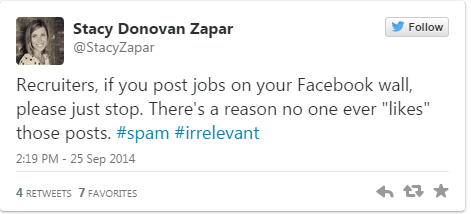
Lastly, we complete this week’s recruiting news installment with my personal favorite social update of the week; that distinction goes to the queen of social recruiting, Stacy Zapar.


Capture.PNG

Yeah. Amen to that sister. After all who has time for looking at jobs on Facebook with Jeter goodbyes, Scandal spoilers, and favorite seasonal pumpkin beer debates? Not that there is anything wrong with that last one.
And there you have it recruiters – consider yourself now in the know for the week that was in recruiting news.
Like the stories? Don’t like them? Want to add your own?
Share what’s on your mind at RecruitingBlogs.com.

About The Author:  Tim Spagnola is one of the  RecruitingDaily partners and a recruiting content snob. As a professionTimal recruiter since 2002, with experience in healthcare and medical device placement, Tim cares about bringing relevant and real time access to resources and information for our recruiting audience.

He is a Dad, blogger, pop culture junkie and self described social media enthusiast. You can follow Tim on Twitter @TSpagnola or connect with him on LinkedIn.

RecruiterBox: A Recruiter’s ATS

ATS Systems are written by HR Folks…

I honestly believe that ATS systems are written by HR folks simply for reporting tools. Seriously it seems that no one thinks about the actual end user who is the recruiter and sourcer.   That is until I got to do a demo with Recruiterbox.   Seriously, I think I really love this ATS. Want to know why? Of course you do that is why you are still reading this. The system has all the bells and whistles that you would expect a system to have so I am not going to talk about the obvious.

Here are a few features that really stood out to me:

  1. You can upload all your resumes in one shot from your computer to our resume management system. If you are starting out or changing systems this is an amazing feature in my opinion. One thing that drives me nuts is having to add resumes to the system and most ATS transfers will charge you extra for doing this. Not these guys.
  2. Are you getting emails from candidates that are not applying or getting referrals? Well, with Recruiterbox you can simply forward an email to a specified email address and it gets automatically converted to a candidate profile. No more having to mess around downloading attachments and adding the information to the system! How awesome is that?!?!?!  Seriously I would get this just for this tool alone!
  3. Not in to Boolean search strings? Neither is Recruiterbox. They have a software algorithm that searches the body of the resumes using natural language.

For example, If you just wanted to draw up a search of all candidates who worked at Facebook, then you’d simply have to search the word “Facebook” and boom, all the people who are at Facebook would come up in a list. This is simply awesome!

I know lots of recruiters who do not have the time or money to take fancy classes to learn Boolean and now you can search a database without complicated phrases and strings.

Recruiterbox accepts resume attachments in all possible formats including:

  • doc
  • docx
  • text
  • rtf
  • odt
  • html
  • pdf.

This is a particular pet peeve of mine and I have blogged about it in the past. I always prefer a document in .doc format but I cannot control how the candidate will send me their resume. Its theirs not mine. This tool makes that obsolete. It will scrape the information for you and set up the candidate in the system for you! Love this!

Even more…

Another great feature is the job dispersing tool. You can upload your jobs directly to Indeed, Simply Hired, Glassdoor, twiiter, Facebook, LinkedIn etc. all in one shot. It will parse it out to whatever sites that you want free or paid if you have an account.  Are you an independent or small firm? Don’t have a careers page? No problem Recruiterbox has a widget that can add it to your established page or they can set one up for you. Yet another cool function.

Recruiterbox has the best functionality that I have seen in an ATS. It is super smooth and very easy to learn.

It is very easy to upload resumes, add new jobs, take notes, and yes HR there is some very easy reporting tools that you can even customize.  You can even add your own forms. Those who have to do OFCCP compliance reporting would love this addition. You can add all your pre-employment forms and track them.

We all know that a good job description is key to attracting candidates. Well, guess what they have a service that will help you write a great job description (http://recruiterbox.com/job-descriptions) free for customers with a paid subscription, and $99 per description (with a 24 hour turn around) for everyone else.  I don’t know anyone who is doing this for their customers so all I can say is WOW again!

The last thing that I thought was simply awesome was the pricing. Yeah I know not sexy but hey nothing in life is really free right?

Wrong. They have packages that literally start out as free, you only get one opening at a time and five users but it is worth a try. Other packages start out as low as $600 a year up to $6,000 a year.

With all the bells and whistles you get with Recruiterbox at any price or package it is hard to look away.

Post Hoc: The Fallacy of Uniqueness in Recruiting and Hiring

not-specialCompanies, like people, like to think that they are special. That somehow, for whatever reason, they’re different from every other employer out there. And when it comes to hiring, those dubious distinctions are indubitably detrimental.

All of us, whether we’re talking about individual employees or enterprise employers, need to realize that while we’re obviously all different in some superficial ways, we’re really not all that unique – or at least not as much as most of us would like to think.

But when employers who are nothing special fail to realize that they’re, well, nothing special, then they’re doing themselves a disservice by making it difficult to actually hire candidates who might end up actually making that dream of differentiation a reality.

Social scientists actually have a formal term for individuals who feel that their particular issues or problems are disproportionately different from their actual rate of occurrence in the general population.

This phenomenon, sociologically speaking, is called “the fallacy of uniqueness.” And it’s likely the reason people often fail at emotional intelligence, interpersonal interactions and learning from others’ experiences. It also makes people feel like they have special abilities or exceptional capabilities that are, in fact, pretty passe. In fact, there’s nothing more cliche than thinking that somehow, you’re one of a kind.

You’re Nothing Special: Impacts on Recruiting & Hiring

Companies obviously suffer from the same fallacy. In fact, because as we all know, it takes employees to create an employer (duh), and the many different people who collectively create companies can compound the problems created by the fallacy of uniqueness.

And that collective can complicate the hiring process, which at most companies, seems to be complicated enough.

Here’s a few ways that the uniqueness fallacy can negatively impact recruiting and hiring:

1. Employers believe that they have more to offer a candidate than an outside observer might believe – and actively act on a belief that’s objectively unbelievable.

2. Employers think candidates need them worse than they need the candidate, even those with in-demand or highly competitive skillsets, leading them to frequently overscreen candidates or holding out for that candidate with the impossible laundry list of extraneous educational and experiential requirements.

3. Employers tend to undervalue candidates’ previous experiences at other employers who, of course, aren’t so special – even if, the fact is, those other companies serve the same industry, market or business function. Experience gained anywhere but the employer is, too often, instantaneously discounted against institutional knowledge.

These three hiring errors are caused by the very human tendency to take a subjective analysis and hold it as objective fact, which, of course, is a fundamental fallacy caused by the fallacy of uniqueness.

So how do you fight human instinct and institutionalized assumptions to overcome the fallacy of uniqueness in recruiting?

Tactical Transparency: Solving for Subjectivity in Recruiting


Screen-Shot-2012-06-10-at-10.40.05-PMThe good news is, this problem with uniqueness is so common that there are some proven techniques to solve a challenge that’s anything but insurmountable in recruiting and hiring. Here are some ways employers can minimize these tendencies and maximize their recruiting ROI:

1. The entire company (not to mention everyone involved in the hiring process) needs to be reminded that external candidates don’t necessarily know the full employer value proposition your company has to offer. In fact, just like there’s no completely foolproof way to guarantee that any hire will ultimately be successful, unless they’re converted consultants or contingent workers, there’s no way to guarantee that they’ll be able to fully realize the reality of working at your work until they’ve actually worked there. Which means, most of the time, we’re taking some chance and element of risk on with every hire we make.

2. It helps to review with your internal hiring team exactly what your employment value proposition (EVP), employer brand messaging, company mission, vision and values really are. Careful competitive analysis can also help inform why – or why not – your company has a competitive advantage against any other employer on the market. Know what you have to offer that’s different, but also reinforce the fact that there’s a good chance that the candidate hasn’t been fully closed on how awesome your company is yet, either – and that just because you’re selecting doesn’t mean you can stop selling.

3. Establish a criteria based hiring strategy before interviewing candidates to eliminate personal bias and turn subjectivity into standardization to make the most informed, objective decision possible when comparing candidates. Remind your hiring team that, if you’re backfilling a position, it can’t be an infallibly awesome opportunity, because the incumbent, at least, found something better out there already.

While we try to more or less hire replacements who most closely resemble or replicate predecessors in the position (the successful ones, anyway), it’s important to remember that even our top A players didn’t walk in the door that way. It took years of learning, growth and applied experience to get them to all-star status.

We need to give candidates that same luxury if we ever want to give them the opportunity to succeed. Make sure you know what that minimum threshold might be, and know that this is a long game if you’re making the right hire. A good hire should be able to grow with your company – not just check off all the boxes for a role that happens to be open at that very moment. If candidates meet that criteria, hire them!

4. Every company faces challenges, ambiguity, internal pressures, external competition and unforeseen issues. No one knows the future, and the only constant in any company is change. That’s why it’s important to address the bigger picture and biggest issues with candidates instead of spending so much time sweating the small stuff. No matter where they work, true professionals will be able to translate previous experience at other companies into predictors of future success.

I find it remarkable that so many of us manage to think of ourselves as so unique and special yet fail to give others that same courtesy, whether they’re another individual or another employer. We accept that we have some flaws, but expect perfection in others – even if we know that’s pretty much impossible. No one’s perfect – and I’m pretty sure that anyone who thinks they are already has a pretty obvious flaw.

Good companies need to establish what their dealbreakers and minimum criteria of what’s acceptable in a candidate – because all of them will have some sort of flaw or perceived professional shortcoming – and stick to it.

Make allowances for learning, growth and culture. Don’t be afraid to take chances on people who come to the table with the stuff no company can train – the integrity, work ethic, intellectual curiosity and even likeability – and factors that will turn out to be far more important in the long run.  Because, ultimately, every candidate is a potential future co-worker. You can’t fix a bad person, but you can make the right person succeed in any company if they’ve got the intangibles that actually, in fact, make us a little unique, after all.

Trust me, your company probably isn’t anything special. And the sooner you realize it, the sooner you’ll start making smarter hires – and overcome the fallacy of uniqueness that’s so common in every company. But realizing and acting to preempt the uniqueness fallacy in recruiting? That, in fact, is pretty special.

130e87bAbout the Author: Evan Donaldson is the Managing Director for InfoSystems Resources (“ISR”), running the IT practice based out of San Diego, CA. ISR is a division of Highmark Companies, a professional services company providing solutions to public and private sector clients based in Arlington, VA

Evan has worked in the technology placement and project field for over 15 years, primarily focusing on Southern California, helping companies find technical candidates to meet their critical needs, who range from senior level individual contributors through leaders at all levels – including C-level executives.

E-mail Evan at [email protected] or connect with him on LinkedIn.


The Evolution of Staffing Technology

Presented by:

Talentwise logo


Staffing technology has come a long way since the days of pushing paper and relying on Rolodex. But if you’re still stuck in spreadsheets or wasting time on manual processes and outdated systems, you’re behind the times. What’s worse: you’re also likely behind the competition, too.


You’ll learn:

  • A Brief History of Staffing Technology: From  tablets to the cloud we’ll look at the evolution of staffing technology.  He who forgets the past is doomed to repeat it. As anyone whose paperwork still actually involves paper (or payroll involves a roll) can tell you.
  • Staffing Technology Today: Go beyond the buzzwords to find out what trends like social, mobile and SaaS really mean. We’ll look at the established players, emerging upstarts and the competitive landscape.  Also let’s break down what these tools and trends really means for real recruiters.
  • A Buyer’s Guide to Staffing Technology: We’ll give you a checklist to make sure that you’re covered when considering your next staffing software purchase.

Meet Our Speakers:


Matt 90x90Matt  is the Executive Editor for Recruiting Daily. He oversees editorial strategy and content marketing for Recruiting Daily.  Prior to joining Recruiting Blogs, Matt served in marketing leadership roles.  He began his career as a corporate recruiter for such companies as Walt Disney and Warner Bros.


Karen Redetzki, Director of Marketing, TalentWiseKaren is the Director of Marketing at Talent Wise.  She has over 14 years’ experience in marketing and communications. Prior to joining Talent Wise, Karen was a senior global marketer at Microsoft. She launched the Windows Mobile communications engine. This enabled Microsoft content creators to easily disseminate and improve the readership of their message across the company.  All while streamlining the quantity and improving the relevancy of what content was delivered. She successfully lead the global PR launches for the Microsoft Advertising Network and received record-breaking coverage from top tier business and technology press.

Location vs. Aggregation: Why Predictive Analytics Are the Future of Recruiting

computer-shopper-crystal-ballI read an article the other day that had me confused. The title implied (as this one does at first) that “location” and “aggregation” are competitors for the future of recruitment. I won’t type out the definition of each word like the cliche or passe blogger of yesteryear, but I’ll link you to their Yourdictionary.com entries via Google here and here.

Do you see what I did there?

To be absolutely fair, the writer does state that they aren’t mutually exclusive at the end, but what bothered me the most is that I don’t think aggregation or location is the future. They’re the present. The now. And, even “megatrends” some say. And, they for darn sure are already working together.

So, what is the future of recruiting?

Well, if anyone is certain, I suggest they build, market, and sell it, or find who has started to build it and give them your life savings as the first, and the only investor of that round and pray to the heavens they execute. Because, any entrepreneur or “wantrepreneur” will tell you they have the idea, but many forget to execute it.

That’s why I want to share the future of recruiting with you. Thanks for asking, and you’re welcome. #BTW

Predictive Analytics: The Future of Recruiting

Recruiting analytics has been worked on for some time, and it’s why I believe that aggregators and others with data may have the edge. Many are producing some level of analytics. But, to my knowledge nobody has pieced together the “money shot.”

And, that money shot is predictive analytics. That’s the future of recruiting.

Specifically, I’m talking about identifying those that are job seekers with no experience in a role, but will do the job well and become autonomous in that role faster than others, thus reducing the onboarding and training time and producing faster. That is a game-changer for both candidate and company.

How amazing will it be for a CPA to find out that due to her years in that world, running her own small, business, and being the Chair of the local Rotary Club she’s ideal for this new role travelling for a company to promote their software around the globe, and she’s in the office at 11PM past 1AM because she had to deal with a personnel issue… AGAIN… and now she’s been trying to determine how she’s going to make it all the way to tax season without folding and she gets the most wonderful message that says it doesn’t have to be this way anymore?

How amazing will it be when big companies and small business alike are at war for the next shortage of software developers that are a rare breed that know the new “Passionteascript” that will solve the world’s thirst for really bad flavors of tea only to find out that there is this percentage of salespeople that have the ability and the patience to learn how to program and they don’t have to worry about quotas, dials, talk time, and making a commission check before Christmas so Santa can come to their house?

The Future of Recruiting: Never Too Late To Start Over

spaceyI could go on in my Faulkner/Burroughs-esque stream of consciousness… and I will… oh, alright, I’ll stop because the point hopefully is made.

Companies want to save money and will do whatever will cut costs whenever it whenever it’s feasible. And most try to determine reasonableness as well.

The amount of cost saved due to not having positions filled or even candidates coming through the door will be astronomical when the industry gets there.

The real highlight to me is at the jobseeker level. In film, books, TV, and certainly music we’ve seen and heard the theme of it’s never too late.

“It’s never too late to start over.”

(Cue Kevin Spacey smoking a joint and listening to Hendrix while bench pressing in his garage with his brand new classic sports car parked just outside.)

That’s what predictive analytics can bring. That’s a dream that’s easy to sell. And, I can’t wait to watch it. And hopefully, be a part of the future of recruiting.

ekstromAbout the Author: Matt Ekstrom currently serves as the Chief Revenue Officer at HiringSolved, a sourcing and recruiting startup which is doing for Talent Search what Google did for general web search, helping individuals and companies find everyone, everywhere and making that information easy to find.

In his role, Matt is responsible for helping HiringSolved grow new business, taking HiringSolved from under $2k a month in recurring revenue in May 2013 to being one of the most sought after recruiting technologies by some of the largest and most advanced firms in the world.

Matt has an extensive background in the recruiting and sourcing industry, having previously held leadership roles at companies like Monster Worldwide and TweetMyJobs. Follow Matt on Twitter @504Matt or connect with him on LinkedIn.

HR and Recruiting Professionals: Time to Pull Your Head Out

ostrich in sandIt’s not exactly breaking news that the general workforce population can’t seem to get enough of HR/recruiting bashing. This phenomenon is akin to TMZ stalking celebrity hangouts waiting for a scandal to erupt.

At any given time, in any given business publication, an abundance of gripes and rants levied at HR/recruiting professionals accompany most articles. Unfortunately in many instances those venting sessions are quite justified.

It’s as if everyone is collectively yelling: “Hey, HR people, it’s time to pull your head out!”

HR & Recruiting: Oblivious to Glaring Gaps

I was originally planning to write an entire article about Jibe’s recently released 2014 Talent Acquisition Survey. The 36-page report explored the gap between what job seekers want to happen during the job search process and how (even if/when aware of its own shortcomings) HR/recruiting doesn’t seem to be responsive to those expectations.

The report’s findings illustrated several examples of HR’s/recruiting’s apparent state of obliviousness to drive that message that home.

Here are a few parts that made my brain hurt. 

1344589013889_5857849HR professionals agree that their current application processes are coming up short:

  • Most feel that it’s extremely important for candidates to feel their application process is clear (69%), user-friendly(64%), and easy (56%).
  • Additionally, close to half acknowledge that most of the people who apply to jobs at their company expect transparency about the process (45%) and follow up often about the status of their applications(42%).
  • Yet, many HR professionals admit that if they were applying for a job at their company today, it’s not very likely that they could describe the experience as easy (57%), user-friendly(54%) or clear (52%).

Another segment continued to highlight how HR/recruiting is in fact aware of some obvious issues, but “struggles” with these “challenges.”

HR professionals know that the application process is crucial to attracting top talent, but are still struggling to improve in that area.

  • More than half (54%) agree that candidate experience is important to their hiring practices.
  • Forty-five percent are committed to enhancing the experience.
  • Almost four in ten (36%) report that improving the candidate experience is one of their greatest challenges.

As you might imagine, there was enough similar material there to fill an entire HR for Dummies book.

But the main thoughts that kept running through my head were…

WHY: Why are these known “problems” not being addressed?

WHO: Who comprises the other percentages of HR/recruiting practitioners that either aren’t bothered by these blatant credibility killers or just aren’t concerned when surveyed about these matters? (have another look at the stats above to see if you also wonder: what about the rest of the profession?)

HOW: How are there still so many people working in HR/recruiting who simply lack any type of clue about how to perform the basic functions of HR/recruiting?

WHEN: When will we stop hearing and reading about the same complaints that really can be fixed with a dose of common sense combined with basic competence?

Beyond the content of this report, I’ve encountered several other incidents of frown inducing HR/recruiting behavior.

Here’s what I mean…

head-up-assTime to Pull Your HR Head Out: Story #1

On a recruiting-focused Facebook page, a third-party recruiter inquired about OFCCP (Office of Federal Contract Compliance Programs) from an agency standpoint. That wasn’t the problem!

But what followed as the context for the inquiry was the statement:

The HR Manager that asked if we were compliant didn’t know what it was. He just knew it was on the checklist he had to ask for.”

Why is someone with the title HR Manager unaware of OFCCP?

I don’t mean to imply every human resources manager should be fully versed enough to recite any given employment-related law. But please, at least familiarize yourself with pertinent industry acronyms and legislation – especially if/when requesting “compliance” from a third-party vendor.

Time to Pull Your HR Head Out: Story #2

There have been countless times that I’ve participated in Twitter chats with other industry professionals. It never fails that someone along the way (mid-chat) will ask “what does ___ (word, term, phrase) mean?” Or, “what does ____ (acronym) stand for?”

These aren’t obscure references or newly invented buzzwords. These are standard business abbreviations used in the context of the chat subject-matter such as: ATS, CRM, ERP, EAP, FMLA, VMS, UI, ADA, ACA, and so on.

Now, I understand that many chats are structured for shared learning and collaboration, but is it really too much to ask for participants to be conversant in the language of the topic?

Even if tweets include “foreign” terms to certain group members, there is this newfangled internet thingy called a search engine where information about every possible topic is available within a few keystrokes.

Time to Pull Your HR Head Out: Story #3

li spamTwice in one week, two different recruiters from the same agency emailed a prospective candidate a message about two different jobs containing the following:

“I am emailing you in case you think you would be a great fit for the position listed below. Please check out the link and apply if you are interested in hearing more about the job.”

So, first let me state that I have no objection to recruiters emailing (or inMailing) job notifications. Where this type of messages loses me is that it puts the burden on the “potential” job seeker to take action (as in applying for the job) before even having a chance to verbally explore (with the recruiter) whether there is “potential” mutual interest.

Approaching prospects this way looks haphazard, lazy and unfocused. The two positions were well below the prospect’s career level, but he would have been willing to have a conversation with those recruiters if that option was offered. Instead, he was left with a matching set of craptastic recruiter spam destined for the delete button.

And, another thing…

Unless you’ve been hibernating in a remote wifi-less village, you probably noticed a trend in “thought-leader” articles spouting various opinions about the need to abolish, obliterate or otherwise render HR departments extinct. That’s all well and good in theory.

What these assorted authors seem to conveniently leave out is an alternative for accomplishing the scope of work that currently falls under the HR/recruiting umbrella. Simply brushing away the so-called non-strategic workload to some mysterious, unexplained, undefined and unnamed “outsourcing” solution is all they suggest.

One recent example of these “get rid of HR” proposals listed several futuristic job titles to allegedly replace the traditional roles we see today. Commenters on the article seemed to embrace the idea of hipster cool kids such as data scientists, game developers, social media managers and content strategists swooping in to rescue businesses from those dreary and outdated categories of talent attraction, engagement, development and retention.

It’s as if all we have to imagine is a poof of fairy dust making all of the typical employee relations, performance management and day-to-day people interactions vanish to make room for some fantastic HR-free world. Granted, after REPEATEDLY seeing all of the above (pull your head out) problems, that fantasy world does sound tempting!

If the genie appeared to grant you three wishes to fix HR/recruiting what would you pick?

talenttalks

About the Author: Leveraging her unique perspective as a progressive thinker with a well-rounded background from diverse corporate settings, Kelly Blokdijk advises members of the business community on targeted human resource, recruiting and organization development initiatives to enhance talent management, talent acquisition, corporate communications and employee engagement programs.

Kelly is an active HR and recruiting industry blogger and regular contributor on RecruitingBlogs.com. She also candidly shares opinions, observations and ideas as a member of RecruitingBlogs’ Editorial Advisory Board.

Follow Kelly on Twitter @TalentTalks or connect with her on LinkedIn.

Managing Hiring Managers: How To Protect Your Recruiting ROI

iCIMS Susan VitaleIt’s a true business irony – despite sharing a common goal, hiring managers and recruiters don’t always see eye-to-eye. Both parties are invested in identifying quality candidates for open positions, but their working relationship is historically tumultuous. Telling of this dynamic is a Corporate Leadership Council study of 8,000 recruiters and hiring managers, where recruiters cited the involvement of the hiring manager as the most critical component of hiring quality employees. On the other hand, only a third of hiring managers reported they were satisfied with the recruiter’s role in the hiring process.

This is not an isolated finding, but rather, illustrative of an ongoing business dilemma. In fact, according to ERE’s 2014 State of In-House Recruiting Survey, wherein both recruiters and hiring managers were asked to grade one another’s performance – both parties received a C+ rating from their counterparts.

Mutual dissatisfaction between these professionals, who are meant to operate as a team, is a problem that can cost businesses precious time, resources and – most pointedly – good candidates. The solution lies in both parties regarding the collaboration as a genuine relationship, not a static business transaction. This relationship that can be further supported by technologies that are designed to facilitate and expedite collaboration.

Managing Hiring Managers: 3 Guidelines for Success

Savvy organizations value open communication and introduce innovative recruiting tools into their processes to strengthen the relationship between recruiters and hiring managers, and thereby build better teams across the company.

A foundation of respect and productivity can be created between these parties by following these simple guidelines:

  1. Having a seat. Recruiters and hiring managers should meet in-person or virtually before diving into the candidate pool. A study by American Sociological Association found that hiring managers often value personal feelings of comfort, validation, and excitement during interviews over technical or cognitive skills – so getting to know the hiring manager’s nuances could be a recruiter’s secret weapon to finding the right candidate.
  2. Managing metrics. An interesting finding in ERE’s recent study indicated that recruiters and hiring managers have different perceptions of key recruiting metrics, such as requisitions-per-hire, interviews-per-hire, and cost-per-hire. It is nearly impossible for both groups to work together if they have conflicting ideas for what their targets should be. At a high level, corporate recruiting metrics should align to business objectives and more tactically, recruiters can simply include KPIs as an area to discuss and agree upon during that initial intake meeting.
  3. Leveraging technology. According to a recent survey by CareerXRoads, the top source of external hires is employee referrals, so a smart recruitment marketing strategy will take advantage of technology that extends the hiring network. The latest talent acquisition solutions can automate job postings directly to employees’ social networks, making it easier than ever for hiring managers to leverage existing employee networks in the search for best-fit talent as opposed to solely relying on recruiter-driven sourcing activities. Businesses today can also give candidates the option to submit a video of themselves during the screening process, which allows recruiters to pre-evaluate a candidate’s communication and presentations skills. This insight can help reduce hiring manager frustration, as it removes the chances of a manager devoting time for a live interview that is quickly shown to be a mismatch.

There are plenty of relatively simple, cost-efficient ways to put more muscle behind a company’s recruitment efforts. Businesses should invest in strong hiring manager-recruiter relationships because they translate to a healthy pipeline of talent, stronger hires and, as a result, a stronger business.

Want to learn more about maximizing your recruiting ROI? Click here to download iCIMS’ Hello to Hired Kit to find out how a full talent acquisition suite can streamline your recruiting process so you can recruit smarter, not harder.


susan_vitaleAbout the Author: Susan Vitale joined iCIMS in 2005 and serves as the company’s Chief Marketing Officer.

As CMO, Susan oversees direct marketing efforts as well as business development across a network of strategic alliances around the globe. Susan also plays an active role in portfolio strategy, helping to ensure iCIMS’ products, power-ups and services remain on the pulse of the ever-changing HR technology landscape.

Follow Susan on Twitter @Susan_Vitale or connect with her on LinkedIn.


The Week That Was – Recruiting

Hello fellow recruiters, talent pros, and sourcers. Who is ready to make a placement this week?

As you may have noted over the recent months, the team at Recruiting Daily has had a lot going on. We re-launched all of our sites, added a great staff of regular contributors and introduced a new editor for RecruitingTools.com. With so much being accomplished behind the scenes, I thought that it was time for me to add my snarky voice back into the rotation (yeah – that’s a skill of mine too). However, I ask that you reserve judgment on whether or not that’s a good thing for at least a few weeks. So in saying all that, I’m excited to introduce a new regular feature on RecruitingDaily.com called ‘The week that was recruiting’.

Let’s be honest – there’s a whole lot of noise out there in the recruiting world, but for those of us who are running a desk full time, it’s easy to miss some of the top stories. Thus the focus of this feature is to offer a quick recap of key stories from the previous week that all recruiters should know about.

Ready to get things started?

To start this week we will open with a tale of the haves and have-nots:

ZiprecruiterThe haves were an easy selection this week as Founder (and RBC supporter) Ian Siegel of ZipRecruiter made huge news by securing $60+ million in the company’s first round of funding. For those who have used this job distribution/CMR tool, you might be quick to note how it has evolved over the years. Now Ian and his team are poised to offer further expansion with enough financial resources to do some damage. Expect big things in the coming months from the ZipRecruiter team. Although on a personal note I hope they scale back some of the advertising. It has been a little too in your face as of late.

branchoutOn the flipside we have the have-nots and that distinction goes to BranchOut. Remember when BranchOut was poised to be the LinkedIn killer? When it was the essential tool for recruiters to source Facebook? The tool that would revolutionize our industry? Ok – I’m pushing it a bit with that last one, but if you’re like me, you downloaded the app, logged in once to play around, got bombarded with spam and never went back. Well apparently there are a whole lot of you out there like me as TechCruch reported that the BranchOut team is heading towards throwing in the towel. When you build a product on top of someone else’s platform one of the pitfalls is that you’re at their mercy.

A few other recruiting items of note –

College BasketballAnd to my fellow recruiters who are sports fans, this one is for you. We all leverage what we have in our favor to make a placement, so why would it be any different in sports? Case in point is Duke’s Coach Krzyzewski. Yahoo had an interesting story this week on how the Duke coach and current Team USA basketball head coach has leveraged his role in the later capacity to attract top high school basketball players from across the country. Is that bad thing? Perhaps for this UCONN fan, but in the grand scheme of things it is all about working with that you have which is a key element for all successful recruiters.

Lastly, each installment of this new column ends with my personal favorite social media update of the week and that honor in this inaugural post goes to my good friend Bill Boorman:

Ziprecruiter

The Founder of TRU knows a thing or two about open, non-facilitated forums. Safe travels Bill, wherever you are this week. I get dizzy just following your whereabouts via social media.

And there you have it recruiters – consider yourself now in the know for the week that was.

Until next Monday, happy hunting and be sure to share what’s on your mind at RecruitingBlogs.com.

About The Author:  Tim Spagnola is one of the  RecruitingDaily partners and a recruiting content snob. As a
professionTimal recruiter since 2002 with experience in healthcare and medical device placement, Tim cares about bringing relevant and real time access to resources and information for our recruiting audience. He is a Dad, blogger, pop culture junkie and self described social media enthusiast. You can follow Tim on Twitter @TSpagnola or connect with him on LinkedIn.

HiringSolved a Quick Review

What is HiringSolved?

HiringSolved makes it faster and easier to find the right person for any job. Our people aggregator gathers data from across the web and filters the most relevant information into a database of candidate profiles. With global coverage, all skill sets, the most advanced search capabilities on the market, and jaw-dropping speed, you’ll be able to source the perfect candidate in seconds.

The Search

HiringSolved provides a robust search tool that is easy to use, highly functional and accurate. There are 4 key areas that we focused on when reviewing their new search tool.

  1. The ability to search and source globablly
  2. The ability to “clone” your perfect candidate (resume finder)
  3. The ability to find talent in any field…. or as we like to call it skillset recovery
  4. The ability to track your work, stay organized and take action

Search and Source Globally

The interface for HiringSolved is clean and easy to use, with little to no frills. The real power here is the tools accuracy in identifying the resume that you are searching for. The database is multi language capable and you have the ability to search up to 10 cities at one time.

From our testing the database was better than most with the returned results for our test.

Clone your perfect candidate

There is nothing special about using Boolean to search a database or keywords to search millions of records; that’s what the software is suppose to do. There is however a value in uploading a resume of your perfect candidate and letting the system assist in determining the best matches in the system.

Is it perfect? No, however the the returned results were more than solid. In fact the results returned in my opinion surpass most of the other tools available that offer a similar matching service. HiringSolved wins in this area.

Find Talent in any field (Skill set recovery)

Pre-built searches make this feature a snap. HiringSolved covers all major industries and skill sets and with pre built searches you do not need to be an expert in creating high value searches. The provided searches are extensive but not the best. This is ok because it is your job as a recruiter to search for what you want. Generic searches return generic results.

You should not lean on a recruiting tool to accomplish this for you.

Keep track and work together

HiringSolved is built on tagging which allows for a fast call organization process for your search efforts. All of your tagging, notes, labels and searches are visible to your team and can be shared for the purpose of collaboration. This is an area of growth for sure however it;s highly functional, extremely fast and easy to deliver results.

All searches are saved the type of search that you performed creating an easy to access library of searches for future use.

Watch a quick demo of HiringSolve here

[youtube url=”https://www.youtube.com/watch?v=fHz0FmFmeYk” width=”500″ height=”300″]

The Comedy of the Profession: Commedia for HR Tech

Arlequin_-_Pantalone_-_Il_Dottore_-commedia_dell'arteFor those of you who didn’t sink tens of thousands of dollars into an ultimately worthless liberal arts degree or aren’t fans of the performing arts genres of the late Renaissance (for $500, Alec), you might not have heard of Commedia Dell’Arte: literally, “The Comedy of the Profession.”

Without getting too deep, it’s basically the Venetian equivalent of “In Living Color,” utilizing stock characters and sweeping stereotypes as the basis for what amounts to a satirical indictment of social mores and cultural values. Kind of like a Tyler Perry movie but without the evangelical undertones and cross-dressing.

For Commedia to work, it requires familiarity with the various character types in play and how they interact when thrust into conflict or collaboration, similar to employer branding, generational theory or corporate diversity and inclusion initiatives.

The aesthetics of Commedia are a lot like contemporary recruiting; the ubiquitous use of masks to dehumanize and deemphasize the individual; an overreliance on borrowing and creating generic content instead of producing work with a modicum of originality (think: “our people are our greatest asset”), and overreliance on presentational style over substance.

But in creating what more or less amounts to what marketers refer to these days as “buyer personas” to speak to their audience, Commedia anticipated what psychologists refer to as ‘confirmation bias’ and talent acquisition professionals refer to as ‘soft skills.’

The fact remains that all people can be conveniently placed into about a dozen different buckets, individual nuance and personalization be damned. If you’ve ever read an article on Gen Y in the workplace, or recruited candidates out of a specific school or company, you’re well familiar with this phenomenon already.

Half a millennium after Commedia’s commercial peak, the art form – and the characters types upon whom its comedy is premised – remains as applicable today as ever. And when it comes to sweeping performance art based on the collision of disparate characters, the HR Tech vendors you’ll see at industry trade shows are, more or less, keeping the Commedia Dell’Arte conventions alive and well.

2014-09-19_15-26-15The Conventions of Conventions: HR Tech Stock Characters

With the fall conference season in full swing, here’s your guide to the Commedia characters you’re likely to run into during a stroll through any expo hall – and watching the drama play out is infinitely more entertaining when you realize that it’s more theatre than anything else.

1. Pierrot (The Sad Clown): One of the few unmasked Commedia characters, Pierrot is a buffoon who is constantly scorned by the obvious unrequited love of the beautiful women he pines after but obviously, his base humor, lower class sensibilities and obvious ignorance of reality means that his affections are constantly unrequited.

The HR Convention Equivalent: Those vendors with the booth in the back no one has ever heard of, promoting prizes no one wants (win an iPod Nano!) and whose “revolutionary” product is so obsolete or specious that you know there’s a pretty good chance that they won’t be around next year, since they blew their entire budget on trying to compete with the cool kids with cash flow, brand awareness and actual case use for HR and recruiting.

Examples: BranchOut, TweetMyJobs, JobsInLogistics.com, those creepy “Business Case for Breastfeeding” people.

2. Harlequin (The Scheming Servant): Harlequin, like the romance novel imprint his name inspired, presents himself as a faithful servant, but who, in fact, uses the confidence of his master to undercut his plans for personal gain. A trickster, Harlequin is more obsessed with style over substance, and will put personal gain ahead of professional duty. Particularly when it comes to winning the ladies.

The HR Tech Equivalent: If this doesn’t sound like one of your HR Tech vendors already, you’re obviously the master being duped. Most HR Tech product marketing and sales falls squarely into the Harlequin school of presentation. If you’ve ever asked if a vendor has a particular function or feature and heard, “It’s on our roadmap for next quarter” and who spend more money on swag and sponsored parties than they do actual product development, ignore that whole “customer first” act. That ends once the ink dries on the contract.

Examples: Any publicly traded “integrated talent management” provider still building off a code base developed sometime during the Clinton administration. There are too many of these to even name – nor do I want their lawyers after my ass, either.

3. Pantalone (Rich Uncle Penny Bags): The “money” in Commedia Del Arte, Pantelone is one of the most ubiquitous and reoccurring characters. With his great wealth and haughty, holier than thou attitude, he’s still driven by greed although he’s already at the top of the pecking order. And always ends up victimized by his own hubris

The HR Tech Equivalent: You probably won’t see them actually at any industry convention, because they’re just too good for deigning to be seen with the peasants in an industry which is also the source of their wealth – wealth largely earned by the exploitation of the mouth breathing masses.

Example: LinkedIn. Duh.

There are many more Commedia characters in the ecosystem, but given the fact that this piece is directed towards HR Tech vendors but uses a dramaturg’s approach, I’m betting none of you even got this far.

But if you did, you already know that Il Dottore (the old doctor who deliberately gets in the way of young upstarts) is any generalized, traditional job board and Scaramouche is any “influencer” whose only claim to such is the fact they occasionally blog. Present company included.

Personal Devices in the Workplace: How HR Can Write Better BYOD Policies

bring-your-own-devicePersonal technology often finds itself inextricably intertwined with work technology. More and more employees are using their personal devices to access their work networks, systems, and/or email.

Allowing employees to use their own devices or to “bring your own device” (BYOD) to work often makes them more productive. Employees are more mobile. They can work from home, while traveling, or during off-hours. BYOD is great — at least until the security vulnerabilities make themselves known.

While it may seem natural to assign BYOD responsibility to IT, with their tools and technical restrictions, the job actually belongs to HR. A Gartner survey predicts that by 2017, half of employers will require employees to supply their own device for work purposes. CIOs named higher employee satisfaction, new mobile workforce opportunities, and reduced costs as reasons BYOD will only grow into the future.

The task of officially introducing this BYOD trend to the workplace begins with HR managers. Policy is at the heart of BYOD, because setting policies is the first step an organization makes to recognize this employee practice. Within BYOD policies, the limits of personal devices at work are often responses to security concerns.

Here are the major considerations HR managers should be of aware of when creating their own BYOD policies:

BYOD Policies: Nice To Have or Necessary HR Evil?

BYOD policies aren’t always necessary. If there are already restrictions against using personal devices, a BYOD policy is probably superfluous. Organizations also don’t need BYOD policies if workers can only use company equipment for company work or if workers simply never use their own devices for work. For instance, a coffee shop usually does not need a BYOD policy for its baristas.

All other HR departments should consider a BYOD policy if they don’t already have one in place. And even if an organization does not currently need a BYOD policy for whatever reason, they may want to consider how to put one into place in the future.

Having a BYOD policy does not make BYOD mandatory — for either the employee or the organization. What the policy does, instead, is outline expectations for employee conduct in explicit terms. It tells the employee that BYOD is allowed, but it also makes the responsibilities and potential consequences of using BYOD clear.

BYOD Policies: Viruses, Malware & Thievery, Oh My!

Of the many security woes employees can expose an organization to through BYOD, viruses and other nefarious entities are the most common. With BYOD, employees increase the chance of bringing more of these dangerous influences into contact with their organization. These nuisances can become full-blown disasters if they spread.

Devices that employees use in their personal lives are more likely to encounter these digital dangers. Websites employees visit for personal use or entertainment are often less secure than professional websites. Using the same device for both work and personal use increases the chances of transferring viruses and malware to their company’s technology architecture.

At the same time, thieves of physical devices are more likely to steal devices that employees carry around. Instead of leaving work devices with work data at work or home, now (in the case of smartphones and tablets), employees are carrying that data with them everywhere.

Designers of BYOD policy should recognize these dangers and make them clear to their employees. Policies should also spell out what the impact and consequences are for failing to avoid these risks. An individual whose non-work device contracts a virus or is stolen must deal with an annoyance. Much more seriously, a company-wide virus or a stolen device containing company data can mean devastating harm to a business, in the form of lost work, lost intellectual property, and damage to customer confidence.

Being Sensitive to Sensitive Information In BYOD Policies

Some information is highly sensitive and must be treated as such. While correspondence between employees is private, a breach in that kind of data is less severe than a breach in credit card information. BYOD policies should be clear about varying levels of information sensitivity.

An organization may want to instate different policies depending on information sensitivity levels. Employees may only handle less sensitive information from their personal devices. Or, employees must follow more secure protocols for more sensitive data.

Technical (In)compatibilities with BYOD Policies

Organizations usually already have security systems in place for their technology. They have vetted and chosen everything from virus and malware prevention and detection software to firewalls and encryption. Another snag in allowing BYOD is aligning these security systems with personal devices.

When employees BYOD, they bring a wide variety of consumer devices to work. Not all these devices will be compatible with the organization’s existing security infrastructure. Different operating systems, makes, and models may each create their own issues.

Organizations need to know what security software is mandatory. Compatibility with this software will determine which devices are permissible for BYOD. If organizations want or need to allow BYOD for devices that cannot support their security software, they should address that as well.

The Limits of BYOD Policies

HR departments should also recognize that policy can only do so much. Policy can create expectations and a system for reprimands when employees stray, but it cannot fix mistakes. If data leaks, or a thief takes a device, the policy isn’t going to prevent or contain the aftermath.

HR departments need to work with IT services and outline detailed BYOD strategies to protect from security woes. A BYOD policy is the first step to outlining a BYOD strategy, but a solid first step lays a solid foundation for your entire strategy.


camAbout the Author: Cam Roberson is the Director of the Reseller Channel for Beachhead Solutions, a company that designs cloud-managed mobile device security tools. In this role, Cam is responsible for all corporate and product marketing strategy and success. Most recently, Cam led Beachhead Solutions through a complete corporate relaunch, including new product development and relaunch, corporate brand and messaging makeover and continuing to build the Beachhead Partner Program of resellers to broaden Beachhead’s market presence.

A graduate of San Jose State University, Cam began his career as a product manager in Apple Computers before launching Business Graphics Group, which he built from inception to the 15th largest advertising agency in the San Francisco Bay Area. Follow Cam on Twitter @BeachheadMDM or connect with him on LinkedIn.