Blog

Walk The Line: Why Corporate Transparency Is More Than A Buzzword

white-sox-logoIn 2002, then President George W. Bush signed the landmark Sarbanes-Oxley (SOX) legislation, which laid out some basic rules of the road regarding business behaviors that continue to impact corporate America today. One of the most important components of the act was increasing corporate transparency.
Businesses could no longer get away with the kind of chicanery that turned companies like Enron, Worldcom and Arthur Andersen from appearing on the Fortune 500 to appearing on American Greed.
Obviously, business has fundamentally changed in the last dozen or so years since the law went into effect, and the concept of “transparency” has morphed from legal mandate to best practice buzzword, but companies are still trying to figure out the fiat of striking the right balance between open information and closed corporate secrecy.
With real time communication, constant connectivity and social networks, transparency is more important than ever, particularly when it comes to employee engagement, customer satisfaction and brand reputation.
The success – or failure – of a business and its bottom line results now rely more than ever on creating a sense of true transparency (even if, in most cases, it’s nothing more than a carefully constructed facade).

Corporate Transparency and Information Balance

transparencyCompanies today must walk a fine line between protecting trade secrets and proprietary information with the expectation of consumers and candidates alike that, in the age of Glassdoor and Google, insights and information about employers are readily available and, most importantly, completely authentic.

Too little transparency leads customers and employees to believe a company is intentionally concealing or hiding important information, an opaqueness caused by omission that can lead to people assuming the worst (albeit often erroneously). Too much transparency, however, can erode competitive advantage and market positioning.

Practically speaking, employees need information about a company to successfully do their jobs, particularly in outwardly facing functions like recruiting; business opacity can hamper personal performance as well as employee engagement – not to mention the ability to attract top talent.

recent study of Korean chaebols conducted by Hanyang University found a direct correlation between company performance and a transparent corporate commitment to ethics; companies whose values follow ethical transparency, in turn, have greater returns on their talent investment, with increased worker productivity and satisfaction.

Of course, full transparency is fraught with manifold issues, particularly involving information security – obviously, not everything is intended for public consumption, as the recent Sony Pictures hacking scandal demonstrated. Although most of our employers probably aren’t being specifically targeted for cyber attacks by the North Korean government, cloud-based file sharing and backup systems do allow companies to provide employees with the information they need while still maintaining controls to preempt private or sensitive information from being accessed incorrectly.
Many of these services offer electronic signature capabilities as well as an automated log of which data (and when) individual employees are accessing, which, unlike paper documents, give employers a control by allowing them to monitor and track data usage as well as flag any suspect attempts to access confidential information for unethical (or illegal) purposes. These systems offer employers a balance between safety and responsibility.

Corporate Transparency and Social Responsibility

sugar coatedThe fact that there’s a direct correlation between companies’ commitment to ethical behaviors and improved financial performance is the business equivalent of karma – not to mention proof that CSR is more than simply a PR ploy. Businesses that rank in the top quartile for social responsibility not only have huge cache for a company’s brand reputation and marketing, but they also lead their peer groups in terms of employee satisfaction, recruitment, and retention.

Building a socially responsible organization starts with corporate transparency; when current and prospective employees perceive their employer as altruistic and committed to the greater good, studies show increased willingness to work additional hours, contribute to intellectual equity and become those all important “brand ambassadors” who actively promote the organization through organic promotion and word-of-mouth marketing.

Similarly, consumers who identify a business as being committed to corporate social responsibility are more likely to become customers or clients; studies suggest consumers are over 50% more likely to buy from brands they perceive as socially responsible over a competitor, even at the same price point.

The ROI Of Corporate Transparency

profit catWith SOX having been enacted over a dozen years ago, the long term impact of this legislation are just beginning to be realized. A study published in the Journal of Banking and Finance looked at the return on investment and cost of debt associated with SOX compliance in 252 large firms. The study found that the companies sample realized a $844 million cost savings over five years as a result of SOX compliance.

For these companies, corporate transparency gave them a better credit rating and yielded significant returns on offset investments. They also found that the companies with less conservative earnings saw greater advantages from corporate financial transparency. When it comes to cost of debt, turns out transparency pays off.

No matter what market or industry your employer happens to be in, corporate transparency has consistently proven the most prescient predictor of company success. Even at public companies or other enterprises that rely on market viability, transparency is more strongly tied to forecasting future outcomes than their accounting or balance sheet.

We talk a lot about the concept of “transparency,” but it’s more than a buzzword – it’s big business’ public commitment to putting their money where their mouth is.

And that’s the bottom line.

Kill Your Unicorns: A Trench Recruiting Reality Check

Recruiting is evolving. Fast. Faster than any time in my 15+ years in corporate recruiting. There are many contributing factors: social media, the maturation of employer branding, the prevalence of mobile devices (and their ability to reach a new ‘always on’ generation), advances in HR technology – just to name a few.

These changes in the recruiting marketplace are happening at a pace most corporate recruiting teams struggle to keep up with. It’s created a new crop of consulting firms (like mine) who help them navigate these new waters. There is a lot of opportunity in this new world.

These industry shifts have also spawned a new crop of hyperbolic statements, unicorn statements, about the state of recruiting. Views I feel are beginning to become more and more disconnected with the trench recruiting realities on the ground for most companies. These unicorn views aren’t rooted in the realities most recruiting teams face.

The Resume Is Dead.

aliveNo, it’s not. One of the most popular unicorn statements is that the resume is dead. That in the age of social media the resume is a stagnant relic from recruiting’s past that has outlived it’s utility. There are three glaring flaws with this point of view.

This unicorn statement assumes all the prospects our organizations might hire are active on social media. Not just active, but so active they leave enough breadcrumbs for hiring teams to understand what they do, how well they do it, and ideally whether they’re a cultural fit for good measure. That’s just not reality for the across all industries and the universe of prospects we might hire.

Let’s assume there is enough accessible social data to make an informed decision on all prospect’s suitability (there isn’t). How are companies who hire at scale supposed to manage that approach? 50,000 global hires in a fiscal year? Super, fire up the social media aggregator!

Another point for trench recruiting, but certainly not least in sheer sexiness of subject, is compliance.

Big Data And Algorithms Will Replace Recruiters Soon.

robotoNo, it won’t. Don’t get me wrong – I’m all for technology (with the podcasting bona fides to prove it). I do think algorithms will enhance corporate recruiting capabilities over time. If you drink the kool aid, that “over time” is allegedly next year.

Really? There will definitely be companies and new HR technology that will enable this in 2015, but to think it will be mainstream is naïve. To sell it as truth is irresponsible.

Most corporate recruiting teams aren’t even mining their ATS for talent. They’re just beginning to incorporate social media and employer branding into their talent strategy. CRM is something that’s beginning to gain traction as we continue to adopt more marketing tactics and sensibilities into corporate recruiting.

That’s the real reality most corporate recruiting teams face. We’re getting there, but our evolution and adoption curve is iterative and we’re still a few stages behind.

There’s Never Been a Better Time to be peabodya Recruiter.

I believe this. There are a variety of career paths, tools, and techniques that recruiters can pursue. There’s room for “old school recruiters” who just want to make placements with their rolodex and phone. There’s room for more creative types with a marketer’s DNA who want to lead branding efforts. There’s room for analytic types who want to crunch talent management numbers, find correlation, and develop strategy.

Let’s kill these unicorns and celebrate this diversity of recruiting career possibilities. There will be a time in the future when these unicorns are commonplace, but it’s not today.

What’s your take on these unicorns? Or others? Am I missing something?

Tell us below which unicorn you’d like to kill in 2015.

Read more at Amplify Talent.

How Recruiters and Employers Can Use Tumblr

tumblr-logoI can’t remember the last time I used Tumblr – besides maybe a one off campaign where some CEO insisted that we use the platform (which hasn’t happened very often). Just like any other social channel where a company fails to support content with engagement, the two prong strategy of post and pray didn’t quite work.

If you’re a recruiter, that should sound familiar.

Tumblr seems to be a little like social’s red headed stepchild, especially when it comes to business use – it’s not like you read a ton of success stories or case studies about brands and consumers flocking to Tumblr – in fact, it rarely merits so much as a passing mention.

Which is why I was so surprised to read this little news nugget in a recent Inc. article:

“The Yahoo-owned social blogging platform is experiencing faster growth in active users than Facebook, YouTube, Twitter, Instagram and Pinterest.”

Yeah, I know – the words “growth” and “Yahoo!” in the same sentence seems like some sort of mistake, but the fact is that for all the sexy, shiny new social networks that brands are talking about as potential marketing platforms (sorry, Ello), the fact is that Tumblr, so often overlooked, has somehow suddenly emerged as the new leader in the race to catch up to the “Big 3” social networks (Twitter, Facebook and LinkedIn).

Tumblr for Dummies (And A Handy Guide for the Rest of Us)

I realize some of you might be reading this and wonder what, the hell, Tumblr actually is. Which is OK, since you’re likely not under the age of 18 and don’t communicate strictly in .gifs.

As a brief refresher, Tumblr is a micro-blogging platform – which basically means (at least in my head) that it’s kinda like Facebook, but with a lower word count limit on posts and more of an emphasis on building followers for exposure instead of building a network of friends.

In fact, Tumblr users can join, post, share and like other people’s posts without ever having to connect with anyone, ever. It’s pretty easy to set up an account, but if you need a simple, step-by-step guide to getting started (or getting back on track), click here. You’re welcome.

Once you’re in, you’ll instantly notice that Tumblr functions a little differently than pretty much any other social network out there. In a world that’s somewhat obsessed with tracking cookies and clicks, Tumblr deemphasizes analytics for what amounts to your own art gallery – without having to worry about running into an old high school friend or that boss you hated at your old job.

One of the primary benefits of Tumblr is that you can post pretty much anything on there, and users do – from blog posts to external links to .gifs to videos and more. That open structure and relative lack of limitations is a big driver behind Tumblr’s user growth – and over the last year, that growth has been co-opted by a steady stream of celebrities and public figures. It’s even created a few celebrities of its own, with top Tumblr users attracting huge followings and fan bases numbering in the millions.

How Tumblr Became the Fastest Growing Social Network

tumblr factsIn the Inc. article referenced above, author Oscar Raymundo explains “how Tumblr became the fastest growing social network in just 6 months” as being driven by a combination of the aforementioned star power, its optimization and ease of use on mobile devices, and a steady product release cycle. In looking at Tumblr, if I had to put my thumb on one specific element that’s made this site so successful – it’s the star power.

Let’s face it, most social media users freak out when a platform rolls out changes. Remember those “bring my old Facebook back” campaigns? But somehow, Yahoo! continues to iterate and evolve Tumblr with limited objections from its highly engaged user base.

So, if consumers (and by extension, candidates) are, statistically speaking, all flocking to Tumblr, why haven’t recruiters followed suit? Normally, recuiters become a somewhat ubiquitous presence on any site that supports free job postings, even if there’s no evidence of efficacy. So where the heck are all the employer brand pages and staffing spam we’ve come to accept as a necessary evil of social media?

I’d venture to guess it’s because you, like me, are already too busy spending your time on the handful of other social sites that are a core component of your strategy and use every day – or sites that you’ve actually had some success finding and developing candidates or clients. But, the fact is, while it’s easy to ignore Tumblr, the fact is that it’s becoming too big, and growing too quickly, to keep completely off your radar.

So, once I’d seen the data, I decided it was time to dust off my old Tumblr account and see what had changed since the last time I’d logged on – and how employers and recruiters might be able to actually use Tumblr to attract top talent.

4 Ways Employers & Recruiters Can Use Tumblr

social_media_guru-f918bc5It seems like recruiters always have some network that’s the next big thing – from Empire Avenue to Pinterest to SnapChat, we’ve seen literally dozens of potential contenders come and go in a flurry of content about how awesome these networks are and how you’re just not doing your job as a recruiter unless whatever the hot new network happens to be that week.

The only problem is, these sites are just as quickly abandoned once recruiters realize that they’re just not generating any candidates or creating any recruiting ROI. Hell, it’s hard enough to get meaningful outcomes out of Facebook or Twitter if you’re a recruiter, much less these other sites with much smaller audiences and relatively limited reach.

Upon investigation, I do think there are a few specific case uses for sourcing and recruiting on Tumblr, and I’ve listed them below. But my advice is that if you’re not already on Tumblr, you don’t really have to be unless you have a reason to be there, and the commitment to actually do more than just post jobs and share career content.

But if you’re trying to recruit for one of the following areas, Tumblr just might make sense for you.

1. Gen Y Recruiting: Let’s face it, if you’re on Facebook or Twitter, you’re old. They both have average user ages of over 30, and the fact that these networks keep getting grayer is driving Gen Y to find a special corner of social media where they’re free from getting tagged by their Grandma or, worse, spammed by recruiters or sold stuff by companies.

Tumblr profiles aren’t built to be professional, and really don’t give a whole lot of insight into the user’s work history. So they’re not so great for sourcing, sorry to say.

But Tumblr is a great place to actually put a finger to the pulse of what Gen Y really cares about, how they communicate and how to build a culture that supports their needs (even if they hate that particular buzzword).

After all, 66% of Tumblr users are under 35 years old, and 39% are under 25. It’s the most popular social network among 18-29 year olds, and the fact that it’s demographics are so much younger than other social networks make it an ideal place to target the emerging workforce.

2. Social Media and Creative Roles: By now, everyone already knows how to use Facebook, Twitter and LinkedIn – these sites are all designed to be as idiot-proof as possible (which still doesn’t seem to deter most recruiters). But Tumblr’s relative lack of structure or rules means that it’s a great place to find examples of candidates doing innovative or interesting things on social media, as well as an ideal way to find samples for roles like designers or copywriters (it is a micro-blogging site, after all).

It’s also an ideal place to find social media marketing candidates – Tumblr emphasizes engagement and curation, and if you can build a following on this platform, more traditional B2B social media seems pretty passe and prosaic.

3. Entertainment Industry Recruiting: Like I mentioned before, the celebrity presence on Tumblr has been a significant driver behind its explosive growth. From Taylor Swift (OK, she’s everywhere) to the Walking Dead to the 1975 (it’s a band, not a year, by the way – just ask your kids), Tumblr is like a repository of pop culture that’s actually cool – no Throwback Thursdays or Mashable memes here.

If you want to find candidates who are highly engaged and knowledgeable about what’s now – or to inform your content or knowledge of what candidates actually care about – Tumblr is an ideal platform. OK, so maybe sourcing Taylor Swift fans seems like a scary (and creepy) idea, but for the right company culture, it could be key.

4. Company Careers Pages: Now that Facebook is changing their algorithm (again) to remove any posts it flags as promotional, particularly those coming from company pages that aren’t paying for the privilege of showing up in news feeds, Tumblr could represent an ideal replacement for creating an employer-brand focused destination that’s visible and creates reach without ponying up a premium.

After all, it incorporates the emerging media like photos and videos that satisfy the voyeuristic qualities people love about Facebook (or employer branding) without the algorithm that basically turns company pages into a tree falling in the woods. If you want to get heard in a place where there’s not a whole lot of noise, Tumblr could just be a practical solution to your social recruiting problems. But I wouldn’t count on it.

So, Tumblr is hot right now, but as far as using it for recruiting and sourcing, the things that make it so attractive to users could, if other networks are any indication, become quickly eroded if it was widely adopted as part of an employer’s social media strategy. After all, most of the site’s users turn to it specifically to get away from your brand spam in the first place.

Like any other social network, recruiting efficacy isn’t about the medium – it’s about the message. And if your social recruiting strategies aren’t working on other sites, Tumblr isn’t the answer to your problems. But it very well could be if you’re having success on social or simply want to extend the reach of the stuff you’re doing that’s already working.


katrinaAbout the Author: Katrina Kibben is the Director of Marketing for Recruiting Daily, and has served in marketing leadership roles at companies such as Monster Worldwide and Care.com, where she has helped both established and emerging brands develop and deliver world-class content and social media marketing, lead generation and development, marketing automation and online advertising.

An expert in marketing analytics and automation, Kibben is an accomplished writer and speaker whose work has been featured on sites like Monster.com, Brazen Careerist and About.com.  A graduate of Pennsylvania State University, Kibben is actively involved in many community and social causes – including rooting for her hometown Pittsburgh Steelers.

You can follow Katrina on Twitter @KatrinaKibben or connect with her on LinkedIn.


How Hootsuite Hires: A Social Recruiting Success Story

512px-owly-binoculars-newHootsuite, a high growth, high tech employer based in Vancouver has emerged as one of the most widely used social business platforms on the market. Its enterprise social monitoring and publishing tools have fueled the company’s explosive growth from bootstrap to big brand, from start-up to social success story.

In under four years, Hootsuite has grown from under 20 employees to over 700, with plans to hire hundreds more global employees in 12 countries in 2015 alone.

That kind of growth would be daunting enough for pretty much every employer, but as the head of talent for Hootsuite, Ambrosia Humphrey faces a few unenviable talent attraction challenges

The first is that there’s a pretty limited pool of developers and coders available in Vancouver, a city that has seen an explosion of start-ups and bigger players competing for the same finite number of candidates, since its proximity to Seattle still doesn’t make getting a Canadian work visa for an international employee any easier. It doesn’t help that the cost of living in Vancouver is among the highest in the West Coast, or that most homegrown tech talent is concentrated around the technical colleges clustered in Southern Ontario (the exact other end of the second largest country).

These challenges are big, but while they’re still unique to Hootsuite, the company also faces the same challenges of attracting and retaining candidates with the skills required to take a high growth, high tech company and build a big enough business for a potential IPO. That’s hard no matter where you are, as you already know if you know anything about the labor market at the moment. And if you’re reading this, well, no need to tell you how tough tech recruiting really is out there.

But Hootsuite must be doing something right, and a lot of that credit goes to the fact that even against those already daunting odds, Ambrosia and her team have taken the company from bootstrap to brand name. We’re talking dozens and dozens of really specialized, really skilled and hard to source hires from all over the world. To Vancouver. To work at a start-up. In social media.

Which means I’ve got nothing but mad props for Ambrosia and her team. And, of course, I wanted to know how in the hell she managed to sit at the intersection of tech hiring, social media and startup recruiting and still have the kind of success – and passion – that she’s managed to achieve while still keeping her sanity and sense of humor. Seriously.

I finally got the chance to sit down to speak with her about her role at Hootsuite and talk shop about some of the things she’s done to simultaneously confront – and successfully overcome – some of the most pervasive talent attraction challenges.

Recruiting Daily: Tell us a little bit about your social recruiting journey. What’s working for you? Any advice for recruiters just starting to think about this stuff?

ambrosiaAmbrosia Humphrey, VP of Talent – Hootsuite: Early on, we adopted the philosophy that everyone is a recruiter, and everyone is responsible for bringing in talent. We talk a lot about “brand ambassadors,” which is easy when you’re a small employer, but growth requires a different strategy.

It’s becoming very difficult to engage people out on social media. Take Twitter. We have 42 different handles and 7 hashtags here at Hootsuite, and that’s just for one company. So the real questions we have to be asking when we look at social is why anyone should pay attention to ours and respond to an ask, which is hard enough to do even when you’re not hiring hundreds of people like we are.

The key for us is building content, conversations and community. Content is king, and people engage with content – and the most successful content all includes photos or video. We don’t have a dedicated team for employer branding, and no one really ‘owns’ it – we’ve been doing it grassroots.

We think since we’re already building a brand here at Hootsuite, we can work around creating a believable employer brand story with existing assets Hootsuite has already built. 

RD: Speaking of your employer brand story, how do your employees fit in when it comes to telling that story? How has becoming a global company impacted that story or how it’s shared on social? 

AH: Our new career page is our calling card, because it allows us to create a separate careers site that’s not just another piece of marketing material. We can really bridge the divide between what Hootsuite says we are as a company and what employees actually think we are.

We’ve created the #HootsuiteLife hashtag, which helps us also track and attribute hires directly to social media. From that, we’ve seen we can attribute a significant number of our hires to people who have actually searched for this hashtag and read this content before they applied.

That means getting our employees involved. All Hootsuite employees are educated on the purpose of this hashtag and what we want to show: fun in the office, our global expansion to places like London, Bucharest, Australia and Brazil. We’re quite a big company, but we’re also quite a young company. That means we don’t have this huge marketing machine to help us localize employer branding. As we mature, that’s going to become more of a focus, but we’ve found that #HoosuiteLife translates globally.

It helps us show that we’re not just pumping our own tires in our recruitment marketing materials, and that all our employees are stakeholders in recruiting – having a global hashtag helps us make sure we’re not focusing too much on Vancouver.

We want employees who don’t work at our headquarters to be heard – and they won’t if no one’s listening.

RD: Obviously, you’re doing a lot of the kind of cool, cutting edge stuff on social and career sites, but let’s go back to the basics. How do these stack up against more traditional recruiting strategies?

AH: I think ideally they are just different elements of the same effort, really. We have a series of #HootHire events, which are basically open house hiring fairs, but we really use social to fuel those and build awareness and engagement with attendees.

We get a lot of PR from this sort of thing, but we’re not casting out the net for coverage. That’s not our goal. It’s about building a community around the places we’re already at, and we deputize our advocates to spread news about our events and raise awareness organically.

These hiring events really are community events, and that helps our #HootHire hashtag trend across Canada and build a ton of buzz. At our last event, we had helicopters covering our career fair from CBC News, the biggest broadcaster in the country.

I’m sure you’re wondering what’s newsworthy (or new) about a career fair, but it’s really about building a social buzz and making the community feel like they’re a part of ours. It also helps us tell our employees’ stories, not just our own.

It is one example of many initiatives we have where the idea might be traditional but the approach has changed. Low cost, high impact, and fueled by social.

RD: So you’ve got some buzz, but come on – does that really translate to hires? It’s hard to imagine many qualified candidates coming in from something like a career fair, even for a company like Hootsuite that’s got such a well known brand.

AH: Our job in recruiting isn’t to control the brand – it’s to create a community. At our last event alone, we had over a thousand attendees, and of those, we made 85 new hires. We hire holistically across our organization, and these kind of events are great for hiring roles like sales and customer support.

We’ve probably pretty much saturated the Vancouver market by now, but we want our models to scale globally, and in all markets these hiring open houses provide a great yield in terms of results by offering candidates a foot in the door by getting to meet us, and a chance for us to get to meet and know candidates we might not otherwise be able to reach through something like social media alone.

We don’t do these for attention, we don’t do these for goodwill – we’re going for hires and those don’t always show up to an event with an audience. #HootHire events are what we call “The Bat Signal” – we send out a beacon so every job seeker hopefully can see it, even if top talent doesn’t always show up. But there are always a few diamonds in the rough that create a really high ROI.

I can’t think of another way to get 4,000 applications submitted, 1200 in-person informational meetings and 85 hires without spending money anywhere else in recruiting. The challenge is definitely getting through the volume which does take dedicated time and effort by everyone.

RD: Talk to us a little bit about how you build a “social organization” and what impact, if any, that’s had on recruiting or retention at Hoot Suite.

HootSuite-CurlingAH: We really thrive on referrals and rely on our employees to support our global hyper-growth. When we’re bringing new people in all the time and sharing training with them on how to use social and make social media a part of the onboarding process, it only makes it that much easier.

We spend a lot of time at Hootsuite making sure that we build social media as a core competency for every role in the workplace, and that there’s no fear around social engagement or usage for any of our new employees.

It’s important to note that we actually engage our long term employees a little differently on social; while we still utilize them for referrals, we find they’re much more interested in using social media to share their voices and speak to our sense of purpose.Social engagement tracks very differently across the employee life cycle, and this really effects things like referrals, because social media usage differs so much between our new and longer serving employees.

We think engagement is critical, and our refer-to-hire ratio is 90%, which means 90% of our employees would refer a friend to work here. In fact, the percentage of hires made from employee referrals is currently 40%.

RD: So what does it take to actually keep employees engaged? Seems like we hear a lot about it being a problem, but don’t often get any solutions for solving it.

AH: When we survey our employees, we find that social interactions, both on and offline, is one of the top drivers of engagement. If it wasn’t, then we’re not drinking our own Kool-Aid because culturally, anyone who doesn’t like interacting on social media is likely not a good fit for Hootsuite.

We work to empower employees by sharing what we’re doing, why we’re doing it and how they can help – and always reminding them that they engage in their individual way, not with a canned company line to tow.

Our leadership team is very committed to helping use social to get our message out, and their involvement is a huge competitive advantage. It’s also helped align our recruiting and social recruiting objectives with the company’s bigger business goals, and it’s also helped us cut way down on third party recruiters.

We don’t pressure or reward our employees to participate in social engagement, and there’s no incentive for doing it, but we’ve deliberately placed the onus as an organization on using social to put stuff out there that’s valuable to employees so they want to share, as well as creating content our candidates are actually interested in. What a product marketer cares about may be very different than what a software engineer cares about, so different things will trigger their engagement.

We try to track trending topics so we can know what’s cool, what’s relevant and what employees are actually going to share. We just make sure that when we have an ask, we’re careful about how we do it, because even the most social companies shouldn’t be putting out anything that’s too self-promotional.

The key is not to come out guns blazing and realize that you can’t make anything go “viral.” All you can hope for is to add value.

RD: Finally, let’s finish with a cliché. As a talent leader, what’s keeping you up at night? Other than owls, of course.

hootsuite-downAH: What’s keeping me up at night? A ton, but the big thing is scale – how can we scale quickly and effectively without compromising what’s working for us? We will be in 12 countries next year and the obstacles increase or pivot every time we move into a new region.

What we need to do is build a strategy that can be supported from a framework and compliance standpoint, but also empowered by local efforts.

We also want to allow global regions to have autonomy to do what they need to move the business forward, with a little support from us on helping with what we think will work, and learning from each other.

We are also focused on spending more time partnering with our customers and listening to what they need as our product expands.

We’re looking ahead holistically, and our bet is that the more education we can deliver to employees, the more successful our social media can be – and we’re helping bring that approach to other companies through our professional services team and using our collective knowledge from our experience at Hootsuite to show them what success looks like on social… at least from our lens.

From a social use perspective, there’s no template we’re following as the space is still being defined around us. Even though we’ve been successful so far, we’re not immune to challenges – we’ve had the same issues other companies have had, the same problem behaviors as other people, but the key is that even when we hit a roadblock, it doesn’t scare off our employees from social. We iterate and partner to build a better practice.

The bigger employers, the enterprise organizations who are more complex sometimes get stuck on social because they have a hard time tying in social media with their existing business objectives, have no idea to track it, or their employees are afraid to use social at all. Those companies see the potential PR nightmares and hear the horror stories and think, “What’s the point?”

We’re still learning, but the point is, we believe social is already revolutionizing the way businesses communicate, and there’s no better time to figure out how to make that a competitive advantage than right now.

We’re going to keep hustling to help shift that perspective, and find like-minded folks to join us along the way.

Don’t Predict the Future of Recruiting. Change It.

We were asked to predict the future of recruiting. We declined. It is too easy. Everything is possible when you are never held accountable. Instead, we took a brief step backward to see how the results we produce today hold up against the past.

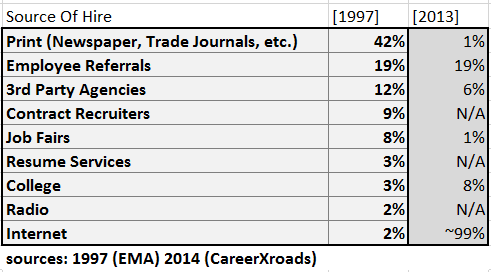
In 1998, Gary Cluff surveyed 4000 Employment Management Association (EMA) members about their Sources of Hire during the previous year (the EMA was swallowed up by SHRM at the end of 1998).

256 companies responded (about ¼ were large firms with 1000+ employees, ½ were midsize firms with 100-1000 employees and approximately ¼ were firms with fewer than 100 employees.)

On average the companies that responded each hired 302 external candidates and filled another 94 openings with internal candidates.

An average of $544,000 was spent by these employers on various ‘fees’ including Advertising ($147,000), Agencies ($275,000), Employee Referrals ($28,500); Job Fairs ($15,800); and, of course THE Internet- $6,200. Staff Salary Totals averaged $362,000 and “office overhead” (which arguably included some consideration for technology tools) was $77,000.

The average CPH was calculated out at $3,256 for and the 302 external hires. (Smaller companies’ CPH was higher- $4,479 for 30 external positions. Large firms averaged only $2,052 per hire for the 750 external candidates they brought onboard.) [Technology costs are notable for their absence.]

One metric seldom used today, the “Staffing Cost Ratio”, a relationship of the Total Cost to Acquire (essentially the CPH) to the Total Compensation Paid, was calculated at 11%. Non-exempt hires were estimated at 25% of the total but not separately broken out. Regional and industry differences existed but the respondent numbers were too small to be ‘diced’ properly.

The Time-To-Start was calculated and defined as the number of days between the date a position was approved and the date when a new employee starts work. (Note: This method could add weeks to other metrics for calculating Time-to-Fill).

Average Time-to-Start ranged from 41 days for the 28 firms responding in the Finance/Insurance category to 54 days for ‘IT’ employers. Large firms were 59 days. Average for all: 52 days.

Great Scott! Back to the Future of Recruiting

doc brownWhat is different in 2014 from 1997? What will be different in 2015?

Everything on the surface. Not so much when you scratch that shiny covering.

Quality of Hire: Missing in 1998, it is heavily discussed today, but at least back then we weren’t deluding ourselves that we could measure it from a proprietary algorithm matching methodology that purported to find people who will fit our firm’s culture without following those hires 1 -2- 5 years down-stream.

Only a few employers and service suppliers can talk intelligently about conducting longitudinal concurrent and predictive validation studies without looking foolish.

That won’t be changing much in the next year.

Big Data: missing in 1998 (although we know where some is). Even more heavily discussed today but when you get right down to it, the lack of standards defining the differences in practices between firms and those same firms’ discipline and willingness to manage the risk required to collect data (and share it) is holding back better decision making. (And it is going to improve slower than the technology to give it meaning.)

Workforce Planning, succession planning, hiring ahead of need, hiring with intent to T&D over extended time-frames before deploying, investing in analytics/ROI for specific sources (colleges, interns, agencies, referrals, etc.) have all moved the recruiting needle some in the last 17 years – certainly enough to predict a revolution, just not enough to experience it.

Shiny objects are enjoyable but distracting if not connected to results that matter. The differences that should count are to be found among the stakeholders – the business leaders, recruiters, hiring managers and candidates.

If, as an employer, you ask each one of your stakeholders whether the hiring process today is better AND whether their own personal and professional results were improved as a result of participating in it compared to years ago (i.e. purchasing power, quality of life, career progression, business accomplishment, etc.) what would each of their answers be? We think any substantive differences that have occurred during the last 17 years are debatable.

They don’t have to be.

Out of Time: The Future of Recruiting Begins Today.

back-to-the-future-deloreanWhat emerging technologies give us and, what we take great pleasure in annually imagining, is the ever-expanding horizon of future possibilities. An extraordinarily interesting and enjoyable (but too often disconnected) exercise that doesn’t always match in real life.

Futurist and pundit anecdotes are always entertaining but, “the future,” as someone has put it so well, “is already here and it is not very evenly distributed.”

For the unique practices we see today to become a common practice tomorrow, practitioners need to step up their game and focus beyond the next shiny object with the discipline to try it, measure it, and share their results.

Rather than predicting the next 10 game changers that might emerge in 2015, maybe it’s better to take one of this year’s solutions and connect it to an old-fashioned business result: Quality, Time, or Cost. Pick one or two (not all three) and project just how you much you can improve it in a year.

That’s what we want to read about. Don’t predict your future – create it.

(Full disclosure: We haven’t written an article about the future of Recruiting since 2002. It was published in the EMA Reporter, a SHRM quarterly journal, in 2 parts and entitled “Staffing 2012: How Talent and Opportunity Connect: Part 1 and Part 2. Much of what we wrote then did not come true by 2012.We, of course, claim we weren’t wrong. We are just off by a couple of years.)

Read More at the Career XRoads Annex.

gerry-300x300About the AuthorGerry Crispin, SPHR is a life-long student of staffing and co-founder of CareerXroads, a firm devoted to peer-to-peer learning by sharing recruiting practices. An international speaker, author and acknowledged thought leader, Gerry founded a non-profit, Talentboard, with colleagues Elaine Orler and Ed Newman to better define the Candidate Experience, a subject he has been passionate about for 30 years.

Gerry has also co-authored eight books on the evolution of staffing and written more than 100 rticles and whitepapers on similar topics. Gerry’s career in Human Resources spans is also quite broad and includes HR leadership positions at Johnson and Johnson; Associate Partner in a boutique Executive Search firm; Career Services Director at the Stevens Institute of Technology, where he received his Engineering and 2 advanced degrees in Organizational/Industrial Behavior.

Follow Gerry on Twitter @GerryCrispin or connect with him on LinkedIn.


Tweeting and Sneezing: 2014 Social Media Lessons Learned

sick-day1I can generally beat colds before they start. My time-honored prescription is soup, tea and lots of cold meds, which almost always does the trick. Despite my best efforts, however, my system isn’t completely immune, and about once a year or so the common cold (or worse) forces me into a mini-sabbatical of Real Housewives, Law & Order and whatever happens to be on TMC.

Unfortunately, I can feel myself coming down with something – my voice is almost gone, I’m starting to sneeze and my body (and brain) are beginning to ache. So, I suppose it’s time to surrender to this annual inevitability and curl up under the covers to catch up with whatever case my good buddy Lenny Briscoe is trying to crack.

Que sera, sera, as Doris says. Whatever.

But before I turn on the tube and turn off my brain again, I wanted to put my suddenly newfound “free time” to use and do some of the stuff that I don’t get to do all that often during commercial breaks and Andy Cohen specials.

That includes ruminating back over the last year and look at some of the progress that’s been made in 2014. Maybe it’s the cold meds, but there’s nothing better than a little bed rest to force some retrospective reflection. And looking back, this proved to be a hell of a year.

Where It’s @: Twitter for Recruiting and HR

beckIn the context of social, 2014 has been, for lack of a better phrase, undeniably ginormous (OK, maybe I should give the Real Housewives a rest).

As a former recruiting solutions vendor myself, I know what it’s like to be on both sides of the HR technology and recruiting services marketplace. Whether you’re trying to fill your sales pipeline with qualified leads or trying to fill your recruiting pipeline with qualified candidates, social media can be an overwhelming and exhausting endeavor to sift through the cacophony of voices vying for market and mindshare, particularly when you’ve got business to close or reqs to fill.

If anything, the noise has become even more overwhelming in 2014, but while the din may be deafening, one thing is crystal clear: content marketing is exploding. When it comes to content, everyone has a competing agenda, from pushing products to peddling people to personal brand building.

Despite the disparate outcomes, and different strategies, that drive social media use,  everyone pretty much has the same end goal driven by the same basic needs. When you get down to it, we want to feel connected to each other, to learn from our peers, to showcase our own expertise and further our personal and professional growth and goals.

Either that, or you have way too much time on your hands or, worse, actually do social media for a living. OK, hell. For the purposes of this post, I’m going with the first scenario.

As a professional recruiter who’s taken to Twitter this year, I’ve managed to grow my account by about 2,000% in 2014 (going from around 100 to almost 2,000 followers) – which kicked the crap out of my initial goal of 2%. It’s been an interesting learning experience, and I’ve picked up some lessons along the way when it comes to best practices for building followers and online engagement that I thought might be useful to any talent professional still starting out (or considering) dipping your toe into the social media ocean.

RTs and Recruiting: Getting Started on Twitter

one-does-not-simply-get-twitter-followersFirst off, don’t focus on volume or absolute numbers alone – your follower count is meaningless if you’ve got nothing of value to offer them. That’s why it’s imperative to focus on what really resonates with you and build a targeted following instead of concentrating purely on how many followers you happen to have.

I made this mistake early on, and it took me a while to realize that worrying about who follows (or doesn’t, right away) you back. It’s nothing personal. Screw your Klout or Kred score.

Unless you’re, say, Oprah or Katie Perry, building social influence and an engaged fan base doesn’t happen overnight. But in my experience, if you stick to following folks you want to connect with and learn from, and share information that you actually care about around topics you have something you want to say (and can do so without sounding like a Successories poster or corporate copywriter) than it’s going to eventually going to happen for you, anyway.

Don’t follow folks based off some algorithm telling you that they’re influential or because they have tens of thousands of followers (both of which can be easily purchased or gamed).  If you feel uncomfortable or uneasy retweeting or engaging with an account, there’s no point in following them.

Similarly, if it looks like an account will overwhelm your feed, or piss you off, then just ignore them – trolls can’t survive unless you feed them, and while everyone has the right to be an opinionated jerk, you have the right not to participate, too.

Twitter for Recruiting & HR: Figuring Out Who To Follow

Twitter-funny-cartoon-birds-imageAs with the rest of life, if you can’t find the good in things or at least accentuate the positive, you’re likely closing doors that it’s in your best interests to leave open. Instead of looking for low hanging fruit and following the same talking heads who seem to constantly show up on those ubiquitous “top influencers on Twitter” lists, search for sources that provide value to you – and in turn, your followers.

So how do you figure out who’s worth following? Like anything, it takes a little trial and error.

You can’t tell from a single tweet or from a terse 160 character profile if the account in question is going to be worth watching or waste your time. That’s why it’s imperative to look at their timeline and review what they’ve tweeted about on any given day, week or month (depending on how much they tweet).

You’ll see some patterns emerge by reviewing accounts more carefully that serve as pretty good indicators of whether or not you should follow any given account.For instance, is everything they share some thinly veiled self-promotion?

Do they have a ten followers and tens of thousands of tweets? Does their feed feel like “noise” or is the  content carefully crafted and consciously curated?

It’s pretty easy to see the difference between a personalized, well-managed account and opting into what amounts to social spam before you press the “Follow” button. Just don’t do so out of a sense of obligation. Only follow those people who your finely tuned recruiting sensibilities tell you is worth the time to make a connection – and you’ll never go wrong trusting your instinct. Go with your gut and remember, you can always unfollow them later.

Twitter for Recruiting & HR: Getting Engaged

favorite twitterAs much emphasis as we put on “engagement,” it’s absolutely essential to making Twitter meaningful and getting the most out of your social networks. Remember, you can’t expect to get value without giving it. Always be gracious and grateful. Make an effort to mention the creators of the content you’re curating, and give the occasional shout out to the influencers whose information you’ve found valuable and think your audience will find value in, too.

Similarly, thank others who mention you or RT your stuff. Favorite or retweet anything someone shares that’s kind, helpful or poignant. Make sure your audience knows you’re listening – and are a real person instead of some automated bot or RSS.

Pro Tip: If you’ve got a public account, then your favorites are public, too. I really like the favorites feature, which I use a lot for bookmarking stuff that I can easily find or read later on.

Don’t pay too much attention to profiles – many people worth following have information that’s either incomplete or intentionally anonymized. For instance, that account with no last name whose profile only mentions their kids and their love of coffee might, in fact, be a CEO, colleague, potential client or one of those once-in-a-blue moon purple squirrel type candidates who could be a fantastic contact (and connection) for you. Treat everyone the same on Twitter and practice giving back. Remember, the Golden Rule applies on social networks, too.

Conversely, I recommend not wasting your time engaging with, worrying about or getting offended by trolls. Report and/or block any account you find unprofessional or uncouth and let other people (and site moderators) worry about their crap. The only way to take care of a troll is by ignoring them completely. It’s really that easy.

Twitter for Recruiting and HR: Finding Your Voice

twitter cartoonOn Twitter, it’s imperative that you always come across as authentic (while keeping it professional). I got some great advice a while back from one of the best in the business, Stacy Zapar (per the shout out advice above, @StacyZapar is one account you should be following NOW).

I took her advice and decided rather than create multiple accounts or choose between the two, I’d use my Twitter account for both personal and professional purposes. Now, this amalgamated approach can, of course, present some challenges, but some opportunities that wouldn’t be possible on some platforms to actually come across as a real person, not just a “personal brand.”

For example, I’d never share anything about that marvelous baked brie I made last weekend on LinkedIn, because it’s just not the right venue or audience. Similarly, I wouldn’t use Facebook as a professional networking tool or use my feed to advertise my open jobs to my family or friends.

Even if one was a candidate, or client it’s not going to look so great when my Mom chimes in every other post with an “I love you” or, on occasion, some slightly incriminating information (as she’s been known to do). And for the record, I wasn’t a fat baby – I was just a little husky.

Twitter, on the other hand, does a great job of bridging the divide between my personal and professional life, an approach which underscores the fact that I’m a real person who likes to cook, travel and hang out with my dog. It also shows that I’m a real recruiter who likes to share interesting infographics and industry articles, and occasionally, an open job when it makes sense (properly hashtagged, of course).

Twitter for Recruiting and HR: What’s Happening?

6566There’s this misperception out there, particularly among recruiting and talent pros, that you’ve got to be on Twitter, even if you don’t want to. But if you’re on Twitter because it’s mandatory and not voluntary, it’s going to show – and you’re unlikely to achieve the strategic goals or professional outcomes that prompted you getting on in the first place.

So if you don’t have the time or see the need, then just don’t do it. The choice is pretty much yours to make, and it’s not the right choice for everyone, particularly if you’ve got too full of a plate to find the time or have a recruitment marketing team or dedicated account at your employer who’s got Twitter covered for recruiting and sourcing.

This is particularly true if you’re in a management role – better to focus on leadership than “thought leadership” in the first place.

But if you’re thinking about whether or not Twitter is right for you, think about this: being on Twitter takes a commitment. Perhaps the people following, mentioning and trying to engage with you aren’t hearing back. This leads them to form an opinion based on social media that has real life repercussions. These opinions, particularly when it comes to lack of engagement or feeling shut out of personalized interactions, can cause people to proscribe those negative sentiments to your company, even if it’s a completely personal account.

Remember, whether you like it or not, when you sign up for Twitter, you opt in to becoming a public ambassador for your company’s brand, employment or otherwise. It’s something to be mindful of. If you’re just checking out Twitter casually or just want to follow the conversation instead of participating it, then adjust your profile or privacy settings accordingly – you might not even need a public account to begin with.

Bottom line: if you are in, go all in. If not, kill your account or stick to tweeting about your kids’ soccer games, that yummy hot chocolate you had this morning or RTing self-help articles from the Huffington Post. That’s cool, too – just don’t bring your brand into it or mention your professional stuff on your personal profile.

If you’re still on the fence about Twitter, I totally get it. I didn’t like or understand Twitter for the longest time because I didn’t actually know how to use it or what the hell I was supposed to do with it. It was overwhelming and a little scary at first, but once I put in the time and dedicated myself to “getting it,” the craziest thing happened: I found out I kind of like Twitter. Turns out this is a pretty cool network once you know what you’re doing.

After figuring out the basics, I set a personal goal for myself of getting to a thousand followers – and that goal, which I gave myself a year to meet, actually was easy to meet by just dedicating a few Sunday afternoons to the cause, with the help of a few free social automation tools and a basic understanding of Twitter 101. And if you want to actually put in the effort to get something out of Twitter, you can do it, too.

Or not, that’s up to you. But if you’re going to be on it, you’ve got to own it, girl! Snap. Cough.

Crap. The cold meds must have just kicked in. So before I go, there’s a lot more to take into account in optimizing Twitter, but if you focus on the basics outlined above, you should get what you need to get going when it comes to planning your personal and professional social media goals for 2015 – and beyond.

OK, I’m headed back to bed – there’s a Hitchcock marathon on, after all.

23a2306About the Author: Nathan Vance is a talent acquisition strategist, sourcer, and blogger who believes everyone has the right to follow their passions and have meaningful careers.

Ever since he faced down the washing machine in his Japanese dorm armed only with a pile of laundry and a Kanji dictionary, he’s been tackling tough problems in innovative ways. His nine-year career in Talent Acquisition began at an internet start-up. He has gone on to use his customer-focused approach and marketing savvy to advise major tech, telecommunications, and aerospace & defense companies on how to identify and engage with top talent.

He currently sits on the Programs Committee for the Chicago USBLN and volunteers for The Lakeview Pantry.

Follow Nathan on Twitter at@nathansources or connect with him on LinkedIn.

Cell Counts: Why Mobile Recruiting Matters for Candidate Experience

zack-morris-phoneThe concept of candidate experience has become so ubiquitous to the recruiting conversation it’s become something of a cliché, a commoditized, catch all catch-phrase that’s grist for the content marketing and consulting mill. Which means it’s a lot like “mobile recruiting,” that other obnoxiously omnipresent talent technology trending topic.

Both candidate experience and mobile seem to be front of mind for most frontline recruiting and staffing practitioners (judging from their prevalence in product marketing and online punditry).

There seems to be some consensus on the importance of improving both mobile and candidate experience, both at an individual and organizational level. Additionally, there’s an industry wide understanding driving those the improvement recruitment so desperately needs comes down to drastically changing the tactics and tools of traditional talent acquisition.

Unlike so many of the silly buzzwords or superfluous concepts disguised as best practices by those selling services or software (or, commonly, software as a service), mobile and candidate experience are really a thing (unlike, say, ‘culture marketing’) – and really important to recruiting and staffing success.

Which makes you wonder why recruiting still sucks so badly at both mobile and candidate experience. The answer might lie in the fact that the two are, in fact, inexorably intertwined, and should be viewed as complementary, rather than competing, concepts.

Can You Hear Me Now? Mobile Recruiting & Candidate Experience

While candidate experience is largely seen in the strategic and process purview, and mobile tends to be seen largely through the lens of recruiting technology, the fact remains that making a meaningful change to candidate experience means first making a meaningful change to their mobile experience.

As outlined in previous posts, customers are consumers, and therefore expect a consumer level experience when searching for and submitting information online. If you’re reading this post, statistically speaking, you’re likely to be doing so on a mobile device.

According to Comscore, over 60% of all online traffic now originates from mobile devices; with SEO firm BrightEdge reporting that smartphones and tablets together now accounting for fully 1/3 of organic search traffic.

Since studies repeatedly show online search strategies to be similar for consumers and candidates, this means that about 3 out of every 5 candidates are reading your job descriptions or viewing your career sites on a mobile device.

The problem is that no matter how sexy your careers site, no matter how compelling your job description copy or engaging your social media content might be is, candidates who are actually answering your call to action on mobile have no way to actually become applicants, a recent CareerBuilder study suggests.

The Sorry State of Mobile Recruiting

In their newly released report, How the Candidate Experience Is Transforming HR TechnologyCareerBuilder surveyed hundreds of hiring professionals and candidates to understand where mobile recruiting is at today, where it’s going tomorrow and its overall impact on candidate experience.

Nearly one half of all employers responding to the survey reported that they offer no way for candidates to access their ATS on mobile devices; only 38% responded that they had a mobile apply process to begin with. Think about how perplexing this is for a minute.

Imagine trying to check out from an e-commerce site like Amazon or eBay on your phone, only to be told that, sorry, you need to try again when you’re on a desktop. You’d likely never complete that purchase, whether out of frustration or forgetfulness.

Preventing this customer churn is why e-commerce sites have aggressively invested in building and optimizing mobile experiences. The same thing is happening to candidates before they can even begin your application process – and 60% of those who actually can won’t even finish that because it’s too long, according to CareerBuilder data.

Of course, 57% of employers have no way of capturing the information of candidates who don’t’ apply, meaning, statistically speaking, the resumes you’re receiving are in spite, not because of, your recruiting process and recruitment marketing initiatives. That 16% of respondents “weren’t sure” whether or not their ATS allowed candidates to apply via mobile is, frankly, perplexing – a reminder how rarely recruiters actually audit their own processes, much less demand their providers offer the features and functionalities that really matter.

Here’s a helpful hint: if you’re not sure whether or not your ATS is enabled on a mobile device, you need to be. Pick up your phone and open your careers site, already. Seriously.

Mobile Recruiting: The Legacy Issues of Legacy Systems

Using ATS with mobile apply capabilities (source: CareerBuilder)

The CareerBuilder survey found 46% of employers report that they are aware of the fact that their ATS doesn’t offer mobile apply capabilities and aren’t doing anything about it.

When asked why they were so behind the rest of the world (literally) on mobile adoption, 28% replied they hadn’t made the investment in the technology; another 18% said that they didn’t have the resources to invest in the first place.

This perceived limitation in resources to support mobile seems to be a critical reason so many employers aren’t more aggressively pursuing these solutions.

This is absolutely asinine, of course; the study showed that approximately 20% of those of respondents were paying more than $3,000 or more per hire, on average (20% had no idea what they were paying, for comparison), and 52% filled 25 or more open positions last year.

Helpful hint: if you’re spending that kind of money on recruiting, you’ve got the resources required for mobile.

With so many hires attributed to job boards (19%) and career sites (19%) from survey respondents, one can assume that a majority of the candidates generated by investing in those traffic sources – rightfully so, given their efficacy – are falling off due to the fact that they’re accessing these platforms via a mobile device. Which means your pipeline has a leak before you’ve even begun to build it simply by not offering mobile apply functionality.

Besides resource constraints, the other primary driver for mobile seems to be technical limitations. Which is similarly silly, considering that nearly half of respondents (49%) reported to using 2-3 systems, and fully 14% reported using 4 or more HR systems in their talent organization.

Here’s another helpful hint: if you’ve got more than 1 system, and it doesn’t’ support mobile, than you’re investing in point solutions that won’t actually solve your most pressing recruitment priority. Of course, if you don’t’ measure mobile traffic to your ATS, like approximately 1/3 of organizations responding to the CareerBuilder survey, then you don’t’ realize the staggering opportunity cost you’re paying by sticking in systems stasis.

If you did, you’d already be doing something about it.

Survey Says: The True Cost of Ignoring Mobile Recruiting

Believe company is missing out on talented applications because it does not offer ATS through mobile devices.
Believe company is missing out on talented applications because it does not offer ATS through mobile devices. (source: CareerBuilder)

Ignorance might be bliss, because recruiters largely seem both blissfully unaware – and ignorant -about the true impact of mobile on their recruiting efficiency and efficacy, particularly as it relates to candidate experience.

Job seekers responding to the CareerBuilder study reported that a quick application process (54%); open jobs for the company are easy to find (48%) and that the application process allows them to highlight their relevant skills (40%) were among the top characteristics of a good candidate experience.

These outcomes are all negatively impacted by not having a mobile recruiting strategy in place to make finding and applying for jobs easier for candidates – or even possible, considering the fact that approximately 82% of job seekers report to using a mobile device in their most recent job search, and 9 in 10 report they plan on leveraging mobile the next time they look for a job. Those statistics alone make a pretty compelling case.

Furthermore, most fully-employed (aka “passive”) candidates rely on mobile during their job search to bypass their company’s network controls, firewalls and monitoring, and mobile usage/adoption is actually significantly higher among diverse candidates than the rest of the job seeker population, according to the ComScore study.

Passive job seekers and/or diverse candidates have always been placed at something of a premium by both internal and agency recruiters (not to mention their clients), which undermines the study’s most surprising finding: a whopping 90% of employers who don’t have mobile recruiting capabilities think that this means they’re missing out on talented applicants.

Yeah. Survey says: you’re an idiot. Seriously.

If you don’t think missing mobile means missing out on top talent, you’re missing the most obvious, and most essential, way to increase applicant flow and quality while improving the candidate experience and staying ahead of the competition.

Which is kind of the entire point of recruiting to begin with.

To learn more about how candidate experience is transforming HR Technology, click here for a full copy of CareerBuilder’s latest study, along with the insights, observations and action items talent pros need to know in order to put the human back in Human Resources.

HRTech-Ads728x90a_28229

Disclaimer: Recruiting Daily was compensated by CareerBuilder for this post. But their data and action items are actually pretty priceless, so in this case, the facts and opinions contained herein do, in fact, represent those of the publisher. Because we’re all about making candidate experience better, too.


What Corporate Recruiters Really Want From A Staffing Agency

wasteLet me be really clear here to start this post off: I’m not hating on staffing agencies. In fact, far from it. I actually grew up on the agency side; I cut my teeth there. I made my bones there. And I clearly have watched Goodfellas like a hundred times too many. I’m grateful for my external recruitment experience and wouldn’t trade it for anything.

That may come as a tremendous surprise to most of you, but as a technical recruiter working in-house, I get a lot of calls from agency recruiters. Like, a lot. And they suck.

Allow us to take a moment, to mourn for those whose heads just exploded from shock.

I want to give something back to the staffing agency world where I grew up. This is a “let me help me help you….help me” type of mini-festo.

More often than not, I tend to screen out the vast majority of staffing agency recruiting calls. The voicemails they leave behind provide some really good fodder for the team on really shitty days, and I’m constantly reminded of

A. Why I Left Staffing 

B. What NOT to do

These messages are too templated to be terrible. In fact, I could probably just replace the name of the recruiter and their staffing agency on each of those well scripted voicemails and it’d just sound like I had the same message on some sort of perpetual loop. But every so often, for reasons I’m not entirely sure I even understand, I feel like being punished. And occasionally, I answer agency calls. And then the games begin.

Hey, don’t judge me – a recruiter’s gotta have a little fun sometimes, too. Even if (especially if) it’s at the expense of other recruiters. I did 18 years in Catholic school as a kid, so I know a little something about self-loathing and guilt.

I get it that you’re just doing your job. You’re hungry and ambitious, and won’t take no for an answer. You’ve got numbers to meet and a quota to beat – whatever. Whatever gets you through the torment of constantly worrying about getting fired by your branch manager is fine by me. But some things are just unforgivable.

What’s even worse is that the things agency recruiters suck at the most are also the easiest to fix. So, stop being a robot dialing for dollars and clogging up voicemail boxes with some variation on the tired theme of your “unique and proprietary database with 16 trillion great candidates” and start being smart about how you engage with potential clients.

4 Ways To Suck Less When You’re Recruiting for A Staffing Agency

Here are some pretty good staffing agency rules for the recruiting road:

if_you_could_check_your_email-11. Don’t ask for my email.

Let me get this straight. You want me to shell out somewhere between 20-30% to have you help me find a candidate. When you call me and we have a conversation about a potential search, I’m not going to have a ton of confidence in your sourcing abilities if you have to ask for my e-mail. I’m asking you to find candidates that we either can’t find or don’t have the time to go out and get.

So, start off strong by showing me you know how to find or can figure out how to find my e-mail schema. Feel free to confirm it – it’ll impress me.

Oh, and if you aren’t yet familiar with tools that can help you find and verify e-mail addresses, learn up.

2. Intake Isn’t Just For Hospitals

fail-3Of course, I have a wealth of information about the role I’m taking out to search, since I kicked things off with the hiring manager when the role opened.

But when I reach the point of actually proactively enlisting outside help, one of two things is true: either the role has changed significantly, or I can’t grasp the gist of the role. If you’re a recruiter, you know what I’m talking about.There are ones you just can’t get your head around, really.

Either way, I want you to have access to the hiring manager so you can pick their brain about what their ideal candidate looks like.

On the inside (that’s what us agency-turned-corporate shills call it), we conduct intake meetings to get all of this information.

And yes, it’s important for you to do so, too, otherwise, there’s a good chance you’re not going to be doing much more than keyword hunting. Don’t know what I’m talking about? Well consider yourself lucky that people like Glen Cathey and Stacy Zapar roam this earth with the sole purpose of making recruiting and sourcing exponentially more awesome.

3. Pull A Fake-Out? Get Out.

resized_the-most-interesting-man-in-the-world-meme-generator-i-dont-usually-take-a-long-lunch-but-if-it-happens-it-sure-as-hell-isn-t-a-hour-and-a-half-059a4fI’m going to be completely honest here: I hate managing people. It’s the least fun part of what I do. But mentoring? That’s what gets the creative Jamba Juice flowing. I love helping other really ambitious recruiters learn, grow and develop.

Helping them tap into a local network, or discover how to use one of those wizard-like tools the SourceCon crowd is always playing with is where I get my energy. So when a freshly minted agency professional approaches me to ask for time to network, have a conversation or ask a question, I’m always happy to oblige. Well, almost always.

Just don’t ask me to go to lunch for an hour under the guise of “I’d love to pick your brain” and have that turn into a 55 minute sales pitch. It’s disingenuous, dishonest, and pretty much kills any chance I’ll ever work with your company or send anyone your way.

4. Free Candidates: Inquire Within

nakedDon’t send me unsolicited candidates. Seriously. It’s that simple.

If we don’t have an agreement in place, I’m taking the information you send me and running with it. Trust me, you’ve given me enough to find the person in under 10 minutes, even if you do a half-assed attempt at concealing their identity. Never works, by the way.

Here’s what I don’t get. Why in the world would I buy the milk from you when you’ve already left the cow in my inbox? I get it…you want to prove you can nail the core candidate profile our company’s looking for.

But in reality, you have no idea how to describe what the hell it is we do beyond our tag line. You’re just matching keywords.

Actually, you know what? Keep sending those resumes to me.

Corporate and agency recruiters need each other to survive. It’s a fact. We live in a very delicate ecosystem where we have an interdependence on each other to do our jobs sometimes – like it or not. No one’s denying that. But if you’re an agency recruiter, you’ve got one of two choices: Ride along, live and eat well like the remora, or be relegated to bottom feeder status.

radloffAbout the Author: Pete Radloff has over 13 years of recruiting experience in both agency and corporate environments, and has worked with such companies as Comscore, National Public Radio and Living Social.

With experience and expertise in using technology and social media to enhance the candidate experience and promote strong employer brands, Radloff also serves as lead consultant for Exaqueo, a high-end workforce consulting firm.  An active member of the Washington area recruiting community, Radloff is currently a VP and sits on the Board of Directors of RecruitDC.

Follow Pete on Twitter @PJRadloff or connect with him on LinkedIn.


Pour One Out: The Day Recruiting Died

permanentIf business is booming, or even if things are just going good, than you should be recruiting. It’s not just something we should be doing for open positions; there should always be buzz about what an organization’s workforce looks like today, and what, ideally, it should look like tomorrow.

After all, people always leave organizations, no matter how big their budget or effective their retention initiatives are. The good ones leave for better opportunities, or more cash, or just a fresh start. The bad ones are managed out, if you’re lucky, or fired, if they’re not. That’s the sort of stuff that just happens, which is also why recruiting should ALWAYS be happening. So too should succession planning. If you’re not preparing for the future while recruiting for current needs, you’re setting yourself up for failure.

Recruiters bitch. Managers bitch. It seems like, somehow, in recruiting. we’re always a day late or a dollar short.

We bitch because can’t hire the people we thought we would hire because we don’t have the money, or couldn’t coerce our clients into making a decision fast enough to land the candidate we were looking for, even after we’ve found them. We also bitch because while there are always too many resumes to sort through, there are somehow never enough people out there for the jobs we’re looking to fill.

Recruiters bitch. Management bitches. It always seems like we are a dollar short and a day late in recruiting. The people we thought we would hire, we can’t because we either didn’t have the money or aren’t able to make a decision fast enough to land the candidate we are looking to hire. We also bitch because we never can find enough people to do the job we are looking to fill.

Bitch? Please.

The Recruiting Roller Coaster: Get Me Off This Crazy Thing

sickRecruiting is a cycle. Hire, quit. Hire, fire. Hire, retire. Oh, and by the way – if you have a crappy quarter, and business sucked, stop hiring, period. Wait, never mind, the next quarter is shaping up to be way better, so better start hiring again. Dammit!

I mean, seriously – what about this recruiting thing is so confusing? How can we make sense out of such senselessness? How can we keep ahead of the curve when the pace is so fast and furious that we’re barely struggling to keep our heads above water?

Can’t we slow down, or take our foot off the pedal for just a minute so we can catch our breath?

Hell, no.

Dude, that right there? That is recruiting. That’s just how it works. If you don’t like it, then get out, because you better get used to the fact that this is business as usual at almost every business, usually. It doesn’t matter what employer you happen to recruit for; all companies follow this same basic formula.

Bottom line is, there will always be too much work for recruiting to keep up with, until there’s not, in which case, we find ourselves out of work entirely. Right?  Makes me wonder how we keep from going under.

Bye, Bye: The Day Recruiting Stopped

walterWell, as I can tell you from personal experience, being involved in a hiring freeze sucks, big time. If you’re not recruiting, then there’s no need to have recruiters, so kiss your staffing specialists goodbye. Adios, amigos. Your services are no longer necessary. We appreciate all you’ve done for this organization, but tough times, you know? And don’t let the door slam you in the ass on the way out.

I’ve been part of more hiring freezes than anyone should have to see in my 20 year career. Hell, most people in this business have – or will, if you’re a sadist and stick it out long enough.

If you’re one of the lucky recruiters who somehow manages to survive a freeze and keep their job, you’re stuck doing side projects and admin crap. If you’re an agency recruiter, you’re going to pretty much bust your ass just to earn an honest buck. Most of the time, that doesn’t pay off, and you start looking for a new line of work when you come up empty handed too many times to count.

This is a great gig, but it’s far from a steady one. Which is why recruiting remains a revolving door, a profession with no barriers for entry and a whole laundry list of reasons why someone would want to get out. But some of us stay put, and somehow, our careers survive the freezes even if our jobs do not.

But what about the managers? What about the company? Who really gets frozen during a hiring freeze? Like most tundras, the landscape of an organization whose headcount is on hold looks pretty bleak. Managers are forced to do more work, and their satisfaction plummets. Their hours increase, the scales of work-life balance tip forever in favor of the former, and they become so disengaged they hate every extra minute they have to spend at the office they don’t want to be at to begin with.

This pattern repeats itself throughout the company; at an enterprise level, a freeze means companies can’t accomplish their business objectives or execute on long term, sustainable strategies because, well, they don’t have the right people, or enough people, to get the job done effectively.

This, in turn, leads to a drop in profits, in stock price, in shareholder confidence, and all those bottom line repercussions that people forget about when they think about the true costs of recruiting the right talent. Of course, this creates the need to let even more people go – voluntarily or otherwise. The vicious cycle continues, on and on and on again.

But let’s go further than a freeze. What happens when a company really stops recruiting? You know, permanently? Have you ever seen an employer who quits looking for talent FOREVER? If you have, you know that when recruiting stops, when the freeze freezes over, then the company itself isn’t far behind. There’s no surer sign a company is going to die than when it kills off recruiting.

It’s just part of the highs and the lows. And if you’re a recruiter, you’ve got to get used to it. It’s the ultimate roller coaster.

Recruiting Is A Hell of A Drug

Rick_JamesRecruiting is a drug. And it’s a damn good one, but it can be dangerous. The highs are incredibly high, but the crash can be even more painful. No matter how far up you get, you’re always going to come down, eventually. But the thing we need to remember is that if you quit recruiting cold turkey, you’re really not going to like what the withdrawal feels like. So quit your bitching and moaning.

Remember, complaining is easy, but recruiting is hard. And as difficult as it is to make that big hire, as soon as you’re done, there’s no time to rest on your laurels or pat your own back. There’s still a need for another one, and another one, and another one after that.

Being busy is good when you’re in recruiting. Frustrating, sure, but it’s all good. All that work means you don’t have to worry about not working at all. At least not in the foreseeable future.

So, what happens if recruiting dies? We’ll probably never discover the real answer, because it’s the lifeblood of any business, and there are plenty of people willing to put up with the pain that comes with the profession. But if you can’t hack it, then get the hell out.

With you or without you, recruiting continues. And it always will.

will_thomson (1)About the Author: Will Thomson lives in Austin, Texas, and works for Rosetta Stone as the Global Sales and Marketing Recruiter. He has been in recruitment and sales for 20 years.

He received his undergraduate from The University of Mississippi, and his Master’s Degree from St. Edward’s University in Austin. He has recruited some of the most sought-after talent around the globe, and is a regular blogger for the recruitment industry.

He is the founder of Bulls Eye Recruiting and you can find him on Twitter @WillRecruits.


Webinar: The Sourcer’s Daily Dozen

Webinar: The Sourcer’s Daily Dozen

Which sourcing methods actually work?  The ones that a top sourcer could use every day to build their pipelines quickly and effectively.  You’ll learn 12 free favorites in this webinar, from simple to elaborate — with a clear how-to on the more complex ones.  Don’t waste time with shiny objects that don’t add value to the recruiting process.

Our presenter, Glenn Gutmacher is one of the pioneers in online talent sourcing.  (Back in the ’90s when it was called “internet recruiting”) he innovated many candidate pipelining methods that continue to be built upon today.  But he is also a keen student who picks up many new sourcing methods in his travels and likes to adapt the promising ones to actual sourcing work to see which can become great enhancements to the process.  Get ready to ask some questions.  This is a live webinar.

In this webinar, you’ll learn strategies for:

  1. Which classic techniques stand the test of time
  2. Which have needed to be tweaked and
  3. What new ones need to be on your radar?

Meet Our Presenter:

Glenn Gutmacher head-100x100Glenn Gutmacher is the North America Group Manager of the Sourcing Center of Excellence at Avanade, a $2B enterprise IT solutions consulting firm owned by Accenture and Microsoft, and founder of Recruiting-Online.com, the world’s longest continuously-running self-paced online course to learn talent sourcing. Connect with Glenn on Twitter or LinkedIn.



[youtube url=”https://www.youtube.com/watch?v=2XcTQ_JTO7w&feature=youtu.be” width=”500″ height=”300″]

Sleeping with the Enemy: Reconciling Recruiting With HR

failure to communicateOne of the hottest of hot button issues in human capital these days seems to be the categorization of the recruiting function and whether or not it belongs in HR in the first place.

It may seem superficially pithy, but it’s a dialogue with drastic ramifications for the future of both recruiting and candidate engagement.

That’s because of the dual dialogue seeking to validate and elevate the recruiting function, at least the piss poor public perception of recruiters.

This would be one thing if the negative sentiment against an entire profession was limited to disgruntled job seekers but, the truth is, hiring managers and even HR counterparts don’t think too highly about recruiters at large, even if they’re delighted with their own talent acquisition team.

This is, in turn, is because recruiters are kind of like the offensive linemen of the working world; we’re only noticed when we make a mistake (and similarly most of that involves flagging in public).  It’s easy to take for granted just how hard filling a job really is.

Calling An Audible: Rethinking the Recruiting Playbook

lucyThe thing is, because we serve more or less as the primary arbiters for connecting and selecting people for jobs, recruiters really should be seen as quarterbacks – we might not call the shots on who gets hired, but we at least call the plays.  The lack of respect is due to the fact that recruiting focuses almost exclusively on externally facing activities, creating a noticeable absence of visibility or proximity within the organization.

Even hiring managers more or less do a quick meeting and somehow, almost 100% of the time, their ideal characteristics or required experience is translated into real names with real resumes coming across their desk.

There’s not a whole lot of transparency into how or from where these candidates were sourced, what it took to get them on the phone for a screen or time required to get through a thousand false leads for one that actually has a hope of getting hired.

Of course, those thousand false leads don’t know why they never hear back from recruiters except for the deluge of terribly targeted e-mail blasts or automated responses telling them their resume is under consideration.  We’re seen as gatekeepers, obstacles blocking the way to the real decision makers.

Decisions, Decisions: Break Downs on the Recruiting Roadmap

well-theres-your-problemThe real decision makers, of course, don’t really get to decide since almost all hiring is done by committee, requires leadership’s authorization (and often intervention) and the position that they end up opening often isn’t actually completely aligned with what they want or need out of a headcount, description be damned.

That description, internally, at least, is generally written by HR according to rigidly defined job types, families and categories required for each position tracked within their HCM, which, of course, leads to generic job descriptions that must go through a dozen approvals simply to open that position.

Recruiters are blamed for finding too many qualified candidates to have time to call back or connect with and when they can’t find enough on the market to meet some ridiculous list of requirements, they’re blamed for that, too.

Adding to the animosity is the fact that recruiters get blamed when an offer’s rejected, although this is almost always due to the HR department and their careful formula involving complexities like internal compression or compensation leveling to put a price tag on a person.

Salary Man: Recruiting ROI vs. Compensation Costs

cream]Any recruiter will tell you that their job is to get the candidate an offer; the only thing that we generally don’t have the ability to pre-close them on is compensation, since this is what holds up the process more than perhaps anything else – and once that magic number comes in from HR along with notice they’ve cleared background, the recruiter makes the call to the candidate right away.

There’s no time to push back, because, inevitably, any candidate with one outstanding offer has at least one more you’ve got to contend with, so you just hope that you’re quick enough and they’re as flexible as they said they were, since the week or so the HR paperwork took gave you the chance to close them on every other consideration during your frequent conversations.

PS: Candidate experience is unilaterally awesome if you’re the one who’s in the offer process. You’ll hear from recruiters more than you likely ever wanted to. Trust me.

Of course, the offer is never enough for the candidate, but it’s almost always enough, which is because HR carefully calculates all offers to fall somewhere between the 25-75 percentile of market average – not that recruiting can ever be trusted with that data (which lives on another system entirely).

But most of the time, the candidates say yes, you make a hire, and even while it’s almost always against all odds, that’s the job you were hired to do.  You get no praises for doing the only thing that’s required of you – and doing just that means that recruiters have to spend a huge majority of their time interacting outside of the organization since that, ostensibly, is where the candidates are.

Within You, Without You: A Case for Turning the Recruiting Process Inside Out

1212_ravi_t500x403HR, as outlined above, owns what happens within an organization. They control the employee records, and can always defer blame to the recruiter when something goes wrong – and no one’s stupid enough to argue with HR.

They can hide behind a veil of compliance and fear, their processes (like performance reviews) as painful as filling out most ATS-based applications; only their respondents don’t have any choice.

And for some reason, performance reviews are seen somehow as being more strategically important to career development and personal growth than job applications, too, which is why there’s such an emphasis on tracking how employees have done in their jobs rather than where their jobs are going.

Which is kind of stupid if you think about it.

Even when it comes to careers, from an internal perspective, that’s not talent acquisition’s area of expertise, even if that’s their entire professional focus.  That’s only valid on the outside, before onboarding – once they’re in, forget about it, except if they apply for an internal transfer. In that case, HR again acts as an impediment instead of an advocate for employees.

That’s because most employees are allowed to apply for positions through some internal portal, and almost every company requires recruiters to contact every single internal applicant. Which would be a great candidate experience, except for about half the time it involves explaining to them why, even though there’s a job that they’d be perfect for, they haven’t been in their current role a full year yet and therefore, are preempted from applying by policy.

Rules are rules, you know?  Only HR isn’t the ones who have to communicate that – and if they do, unlike recruiters, they can always point to the employee handbook where there’s some legal mumbo jumbo about transfer eligibility buried in back, letting them wash their hands of the fact that process often preempts talent.

Learning Opportunities: A Recruitment Marketing Reality Check

realityHR, of course, is the same group who require recruiters to call them before even talking to an existing employee who applied for an open job, to ensure eligibility and good standing – not that they’ve ever met that employee, of course, but because they have access to the performance management system that simply doesn’t synch with ATS records.

If the answer is “no,” then it’s the recruiter’s job to let the employee know, even if they’re not allowed to let them know why they aren’t getting an open position as an internal applicant.

That’s a fun little dance – if you’re a semi-sadist.  Recruiters have to play cheerleader outside the company but counselor to the career frustrations of those already working there.  Talk about a thankless job.

If the answer, alternatively, is yes, great! That means that not only does your HR person know you’re looking, they’re going to send a form to the manager (or in some occasions, make the recruiter who they’ve never met do it) to get them to sign off that they’re OK with potentially losing that employee.

A shocking percentage of the time, they’re not – and when they are, you can bet there’s a conversation about it pretty shortly after this built-in check in the corporate hiring process.  Often, this is the first big picture career conversation most managers will have with these employees – and mind you, this all goes down before a recruiter even calls to tell you that they’re interested in setting up an introductory meetings.

Given the absence of any responsibility or input into internally focused processes afforded most talent acquisition functions, it’s silly to pretend recruiting is part of HR, since it’s HR’s primary role to manage the existing employee population.  Advertising to and strategically attracting prospective candidates, like sales leads, into a funnel and converting them to a purchasing decision, whether it’s buying a widget or a job, is marketing.

But it shouldn’t be that way – recruiters should be part of the HR organization.

Sleeping with the Enemy: Reconciling Recruiting With HR

sleeping_with_the_enemyAfter all, recruiters know more about the professional background of your employees than anyone in the organization – and have seen enough of a comparison sample externally to know how they stack up.  That’s really good information that would be really useful to the performance planning and workforce strategy functions – which, of course, recruiters are left out of entirely.

Furthermore, recruiters should have the autonomy to recruit internally just like they recruit externally – that is, without HR or supervisor approval, recruiters should be able to contact the best talent available for any position.

Most of external sourcing is simply finding people with experience in systems and roles that most closely replicate those currently used externally, so it only goes to figure that the best talent on the market – the best organizational fit, if you’re a consultant – comes from within.

They hit every preferred qualification in the auto-generated JD – but the ATS and HCM daily data searches performed by HR and recruiting, respectively, more or less occupy different planets with no interfacing other than manual input into the HCM to create the record necessary to initiate onboarding.

Which is why we continue to post and pray instead of develop and train – after all, it’s not the systems’ fault that there’s no communication between HR and recruiting.

Setting The Line: A Scorecard for Selecting Applicant Tracking Systems

atsIt’s not the fault of applicant tracking systems (ATS) that they’re somewhat schizophrenic; after all, they’re built to serve many different masters and their often competing demands.

Whether you’re an HR leader relying on an ATS for compliance, a recruiter accessing the system daily to search for resumes and store notes, a senior executive looking for analytics or an admin managing tasks and running reports, there are almost as many end uses for most enterprise ATS implementations as there are end users.

Of course, for anything but the most simple or straightforward of tasks, most of these systems are borderline at best, so it only makes sense that they’d have developed the SaaS equivalent of a borderline personality disorder.

But don’t blame the software – it’s not the technology that’s gone completely mental. It’s the fact that the all-in-one, absolutely amazing, “As Seen on TV” type hype surrounding this software has set unrealistic expectations, both during the selection and implementation process, about what these systems’ capabilities are truly capable of.

In almost every category, ATS software fails to deliver as promised – which has left many organizations unhappy with their existing recruitment systems or shopping around for a new one. But simply replacing an old or obsolete ATS with a newer version with some extraneous bells and whistles fails to fix the fundamental issue that we’re expecting too much out of our systems. The thing is, most work as expected when they’re used as intended – it’s just that our intended uses continue to expand so fast that no system could ever keep pace with our demands.

This creates a vicious cycle in which our system serves as a pariah for a much more basic process problem – a cycle that’s only getting worse as our needs (and related demands) continue to expand. Recruiters now demand their applicant tracking systems have social and mobile capabilities, referral plug-ins and employer branding widgets, not to mention an entire suite of marketing and CRM tools that simply didn’t exist even three years ago.

That’s why it’s so essential that for a system to evolve along with your organization’s recruiting needs today – and tomorrow – integrations are everything. It’s no longer a matter of what these systems can do independently; rather, employers and agencies have to consider the entire ecosystem of third-party partners and point solutions offering existing integrations which extend and augment these systems. A provider’s current and future partners play a vital role in determining the relative success or failure of any ATS implementation. Yet far too often, this crucial criteria is almost entirely ignored during the ATS selection process.

Setting the Line: 9 Criteria for Scoring Applicant Tracking Systems

I recently had the pleasure of helping lead an applicant tracking system selection, and wanted to share some of the lessons I learned while vetting these vendors at my own organization. One method in particular stood out as particularly useful in expediting the process; you can download the document embedded below to build a weighted scorecard to ensure all potential providers are measured on an even playing field by using uniform benchmarks based on preestablished criteria.

The 9 Criteria I developed were based on beginning the purchasing process by posing critical questions to representative members in each stakeholder group who would represent the systems’ ultimate end users. The only real question I found I needed, however, was a simple one: “What do you hate about the current solution?”

Talk about opening up Pandora’s Box. But after the venting and vitriol that inevitably accompanied any response, I found I could more easily get them to rank their specific pain points and most critical challenges to determine which features were ‘want to have’ vs. ‘need to have’ when considering a new applicant tracking system.Those wants and needs then became the subcriteria that you’ll see on the second tab of the worksheet. Each item in this equation is valued equally to develop an average of the criteria in aggregate to ensure objective consideration of the identified criteria.

This exercise is critical for any successful software selection process; I’d strongly encourage you to start with getting similar stakeholder buy-in and developing your own unique criteria to suit the specific challenges facing your talent organization. I’d also recommend using the notes column in this spreadsheet to create transparency and consistency around scoring as well as methodology for ranking relative criteria (e.g. systems with lower prices score higher than more expensive solutions).

Software Demos and Scoring: A Recruiting Technology Test Drive

rolledPowered with this basic checklist, you’ll then want to take the time to meet with vendor representatives – ideally from the product team and not just some sales guy – for a comprehensive demo and systems walk through.

Let them know when scheduling this initial conversation that you have specific questions that must be comprehensively answered for continued consideration as a contender for your business.

If they insist on a standard demo, that’s OK, but make sure that you allocate ample time to making sure your questions are directly answered and that their product knowledge is sufficient to give you the information required to rate each vendor 0-3 on the scoring system on the first page of the spreadsheet.

If they’re unable or unwilling to answer these questions to your satisfaction, make sure to follow up to get sufficient answers or written responses to any outstanding issues or concerns you might have.

If there are other members of your team involved in the selection, make sure that they’re able to participate in this initial demo conversation and meet with them briefly afterwards to compare notes and agree on a score for each sub-criteria you’ve identified.

Going back to the first tab on the worksheet, you’ll note that each of the 9 criteria has an associated percentage that it’s weighted against.

Of course you’ll want to set these benchmarks at the beginning, but make sure to meet after you’ve actually done a few demos to discuss whether or not these are still the most meaningful criteria.

We significantly changed our weighting for categories as some features we identified as ‘value added’ ended up shifting in hindsight to ‘strategic priority.’ The weighted score will highlight the seemingly slight variances between ATS’ key features, which can make a huge difference in impacting the outcome of your software selection.

Switching systems can be scary. The good news is, you’ll survive. Don’t fear change, but don’t run into a burning building without having a plan – or at least a pretty decent exit strategy. If you lack the resources, time, experience or business case for switching vendors, you need to first anticipate whether the costs of changing systems will outweigh the costs incurred in implementing one – and that can often be a pricey proposition, at least up front. But you’ve got to commit to change to create it. Period.

A word to the wise: applicant tracking system selection can be done by committee; so too can implementation. But the truth of the matter is that someone in your organization will ultimately be responsible for managing the project and have to run point on an often complex configuration or involved implementation process. If you don’t have that dedicated resource to spare, consider outsourcing the project, or at least bringing in an outside analyst or experienced consultant to help get the project done more effectively and efficiently.

The Legacy of Legacy Systems: Opportunity Costs & Obsolete Software

enterprise_softwareIndecision is a decision. There are opportunity costs of staying with your current ATS, too – you don’t necessarily need to make a switch to pay a premium for your system that’s lagging behind the market or isn’t even being actively developed. In fact, while it seems the M&A frenzy within the HR Technology space has slowed, many of the legacy systems out there aren’t anywhere on product roadmaps or being actively supported, much less built out. Of course, your provider might assure you otherwise, but if you haven’t seen a major update or new feature rolled out in the past 6 months, chances are that this platform is probably being sunsetted sometime soon.

For many vendors, pulling the plug on these legacy platforms is a conscious decision; when you’re losing customers faster than you’re acquiring them, then it just doesn’t make a whole lot of sense to keep dedicating resources to the product – better to let it die than continue hemorrhaging cash.

It’s just the circle of life for a software’s life cycle (cue the Lion King theme). This means that users of these systems will soon be faced with a choice: upgrade or lose support. This forced decision can force a huge crisis – or at least be a little harder to swallow – if you don’t have a Plan B in place.

Which is why there’s no better time than now to start figuring out what’s out there and at least put your foot in the water of applicant tracking software selection. Open enrollment is almost over, headcounts won’t reset until the beginning of the year, and most candidates (and clients) are out of the office for the holidays.

Now may be the best time to finally get with the system – or at least start building a scorecard and a strategy for that day when you and your leadership finally decide to quit bitching about your crappy ATS and actually do something about it.

aaron lintAbout the Author: Aaron Lintz is a Talent Sourcing Specialist with @Commvault Systems. Over the last decade, he has held corporate sourcing and agency recruiting roles, helped develop applicant tracking solutions, and managed email & social marketing programs. His passions for experimentation, automation, and willingness to share make him a natural sourcer.
Follow Aaron on Twitter @AaronLintz or connect with  him on LinkedIn.


Employee Productivity: Tips and Tricks for Making Headcount Count

1331301002714_6273841We talk a lot about the correlation between employee engagement and its bottom line impact, but since we’re in HR and have a hard time measuring anything that’s not gathered from a simple survey, sometimes the math can get a little fuzzy. Good thing for the wonks over at the Department of Labor, who actually track labor productivity in the U.S.

According to the DoL, worker productivity increased by 2% in Q3 2014 year-over-year, which ostensibly good news for employers (although this only includes non-farm businesses, which apparently are still tracked only by almanac).

The bad news? It’s actually down from the 2.9% year-over-year increase the BLS reported in Q2, following a trend of plateauing productivity that evidences what most HR pros already know: that employee engagement is down, and it’s becoming increasingly difficult for employees to continue to do more work with less resources, which has become entrenched as something of a post-recessionary reality at many organizations.

Labor theorists from Frederick Winslow Taylor to Jack Welch have all purported to have discovered the silver bullet for increasing individual worker outcomes, but the fact is, there’s no magic formula that’s proven to boost long term productivity at any size company in any industry – and in fact, productivity levels are at their historical height worldwide (diminishing returns aside). But it’s a trend that’s unlikely to continue for much longer.

That’s not to say that there’s nothing employers can do; in fact, there are several proven methods for boosting productivity that have been successfully implemented throughout the past several years, particularly as worker wages have stagnated and compensation no longer seems to have the cache for improving engagement, morale, satisfaction and ultimately, productivity as it once did.

Here are three methods for getting more from your workers worth considering.

Improving Employee Productivity: Lean Versus Green

soylentThey say the average worker spends more time at the office than at home, but when that office space is completely depersonalized and desanitized, lacking accoutrements like family photos or personal tchotchkes, then this creates one of the most toxic environments for worker productivity imaginable.

According to a study published in 2014 in the Journal of Experimental Psychology, having a work environment that prevents individual workers from personalizing their space creates a lack of mental stimulation that has a negative impact on employee productivity, creating a pervasive lack of ownership mentality and sending an implicit message that the organization doesn’t value or emphasize the individual within the context of the larger company.

If your office has the charm of a public restroom, than it might be time to step in and encourage workers to start decorating their workspaces – even if those changes are limited to a few personal items or even allowing employees to bring in plants and other greenery at their own expense, this small change is likely to lead to a long term improvement in boosting both morale and productivity.

Exeter and Cardiff University researchers, in a recent study, conducted an experiment where they added a single plant for every square meter of floor space in two disparate office environments: a Dutch call center and a government office in London. Both organizations were considered “lean” at the time the study commenced, with a proven track record of above average productivity.

Even with these lean practices in place, however, after 18 months of simply adding plants to their office environments, the study found that employees experienced higher memory retention and cognitive awareness, directly correlated with a staggering 15% increase in overall productivity. The lead researcher, Marlon Nieuwenhuis, concluded that investing in plants actually led to the perception of workers that their quality of life at the office had improved – which will positively impact any organization’s bottom line.

If your office has a lot of natural sunlight, than you should consider making an investment in some low maintenance, low cost options like spider plants, jade plants or peace lilies, according to floral delivery company FTD, which offers a corporate delivery service to help businesses go lean with green. They’ll not only deliver fresh flowers directly to your office, but offer a 10% first time discount for new e-mail subscribers. If your office doesn’t have a natural light, consider substituting real plants with synthetic ones, or else brightening up the space with the strategic addition of paintings and photos. Also, consider small changes in lighting – the brighter the lighting, the more engaged employees are likely to be.

Consider what your office smells like, too – the study found, unsurprisingly, that unpleasant odors can significantly erode worker productivity, ostensibly since it’s hard to concentrate on your work when there’s always some sort of funky odor floating around. Unless, of course, that odor is caused by the workers themselves. We’re looking at you, Dave in accounting.

Improving Employee Productivity: Ergonomic Investments

ergonomicsTurns out, the work you do is also impacted by how comfortable you are doing it. And if you’re thinking, well, duh, then you don’t think like the government, who actually commissioned a study on this subject – with less than surprising results. The Washington State Department of Labor and Industries compiled data from 250 case studies designed to measure the impact of an ergonomically-correct office.

One insurance firm, for example, found that something as small as replacing old desk chairs with newer models offering such amenities as arm rests, adjustable height and lumbar support had a big impact on worker productivity: approximately 15%, in fact, in just one year. Similar results were reported among the study sample, with gains not only in productivity, but also lower absenteeism and error rates, all of which ultimately increased company profits.

Even if you’re not in the market for new office furniture (which can add up at major employers), consider making your office more ergonomically correct through an inexpensive change like providing mouse pads and keyboards with wrist supports; another low cost solution that instantly improves ergonomics is adding monitor arms to allow employees to adjust their computer screen height and angles. Footrests are another inexpensive investment that ergonomically increase comfort during long days spent jockeying a desk, and subsequently, boost productivity, too.

Improving Employee Productivity: Flexible Scheduling

telecommutingTechnology research firm FCW cites lack of trust and perceived disconnects in communication as the primary reason many managers or leaders are resistant to introducing flex time or telecommuting initiatives. But since the goal of most managers is directly correlated with worker productivity and P/L, then not only are these resistant leaders behind the times, they’re likely behind the science on flexible scheduling – science that proves a huge correlation between flexibility and productivity.

For example, a recent employee retention study conducted by researchers at Harvard University (which must mean the results are pretty legit, considering the source) looked at the impact on employee productivity in a Chinese call center over a nine month period in which employees were given the opportunity to work from home.

Those employees who opted to telecommute ended up completing nearly 14% more calls than their counterparts actually at the office, and were similarly much less likely to quit their jobs. Professor Nicholas Bloom, the lead researcher for the Harvard Study, concluded that during this 9 month pilot period, not only did worker output and retention significantly increase among the telecommuting test group, but also, the call center saved about $1900 per employee by factoring out the costs of office furniture and energy. Which is a pretty compelling argument for any CFO, frankly.

If you’re one of those old school employers who think that real work can only be done at the office, consider taking small steps to catch up with the telecommuting times. Consider starting by offering remote work an incentive-based benefit; for example, workers who reach given goals for the week by Thursday can have the opportunity to work from home on Friday.

Similarly, an option employers are increasingly adopting is that of the four day work week, or flexible start times for roles that aren’t rigidly required to run from 9-5. That way, even if employees have to go to the office, they’re still provided with enough flexibility to make a demonstrable impact on their morale, satisfaction and ultimately, bottom line productivity.

You don’t need to be a genius to figure out that the most productive workers are the ones who are also the happiest.  Companies that don’t start taking the necessary steps to address worker needs today are likely to miss out on improved productivity and profits tomorrow – not to mention losing some of their best people in the process.

After all, if your company isn’t offering these basic perks to top talent, there’s a good chance they’ll find a competitor who will.

Walking the Talk: Aligning Your Candidate Experience to a Great Workplace with @VirtualJoe and @KimPeters

Walking the Talk: Aligning Your Candidate Experience to a Great Workplace

Due to a lack of education most recruiters tend to be looking past experience.  Seems like something they should be focusing on.

First of all, check out these panelists.  Either this is a great panel or we are crazy. Probably both.  Either we are focusing on the good the bad or the ugly right?  While skills are important, what’s the experience like?  Because so many of us focus on one we aren’t focused on the other.

Meet Our Presenters:

Kim PetersKim Peters is CEO of Great Rated. There she is focusing on helping companies tell the story of their workplace cultures.  Most noteworthy she connects them with people who want jobs. Also Kim has over 15 years’ leadership in the online recruitment industry.


Joe MurphyJoseph P. Murphy is Principal and Executive Vice President of SHAKER. SHAKER is a pioneer in online candidate evaluation.   Mr. Murphy has over 30 years in human resources. The emphasis of his current work is on candidate experience and improving quality of hiring. He is an active leader in the Candidate Experience Awards.

Keep coming back to the site for future webinars.  We appreciate everyone who has taken the time to learn!


Say Anything: What the 80s Can Teach Us About Candidate Engagement

I_Love_80s-FrontalYou’ve finished a thorough intake with your hiring manager.  You’ve done your homework, and you’re aware who you’re competing against, how much they’re paying and what companies you should be targeting.  You’ve even developed a short list of prospective candidates to target after a couple quick searches.  Nice.

But if you think you’re done with sourcing, think again.

You can talk the talk.  You even have the audience you’re talking to.  But can you get them to listen – and actually respond?

The one lesson I probably picked up on the fastest when I first started sourcing is that finding talent is really only half of the battle.  It’s engaging that talent and actually converting your prospects into candidates that’s the real deal breaker.

To be great at sourcing or recruiting, you’ve got to think like a marketer.  In marketing, the only metric that matters is conversion.  In recruiting, conversion means hires.

It’s really that simple.

Now, I know what you’re thinking. But I’m not going to get up on my soapbox and delve into the “theory” behind this statement.  I want to take a step back and look at the basics of candidate engagement.  Because we can all agree, you can’t hire people without actually talking to them.

Careless Whisper

whamThe templates sing like sirens on the rocks – calling out to you, begging you to give in and take the easy way out.  It’s tempting; you’ve got like 15 reqs you’re working on this week alone, which means a whole lot of candidates and clients to juggle, a whole lot of processes to manage and even more pressure to get the roles filled and filled quickly.

But even when you’re too busy to breathe, and the concept of a lunch hour has become completely alien to you (along with your social life) – every recruiter has had those moments – even then, please.  Avoid sending bulk e-mails in masse or similarly targeting your network with whatever spam technique you can think of (like always). Don’t be that guy.

I know. Your inner recruiter is telling you that you don’t have time to do anything but the bare minimum, and that these kind of tactics might not be the most effective, but they’re better than nothing.  The thing is, the easy road does not lead to greatness.  Those messages you keep sending out are awful.

Not that anyone’s actually reading them to know better – which is probably a good thing, since it avoids pissing everyone off by actually hitting their inbox. Instead, even the most outdated and ineffective e-mail client (looking at you, Outlook) will immediately relegate these messages straight to a spam folder, next to e-mails from Nigerian Princes asking for bridge loans or ads for generic Viagra written in Russian.

A few, unfortunately, slide by – and if you’ve ever made the mistake of opening one, you know that they read about as well as instructions from Ikea or the user manual for your SonicCare toothbrush. I’d venture to guess that the only people who even open these sends that somehow snuck past the junk mail filters are just as junky as the copy inside.  The kinds of candidates so desperate for a job they’ll do anything – including reading your spam in the first place.

This begs the question: is that really the kind of candidate you want?

Don’t You Want Me Baby?

Human-League-Dont-You-Want-MeHands down, the best way to actually connect with a candidate is to do so directly, with a message that’s customized and targeted specifically for them, and actually speaks to their professional expertise and experience.  The best way to do this, of course, is by doing something that’s kind of revolutionary for recruiters.  It’s called being interesting.

You’ll never hear back if you’re boring.

Your candidate communication has to be attention grabbing. They have to be compelling. And they have to say just enough to leave the candidate wanting to know more. It’s a whole lot harder than sending spam, sure. But it’s a hell of a lot more effective.

Let’s start where your candidate does: at the subject line. A great subject line is key. It’s got to say something to speak to the prospect’s background, experience or personality – the kind of stuff you can clean from viewing their resume, social media profiles or even a blog post or publication they’ve written.

Don’t overthink it – just do it. Start writing.

Here are some sample subject lines to show you what I’m talking about:

“Let’s Book A Little FaceTime to Talk About Tech.” for a target lead who works at Apple

“Saw your code. You’re doing some pretty amazing stuff.” for a candidate sourced from Github

“Congrats on the New Gig. How’s It Going?” for a recent hire who be second guessing their choice

You see where I’m going. Actually say something a real human would respond to. Weird, right?

Let’s take it to a whole other level. Here’s a crazy idea – people like jokes. You should tell one. Here’s a real one I sent in a message to a developer (who, by the way, got back to me):

Subject: What’s the best way to pay a Product Manager?
Body: Amex. They love taking credit for things.

Boom! Get it? Come on, it’s not so bad – or maybe it’s so bad it’s good – but either way, assuming they’re not looking for a PM job, then they’re going to at least remember you when you follow up with a call, like all good recruiters do. Most (from my experience) will actually respond to your original message. As hard as it might be for most of you to believe.

But that’s not the point right now. The point is to just get them to click “open” instead of deleting the message entirely. You can’t read what you don’t open, so do whatever it takes. Be cheezy. Be witty. Be self-deprecating. Just be authentically you (unless you really drink your company Kool-Aid or think your company’s recruitment scripts really work. Then you need a full reboot altogether).

Tainted Love

There are a few recurring, common mistakes that virtually guarantee your e-mail will get red flagged as recruiter spam – so use these tips to avoid getting sent straight to the junk folder:

  • Make sure the account you’re sending the message from has a full first and last name
  • Avoid overly complex HTML or any graphic-based templates whenever possible
  • Include a signature line with your name, title and a real, direct phone number.

Sweet Dreams Are Made Of This

sweet dreamsOnce you get the prospect to open the e-mail, good news – you’re halfway there. Start off by apologizing for whatever cheezy subject line you used; you’ll always win points when they realize they’ve gotten trapped into reading a recruiter message. Then, try on one or more of these on them – they work like a charm.

Flattery: Start laying on the superlatives about their stellar background, superior skills, and all around awesomeness. The fact that you are reaching out to them is a big deal – you’re like nervous you’re such a huge fan of their work. They rock.

Commonality: Mention common connections, hobbies, volunteer affiliations, that you went to the same school (even if you actually didn’t). Anywhere you find common ground, stomp on it. It means that you not only took time to read their profile, but you’re like them – and you’re not just a recruiter, but a real person who’s like them, in some weird way.

Draw Them In: When it makes sense, subtly lay in a few lines about the creative and kick ass stuff that your company’s currently working on.

Then, do what you do best. Somehow, let it out there that you’d like to have a conversation about what they want out of a job (not about what you’re looking for to fill your job).  Ask them about their background, tell them you think that there might be something there, praise their accomplishments while peppering in a few of your company’s.  Make it mutually beneficial.

Keep your message short and sweet. The only goal is to get a response. Even if that response is that they’re not interested (right now), you still win, because if you can successfully start a conversation, you’ll not only make a new contact, but possibly, a new referral source.

Don’t Stand So Close To Me

dont standOne short caveat – don’t ask for referrals right off the bat during any initial contact. Trust me, if they take the time to read about the job, and they know someone who’s a fit who’s looking for a job…THEY WILL LET YOU KNOW. But now is not the right time – wait until you get to know them a little better – and they know you well enough to know they can trust you.

Why would you ever refer someone you know to someone you don’t?

Stupid, right? Yet, that still doesn’t seem to stop recruiters for asking for referrals from people they don’t know – which might, in fact, be even dumber. Here’s a trick that I’ve used that seems to work well for me – I ditch my company account and e-mail potential candidates from my personal Gmail.

Chrome extensions like Connectifier, Connect6 or Prophet make it much easier to grab personal e-mails straight off of social profiles.

That way, instead of some formatted Outlook e-mail with an overly elaborate HTML-only e-mail signature, you’ll send a personal e-mail to another person’s e-mail. Just like in the olden days, when we were still actually excited to get a message in our inboxes or before Grandma started tagging you in every Facebook post she ever put up. Just go with me here. Old school still works. Especially when it comes to candidate engagement.

Again: when using personal e-mail, you’ve still got to have some sort of signature. For example, think about including URLs to your LinkedIn or About.me profiles (both networks offer DIY signature tools). Include your name, your title and your direct phone number. It’s important to immediately show that you’re a “real person” with real credentials. Which always comes in handy later on.

867-5309 (You Got It)

jennyAnother idea: step away from the screen and pick up the phone. Enough with the e-mails, the instant messages, the texts, the DMs, take out the whole heap of digital garbage. Roll up your sleeves and actually call some folks.

I know what you’re thinking: yeah, right. No candidate wants to get a phone call. News flash: you’re wrong. Actually, these days, most people don’t even expect you’ll ever try them on the phone – and will actually be more likely to be receptive when you do. This works to your advantage, because once you can connect with a candidate via voice, you’re light years ahead when it comes to building a relationship.

Relationships are what recruiting and sourcing are all about – and always will be.

OK, so they might not pick up the phone the first time. But leave a short voicemail, and try them again – if the first call was at lunch time, maybe you’ll have better luck when they first get into the office at 7:30 (9:30, if they’re in tech).

If that still doesn’t work, try calling around 10:30 or 2:30, which is normally right around when meetings are wrapping up and they get a chance to get back to their desks for a quick breather.

Another great time to try on the phone: 6:30-7:30 PM. This is when most people are starting to leave the office or stuck in traffic on the way home. Hell, they may be on the train or headed to the gym or even for a quick drink after a particularly lousy meeting with their boss. This is, in fact, often when they’re their most receptive – and this is the real power of mobile recruiting.

Heck, you can always try a Saturday. Yeah, it sucks, but you can be sure your competitors aren’t calling then – or if they are, and you aren’t, you lose. It’s a good way to get your boss to give you some flexible working hours during the rest of the week, and most will let you try it for a week or two. It works, so if you’re not seeing results for a couple of weeks, don’t worry.

Weekends are one of the best times to get through the noise and actually connect with a candidate

Let’s Hear It For The Boy (or Girl)

hear itAlright, so you’ve tried everything. But you still haven’t heard back after your highly targeted e-mail,the couple cold calls and voice mails you left, and maybe a tweet for good measure. By the way, don’t overdo it – 3 contact attempts should be about as many as you should try if you don’t want to come across as some sort of psycho. No recruiter wants a restraining order (though many deserve one).

If they don’t get back to you right away, don’t worry. Your day will come. Maybe it wasn’t the best time. Maybe your message got lost in a spam folder or accidentally archived.

But some day, the candidate will decide that they’ve had it with their crappy job and annoying boss, and they’ll search through their contacts and inbox to see what recruiters have contacted them.

They’ll even look for those robo-recruitment messages. But your message, brimming with personality, your contact details, and sent by an actual person, are bound to stand out. And you’ll be the first call they’ll make.

Or maybe they won’t even call. Maybe they’ll see that link to join your talent network next to the copy of the (no longer) open job you originally e-mailed them about. And they will engage with you. You know they will.And you’ll be waiting – and you’ll actually connect with a candidate.

That’s what it takes to be a winner in recruiting. Only losers use spam.

23a2306About the Author: Nathan Vance is a talent acquisition strategist, sourcer, and blogger who believes everyone has the right to follow their passions and have meaningful careers.

Ever since he faced down the washing machine in his Japanese dorm armed only with a pile of laundry and a Kanji dictionary, he’s been tackling tough problems in innovative ways. His nine-year career in Talent Acquisition began at an internet start-up. He has gone on to use his customer-focused approach and marketing savvy to advise major tech, telecommunications, and aerospace & defense companies on how to identify and engage with top talent.

He currently sits on the Programs Committee for the Chicago USBLN and volunteers for The Lakeview Pantry.

Follow Nathan on Twitter at@nathansourcesor connect with him on LinkedIn.