

Blog

Is Your Job Application Process Turning Off Top Talent?

hr promiseIf you clicked through to read this post, you must have had a little niggling doubt in your mind that the answer to the title of this blog, in the case of your company, is ‘yes’.

Maybe it’s because you thought your job ad was killer but you’re not getting the hoards of candidates you thought you be by now. Or maybe it’s because you’ve never received the amount of applications you thought you would have done for several jobs over the years.

Either way, you have your suspicions that your company’s application process isn’t all it’s cracked to be, and you want to know where you’re going wrong and how can you fix it.

Well, you’ve come to the right place.

First things, first…

unrequitedThe first thing you need to know (if you did’t already) is that today’s job market is a candidate driven one and the quality of their application experience can and will influence their perception of the company they’re dealing with.

As a result, establishing a positive relationship with all potential candidates through a courteous, easy application process is essential to improving your reputation with job seekers and filling your talent pipeline with willing candidates for future hiring.

In order to establish such a relationship, companies must see the application process as a two-sided affair. We said before, that today’s job market is a candidate driven one and by that we mean that candidates are now just as capable of rejecting you, as you are of rejecting them.

So, if you entice them to apply with a fabulously creative job ad, but fail to persuade them to complete an application with a compelling application process, you may lose your talent to someone else. Simple as.

In the past, the application process has always favored recruiters and employers. We’ve always expected that if a candidate wants a job badly enough, they’ll take time out of their schedule to put together an application and fill out our forms regardless of how long that might take them. We’ve also always assumed that we need not contact everyone who has applied, just the people we believe are a good fit for the job in the end. Not any more!

The True Costs of A Bad Application Process

karmaCandidates are starting to develop negative opinions about companies with bad application processes. Nowadays, if the application process takes too long or a candidate doesn’t hear back from a company after spending a long period of time filling out an application form, candidates start to feel like it was a mistake to waste their time applying to that company in the first place, when they could have applied elsewhere.

Such bad feeling can lead to poor company ratings and bad publicity, none of which you want if you’re trying to attract top quality talent.

In fact, when surveyed by Careerbuilder,  this is how candidates said they would respond to having a negative application experience:

  • 42% said they would never seek employment at the company again
  • 22% said they would actively tell others not to work for that company
  • 9% said they would not purchase products and services from that company

In very stark contrast however, this is how candidates said they would respond to a positive application process (even if they were rejected):

  • 56% said they would consider working for that company in the future
  • 37% said they would actively tell others to seek employment in that company
  • 23% said they would be more likely to buy that company’s products and services

Forming strong connections with interested candidates requires you to understand their side of the equation. For example, filling out lengthy application forms just might not be possible for someone who is already employed and therefore has considerable restraints placed on their time. So, you should be mindful of that fact when creating your application process.

Similarly, candidates hate being left in the dark when it comes to the application process. If they have spent the time filling out a form, perfecting it and sending it to you, they expect an acknowledgement of their effort for doing so. They need to know that you received that application and they need to know if they were successful with it, as a bare minimum.

How Can You Improve your Application Process?

job app questionsAs the National Recruitment Partnership of Australia very eloquently put it:

“The job application process is not a circus of spinning plates and flaming hoops for the candidate to balance and jump through, just to prove they want to work for your company. It should be a strategic and nuanced process respectful at every juncture that easily and skillfully determines which candidate shows the most appropriate skill set and best cultural fit.”
So while you may think that numerous aptitude tests and questionnaires will facilitate you in finding the best applicant, the chances are the highly skilled candidates you seek will have numerous opportunities waiting for them and they neither have the time or the patience to negotiate your obstacle course of an application process.

So how can you go about improving your company’s application process? Well, we’ve set out a few options we believe will bring any process up to scratch:

Providing Feedback

its_not_you_its_me_your_resumeFirst and foremost, as a bare minimum, your application process should recognise the people that go through it. Candidates do not look kindly on being left in the dark when it comes to the hiring process. In fact, it’s one of the top 3 frustrations they suffer when going through an application process.

Therefore, feedback is an essential element of not only a great application experience, but also a great candidate experience.

Honesty, transparency and clarity are what many recruiters feel candidate’s who are not hired, deserve to hear from the recruiter who has chosen not to proceed with them as a candidate.

And yes, if a candidate took the time to apply for your job in the first place, you should take the time to put together a proper response for why they didn’t get the job. Feedback builds better candidate’s for the future and will make the candidate respect your decision. As Stacy Zapar Donovan said:

Today’s “no” candidate is tomorrow’s “yes” candidate (or source of referral) so never burn a bridge.”

One-Click Apply

Installing a one-click apply button on your careers site could be the best thing you ever do. One-click apply is a feature that allows candidates to apply for jobs quickly, using a stored resume and cover letter or in some instances an online profile, such as LinkedIn. Having the ability to apply for a job in one click means minimal effort on the candidate’s part and it could increase the number of applications you receive.

Take ZipRecruiter, for example. They split tested adding both LinkedIn and Indeed one-click apply buttons to their job ads in addition to their own one-click apply button and found significant statistical evidence to prove that adding the two buttons increased their overall volume of applications by 5%.
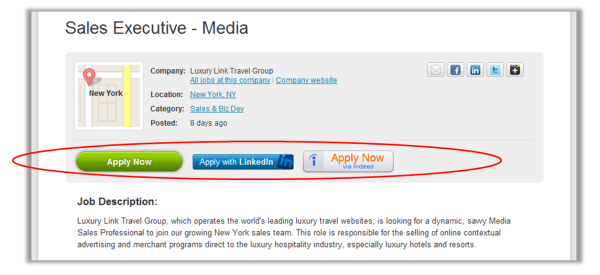
application process

That was against a run rate of 200,000+ applications, so that 5% lift equated to an additional 10,000 applications per month. And to put that into perspective, ZipRecruiter made the point that if they were to try and buy enough traffic to generate 10,000 incremental applications, it would cost them between $20,000-30,000!

After their first full month of running both buttons, the breakdown of application method on ZipRecruiter looked like this:

FEBRUARY

  • Indeed Apply: 6.9% (12,564)
  • LinkedIn Apply: 6.4%  (11,599)
  • ZipRecruiter Apply: 86.7%  (157,589)

Just one month later…it looked like this:

MARCH

  • Indeed Apply: 10.1% (22,003)
  • LinkedIn Apply: 6.6% (14,377)
  • ZipRecruiter Apply: 83.3% (180,616)

The raw volume of applications through the Indeed Apply button shot up 75%! Then in June, the raw volume of applications through the Indeed Apply button went up again by another 66% over May.

JUNE

  • Indeed Apply: 16.0% (38,610)
  • LinkedIn Apply: 5.4% (13,017)
  • ZipRecruiter Apply: 78.6% (188,747)

In just 4 months the Indeed Apply button utilization had increased by over 200% — from 12,000 applications to nearly 40,000 applications in a single month. What’s more, the bulk of these applications appeared to be incremental i.e. more candidates out of the same volume of traffic. You can’t argue with those figures!

Go Mobile

cell60% of job seekers are now using their mobile devices to search for jobs and almost half of them are applying for the jobs they find via mobile search on those devices, as well. 40% of candidates will abandon a non-mobile application process.

But employers who accept mobile applications are twice as likely to receive as many quality applicants. So having a mobile optimised application process is a no-brainer.

As a general rule, applying by mobile should take no longer than 90 seconds. One-click apply buttons (as we’ve seen) are preferable, but if you require a candidate to enter some details when applying it is advisable to have no more than 7 mandatory fields.

Remember, candidates will be using their index finger to scroll through the site and click on any links, not their mouse. Therefore, buttons need to be big enough and text cannot be too lengthy.

Conclusion

The most important thing to remember when setting out or amending your application process, is that it is a two-sided process. And in order to establish a positive relationship with all potential candidates you need to have a courteous, easy application process in place.  Companies that don’t risk leaving themselves open to poor company ratings and bad publicity at the hands of disgruntled former applicants.

The purpose of your application process is to encourage those skilled candidates who have sought out your job opening, to complete an application. It shouldn’t require them to jump through hoops in order to do so. Remember that.

See more at the Social Talent blog.

siofraAbout the Author: Siofra Pratt is a Digital Marketing Executive at Social Talent, which she originally joined as an intern in May 2013. In her current role, Siofra manages inbound marketing & content creation, social media management and advertising for Social Talent and is the voice of the Social Talent Blog.

A former banker, Siofra holds an honours degree in Commerce and an honours Masters in Creative Advertising.

Follow Siofra on Twitter @Sioffy or connect with her on LinkedIn.


7 Email Hacks For Your Inbox

As a recruiter and HR professional your inbox is your communication tool and can sometimes work its way into the hundreds of received emails daily. The proper mix of Email Tools can impact your productivity. Make your life easier by following the 7 hacks listed below. Some are tools and others are techniques.

Here are 3 easy to install practices to help alleviate your inbox hell:

Email Hack 1:  Install a follow up system that is unique to your inbox:

Regardless of which email client you are using there is always going to be an opportunity for you to set tasks on incoming messages. If your inbox is like my inbox you are receiving 100+ messages a day. This can get messy rather quickly.

Steps to take action:

Some email clients will allow you to right click on the email message and set a task reminder or follow up. If this is the case with your inbox than you are set. Simply add a task to the important messages you need to follow up with.

If however your inbox does not allow the famous right click you can…

Create a filter in your inbox (gmail for me) that takes a designated keyword from every subject line and places an action on that new incoming message. You will need to BCC yourself on actionable emails that require a follow up and make sure your filter is included to pull all BCC emails into a follow up folder for daily monitoring.

Email Hack 2:  Use your email subject lines to call back action items in a later search:

Action words can make the most congested inbox simple to navigate. I like to use my subject line to include action words pertaining to the importance of that particular email.

I have created a list of actions that make sense in my inbox, for example:

  • Action Required:
  • Call:
  • Owed:
  • Opportunity:
  • Meeting:

After the action word, I than add my subject line. In the future should I need to recall that message I can search my action terms and the person I sent the email to for a quick and easy find.

Subject line example: Meeting: Are you free to have a call…

If needed, I will recall the message by searching my sent mail for” “meeting NAME OF PERSON”

Email Hack 3: Twice repeated equals automation in my life

Depending on the inbox that you are using, you may or may not have the ability to use this hack. Using Gmail I am able to take advantage of basic automation. My rule is that if I am repeating a task twice and the need is there for more explanation, I try to automate all or part of that response.

You can do this by creating multiple signatures that are used for specific reasons. Signatures are not limited to your name and contact information. You can create an entire email response, for example to respond to FAQ’s. I do not recommend creating a signature that sounds canned. You can still be very personal in your response using this technique.

Simply select the signature at the time of your email reply, edit the message if needed and send away. You response time is minimized, the other party is happy and your time is not drained on time wasting tasks.

Here are 5 Top Email Extensions To Help With Automation

Vibe {Submitted from @DeanDaCosta}

Vibe is an easy to use people research tool. You can use Vibe to find the person behind any email address. After installing the Vibe Chrome, Mac, iPhone or Outlook app, with a simple hover or click on any email address, you can find all information about the person in less than 3 seconds.

From an email address, Vibe will find Name, designation, Work History, Social Media handle, Topics of Interest and more.

What can I use Vibe for?

Majority of our users are sales, business development and recruitment professionals. If you are a person who receive/see a lot of emails every day, Vibe can help you in people research. Vibe makes it very simple to research any email address.

Vibe helps you be better informed about your leads, prospects or contacts.

[youtube url=”https://www.youtube.com/watch?v=13Hln6QfT2I” width=”500″ height=”300″]

XOBNI {Submitted from @DeanDaCosta}

Xobni (the word ‘inbox’ spelled backwards) makes your inbox and address book smarter. First launching to the public in 2008, Xobni and its Smartr product suite, discover all the people you’ve ever emailed, called or texted, and creates complete and social profiles that are instantly searchable.

Profiles include a:

  • Photo
  • Job title
  • Company details
  • Email history as well as updates from your contacts on LinkedIn, Facebook, and Twitter

[youtube url=”https://www.youtube.com/watch?v=0vA44-AlS1Q” width=”500″ height=”300″]

Grexit

GrexIt turns your email into a simple, powerful collaboration tool, providing a central hub for sharing files via labels and notes. It’s different than Drive so it’s worth mentioning as a recommended tool to review.

GrexIt gives you Shared Labels and Shared Notes in your Gmail, which help supercharge your email and enable your to do project management, customer support and sales without ever having to leave their inboxes.

grexit

EverContact

We’ve shared this tool previously but t’s worth mentioning again in this list because it’s an easy way to keep you address book and phone contacts up to date in your Gmail account.

The tool simply scans the signature file of your email conversations, references that data against your current address book and updates all existing contacts with the appended data.

Evercontact in a nutshell

  • Launched in 2011 under the name WriteThat.name.
  • Evercontact analyzes emails to extract useful nuggets of business/contact information.  It has expanded from Gmail to Google Apps, Outlook, Highrise and Salesforce while adding extended features like Flashback, AddMe and more.
  • Since September 26th, Evercontact has been available as a chrome extension, expanding the magic of the service to the entire web.
  • Since its launch in 2011, over 1 billion emails have been analyzed, allowing users to manage over 400 million new or updated contacts.

evercontact


All About the Benjamins: How To Make Your Career Path Pay Off

make_it_rainRecently, I’ve been asked for career advice by a number of recent college graduates, as well as more experienced members of the emerging workforce still in the early stages of their professional life. Given my broad experience across many different types of companies and roles, most of these ‘young guns’ seem to come to me for pretty much two reasons.

The first is that they’re looking for specific insights about an industry or company. The other is that they’ve been bit by the entrepreneurship bug and are attempting to start their own ventures.

No matter what their motivation, almost every one of them is very ambitious and driven to find a way to make a lot of money (at least compared to where they’re at today). I begin these discussions by framing the conversation and introducing my supposition that there are basically four routes to financial success over the course of a business career.

Each of these options has different applications, and implications, but following any of these four paths should pay off over the long term:

1. Paying Your Dues

corporate catThis is the most traditional and obvious of the career paths, but the most obvious: get in at an established company and work your way through the ranks. Yes, I understand that this is old school and takes several years to work your way up the corporate ladder, but the fact remains that paying your dues and climbing companies’ respective ranks is still a great way to make a lot of money.

Note that I used the word ‘companies’ (plural) and not ‘company.’  This isn’t meant to detract from the value of gaining experience within a single established organization, especially if you find the right fit or a situation where you can accelerate your career progression.

This just means that working for established companies gives you the experience you need to be financially rewarded as you climb your way to the top – and reap increased dividends when you get there.

Conversely, staying focused on a particular industry, like CPG, tech, defense, financial services, etc. can catapult you to the C-Suite faster. All you need to do is read the financial filings of any public company to see the kinds of compensation packages the executive teams at these firms earn. Spoiler alert: it’s a lot.

As I compare myself to my peers back when I started out my own career path, I see that so many of them have risen through the ranks to the VP level or higher at some of the world’s biggest brands (such as GE, Pepsi, Kraft and Viacom, to name a few). They’ve worked hard to get there, but I’m telling you, based on the rich compensation packages, it’s pretty nice when that sweat equity finally turns into a tremendous amount of real equity.

The key for each of them is that along the line, they became functional or business experts and either concentrated on one industry or built a skillset that’s transferrable across adjacent industries. Most importantly, though, they stayed the course and didn’t jump to the next job at the drop of a hat. Instead, they stayed at a single organization for many years, climbing the ranks (and rolling up their sleeves) to reach a level with a large enough responsibility and scope to command a commensurately large paycheck. The dedication and commitment required for paying your dues pays off in due time.

You don’t even have to be an “A” player – you just have to be a solid performer and consistently deliver for the company. Even average performers and B players tend to keep climbing over the course of several years as they continue to amass the specialized industry and functional expertise required to make it to the top of the org chart (and pay scale).

2. Make Professional Services Your Product.

350-hire-a-professionalWorking as a professional service provider is another way to make your career pay off. Some examples of these would be management consultants, investment bankers, lawyers, accountants, real estate agents, doctors, etc. In these or any type of professional services role, it’s more or less a meritocracy, so if you’re good at what you do and work hard, then you’ll get paid what you deserve – which is a lot, given the high demand for these highly skilled kinds of services.

The tradeoff, of course, is that it takes a while to start out on this path, which means that paying your dues can be a steep cost in the professional services arena. Most of these roles require extensive travel or exhausting hours. Typically it takes someone in professional services somewhere between 7-10 years to achieve the level of success required to finally get some control over your work life – and time to enjoy the financial rewards, which at this point, really start to scale.

On balance, if you’re willing to put in the low pay and luxury free lifestyle required for the first few years of starting out, this is probably one of the best risk/reward choices for a career path if, ultimately, your career choice is mainly monetarily motivated.

I’ve got several friends offering professional services in fields like law, management consulting or accounting who, after many years learning the trade at companies like McKinsey, PwC or Accenture, have had the ability to leave and set up their own shop with great success. While it obviously took some time and persistence for their practices to pay off, they’re now running successful firms – and reaping the financial rewards that come with it.

3. Be the Best.

karatekidBecoming truly world class at any profession for which market demand outstrips supply is one of the hardest career paths to pursue, but one of the most lucrative, too. Becoming truly world class at something for which there’s a real demand, whether that’s a scientist, mathematician, PR Manager, designer, software developer or whatever means that you’re a lot like a top-tier athlete hitting free agency: you can more or less write your own ticket (and paycheck).

If you’re one of the best in the world at something – anything – than you’ll be able to make a lot of money either working for a company that specifically needs to leverage your skills in order to succeed, or else creating your own company or consultancy as a one-man shop. You can also augment the often exorbitant fees companies and corporations are willing to pay for world-class expertise with additional income through such ancillary revenue streams as professional speaking and writing engagements.

The obvious challenge on this path is there’s no faking being the best. You need to be truly world class at what you do, and this takes years and years of dedication, passion and patience. And, since this career ladder takes perhaps the longest to climb, there’s no guarantee that what’s hot in the market today will still be in demand by the time you build up the requisite expertise over the intervening years.

Similarly, there’s no real guarantee that you’ll ever achieve a level of proficiency that legitimizes your claim at being among the best in the business. But if you are, and your skills are in demand, you’ll be able to bank on that expertise and reap the financial rewards that will almost inevitably follow.

4. Embrace Entrepreneurship.

fridayThis is one of the most common paths to pursue, and as a rule of thumb, it’s also the biggest risk of any of these career paths. But entrepreneurship also has the biggest upside when it comes to rewards, too. There’s already a ton of stuff written about what kind of person or profile makes the most successful entrepreneurs, and the various paths open to those who opt for the autonomy of entrepreneurship, from startups to small businesses to franchising.

Done the right way, any of these options can pay off, but as a warning, not everyone has the personality, risk profile and skill set to become an entrepreneur. Given the large standard deviation in possible outcomes and the requisite commitment to stand a reasonable chance at success, you’ve got to be self-aware enough to know if this path truly suits your competencies, mindset and compensation expectations.

My general advice to those thinking about pursuing their own ventures is to wait until you have some level of expertise in a specific area that can be applied to, and inform, your entrepreneurship. Having a unique skillset combined with a deep understanding of the market, competitive landscape, customer need and how to build a business around these dynamic elements requires some deep domain or functional knowledge.

Sure, there are a few very notable exceptions (Zuck, I’m looking at you), but these savants are obviously outliers, and, as they say on commercials, individual results will vary. That’s why getting the experience needed to solve any problem or business need better than what’s currently available should be the starting point of any entrepreneurial venture.

As I tell the folks who come to me for advice, remember that you don’t have to make a commitment to any of these options. It’s not an “either/or” proposition, and you’re not locked into any one, but beware that there are tradeoffs to pursuing any of these paths. As your career progresses, you’ll naturally close the door to some opportunities, even as others open. You can still be financially secure by mixing and matching two or three of these options, but in order to get to the level of wealth so many emerging workers expect – to really make it rain – you’d be wise to pick one lane and stick to it.

But remember: it’s not all about the Benjamins. And like any of these options, there are trade-offs that come with chasing a bigger paycheck – and if you don’t have a passion for what you do, there’s no amount of money in the world that can replace the value inherent to doing what you love.

Of course, for many of us, that’s making money, so if you want to rake it in, than choosing one of these four paths will really pay off. Promise.

rayAbout the Author: Ray Tenenbaum is the founder of Great Hires, an early stage recruiting technology startup offering a job slate interviewing platform and mobile application. Ray has previously spent half of his career building Silicon Valley startups such as Red Answers and Adify (later sold to Cox Media); the other half of his career was spent in marketing and leadership roles at enterprise organizations including Proctor & Gamble, Kraft, Booz & Co. and Intuit. Ray holds an MBA from the University of Michigan as well as a bachelor’s in chemical engineering from McGill University.

Follow Ray on Twitter @RayTen or connect with him on LinkedIn.

I Lost My Facebook Search Keys.

medicine-man-1992-02-gBack in January 2013, Facebook launched one of the most awesome sourcing/recruiting tools of our time, better known as Graph Search. This was pretty much just basically a search engine exclusively for Facebook with like 50 different filters.

It was free. It was awesome. It was overlooked by most talent pros, who didn’t get the point of sourcing on Facebook and didn’t use it. Suckers. Well, their loss was my gain!

Back in the day (1992, in fact), Sean Connery made a movie called the Medicine Man. It’s a good flick – definitely check it out if you haven’t seen it.

There’s this one quote in the movie that he says in that Scottish brogue that’s stayed with me ever since:

“I found the cure for the fucking plague of the 20th Century and now I’ve lost it. Haven’t you ever lost anything? Your purse? Your car keys? Well, it’s rather like that. Now you have it. Now you don’t.”

Of course, in the film, he was referring to his frustration over the fact that he’d lost the ability to recreate the cure for cancer he discovered in the jungle.

I feel you, Connery, because I found the cure for fucking sourcing and recruiting passive candidates, and now, it’s gone. I had it, and now, I don’t. Which sucks. Big time.

See, on December 13, Facebook reverted their Graph search back to just plain old Facebook search. In doing so, they changed everything!

Shot To Hell: The Demise of Sourcing’s Silver Bullet

fb searchFacebook says that the change made search more “intuitive” on the social network; now, you just type in what you want, and supposedly, Facebook will know what you’re looking for and bring you the results you want, without any of those ‘confusing’ filters and features that made Graph Search so damn cool. Facebook, you see, just wanted to make searching easier. And in the process, they ruined sourcing.

I had quite possibly the greatest sourcing tool of our generation and now, I’ve lost it. I’ve tried looking for it, but Facebook just blew it up. I’m not taking this too well, and realize I’m throwing a tantrum that’s probably a bit child like, but I want my graph search back and I don’t really know what the hell I’m supposed to do until it returns.

I could kick and scream, of course, but I’m pretty positive no one will listen, or care. Which strikes me as funny, really, the fact that no one cares about this significant shift in sourcing strategy.

Facebook made their search switch two weeks ago, and I sat back and waited to hear the inevitable onslaught of sourcing folks up in arms, losing their minds over losing this amazing tool. But there was nothing. The silence was deafening. And kind of damning, too.

Pour One Out: Facebook Graph Search & Seizure

so whatBecause it made me realize just how great Facebook graph search was for sourcing. I was basically using a really powerful tool to recruit candidates that no one else seemed to be using. Sourcers hate Facebook, as a rule, because they feel that just because they don’t want anyone poking around on their profile, they shouldn’t be poking around a potential candidate’s profile, either.

Yeah. I know that sounds silly. But it’s also mostly true. HR and talent pros hate the fact that anyone else out there might actually use Facebook to find them. This is, after all, their ‘personal’ social network. This is where I like cat videos and mega death rock music. I just don’t want people at work knowing I like those two things together. Ahem.

And that right there was the beauty of Facebook’s social graph. It had search capabilities that had all the power of LinkedIn Recruiter, but four times the number of potential candidates, and unlike LinkedIn, you didn’t have every single recruiter in the entire world banging away on it non-stop, all day, every day.

But when you reached out to a potential candidate using Facebook, it was like going back in time like five, six years – it reminded me of how people used to respond to recruiters on LinkedIn in its halcyon days. They were flattered. They responded. They thought that your ability to just find and message them was some kind of magic trick. Of course, now you’d have to be a magician to actually get this kind of response on LinkedIn, but Facebook was another story entirely.

When Facebook first launched graph search, I saw it as the beginning of the end for LinkedIn. But a couple weeks ago, Facebook, for whatever reason, decided to make a few tweaks that will let LinkedIn live a little longer. It’s a sad day, my friends. I’ve lost the keys to Facebook search, and I’m doubtful I’ll ever see them again. But here’s hoping.

Tim-HeadshotAbout the Author: Tim Sackett currently serves as the president at HRU Technical Resources, a $40M IT & Engineering contract staffing firm and RPO based in Lansing, Michigan. Prior to joining HRU, Tim was the Director of Employment at Sparrow Health System, Regional HR & Staffing Director at Applebee’s Intl., Retail Health Recruiting Manager at ShopKo Stores and Regional HR Manager for Pamida.

A 20 year veteran of HR and recruiting, Tim has split his career between recruiting and HR generalist roles as well as between the HR vendor community and corporate America, giving him a unique perspective from both sides of the desk. A highly influential blogger and speaker, Tim has a Masters in HR as well as an SPHR certification. Tim blogs regularly at his personal blog, the Tim Sackett Project, and is a regular contributor at Fistful of Talent.

Follow Tim on Twitter @TimSackett or connect with him on LinkedIn.

The 3 Cs of Employee Engagement

ee engagementYou don’t have to be an expert to agree with the fact that an engaged workforce is directly correlated with creating a powerful competitive advantage. That’s why it’s so important for executive leadership and business managers to actively explore strategies they can implement in their organization to drive overall engagement.

This common sense sentiment, however, can often be undermined by the fact that, as a rule, managers and CEOs don’t want to waste a ton of time, effort and resources in any internal initiative without being able to analyze, quantify and ultimately, align improved performance to bottom line business results.

That can create something of a vicious cycle, since the fundamental success (or failure) of any organizational initiative, particularly one driving employee engagement, requires, well, engaged employees.Talk about a Catch 22.

So, what, exactly, are leaders supposed to do to break this cycle and build a more collaborative, connected and collegial workforce?

First, let’s look at what, exactly, an engaged employee really is. Beyond the buzzword, it’s simple: an engaged employee is an involved employee. Spotting engagement isn’t hard if you know what you’re looking for: engaged employees are enthusiastic about their day jobs and excited about the company’s future. They also understand how their roles fit into the bigger business picture, and put the needs of the company and their colleagues ahead of their own.

To that end, engaged workers are motivated by more than monetary incentives – they understand that their financial success and that of the company’s are (in the long term, at least) two sides of the same coin. Engaged employees are devoted to doing what it takes to boost the business, and for them, the bottom line is just that.

Building a truly engaged workforce isn’t easy, particularly if you’re an entrepreneur, startup or small business without a ton of resources or a dedicated HR department to task with monitoring and improving engagement. While it’s easy to overlook engagement, it’s impossible to ignore – particularly when recruiting, referrals and retention are all directly tied to this critical core competency. That’s where the three Cs of employee engagement come in.

Communication

commIt’s imperative for leaders to keep their expectations for employees as simple and direct a possible, and offer direct feedback (and ongoing coaching) regarding their performance and its impact on the company. Experienced managers already know how to set up the procedures and processes required to help employees reach their professional goals and aspirations while making sure they’re mastering the fundamentals their role requires.

When going for greatness (an aspiration every manager should shoot for), feedback is extremely important. Even if those reviews aren’t always glowing. Remember, there’s no such thing as coaching without constructive criticism.

The frequency by which you communicate with your employees is just as critical as the content of those communications. It’s important to find a balance between communicating enough so that they feel their contributions are appreciated and valued while avoiding appearing like an autocrat (or worse, a micromanager).

That balance will be different for every team and organizational dynamic, but the best benchmark is simply creating an environment where people feel comfortable in their working environment and aware of how their work fits in with the bigger business. If people feel uncomfortable at the office, or that their contributions are unimportant or unrecognized, than they have no real incentive to help the organization thrive.

I know a lot of that sounds obvious, or specious, but the thing is that as much as we talk about employee engagement, it’s more difficult to achieve than meets the eye. And it all starts with communicating with your people, showing that you care about them and that little wins can be a big deal. If employee engagement suffers, so too does the business, which means that if you’ve got an issue or a weak link that’s affecting overall performance (whether a situation, a person or just an overlooked task), the only way to discover and fix employee engagement issues is by communicating with employees. It’s not rocket science, but too often, this critical competency is either overlooked or aggregated in anonymized survey results. But remember: employee engagement is personal, and that’s why your communications approach needs to follow suit.

Credibility

true storyThe success or failure of a company can often hinge on its credibility. Having a good reputation is just good business. That’s why it’s important for leaders to live their values, exemplifying their ethics beyond just a hoaky mission statement or some corporate copywriting. Employees, as a rule, want to feel proud of their employers, and when their mission, vision and values actually align with their employers, it creates the ownership mentality that underpins all employee engagement. If your employees brag about where they work, you must be doing something right, right?

But similarly, when a company is either unethical or lacks credibility, than employee engagement will suffer along with overall performance. Employees can be the most effective brand ambassadors, but ultimately, they can also be the biggest brand detractors, which is why it’s so important for leaders to practice what they preach – and make sure that example is evangelized to every employee.

The power of an ethical approach and attitude to business cannot be understated. Credibility can only be fostered when there’s an atmosphere of fair play and honesty, and those overarching ethics create a powerful magnet for attracting and retaining top talent. Remember, engagement isn’t always tied to financial incentives, and while money is important, working for a higher cause is almost always more effective for engagement than working for a higher salary.

Career

career pathWhen it comes to emloyee engagement, the importance of this “C” can be hard to see, but it’s critically important. Engaged employees, after all, have the best chance for benefitting from a successful career. The business world can be a Darwinian battlefield where only the strongest survive – and this goes for both your company and your employees. By not only caring about the well-being of your people, but proactively helping them develop and thrive professionally and personally, you’re simultaneously helping the company.

That’s why it’s so important for leaders to offer meaningful, challenging work opportunities to open the door for career advancement and growth. Letting employees know what’s in it for them will inevitably lead to a sense of excitement, willingness to learn and try new things while holding them personally accountable for their professional progress by tying these important tasks and responsibilities to organizationally oriented outcomes.

Employees want to be challenged, but it can be scary for many leaders to get up the nerve to challenge the status quo and drive change. Remember that challenging employees must be coupled with confidence; you get what you give, so you should try to give as much as possible to employees in order to make them feel engaged and edified. Creating a challenge for employees makes even the most mundane tasks meaningful, because solving those challenges will build a work environment that’s stimulating, interesting and drives innovative thinking and experimentation.

Remember: employee engagement isn’t just an initiative, it’s an imperative.

About the Author: Steve Brown is a regular contributor and author on a variety of business related topics. His work can be seen on many high traffic, high visibility sites such as PeopleInsight, a UK based consulting firm providing employee engagement and staff survey expertise across the public, private and not-for-profit sectors.

6 Top Keyword Research Tools

In your quest for better search engine optimization, you will undoubtedly encounter the problem of keywords. As a recruiter looking to implement an on online attraction strategy, keywords are vital for your success, but finding the right keywords and the best related keywords can be difficult.

There are literally hundreds of techniques to find your keyword niche and probably even more tools to help you find them.  Plenty of recruiters in our space will spend  countless hours searching through analytics, talking big data and SERPS, but very view actually know what they are doing.

Here are 4 key questions to ask yourself as you start your hunt to find your keyword list:

Do you understand long term skills required for the position that you are marketing?

This sounds simple but how many job descriptions read like a children’s book? In reality the job description may be inferior to the children’s book, as the book will have a beginning, a middle and an end.  Do not be the poster throwing darts at a board full of balloons. Understand the target skills and end game for your posting.

How many ways will a potential jobseeker search for my open job?

Crack a smile, because you’ve been duped. We are not referring in the literal sense of “how” the jobseeker will search (i.e. mobile, desktop). We are talking about the path a jobseeker may find your posting such as keywords and variations of those keywords. In order to be successful with your online keyword capture, you have to understand how an expert in the skill set you are searching will research that skill, in the form of a question online.

Do I have a firm grasp on competition and industry targets?

This is important. Most of the stories we hear about are recruiters mention long tail and short tail keywords. “I know that this lead found my blog using this keyword” This is great information if you want to be found with your competitor and be in competition with the same leads that are responding to both jobs. Why not separate yourself and attract a different set of leads? Get deeper into your competitions online presence. Track their ads, track their retargeting efforts, track social footprint and make informed decisions on where you need to spend your money.

Does the content on you page represent the performed search?

When someone clicks on your link to view your job description will they land on a page the is relevant to the search result they just clicked? If they clicked a link to view a job description of a nurse, are you redirecting them to a page dedicated to nursing opportunities?

You need to make sure that your on page call to action is singular and clear. Do not share multiple openings, locations and company information. Jobseekers will Google that information. The sole purpose of this page is to capture their interest in learning more about a career opportunity.

The details can be shared later.

Performing Keyword research is not an easy task. It’s tedious too most and simply boring to the rest. The more effective keyword research  you complete, the more likely you’ll achieve your attraction goals for the immediate needs but most certainly for future needs as your traffic driving engine becomes a machine.

That said, there are several options that you should consider over others on the market.

Here are 6 top keyword search tools that we recommend:

Google Keyword Planner

Google offers a free keyword tool that can be used by anyone. In addition, it can be combined with other Google tools for better accuracy and results. However, Google might not be the very best option out there, as it is somewhat limited in its scope and accuracy. That said, it is hard to beat the price of this useful tool. Google also offers a new search-based keyword tool that offers better accuracy based on actual Google searches by consumers.

Here is an overview from Google’s site:

A tool that provides keyword ideas and traffic estimates to help you build a Search Network campaign.

  • Search for keyword and ad groups ideas based on terms that describe your product or service, your website, or a product category related to what you’re advertising. You can also enter or upload a list of keywords. And you can multiply two or more lists of keywords to create a new list that combines your keywords.
  • Get historical statistics, like the number of times people have searched for a keyword or how competitive that keyword is.
  • You can also get traffic estimates, like how many clicks and impressions your keywords might get for given bid and budget amounts.

Google

Bing Keyword Research Tool:

Don’t sleep on Bing. Bing has come a long way form it’s annoying graphics and cute clicking tools on it’s pages. In order to use the Bing Keyword search tool you’ll need to log into your webmaster account with Bing.

We like this tool because t’s free and provides you with a full 6 months of historical data for your serch queries.

  • All Data is from Organic Search:  All query volumes and keyword suggestions are based on organic search, not on paid search or search advertising data, giving you the most natural ideas and accurate numbers.
  • Up to 6 months of Data: The Keyword Research tool shows stats and suggestions based on up to 6 months of historical data. No averages.
  • Keyword Ideas by Language and Country/Region:  The Keyword Research tool can generate keyword suggestions in wide range of languages and countries/regions, allowing you to fine-tune your keyword ideas for the markets you serve.
  • Research History:  Simplify your keyword research with a history of up to 25 keywords for quick access to prior topics you researched.

BingKeyword Discovery

Keyword Discovery is not free but they do offer a free trial. We personally find this tool to be of value because of it’s deep segmentation ability.  Keyword Discovery collects search term data from over 200 search engines world wide. As a result we have the largest keyword database that contains nearly 38 billion searches.

Note that there database although it scrapes data daily from the 200+ search engines the tools works with is only updated on a monthly basis. This is ok and should not be a deal breaker.

Keyword Discovery allows you to gather information from:

  • Keyword Research
  • Industry Keywords
  • Spelling Mistake Research
  • Seasonal Search Trends
  • Related Keywords
  • KEI Analysis
  • Keyword Density Analysis

Keyword_DiscoveryWordtracker:

While Wordtracker is not free, the company does offer a free trial of the program. In addition, this offering has been around for a relatively long time, proving that it has the staying power to remain competitive in a very cutthroat market. Wordtracker might just be the best option out there, as it offers better accuracy, the ability to save keywords and the ability to manage all of your various projects effectively from one single program.

In addition, Wordtracker gives you the ability to compare your keywords to those of your competitors, find related keywords and even plan your SEO campaigns through the program.

While those are the three top options if you are seeking a keyword suggestion tool, there are numerous others out there. However, you should ensure that you compare the capabilities of all products to one another and never rely on self-aggrandizing hype from the keyword tool developer, itself. Real comparisons and the use of real customer feedback is necessary to determine the best keyword research tools.

Finding the needed keyword research tools is still an essential element to your success. While the list above will give you an excellent starting place, you will still need to determine which one is right for your particular needs.

WordTracker

KeywordEye:

Keyword Eye is a pretty great tool that will help you  with your keyword and competitor research.  We found KeywordEye to be a great option because it’s a simple to use but robust platform allowing you to hold brainstorming sessions prior to launching a PPC or an SEO campaign.

3 great things about KeywordEye:

  1. One of the key attributes that stick out is that you are able to research what questions people are asking in your target sector.
  2. Analyze on-site keyword trends within the content of top ranking pages
  3. You are provided top content generated on, by or for your target as well as top influencers sharing this content.

Keywordeye

UbberSuggest

No, this is not your taxi cab recruiting tool. Ubersuggest is one of the most popular research tools available today. This is because the return is instant and yourkeywords are returned with supporting data from Google suggest  as well as others.

With this free keyword tool you can instantly get thousands of keyword ideas from real user queries! Use the keywords to get inspiration for your next blog post, or to optimize your PPC campaigns.Ubber


Have you read:  5 Top Chrome Extensions For Recruiters and Sourcers

Free Sourcing Tools For Recruiters from @Deandacosta

Ready. Set. Go.

Sourcing requires skill. It requires the skill to uncover leads that have not already been uncovered by your competitor. Having the proper arsenal of sourcing tools at your disposal is important to your success especially when you are on the clock to close out your clients most prioritized reqs.

After you get comfortable with the 3 short tutorials below, you can watch 3 more tutorials on Search Engines and Contact Capture here

Here are 3 strong recruiting tools that we recommend to have in your arsenal:

  1. SourceHub by Social Talent
  2. 3 Sourcing
  3. Jobvention

SourceHub by Social Talent

Over 10,000 recruiters, sourcers and HR professionals have discovered the power of SourceHub when it comes to creating Boolean search strings and searching for candidates across 11 different social media, job board and talent aggregation sites.

Because, not only does SourceHub allow you to create all-encompassing Boolean search strings for your specific job openings, it also allows you to run those search string in a variety of different online places including some of our favorites like:

  • LinkedIn
  • Twitter
  • Facebook
  • Google+
  • Google
  • Indeed

[youtube url=”https://www.youtube.com/watch?v=6hcmdHCkt0U” width=”500″ height=”300″]

Jobvention Boolean Search String Generator

Another quick and easy tool to use for helping you to generate a fairly tight Boolean Search. It’s a great tool but you need to be cognizant that this is a generator and not a master. The tool itself is hosted on site and functions almost identical to the advanced search in any of the major search engines.

We like this tool because it’s free and takes the guess work out of Boolean search creation for those that may not be able to create searches on their own.

Here is how it works:

  1. Enter your search criteria
  2. Jobvention builds the search and off you go

[youtube url=”https://www.youtube.com/watch?v=NI43YF_u92M” width=”500″ height=”300″]

3 Sorucing’s People Graph

PeopleGraph is a search engine for people. It enables you to search people across multiple platforms and networks, quickly, easily, in one place.

The PeopleGraph Chrome Extension enables you to navigate someone’s social profiles. Hover the PeopleGraph logo to see the other profiles.

[youtube url=”https://www.youtube.com/watch?v=ZSsCjOd7EP0″ width=”500″ height=”300″]

The Most Wonderful Post of the Year.

CHOfficepartySomewhere between Labor Day and Halloween, the official “holiday” season kicks off, an annual annoyance that essentially means that we dedicate approximately a full quarter of each year to those “magical moments” where celebration and consumerism collide.

Which makes sense, considering without these yearly “magical moments,” we’d probably be hard pressed to find fodder for family photos or B2B editorial calendars.

It’s the “most wonderful time of the year,” if you believe the song lyrics – ’tis the season, after all, for saccharine sentimentalism and annoying aphorisms like these, after all.

While you might be hanging stockings over the fireplace or spinning Dreidels or doing whatever it is people do on Kwanzaa, workplace leaders prepare for this yearly occasion by building a strategy to indulge their employees and recognize the fiscal year end with some sort of obligatory holiday celebration.

Some employers dole out cash in the form of spot bonuses. Others pass random swag, from edibles no one actually eats to tchotchkes no one actually uses.

And, still others throw some iteration of a holiday party for employees, ranging from modest break-room potluck to black tie soirees at swanky venues (although ultimately, most employees would probably just as soon take the cash, frankly).

No matter how much or how little emphasis employers place on the holidays, some workers will inevitably be thrilled with the fa-la-la-la-las, while others will just be blah. There’s no avoiding the fact that for many, ’tis the season for being super scroogy and stressed out with the added emotional and budgetary burdens that so often burst with the addition of extra festivities and their associated obligations.

Season’s Beatings: HR & The Holidays

ygEOZasecret-santa-office-gossip-christmas-season-ecards-someecardsThe stress outside the office is enough to overburden anyone, a melange of extraneous travel to visit relatives, hosting unwanted house guests like intrusive in laws or even just the obligatory present purchasing and holiday decorating. Of course, most can’t even escape at the office, as that anxiety is compounded by expectations to participate in events like Secret Santa, office gift exchanges or the omnipresent potluck.

Our holiday rituals have become codified at most corporations, although navigating these traditions while observing organizational hierarchies, co-worker relationships and office politics can be a dicey proposition at best.

The need to avoid any potential controversy between colleagues or co-workers seemingly creates the equivalent of an EEOC guideline to make the celebrations as sanitized and secular as possible. After all, abiding by office etiquette like gender and age neutrality and PC terminology is always in season, particularly for HR organizations.

Party going and gift giving can quickly turn from pleasure to panic when trying to appropriately accommodate every employee and make sure their spirits stay bright. Nowhere is that more true than when it comes to giving coworkers, clients and colleagues gifts – whether as a personal thanks or as part of a larger corporate recognition and rewards initiative. But, you’re in luck if you’re a recruiting and HR professional: we’re hooking you up with a gift that keeps on giving.

It doesn’t require any trips to the mall, has no associated costs and is about as thoughtful a present as any HR or recruiting practitioner can give their employees – and, unlike those fruitcakes, is something that any employer can actually use immediately – and continue to realize positive returns for the foreseeable future, too.

Stick to this list, and you’re pretty much guaranteed to be an HR hero this holiday season. Or at least, not piss off anyone too much.

Making A List, Checking It Twice: 2015 HR & Recruiting Resolutions

Stick to this list, and you’re pretty much guaranteed to be an HR hero this holiday season. Or at least, not piss off anyone too much.

  • Actually take the time to get to know your hiring managers.
  • Stop writing job ads that suck.
  • Start notifying candidates when they’re no longer under consideration.
  • Delete the phrase “our people are our greatest assets” from all career-related copy.
  • Stop using cliches to describe your culture. Start showing what’s interesting and unique about it instead.
  • Instead of chasing candidate experience “best practices,” just practice common courtesy and common sense.
  • Make your application process as easy and pain free as possible. This means optimizing for mobile.
  • Write personalized e-mails and InMails worth reading instead of getting sent straight to spam folders.
  • Apply for your own jobs and actually audit your own application process. 
  • Spend some time outside of the silo to get a better understanding of the roles you recruit for.
  • Take the time to really read resumes or review profiles before reaching out to potential candidates.
  • Show up or call on time for scheduled meetings, screens and interviews. 
  • Don’t make it all about you – make it about the candidate, too.
  • Stop asking “what’s your greatest strength/weakness” in interviews. Make questions meaningful.
  • Eliminate recruiter bias and only select candidates based on objective and relevant experience or expertise.
  • Be compassionate and never forget that candidates are people, too. People get nervous and awkward sometimes.
  • Go with data and analytics instead of going with a gut feeling.
  • Stop worrying about passive candidates and start searching for the most qualified, regardless of employment situation.
  • Focus on selecting candidates based on performance and potential instead of interview preparation and presentation.
  • Understand “been there, done that” is not an indicator of future performance.
  • Avoid stringent selection criteria that rules out anyone who isn’t a violet-hued woodland creature. 
  • Think about the bigger business picture and bottom line.
  • Keep your mind open and your mouth shut.

This list is obviously just for starters – there are a litany of simple gifts like these you can give to your clients, colleagues and candidates to make their spirits bright, even when it’s not the holiday season. Feel free to add any additional tips and spread the cheer (and a copy of this list) to any deserving HR or recruiting professionals on your gift list.

After all, it’s the small things that will help our profession – and reputation – go from naughty to nice.

talenttalks

About the Author: Leveraging her unique perspective as a progressive thinker with a well-rounded background from diverse corporate settings, Kelly Blokdijk advises members of the business community on targeted human resource, recruiting and organization development initiatives to enhance talent management, talent acquisition, corporate communications and employee engagement programs.

Kelly is an active HR and recruiting industry blogger and regular contributor on RecruitingBlogs.com. She also candidly shares opinions, observations and ideas as a member of RecruitingBlogs’ Editorial Advisory Board.

Follow Kelly on Twitter @TalentTalks or connect with her on LinkedIn.


Mapping the HR Technology Universe

images (1)In the very, very beginning, RecruitingBlogs (fondly known as RBC), was a way station for a group of recruiters focused on the latest techniques and technology. If you were to dig through the archives, you’d find a trove (treasure or otherwise) of my writing.

In the early days, I chronicled the evolution of the community. I went on to run the Recruiting Roadshow and publish a list (and interviews) of the community’s top influencers. Much of what became the online recruiting ecosystem has its roots in that time and those people.

In the intervening years, I’ve spread my wings and begun exploring the larger world of HR. I’m tempted to think that some of you are not sure that you want to be considered a part of that world. I wanted to understand the broad impact of technology on people at work. My starting place has been HR and Recruiting.

So, I’m reaching out as an alumni.

This fall, I started a company with my very good friend William Tincup. It’s called Key Interval.Our job is to map the actual experience of workers who use technology to solve Recruiting and HR problems. We do that with quantitative surveys and qualitative interviews. You might want to take a look at our Research Calendar.

We are exploring and mapping a range of things from the best way to manage a vendor to whether or not engagement with software actually matters. I don’t know about you, but my inbox is full of spam from people who want my opinion. It must be the year of the survey; maybe the decade of feedback. I’m asking you to make an exception in this case.

Please take our survey. In this first (we’ll do one a month), the point is to understand the foundations of a great relationship between users and vendors. Some of the questions will make you think for a while.

When you’re done, we’ll provide you with a copy of your answers. When all of the surveys are complete (around Jan 15), we’ll send you a report that compares you to people in similar circumstances.

As things quiet down, I’d really appreciate it if you’d complete the survey.

Thank you.

KIR-pro-John-tail-250x315pxAbout the Author: John Sumser is a founder and principal analyst of Key Interval and editor-in-chief of HRExaminer, a weekly online magazine about the people and technology of HR. Widely respected as an industry analyst, Sumser has been chronicling and critiquing the HR Technology industry for almost two decades.
During that time, he has consulted with more than 100 HR vendors on matters of strategy and positioning in the market. Prior to his involvement in the HR Technology industry, Sumser was a senior executive in Defense Technology. From large scale software development to naval architecture, he was the leader of tech development teams in a broad variety of settings. His passion is the intersection of people and technology.
Follow John on Twitter @JohnSumser or connect with him on LinkedIn.

What Is The Ideal HR & Recruiting Vendor Relationship?

KIR-prof-duo-tail-v101-800x521pxI’m lucky enough to get to work with some of the most brilliant people in our little weird incestuous industry that is HR and recruiting, one of whom would argue that there’s no such thing as an HR and recruiting industry.

But, assuming there is one, that guy, William Tincup, would easily rank close to the top of the list of the people I’ve learned from and modeled myself after the most.

He’s one of just a handful of “influencers” and “thought leaders” that do both but shrug off both labels as spurious. It’s a rare quality – both changing the game and at the same time not taking themselves too seriously.

It’s not the personal brand that matters to the best in the business – it’s the profession, and facilitating the ideas and dialogue necessary to get it going.

His partner, John Sumser, is another low-key, high impact thought leader who actually thinks, and what he thinks about constantly is industry improvement through ideation and disruption.  He’s often subversive – throwing out ideas to see what sticks – but uncannily, no matter how out there his theories might be, they’re always incredibly prescient.

I have incredible respect for both of these guys, and you know that for me to publicly give anyone props runs contrary to my general trolling, cynicism and snark.  Which is why, when they reached out to ask for my help to get the word out about their first survey for their newly launched analyst firm, Key Interval, I immediately agreed to help, just doing a solid without the normal sales spiel attached.

So, I’m not making any money off of writing this, which goes against my ethos, really. This isn’t a pitch or a lead gen campaign, and you won’t get contacted by any software sales guys by participating – probably to the chagrin of the publishers of this quality site.  The reason we can get away with a little vendor pay-for-play, though (guess that model makes us an analyst firm, too) is because real recruiting and HR professionals read this site.

I know, it’s weird, but while they don’t have a lot of time (and waste a ton more talking about how little time they have), HR and recruiting practitioners and leaders, those decision makers that everyone’s after, spend a few minutes of theirs on this site every week.  Statistically speaking, if you’re reading this, you’re almost indubitably one of them.  Big data, y’all.

I need your help in spending just a little bit more of your time filling out this survey from Key Interval. I know, everyone in the world wants you to fill one of these out – I get those e-mails, too, and it’s obnoxious.  But the reason I’m writing this is to ask not to disregard this one.

The intent of this report is to be able to get actual, unbiased information about HR and recruiting professionals just like you and figure out what, in aggregate, you’re thinking about as an industry.  Not what a vendor wants to think you think.  There are no agendas here other than getting information that’s actually informative – and has the ability to inform the direction of our industry.

So don’t blow this one off.  It will take you as much time to do as, say, not calling back a candidate to tell them they’re no longer under consideration, or just a little longer than it took for me to get to the point, which is a perpetual problem.

Click here to fill out this survey.  Help a brother out.  And if not me, the other recruiters who are reading this site – because I only write op-eds, but really could use the data to actually inform my suppositions about what’s actually on your minds in aggregate instead of in anecdotes.

Plus, this stuff all of you do every day is actually relevant in helping drive change in the industry responsible for the products and services that help you get that stuff done. And I promise you, they’re more interested in these results than anyone.

Give them a piece of your mind – and maybe, if the findings of the ideal vendor relationship project are validated, they’ll listen up and finally leave you the hell alone.  Yeah, I know. But it’s a nice thought, no?

Thanks in advance for your help.  For real.

3 Sourcing Tools For Search and Contacts

Let’s cut to the chase and get real. Every week there are new sourcing tools being introduced into the market, most of which fail. It’s difficult to know all of the tools you access to and when you do, you often find yourself wasting more time trying to figure out what vale the tool brings than you’d be wasting looking at the top 25 celebrity fails for the week.

Lets avoid the prophecy and the time wasted and share 3 of the top sourcing tools for search engines and contact capture that I use almost daily.

3 Top Search Tools For Search Engines and Contact Capture:

  1. iMetaSearch
  2. Contact Capture by Broadlook and
  3. Elite People Search

iMetaSearch

As a recruiter, what is more time consuming while searching the web and sorting through thousands of search results? iMetaSearch is great tool that allows you to gather results from all of your search engines and analyze them into an easy to follow interface.

Why use iMetaSearch?

  1. Like most meta search engines it searches multiple search engines.
  2. iMetaSearch provides you with results that are color coded and grouped
  3. It provides a listing of common words form the results allowing you to improve your search strigs as well as group you results together and prioritize them.
  4. Top search engines iMetaSearch will work with including Yahoo, Bing, Google, Dogpile and more that you can see in the video

[youtube url=”https://www.youtube.com/watch?v=K9UD45bmomc” width=”500″ height=”300″]

Capture by Broadloook

Capture, in my opinion is one of the fastest most reliable tools allowing you to move contact data into your database.  As a recruiter or sourcer it is important that you have the ability to trust your tool set to help complete your data, which we all know if often chunky at best.

I love this tool because it allows you to capture (pun intended) data from most any source you can find.

Some of the most popular are:

  1. Email signatures and email archives
  2. Team and management web pages
  3. Search engine results
  4. Excel, Google spreadsheets, PowerPoint and PDFs
  5. Social networks
  6. Resumes and job boards

[youtube url=”https://www.youtube.com/watch?v=uGbkx1cEN4s” width=”500″ height=”300″]

Elite People Search

Elite People Search is a free cross functional search platform that allows you to search for identities in the United States targeting state, county and city.  Elite People Search uses the Zabasearch.com search engine and returns serious results.

Elite People Search allows you to:

  1. Perform multiple searches at one time
  2. Search by state, county and city
  3. Map multiple phone records to one individual
  4. Tabbed results and you can also print your results if you choose

[youtube url=”https://www.youtube.com/watch?v=F8ou1TvO3Ng&feature=youtu.be” width=”500″ height=”300″]


Predictive Analytics: What Big Data Means for the Future of HR

Screen-Shot-2014-04-22-at-15.53.47It’s only been fairly recently that human resources has even become codified as a profession. The Industrial Revolution and the subsequent manufacturing age at the dawn of the 2oth century signaled the desire of companies to focus on the concept of workforce productivity – essentially viewing their employees as merely the “labor” element required in the manufacturing process.

Fast forward a few decades, and a more human-focused approach to HR emerged once employers made the then revolutionary discovery that “happy” workers were satisfied workers, and that engagement and productivity were inexorably intertwined. Of course, the focus during the nascent days of people-centric HR was largely on industrial and labor relations with organized labor and the unions representing their workers.

The 21st century brought with it the concept of human capital management, an approach which informs much of our current thinking and tactics around human resources today, including, but not limited to, such employee lifecycle essentials as benefits administration, talent acquisition, employee engagement, employee development, rewards and recognition.

HR: A Function in Flux

Despite our current perceptions of HR, however, the future of human resources finds itself in flux – and poised for yet another major transition. As a profession, we’re at the pivotal point where employers must again learn how to adjust to a new brand of HR, driven by the growing importance (and influence) of globalization, the increasing pervasiveness of social and mobile technologies as well as the rise of “Big Data” and analytics.

The effects of globalization and social are already evident, allowing even smaller businesses and mom & pop shops to harness the power of a global workforce – one that’s available and connected 24/7, one that can collaborate across time zones and markets and one that can expand any company’s customer base beyond traditional borders.

Human resources has been directly affected by these changes, which have necessitated HR to activate increased strategic emphasis and dedicated initiatives targeting employee engagement, access to technologies and tools which enable collaboration and, of course, new ways of hiring, onboarding, training and developing talent.

Social remains a catalyst – and a solution – to both sides of this equation, as employee adoption of social networks as a means for internal communication and collaboration has enabled a smarter, more efficient and ultimately, more effective workforce.

Doing the Math: The Rise of Data Driven HR

2014-12-18_14-28-58Enter Big Data and analytics. We’re seeing how technological innovations like Watson Analytics here at IBM, for example, can transform the way organizations analyze and interpret vast amounts of data and apply actionable insights to effect real change.

It’s this sort of technology that, perhaps more than any other factor, is positioned at the forefront of the next transformation of the human resources function.

As Big Data and Analytics penetrates the entire organizational structure of any business looking for new ways to gain a competitive advantage, some companies have already realized that getting that edge over the competition really relies on analyzing and using this data as a driver for extremely precised, extremely informed decision making in areas like sourcing and recruiting, productivity, customer service, innovation, execution and the behaviors of individual employees and aggregate workforces alike.

In today’s constantly evolving, dynamic and technology-driven world of work, executive leaders and managers are increasingly pushing for operations and back office functions to contribute to improved business outcomes as much as, say, sales and marketing. That means it will become incumbent on traditional cost centers like IT, finance, and, yes, even HR, to demonstrate their direct impact on business growth and the bottom line. Simply doing enough maintenance to keep a business running is no longer enough – you’ve got to have the numbers to back up your worth.

As a result, HR professionals, who already have a pretty impressive portfolio of requisite professional skill sets, will soon add yet another responsibility to a list that’s already pretty lengthy: data analytics. Which isn’t as scary as it probably sounds – all it takes for HR professionals to acquire mad analytics skills and the ability to turn that data into fact-based recommendations to drive better business outcomes is the right technology.

The right technology, in turn, will come fully equipped with built-in cognitive capabilities (similar to those seen with IBM Watson) that are intuitive, easy to use and don’t require a ton of specialized knowledge, training or deep expertise in analytics in order for HR to glean the insights they need from the employee data they have.

This data-driven approach to human capital management will extend across all elements of the employee lifecycle, from sourcing and selection to performance evaluation and succession planning – ideally, in a language that both HR end users and key stakeholders, including their C-Suite counterparts, can understand and act on.

Building A Smarter Workforce With Big Data & Analytics

ibm-computer-replace-people-jeopardy-tv-ecards-someecardsEvery company’s workforce generates a massive amount of data every day – but it’s only right now that organizations are discovering the potential value of this human data goldmine that’s just waiting to be tapped. Early adopters have quickly realized the benefits of data-driven decision making and the improved business outcomes that data facilitates in very tangible ways.

Analytics tools and Big Data technologies act as a bridge to strengthen that connection between people results and business results. This means, for the first time, HR can easily discover and articulate their impact – and organizational value – in ways never before possible, like, say, how a specific skill set directly influences company profitability.

While this is just one real example of how organizations can link their line workers to line items on a P/L, when it comes to analytics, the possibilities for HR are endless. Imagine being able to tell your CFO how employee skills specifically drove revenue!

Talk about getting a seat at the table.

The HR department of the future will include experts solely dedicated to studying and implementing this new brand of data-driven human resource management. These workforce scientists will deftly blend disparate disciplines like behavioral science, statistics and psychology to improve both organizational and individual performance using predictive analytics, which will add a level of precision previously unseen in the space.

By applying an approach predicated on predictive analytics, companies will be able to understand how individual, job, team and organizational traits produce optimal performance, and enable them to adjust their current and future workforces accordingly.

This isn’t science fiction or futurism – it’s today’s reality, and the shift from HR as we know it into a more sophisticated, scientific and strategic function using a model driven by Big Data and analytics will provide a finger to the pulse of employers’ respective workforces and enable real decision making in real time while seeing how much headcount really counts.

Knowledge truly is power, and aphorisms aside, the companies with the foresight to take advantage of this next HR revolution will not only build a smarter workforce today – they’ll be armed with the insights and information required to beat the competition tomorrow.

12089505973_70106acf2d_mAbout the Author: Jonathan Ferrar is Vice President, HR, Workforce Analytics and is responsible for Strategy and Product Management for the Smarter Workforce business at IBM. Jonathan has over 20 years experience in HR at the executive management level, with a career that spans three major companies, including Andersen Consulting (now Accenture) and Lloyd’s Bank.

Jonathan is a Fellow of the Chartered Institute of Personnel & Development (CIPD) in the UK and has worked globally; he is currently based in New York. Jonathan has been recognized as one of the top HR Analytics Influencers in the world.

Follow Jonathan on Twitter @JAFerrar or connect with him on LinkedIn.

Recruitment Marketing Doesn’t Have To Suck.

hr resumeRecruiting and HR is basically a perpetual balancing act. We’re asked to juggle being equal parts psychologist, peacekeeper, business partner, and now, we’re supposed to be marketers, too. Crazy, I know.

That’s a pretty big ask for a professional population who, by and large, have no formal education or academic background in any of these areas. It’s only fair to assume, then, that mistakes (or, as HR people like to call them, “learning opportunities) are going to happen. It’s the only inevitability in our industry other than change.

The key is to make sure those mistakes are minimized when yet another responsibility is heaped upon an already overstacked professional portfolio. Those responsibilities increasingly entail recruitment marketing and employer branding – where those inevitable mistakes can be painfully public.

So, what’s today’s talent professional to do when they suddenly find themselves forced to become marketers, too? The key is to break down the silo and look outside the world of HR for a little inspiration – and direction – to avoid any blunders. Here’s how to actually make this “learning opportunity” into a lesson plan for developing and executing a talent attraction strategy.

Recruitment Marketing Mistake #1: The Truth, and Nothing But the Whole Truth

douche

Adam Levine is a pretty good looking guy (at least in my opinion – and I know I’m not alone in thinking that, either). Unfortunately, the picture on the left shows what happens when you try to embellish something that’s already attractive a little too much.

Thanks, Photoshop guy, for taking a perfectly good set of abs and completely erasing them (and his entire midsection, for that matter).

This ad – and the litany of others like it – recently went viral on social media, but for all the wrong reasons. Trust me, this is not a good look on anybody (even Adam).

Don’t be afraid to be you. Erasing all signs of your company culture and the authentic personalities of the people responsible for shaping that culture will only come back to bite you. And, chances are, if you choose to sanitize your employer brand, then you won’t even be remembered for the wrong reasons – you’ll be ignored entirely. Which kind of defeats the point.

Embrace what makes you unique. If you’re a little weird, that’s OK, too – just as long as you stay true to who you are and show what working for your company really looks like. No Photoshop required.

DO lose the stock images, overused buzzwords and generic corporate copy that’s lost any modicum of meaning or emotional connection. For your audience to remember you, you’ve got to tell a story that really resonates with the targeted talent your employer needs – and nothing works better than keeping it real. For real.

Recruitment Marketing Mistake #2: Refreshing The Real Thing

unnamed (1)You probably recognize the logo on the right – after all, it’s the world’s biggest brand. But you might not have seen it like this before – and the fact that something as simple as switching from red to blue threw you off or confused you for a minute should show how important brand consistency really is. If you can’t get your messaging, branding and logos straight, you’re only going to confuse (and likely repel) the same talent you’re looking to attract.

Don’t be that guy. Candidates today don’t just check out your career site or reading job board posts – they’re combing through your social sites, reading through your Glassdoor reviews and digging up any digital dirt they can find on your organization to get as much information as possible on your organization’s DNA. Most of the time, that due diligence happens before they even hit apply. Chances are, if you’re presenting conflicting stories about your employer brand, then they’re not going to apply. Plus, this inconsistency isn’t just unprofessional – it’s sloppy, too.

Do clearly communicate the same consistent messaging and deliver the same voice, brand identity and look across channels and all forms of communication. Know who you are, what you want to say and how you’re going to say it – and continually deliver on that brand promise. A/B testing is one thing – A/Z testing just looks like you’re throwing up crap to see if it works. Hint: it never does.

Recruitment Marketing Mistake #3: Engage And Repel

Brand-Failure #1 WaitingSo, you’ve built a brand across platforms, spent beaucoup bucks on products and services to support your strategies and finally gotten the eyeballs you hoped would find you in the first place. Maybe some of them even convert and turn into candidates. Then, suddenly, you disappear – no follow ups, no engagement, no nothing. It’s a disaster waiting to happen (and almost always does).

Don’t be the talent acquisition team that leaves your candidates hanging, or only follows up with some automated, cookie-cutter message. Remember: automation can never replace personalization – and there’s no technology that trumps the human touch.

Remember that every applicant has invested time and energy in your organization – and the least you can do is reciprocate by letting them know when they’re no longer in process.

Do unto others – hey, it might sound cliche, but it’s called the Golden Rule for good reason. A little courtesy goes a long way – and a little communication is the least you can do to recognize their efforts, even if they’re not ultimately successful. Keep your candidates in the loop, and, if at all possible, you might even consider giving them some feedback or a few pointers.

They won’t hold it against you. They’ll probably love you for it.

Recruitment Marketing Mistake #4: Why You Gotta Be So Complicated?

unnamed (2)The only people who like complexity are emo kids and teenage girls who think “complex” is a characteristic that somehow makes for a good boyfriend. Oh yeah, and consultants, of course. But we know how those stories all end – with a whole lot of heartbreak (and bitterness, to boot).

Don’t make your application and interview process into some sort of obstacle course or Japanese game show. You don’t want your candidates to feel like they’re looking for buried treasure or trying to defeat the Nothing – which is what happens when just getting a resume submitted feels like The Neverending Story before the actual hiring process even begins. You won’t only lose applicants – you’ll lose customers and clients, too.

Do keep it simple, stupid. Make your application process as streamlined and straightforward as possible, with as few steps required as you can. A one click apply is kind of like a dream come true compared to most candidates’ experience with draconian HCM systems. Seriously. Work towards this – your systems should support you rather than control you (and your candidates).

Forget what’s new or what’s next. Don’t get blinded by the glare of some flashy new technology or hot feature you don’t really need if it means adding any extra steps. If your process requires a GPS to navigate, then get lost.

Now, I’m not saying you’re not going to make any mistakes. But at least if you can keep from committing these four biggest mistakes, you’ll avoid the biggest (and costliest) ones any nascent marketing professional can make. Particularly if that marketing happens to be related to talent acquisition.

bw-headshot color

About the Author: Bridget Webb is a Recruitment and Marketing enthusiast, leader, and speaker. Her specialties include Demand Generation (customers & talent), People Analytics, Employer Branding, HR Technology and homeroom mom duties.

She graduated with a degree in Design and Business Management from the University of Montevallo and currently resides in South Carolina.

Follow Bridget on Twitter @Webb_Bridget or connect with her on LinkedIn.

Why Diversity Recruiting & Sourcing Just Makes Sense

1331622846762_2603379Last summer I found myself up against a deadline. Per our new Vice President of Human Resources, I had 3 days to pull together a diversity budget for our 30,000 employee division. After I scrambled to format a spreadsheet, thresh out a master list of organizations and carve time out of an already packed schedule, I found myself making calls to dozens of various organizations basically asking if we could send them money and for how much.

Now, I’m guessing most diversity initiatives don’t start off like this. But it was the project I was given. And it was quite the crash course in running a corporate diversity recruitment program.

Long story short, folks got back to me with various projects and opportunities to partner, and I happily plugged the numbers in to submit to my VP. In fact, the budget was done early.

Case closed? Not quite. One of my calls was a bit different. It went something like this:

“Hey, Nathan! Thanks for the call. We actually are in the process of launching our Chicago affiliate. Would you like to be on the committee? We’re meeting next week.”

Now, another commitment in my schedule wasn’t exactly what I was looking for. I already volunteer once a month at a food pantry and am active in a number of other causes. But the mission of this specific organization happened to be something that was near and dear to my heart: disability workplace advancement.

My mom was a Special Education teacher and hanging out with her students after school was one of my favorite things to do. These kids were strong. They were curious and smart. And they could be really funny and awesome to hang out with. They just had a thing or two that made what comes easily to most of us, well, difficult.

I strongly believe that everyone has the right to a rewarding career. That is why I’m a recruiter.

But going beyond that, with a little education and extra support, can’t we all learn a thing or two and help others do what they dream about?

Diversity Recruiting & Sourcing: Lessons Learned

get itNow, with years of recruiting experience under my belt, I’d already implemented diversity strategies into my hiring plans. No, I’m not talking about joining diversity and inclusion-focused LinkedIn groups and walking away. I had hired folks with disabilities.

One of my favorites was a woman with a dexterity deformation that I helped hire into a customer-facing, performance-based marketing role for a major hotel chain. She thrived. And later that year, I got to introduce her to my mom during the company employee holiday party. We still keep in touch.

So, of course I said yes and joined the committee.

Since I’ve been taking an active part in the USBLN, I’ve been amazed at the experience. I’ve learned so much about the challenges these job seekers face. I’ve learned a ton about pioneering companies that care about this group of our communities.

It’s also opened many doors to me. I met Randy Lewis, the former Walgreens SVP who introduced pioneering disability workplace initiatives at the company and then wrote a book about it. I met Dr. Mary Ellen Weber, a NASA astronaut who spoke about leadership and challenges in space at an invite-only diversity & leadership conference.

I have met and worked with government leaders including the Chair of the Chicago Chamber of Commerce and the Commissioner for the Chicago Mayor’s Office on People with Disabilities. I helped bring my company’s Executive Director of Workplace Diversity to Chicago to speak at an event, and she in turn invited me to come to corporate headquarters to meet with the company’s diversity leaders.

I mean. Holy smokes!

Why Diversity Recruiting & Sourcing Is A Business No Brainer

catduhfaceNow, I seem to have digressed down the path of talking about how great this has been for me. So let me get back to recruiting and the purpose of this post:

Why wouldn’t you, at various levels, utilize diversity and affinity groups and strategies in your hiring efforts?

Think about it like this: you’re a working mom. Wouldn’t you be far more interested in a company that supported working moms? A company that offered child care, employee resources groups and/or flextime? Of course you would.

Or this – You’re a diversity candidate, at a diversity job fair. Wouldn’t you notice not only who is there, but who isn’t there?

I sure would.

And I do. You see, I am a diversity candidate myself. Yeah, yeah. I’m a white guy who by all accounts looks about as diverse as a Walmart in Dubuque. But I am also a minority. You may not know by looking at my resume or LinkedIn profile that I care about these things on a very personal level.

I also have family members who care about such things. And guess who else is helping your candidate debate that new offer of employment you made them today? Your candidate’s family, that’s who.

Do you have employee resource groups that resonate with your candidates? Do you take part in the local Gay Pride Parade, or Women’s Leadership events or organizations? Better yet, do you have leaders in your organization that represent and reflect your communities?

I’ve written about candidate engagement before, and I will reiterate: sourcing and identifying prospects is only half the battle. When engaging prospects, you need to make a connection and offer value to get a conversation going. Quickly.

Think about how easy that could be if your opening message includes how your company values diversity & inclusion? What if you specifically mentioned that your company is a platinum sponsor for the National Society of Hispanic MBAs, or that your VP of Finance is a member of the National Association Black Accountants – that they are a member of, too.

I hate to say it, but, well: Duh!

Diversity Recruiting and Sourcing: Business Case Closed

diversity cartoonYou can slice and dice it any way you want. At the end of the day, our job is finding the best talent for any given job we are working on. Anything that gives you an edge in either identifying or engaging top talent is something that, well, gives you the edge. Diversity sourcing and recruiting is a silver bullet.

Another thing – because no one told me this early in my career: Yes, you can join and/or participate in the National Associate of Black Accountants if you are not black nor an accountant. You can walk next to your company’s float in the Pride Parade and be heteronormal. You can go to a women’s networking event by yourself and be a guy.

How is it that you don’t get laughed out of the room? Because these organizations exist to foster inclusion. It’s about “we,” not “them.” If you are supportive and have something to offer, you have earned a place at the table.

So, long story short: just do it. Find organizations that resonate with you, for personal AND professional reasons, and get involved in 2015. Your passion will shine through and that translates to new connections, strong relationships, and hires.

That’s gold for those of us in recruiting. And heck, you might meet an astronaut.


23a2306About the Author: Nathan Vance is a talent acquisition strategist, sourcer, and blogger who believes everyone has the right to follow their passions and have meaningful careers.

Ever since he faced down the washing machine in his Japanese dorm armed only with a pile of laundry and a Kanji dictionary, he’s been tackling tough problems in innovative ways. His nine-year career in Talent Acquisition began at an internet start-up. He has gone on to use his customer-focused approach and marketing savvy to advise major tech, telecommunications, and aerospace & defense companies on how to identify and engage with top talent.

He currently sits on the Programs Committee for the Chicago USBLN and volunteers for The Lakeview Pantry.

Follow Nathan on Twitter at@nathansourcesor connect with him on LinkedIn.

Stop the Recruiting Spam. Seriously.

Spam (1)No matter how awesome my day happens to be, as soon as I open my personal e-mail, it’s pretty much guaranteed that it’s all downhill from there. Seriously, nothing pisses me off – or depresses me – quicker than simply opening my own inbox. I should know better by now – after all, the important stuff goes to my business e-mail, anyway – but for some reason, I’m still a glutton for punishment after all these years.

As soon as I open my inbox – no matter what time of the day (or night), I’m inundated with recruiter spam. That doesn’t make me unique – after all, recruiting junk mail is as ubiquitous as those ads for cheap imported Viagra or getting hit up for a bridge loan by a Nigerian prince – but as a recruiter, it makes me a little depressed. It’s also infuriating. Don’t believe me, ask pretty much every job seeker out there.

If you’re in recruiting, or even tangentially touch the employment industry, please, from one recruiter to another, I have one simple request. Please stop sending out bullshit e-mails about employment opportunities. They’re not only obnoxious, they also keep good recruiters from good jobs from getting through to good candidates because they’re pretty much preconditioned to immediately disregard any e-mail even alluding to job opportunities.

Why Do I Have To Write About Recruiting Spam Again?

quixoteLet me be clear: e-mailing prospective candidates is obviously an inevitable, and integral, part of any sourcing or recruiting strategy, so I’m not saying never to send job related e-mails. And if you’ve got to automate them, that’s OK too, provided you have the right system and relevant opportunities.

The ones I’m referring to are the ones that are the recruiting equivalent of “Hey, You Won A Million Dollars” or “A Loved One Has Died and Left You Money.” The kind you roll your eyes at, mark as spam and wonder who the hell is dumb enough to even open those things. Like, seriously.

But I get the same kind of spam from recruiters pretty much every day. Take this one I just received from CyberCoders, one of the worst offenders, who feels the need to shoot me one of these recruitment crapvertisements at least once a week. In this case, I screwed up and e-mailed the recruiter back to request they remove me from whatever lead list they bought this month. Big mistake.

Trying to unsubscribe from these job-bots is like fighting a hydra – you cut one spam account off, and two more pop up in its place.

I mean, I should feel bad for the recruiter whose branch manager (or whoever the hell happens to be in charge over there) forces them to send out this BS as part of their process. I’m sure they have no say in whatever the company tells them to do to present opportunities on their behalf to generate candidates – even if, assuming they’re not an idiot – they know that the only response they’re likely to get is pissing off their lead list.

This is verbatim, if you can believe it.

“I am a recruiter here at CyberCoders who specializes in placing Lotus Notes Developer Candidates as well as similar positions in Reston, VA and other locations nationwide. I am e-mailing you in case you think you would be a great fit for the position listed below. Please check out the link and apply if you are interested in hearing more about the job. :)”

Uh, last time I checked, it was your job, not mine, to determine whether or not I’d be a great fit for the position – that’s what they pay recruiters to do. Second off, there’s no way I’m clicking any link that’s sent via Spambot – I’m not an idiot. And the little smiley face? That’s the icing on the BS cake.

Of course, I actually get these spammy job related e-mails from PEOPLE I ACTUALLY KNOW.

Here’s a perfect example:

“General Dynamics IT Seeks a Principal Contracts Manager with TS/SCI and Poly

General Dynamics Information Technology seeks to hire a Principal Contracts Manager (TS.SCI with Polygraph required) in Herndon, VA qualified candidates must possess a minimum of 8 plus years of experience, and full knowledge of working contracts in the IC.

To view the full job description, please click on the link below.

Also – If you refer a friend I end up placing at any of my open jobs, I will give you an iPad for the referral!

This position is for a Lotus Notes Developer in Reston, VA.”

 Yeah, I received this little ditty on a Friday – and it kind of killed my attempt to finish the week off on a high note. I’m keeping the perpetrator’s identity anonymous, since they’re a “friend” in the industry. Of course, a real friend would never show such a disgusting lack of professionalism or ingenuity. I know this person – they’re better than this. But is it their fault? Should I blame them? If not them, who?

I decided to find out what was going on.

Who’s Really to Blame for Recruiting Spam?

spamLike I said, I know  this cat, and thought that there was no way in hell this was a tactic they’d ever consider using themselves. So I replied to their e-mail from my personal account and pretty much told them as much. Of course, that ironically went directly to a junk folder (their spam filter is apparently better than ours), so I did something shocking for a recruiter: I picked up the phone and gave her a all.

She was a bit taken aback, and when I spoke with her about it, she seemed taken a little off guard. But her surprise paled to mine when I heard her response. You know what she had to say for herself? She said, “Sometimes one slips through. Most people just ignore it.”

Lovely. So this is where we’re at now? Automation and scale have completely replaced personalization and relevance in recruiting? Have our systems and processes become so dependent on these SPAM campaigns that major organizations and mom & pop shops alike have diluted our profession and eroded our value – and experience – at finding the right resume or fit for a job?

Now, it’s just keyword matching and volume – throwing shit to see what sticks, more or less. Hey, if you’ve got the right word in your resume or social profile, I guess that means you could be qualified, right?

Nope. That’s not even close to the truth. Instead, this response from a former manager (and current friend) to the spam he consistently receives from lazy recruiters really hits close to home:

“Recruiters fill up my LinkedIn inbox, my email, and my phone voice mail trying to fill a position without knowing anything about me or even speaking to me. No matter how you want to put your neat little spin on it, recruiters deal in volume and I would venture to guess the vast majority do a poor job at assessing skills necessary for a position.

Mention you have maybe a couple of years experience working with Java on your resume (but if the recruiter did their due diligence and read the thing, they would have noticed it was 10 years ago), and you’ll have them contacting you for a “Senior Java Developer Position”. Say what? I don’t really do Java anymore. Didn’t you at least read the whole resume. No you didn’t.

Don’t misunderstand this to mean I don’t like recruiters or don’t use them, because I have in the past and may in the future. They are necessary to turn to when I am ready to make a change because the few I know really well and trust have their finger on the pulse of the current job market for our industry and will help me make that change or move into that new opportunity (a.k.a., they will help me find that next job).”

Seriously, this was one of the best responses I’ve ever read. #TrueStory

Recruiting Spam and Reputation: What’s At Stake

less is moreMy point is this: if you’re part of the recruiting spam problem, then you’re doing it all wrong. And you’re not just killing the reputation of recruiters everywhere, but you’re killing your own professional reputation, too. After all, your name is attached to every one of those lazy form e-mails you use to fish – and likely that link bait will come back to bite you someday. I wouldn’t want to be remembered that way, and I’m pretty sure that with a limited pool of qualified candidates and connections, that’s not how you want to be remembered, either. No freakin’ way.

Nope. I want to be remembered for engaging candidates the right way. I’m not interested in wasting their time simply because sending out automated e-mails and hoping for the best is easier than actually rolling up your sleeves and doing some real recruiting. Sure, it takes more time – and more effort – but then again, everything worthwhile does. And if you’re a recruiter, then nothing is more worthwhile than connecting with the right candidate.

I know that this will fall on deaf ears – it’s false hope to think that somehow, recruiters are suddenly going to become less lazy or that the spam will cease (or even abate, a little), but maybe, just maybe, it will at least hit a nerve to make someone have pause – or pangs of guilt – right before hitting send on their next campaign.

Of course, I wouldn’t count on it, but hey, a guy can always dream, can’t he?


Derek ZellerAbout the Author: Derek Zeller draws from over 16 years in the recruiting industry. The last 11 years he has been involved with federal government recruiting specializing within the cleared Intel space under OFCCP compliancy. Currently, he is a Senior Sourcing Recruiter at Microsoft via Search Wizards.

He has experience with both third party agency and in-house recruiting for multiple disciplines and technologies. Using out-of-the-box tactics and strategies to identify and engage talent, he has had significant experience in building referral and social media programs, the implementation of Applicant Tracking Systems, technology evaluation, and the development of sourcing, employment branding, military and college recruiting strategies.

You can read his thoughts on RecruitingDaily.com or Recruitingblogs.com or his own site Derdiver.com.  Derek currently lives in the DC area.

Follow Derek on Twitter @Derdiver or connect with him on LinkedIn.